Find partners
Whine with HR

Whine with HR

Hosted by WRKdefined Podcast Network

BusinessCareersInterviews guests

Episodes

81

Latest episode

Aug 2026

Language

EN

About the show

Whine with HR is hosted by Juls and Trish, two lawyers and HR professionals with 15+ years of experience, who figure it’s better to laugh at the craziness that is HR than to cry about it. In each episode, Juls and Trish will discuss the wine of the day that they’re drinking and the “whine” of the day that they’re thinking (about). They will also offer tips and suggestions for dealing with those “whiny” HR situations. We hope you will join us for some wine, whine, and laughter!

Listen to episodes

60 recent
September 9, 202639 min

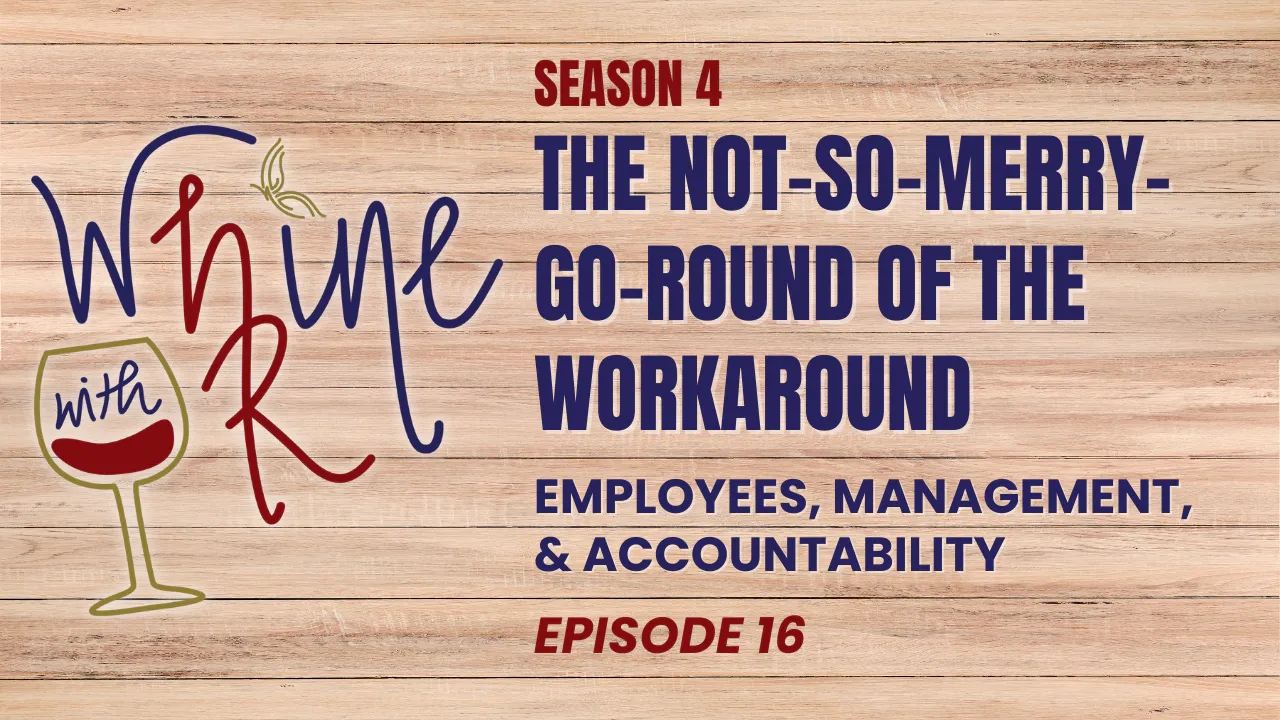
The Not-So-Merry-Go-Round of the Workaround

This episode explains why working around employees who fail to do their jobs creates bigger problems for coworkers, HR, managers, and the company. You'll learn how workload imbalances damage morale, why inaction can make HR appear ineffective, how leadership can prevent workarounds, and how employees can set professional boundaries and document situations when they are repeatedly asked to do someone else’s work. Key Takeaways Workarounds shift an employee’s responsibilities onto coworkers instead of addressing the underlying performance problem. Unequal workloads can damage morale because employees feel overworked, undervalued, and unrecognized. Favoritism, nepotism, friendships, and difficult personalities can make accountability harder to enforce. When employees report a problem and nothing changes, they can become frustrated, disengaged, and less willing to speak up. HR can be placed in a difficult position when leadership refuses to act but employees still expect HR to solve the problem. Companies can lose strong employees when they tolerate ongoing performance problems and workload imbalances. Managers should be held accountable for managing employee performance, including addressing people who are not meeting expectations. Updated job descriptions can help HR and leadership determine where responsibilities actually belong. Employees can protect their workload by asking how new tasks should be prioritized against existing responsibilities. Documenting concerns, requests, and professional responses can help employees and HR navigate ongoing workplace problems. Timestamps 00:05 – Defining workplace workarounds 05:08 – How workarounds create workload imbalance 07:38 – Why workarounds damage employee morale 09:33 – How favoritism makes accountability harder 11:36 – What happens when employees report problems 13:28 – Why workarounds put HR in a difficult position 18:15 – How companies lose good employees 20:28 – How leadership can prevent workarounds 23:25 – Using job descriptions to challenge workarounds 27:30 – How employees can set boundaries Keywords workplace workarounds, employee accountability, poor employee performance, workload imbalance, workplace morale, HR challenges, manager accountability, setting workplace boundaries, employee burnout, documenting workplace issues

September 2, 202612 min

The Short Pour - Workday & Meta Lawsuits

This Short Pour explains how AI-assisted hiring and layoff systems can create or amplify discrimination, even when employers do not intend to discriminate. You will learn what the Workday and Meta lawsuits allege, how disparate impact can arise from automated screening and performance metrics, and what employers can do to identify bias, test AI systems, and account for accommodations and protected leave. Key Takeaways AI hiring tools can create discriminatory outcomes even when they are designed to evaluate qualifications rather than protected characteristics. The Workday lawsuit alleges that automated screening and recommendation tools disadvantaged applicants based on race, age, disability, and other protected characteristics. Disparate impact focuses on whether a seemingly neutral process disproportionately harms a protected group. The Meta lawsuit alleges that AI-assisted evaluations and productivity metrics contributed to employees on protected medical, parental, or disability leave being selected for layoffs. Performance metrics can disadvantage employees who are absent or working under accommodations if the system does not account for those circumstances. Employers should examine how metrics are created and identify where bias could enter an automated decision-making process. AI-assisted employment decisions still require meaningful human oversight. Testing AI systems with employees from different populations can reveal accessibility and discrimination problems before they affect employment decisions. Hiring systems should allow appropriate accommodations, including additional time when automated processes could disadvantage applicants with disabilities. Employers should regularly review whether their AI systems produce disproportionate outcomes for protected groups. Timestamps 00:59 – Alleged bias in Workday automated hiring 02:01 – Understanding disparate impact 03:31 – Alleged bias in Meta layoff decisions 04:06 – Protected leave and AI evaluations 05:27 – How performance metrics can discriminate 07:13 – Court response to the Meta layoff claims 08:12 – Employer oversight of AI decisions 08:35 – Checking metrics for disproportionate impact 09:21 – Testing systems for accessibility 10:14 – Building an AI bias checklist Keywords AI employment discrimination, AI hiring tools, workplace AI bias, automated hiring, disparate impact, AI layoffs, employment law, disability accommodations, protected leave, HR technology, Workday lawsuit, Meta lawsuit

August 26, 202630 min

The Hunger Games: Navigating Organizational Politics

Office politics are unavoidable, but HR professionals can learn to navigate them without sacrificing credibility, objectivity, or employee trust. This episode explains how to identify informal influence networks beyond the organizational chart, build relationships without aligning with a faction, prepare for high-stakes decisions, and stay evidence-driven when investigations or leadership conflicts become political. The goal is not to eliminate workplace politics but to understand how influence works and use it responsibly. Key Takeaways Office politics often operate through informal influence networks that are invisible on the organizational chart. HR should understand who employees and executives actually trust before a workplace conflict develops. Knowing where influence exists helps HR build support for decisions without becoming part of a political faction. HR credibility depends on employees believing that facts and standards will be applied consistently regardless of who is involved. Documenting decisions and challenging assumptions can help prevent bias from shaping investigations and workplace decisions. Good decisions should be driven by information, not pressure from leaders demanding immediate answers. HR professionals sometimes need to deliver difficult messages respectfully instead of avoiding uncomfortable conversations. Preparing evidence, policies, precedent, and questions before high-stakes meetings can help HR redirect politically charged decisions. During investigations, HR's responsibility is to establish facts and explain risk, not deliver the outcome stakeholders want. Influence comes from relationships and trust, but HR should never sacrifice objectivity simply to gain access or political influence. Timestamps 04:25 – How common office politics really are06:40 – When HR gets pulled into conflict07:52 – Finding the organization's real influencers08:22 – Mapping informal workplace alliances10:24 – Protecting HR credibility13:49 – Preventing assumptions from shaping decisions14:49 – Handling pressure for immediate answers17:18 – Preparing for politically charged decisions19:49 – Managing politics during investigations25:04 – Building influence without losing objectivity Keywords office politics, workplace politics, HR credibility, organizational influence, workplace conflict, HR investigations, leadership conflict, informal influence networks, HR objectivity, workplace decision making

August 19, 20268 min

The Short Pour: EEO1 Portal & EEO1 Reporting

The EEO-1 reporting process is unusually uncertain, leaving employers wondering whether the reporting portal will open and whether current requirements could change. This episode explains the proposed regulatory changes, why existing reporting obligations technically remain in force while the proposal is reviewed, and what HR teams should do in the meantime. The practical recommendation is straightforward: continue collecting and preserving employee data so your organization is prepared if reporting resumes and can still use the information for workforce planning and decision-making. Key Takeaways The EEO-1 reporting portal has not opened on its usual schedule. A proposal has been submitted seeking to rescind certain employer reporting requirements. Current reporting obligations technically remain in force while the proposed change moves through the regulatory process. The proposal still faces regulatory review, potential public comment, a final rule, and possible legal challenges. Employers should continue collecting EEO-1 data even while the future of the reporting requirement remains uncertain. HR teams should preserve relevant employee data so they can respond quickly if the portal opens with a short submission window. Organizations may eventually be asked to provide previously collected data even if reporting requirements temporarily change. Workforce demographic data can help employers identify gaps in recruiting pipelines, onboarding, development, and succession planning. HR should consider workforce data useful for organizational decision-making rather than collecting it solely for government reporting. Employers should maintain consistent data practices while regulatory requirements remain unresolved. Timestamps 00:18 – Why EEO-1 reporting is uncertain00:51 – Why the reporting portal remains closed01:15 – Proposed changes to reporting requirements02:10 – Why current obligations still matter02:39 – How the regulatory process could unfold03:08 – Where the proposal currently stands03:30 – Why employers should keep collecting data03:53 – What employee data should be preserved04:44 – Using workforce data beyond compliance06:30 – Why maintaining the data matters Keywords EEO-1 reporting, EEO-1 portal, EEOC reporting requirements, employer reporting requirements, EEO-1 data collection, HR compliance, workforce demographic data, EEOC regulatory changes, employee data reporting, EEO-1 compliance

August 12, 202631 min

Titles? Are We Still Doing That?

Job titles are becoming less reliable as indicators of what people can actually do. This episode explains how HR can shift from title-based hiring toward skills-based talent practices by identifying the capabilities required for each role, rewriting job postings around outcomes, evaluating candidates using evidence, and regularly updating skills frameworks. The discussion also explores how skills-based approaches can improve internal mobility, reduce unnecessary hiring barriers, and help organizations adapt as AI and automation change the work itself. Key Takeaways Job titles often hide major differences in responsibilities, capabilities, and scope across organizations. Skills-based hiring requires HR to define the capabilities and performance outcomes a role actually needs. Removing degree or title requirements without replacing them with clear skills criteria creates a different hiring problem. AI and automation are changing jobs quickly enough that traditional job descriptions can become outdated. Organizations should treat their skills frameworks as living systems that change alongside the business. Looking at employees' actual capabilities can uncover internal talent that traditional titles and career paths overlook. Hiring teams should identify what successful employees in a role can do rather than relying on intuition or title history. Job postings should ask candidates to demonstrate relevant skills and evidence of work instead of relying on years of experience as a proxy. Structured interviews, work samples, skills assessments, and project histories can create more consistent hiring decisions. HR should routinely review job descriptions and hiring profiles and use performance and retention data to determine whether the process works. Timestamps 00:06 – Why job titles are losing relevance04:51 – Moving from titles to skills05:25 – Why skills-based hiring is accelerating06:29 – Defining capabilities instead of credentials06:58 – Why identical titles hide different work08:13 – How AI changes required skills11:24 – Finding overlooked internal talent15:30 – Auditing roles for required skills18:40 – Identifying what makes employees successful22:26 – Rewriting requirements around evidence and outcomes Keywords skills-based hiring, skills-based recruiting, job titles, skills-based talent management, job architecture, internal mobility, hiring skills assessment, skills-based job descriptions, workforce planning, evidence-based hiring

August 5, 20267 min

The Short Pour: Investigate Bad Things...C'mon!

Workplace investigations can either build employee trust or destroy it. This episode explains a repeatable seven-step investigation process for HR professionals and managers, including how to receive complaints, preserve information, conduct interviews, assess credibility, document decisions, prevent retaliation, and follow up. It also covers common investigation mistakes and what managers should do when an employee first raises a concern. Key Takeaways Workplace investigations are an important opportunity to build or lose employee trust. A consistent investigation process helps protect employees, managers, and the organization. The seven-step framework covers intake, planning, preservation, interviews, credibility assessment, documentation, action, and follow-up. Managers should document what employees report and involve HR promptly. Managers should not confront the accused or attempt to resolve serious complaints independently. Confidentiality should not be promised when information may need to be shared on a need-to-know basis. Leading questions and comparing witness accounts can undermine an investigation. Retaliation concerns should be investigated separately from the underlying complaint. Documentation should capture both investigative steps and the reasoning behind decisions. Investigations should move quickly, but fairness and thoroughness matter more than speed. Timestamps 00:19 – Why investigations affect employee trust01:55 – Rising employee relations investigation workloads02:32 – Why organizations need a repeatable process03:04 – Seven steps for workplace investigations03:30 – Common investigation mistakes to avoid03:59 – How managers should receive complaints04:25 – Preventing retaliation and protecting information04:52 – Investigating misconduct and retaliation separately05:25 – Why investigations are a trust exercise05:41 – Balancing speed, fairness, and thoroughness Keywords workplace investigations, HR investigations, employee complaints, workplace retaliation, investigation process, employee relations, manager complaint response, workplace misconduct, investigation documentation, HR compliance

July 29, 202641 min

Investigate Bad Things...C'mon!

People make mistakes - sometimes bad ones. Serious ones. When they do, you need to know how to handle it without creating more risk for your organization. In this episode, we give you a mini-class in conducting investigations. This will be one you'll want to bookmark - and share with that manager who needs it! So, grab your favorite beverage and join us! Every follow helps us reach a wider audience, so please, if you enjoyed the show, share with your friends, families, and co-workers (especially those who need to be listening)! Thank you, as always, for joining us! Follow us at your social media of choice! Our Facebook Group offers an opportunity for listeners and HR professionals/managers to connect with one another and share stories. We will also offer exclusive content in the Group. You can find it here: https://www.facebook.com/groups/whinewithhr. You can share wine and/or topic recommendations there or send us an email at whine@monarchendeavorsllc.com. And don't forget to keep up with us on our website, whinewithhr.studio! Even lawyers have lawyers, and we were told we need to add this disclaimer: This podcast is for educational purposes only. Whine with HR, LLC is not a law firm and does not provide legal services. No attorney-client privilege is established. Nothing discussed during podcast episodes should be construed to create an attorney-client relationship. Any opinions given or materials provided are not intended to be legal or consulting services and should not be considered such by the listener. © 2026 Whine with HR, LLC

July 22, 20269 min

The Short Pour - Differing Abilities, Not DIS-Abilities

Welcome to the Short Pour! The Short Pour is a quick, punchy recap designed for busy schedules (and short attention spans). In just a few minutes, we’ll serve up the highlights, key takeaways, and a few sips of insight from our latest episode. Want the full experience? You’ll need to check out the complete episode for all the details. But for now, grab a glass, take a breather, and enjoy a little taste with us. This Short Pour covers Season 4, Episode 12: “Differing Abilities, Not DIS-Abilities".

July 15, 202647 min

Differing Abilities, Not DIS-Abilities

Disability bias can show up in obvious ways, like illegal interview questions, and in quieter ways, like inaccessible celebrations, assumptions about stamina or communication style, or promotion decisions based on “fit” instead of job-related criteria. In this episode, we discuss ways you can make sure your employees with differing abilities are getting the support they need. Resources from this episode: https://www.americanbar.org/groups/diversity/disabilityrights/resources/implicit_bias/ https://www.bls.gov/cps/demographics/disability.htm https://askjan.org/topics/costs.cfm Every follow helps us reach a wider audience, so please, if you enjoyed the show, share with your friends, families, and co-workers (especially those who need to be listening)! Thank you, as always, for joining us! Follow us at your social media of choice! Our Facebook Group offers an opportunity for listeners and HR professionals/managers to connect with one another and share stories. We will also offer exclusive content in the Group. You can find it here: https://www.facebook.com/groups/whinewithhr. You can share wine and/or topic recommendations there or send us an email at whine@monarchendeavorsllc.com. And don't forget to keep up with us on our website, whinewithhr.studio!   Even lawyers have lawyers, and we were told we need to add this disclaimer: This podcast is for educational purposes only. Whine with HR, LLC is not a law firm and does not provide legal services. No attorney-client privilege is established. Nothing discussed during podcast episodes should be construed to create an attorney-client relationship. Any opinions given or materials provided are not intended to be legal or consulting services and should not be considered such by the listener. © 2026 Whine with HR, LLC

July 8, 202635 min

The Short Pour - Just When You Thought It Was Safe to Go to Work

Welcome to the Short Pour! The Short Pour is a quick, punchy recap designed for busy schedules (and short attention spans). In just a few minutes, we’ll serve up the highlights, key takeaways, and a few sips of insight from our latest episode. Want the full experience? You’ll want to check out the complete episode for all the details. But for now, grab a glass, take a breather, and enjoy a little taste with us. This Short Pour covers Season 4, Episode 11: “Just When You Thought It Was Safe to Go to Work".

Is this your show?

Claim this listing to keep it up to date, reach guests who want to pitch you, and manage bookings with Guestify.

Claim this listing

More Business podcasts