
Find partners
Wag The Dog Newsletter Podcast

Wag The Dog Newsletter Podcast

Hosted by Philippe Borremans

Episodes

78

Latest episode

Nov 2025

Language

EN

About the show

The podcast version of the curated newsletter Wag The Dog serves as your auditory guide through the intricacies of risk, crisis and emergency communications, taking into account the dynamic influences of technology and AI. Each episode delivers practical strategies and expert knowledge straight to your ears, improving the way you handle communication challenges. This series is for professionals who want to improve their practice in a world where effective communication is key. Tune in to change the way you navigate the complex landscape of crisis communications.

Listen to episodes

60 recent
November 24, 2025Episode 787 min

Stop Telling Me to "Build Trust": Why Crisis Communication’s Favorite Mantra Is Broken

Is the "Golden Rule" of public relations actually making us worse at our jobs? In this episode of The Wag The Dog Podcast, we deconstruct the industry’s obsession with "building trust" and explore why it is often the wrong goal for modern crisis management. Based on the viral newsletter issue by Philippe Borremans, we dive deep into the science of why trust is not a mechanical switch you can flip with a press release. In this episode, we cover: The Flawed Logic of Trust: Why research by Engdahl & Lidskog proves you can’t "logic" stakeholders into trusting you.The Sandman Formula: A breakdown of Peter Sandman’s Risk = Hazard + Outrage and why Trust is only 1/12th of the solution.The Knife Metaphor: A powerful visualization of why Control matters more than trust in a crisis.The "Dark Side" of Trust: Why excessive institutional trust led to disasters like Enron and the 2008 financial crash.Cultural Blind Spots: How Western "transparency" strategies can backfire in collectivist cultures (featuring research on Japan by Katharina Barkley).The New 2025 Framework: What to build instead—focusing on Credibility, Legitimacy, and Procedural Fairness. If you are a communication professional, PR strategist, or emergency manager, this episode will challenge your assumptions and provide a more effective roadmap for navigating outrage. Key Resources Mentioned: Peter Sandman’s "Outrage Factors"The "Information Deficit Model"Research by Neal, Shockley, and Schilke on Institutional Trust Subscribe to the Newsletter: Get the full article, citations, and weekly insights on the future of risk and crisis communication at www.wagthedog.io.

January 22, 2025Episode 7724 min

Crisis Communication Strategies from the WEF Global Risks Report 2025: Key Priorities

In this episode, we unpack the key insights from the World Economic Forum's 2025 Global Risks Report, focusing on the rapidly shifting landscape of crisis communication. From geopolitical instability and environmental degradation to technological vulnerabilities and deepening social divides, the discussion explores how these interconnected risks demand more adaptable and culturally aware communication strategies. We then cover cross-sector collaboration to foster trust and resilience, as well as practical steps like improving digital literacy and tailoring messages for diverse audiences. Plus, we examine the potential of the Universal Adaptive Crisis Communication (UACC) framework to provide a cohesive approach to navigating today’s most pressing challenges. Join us as we explore what it takes to communicate effectively in an increasingly complex and uncertain world.

December 5, 2024Episode 765 min

Revolutionizing Crisis Communication: The Power of Low-Code Tools

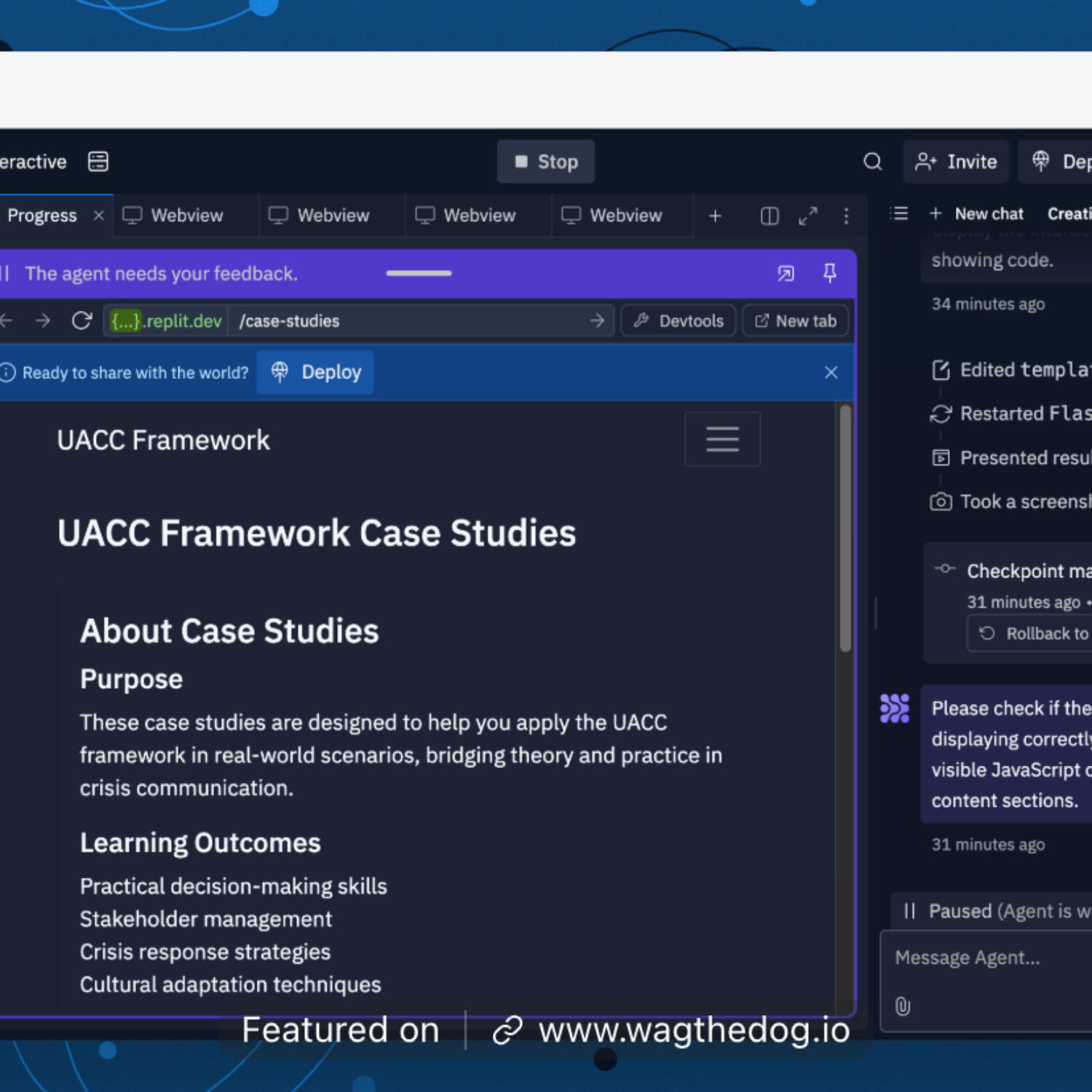
In this episode of the Wag The Dog Newsletter Podcast, your virtual hosts explore how low-code and no-code platforms like Replit are transforming the field of crisis, risk, and emergency communication. We dive into the challenges communicators faced in the past when developing custom tools—long timelines, high costs, and reliance on technical experts—and discuss how platforms like Replit are breaking down these barriers. By empowering professionals to create tools quickly and independently, these platforms are fostering innovation, agility, and customization in the profession. We also highlight the Universal Adaptive Crisis Communication (UACC) framework, developed by Wag The Dog newsletter creator Philippe Borremans. This tool helps organizations assess their crisis communication readiness, offering tailored recommendations and real-world case studies—all built using a no-code platform. Discover how tools like Replit and projects like UACC are not only making communicators more effective but also opening up a world of new possibilities for smaller teams and organizations. Whether you’re looking to prepare, respond, or innovate, this episode will inspire you to take the next step. Check out the UACC tool mentioned in the episode at www.wagthedog.io and join us to explore how technology is reshaping our profession.

November 28, 2024Episode 755 min

When should we use AI in crisis communications?

In this episode, we explore the growing role of Artificial Intelligence in crisis communication. From real-time sentiment analysis to multilingual support, AI offers incredible potential to enhance response strategies. But where does technology end and human connection begin? We discuss the Universal Adaptive Crisis Communication (UACC) framework and the AI Integration Matrix—tools designed to help communicators strike the perfect balance between efficiency and empathy. Learn when to lean on AI, when to rely on human-led approaches, and how to navigate this evolving landscape without losing trust or compassion. A must-listen for crisis communication professionals looking to harness the best of both worlds.

November 20, 2024Episode 746 min

Survey Data Risks: Crisis Communication Oversimplification

In this episode, we explore why relying solely on demographic data—like generational heat maps—can lead to critical missteps in crisis communication. While these tools are helpful in marketing, they often fall short when precision and immediacy are required. Learn how generational stereotypes and oversimplified messaging can alienate your audience during emergencies, and discover five practical strategies for audience-centered crisis communication. From psychographic insights to feedback loops, this episode equips you with the tools to craft messages that resonate when it matters most.   Perfect for communication professionals looking to enhance their crisis strategies with real-world insights.

November 14, 2024Episode 734 min

Crisis Communications in an Age of Constant Upheaval - how polycrises and permacrisis changes the way we communicate.

Are you still thinking about crises as one-off events? Think again. In this eye-opening episode, we explore the emergence of "polycrises" and "permacrises" - the new challenges reshaping how organizations handle emergencies. Learn why traditional crisis management approaches are becoming obsolete and discover practical strategies for navigating these complex, interconnected challenges. Whether you're dealing with multiple overlapping crises or managing long-term, persistent challenges, this episode provides essential insights for modern crisis communication professionals. We break down the key differences between polycrises and permacrises, share actionable frameworks for each, and explore how to keep your stakeholders engaged without burning them out. Keywords: Crisis Management, Corporate Communication, Risk Management, Organizational Resilience

October 26, 2024Episode 724 min

Preview: Universal Adaptive Crisis Communication (UACC) Framework

The Universal Adaptive Crisis Communication (UACC) Framework is designed to manage complex, overlapping crises. It focuses on five key areas: engaging all stakeholders, recognizing interconnected crises, balancing proactive and reactive communication, ensuring cultural sensitivity, and using emotional intelligence. It’s applied through a four-phase process—preparation, training, crisis response, and post-crisis evaluation. It’s flexible enough to handle everything from natural disasters to corporate crises.

October 8, 2024Episode 716 min

Three risk and crisis reports analysed

In this episode, we explore the evolving landscape of crisis communication, diving into key insights from recent global reports. From the rise of compound crises to the challenges posed by climate change, cyber threats, and psychosocial impacts, we discuss how communicators must adapt their strategies to meet these growing complexities. Join us for an engaging discussion on the power of data, localisation, and the critical need for integrated, adaptive crisis response. Plus, hear the latest insights from our survey on the future of crisis communication preparedness—your feedback is shaping an exciting new project!

September 19, 2024Episode 688 min

Ditching risk maps - introducing crisis scenario analysis

This episode introduces a step-by-step guide for implementing scenario analysis in crisis communications. It argues that scenario analysis is a more effective approach to risk management than traditional risk maps, as it provides a more in-depth and nuanced understanding of potential crises. The conversation outlines the six-step process for conducting scenario analysis in the guide, covering steps like identifying key variables, developing scenarios, assessing impacts, planning responses, implementing continuous monitoring, and testing and refining plans. The guide also includes appendices with templates for scenario development, impact assessment, response planning, monitoring, and exercise planning. Available by subscribing to the Wag The dog Newsletter.

September 17, 2024Episode 676 min

Battling the Conspiracy Beast: How AI Might Be Our Unexpected Ally

In this episode, we explore the danger of conspiracy theories during emergencies and how they can undermine public trust and safety. Learn how AI is becoming an unexpected ally in the fight against misinformation, especially during crises like pandemics and natural disasters. We'll dive into groundbreaking research on AI-driven conversations that reduce belief in conspiracy theories and discuss strategies to combat misinformation in a digital age.

Is this your show?

Claim this listing to keep it up to date, reach guests who want to pitch you, and manage bookings with Guestify.

Claim this listing

More Business podcasts