
Find partners
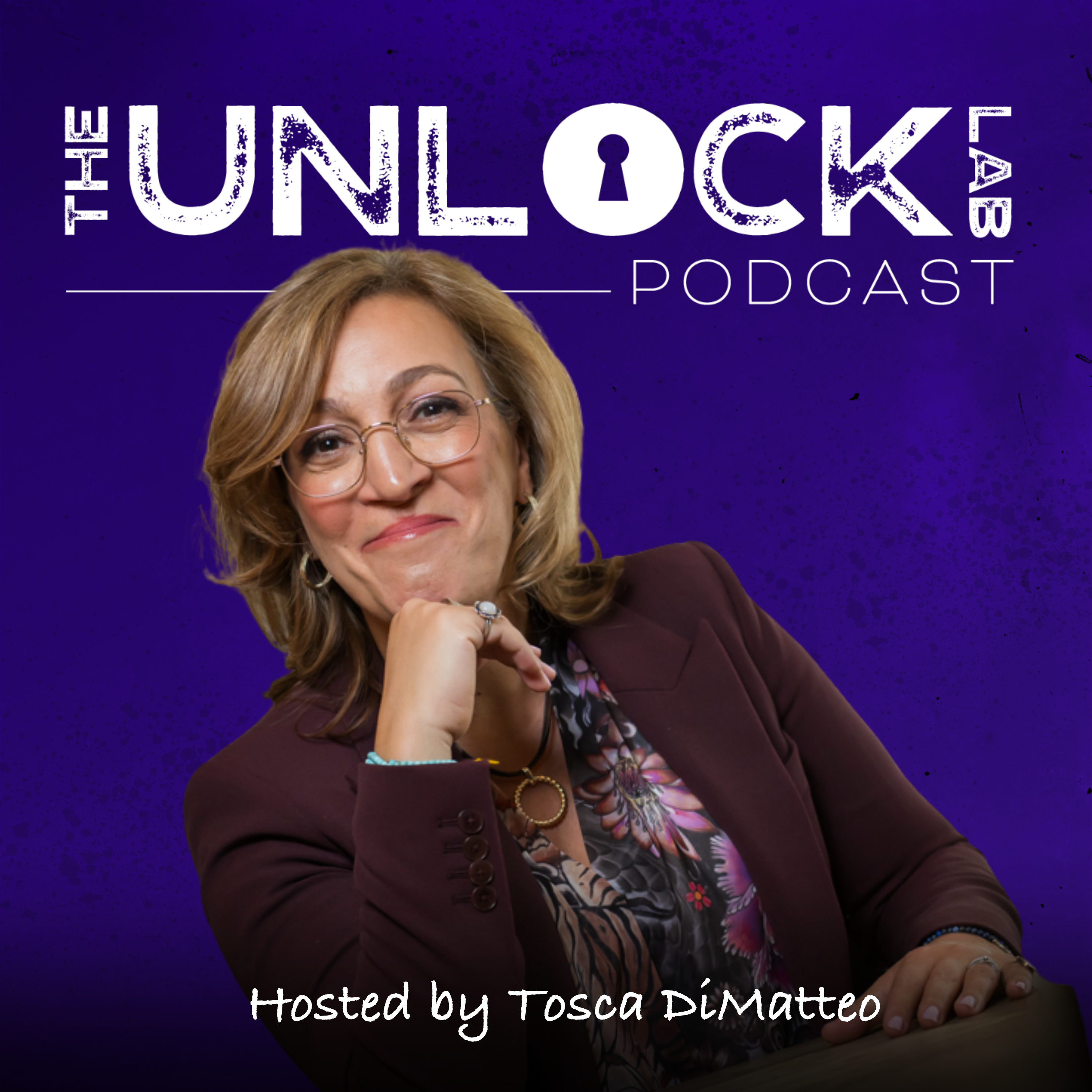
The Unlock Lab

The Unlock Lab

Hosted by Tosca DiMatteo

Episodes

111

Latest episode

Aug 2026

Language

EN-US

About the show

Reaching your next level of leadership starts here. The Unlock Lab is the podcast for leaders ready for the next level — in how you lead, work, and live. Hosted by speaker, coach, and life-lesson excavator Tosca DiMatteo, each episode digs into the thought and behavior patterns holding you back from what you want — and helps you write a new script. Truth bombs, practical tools, and real conversations to help you lead in a way that feels aligned and authentic to you. Take what works, experiment with what scares you, leave whatever doesn't resonate. 🔑 Subscribe and welcome to The Unlock Lab.

Listen to episodes

60 recent
August 18, 2026Episode 11024 min

Ep. 110: Everyone Told Me Not To Quit Without A Plan. I Did It Anyway.

It's eight years to the month, almost to the day, since I put in my notice and left corporate for good. It’s not a sexy story, which is exactly why I wanted to talk about it. I first share the story about how I never wanted to be an entrepreneur, nor was that encouraged. I was encouraged to go get an education and get a J-O-B in an office, versus the very labor-intensive path that my father took. So you can imagine why entrepreneurship was never a dream of mine. On top of this, I watched my parents struggle financially, and at 22 I was diagnosed with type 1 diabetes, which only solidified my belief that I needed somebody else to write my paycheck so that I could afford healthcare. So how the heck did I end up running my own business? In 2018, there was a large possibility that my husband’s career would take us to a different state, and for the first time in my entire linear career I stopped to ask myself: What else is possible? We never moved, but my inquiry continued. My heart knew it was time to go, but my mind gave me every possible reason to stay, especially without knowing what was next. I eventually realized those inner critic voices were fear-based and scarcity-based, and they were not my true beliefs. That was the unlock that led me to quit without a plan. And I mean I had no idea . No plan to launch a business and certainly no side hustle waiting in the wings. My one plan was to earn a coaching certification because I thought it would anchor me. So again, I'm sharing this because it is not a sexy story. There’s a version of the entrepreneurship story where someone builds it on the side and grows it until it replaces their income. While that’s true for some, I think everyone’s story is completely unique. I think most big transitions involve a lot more fumbling through immediate next steps than a 12-point plan at the start. Episode Highlights Why entrepreneurship was never the plan, and how a type 1 diabetes diagnosis at 22 reinforced the need for a steady paycheck. The question that started everything: What else is possible? How inner critic work revealed that the voices telling me to stay were fear-based, not true. Why setting an arbitrary quit date with two friends created the accountability that made my choice real. Why the energy behind running away from something versus going toward something is completely different. What eight years of entrepreneurship taught me about redefining success. Quotables “All those inner critic thoughts were not mine. They were fear-based and scarcity-based, but it wasn't what I truly believed.” “Sometimes we know a lot less than we wish we knew when we're making a big change.” “It's called a leap of faith because you don't have all the information and you don't have the 12-step plan.” “I told myself for years that I really valued a consistent paycheck. I've come to learn that's actually really at the bottom of the list.” “You don't need a perfect roadmap and you don't need all the answers. You just need to listen to yourself in a way that maybe you never have.” Tosca's Links & Resources Sign up for Tosca's Newsletter Tosca's Website Get in Touch with Tosca LinkedIn Instagram Production Audio theme music by Adrian DiMatteo adriandimatteo.com Editing by Starlin Media

August 11, 2026Episode 10916 min

Ep. 109: How to Use the End of Summer to Reset Your Life

I'm with you for my first solo episode in a few weeks and am being honest about where I am right now: in the middle of a liminal phase. Asking what's the next phase of me, what do I not want to bring with me, and what more of my truth do I want to bring to the table. Most of us are somewhere in that journey of becoming the next version of ourselves, and it can be the most difficult place to be. I'm in it, I don't have it all figured out, and still I know it's going to be okay. I share what came out of my trip to Yellowstone this summer, starting with something I don't think we talk about enough: setting yourself up for success for when you take time off. Knowing what you need, what boundaries you have to hold, and being honest about the dynamics that actually work for you is key to making your time off an opportunity to be replenished. If you keep coming back from vacations more depleted than when you left, that's worth looking at. I talk about the crazy news cycle around the man who was flung by a bison while in Yellowstone, and what it revealed about where we put our attention. When we're consumed by the spectacle and the drama, we're not focused on what actually moves us forward. That happens at work and in life as well; are you playing victim, persecutor, or rescuer? And what would need to change for you to enter the fall in a better state of mind and heart? And finally, I talk about a secret hobby: the fact that I take photos everywhere I travel and yet they stay under wraps. I have told myself for years they weren't special and nobody cared. That's my inner critic talking - but not what I truly believe. So what brings you joy that you aren't giving yourself permission to do? What gift are you keeping under wraps that people would actually benefit from? Summer isn't over. Ask yourself what you need in these last weeks of it. Episode Highlights: What a liminal phase actually feels like, and why it's so uncomfortable to be in one. Why setting up a vacation for success matters more than the destination. The hard truth about visitors, family dynamics, and time limits you refuse to enforce. Nature, boredom, and why humans were never designed to constantly go-go-go. The bison story and the drama triangle: victim, persecutor, rescuer. The inner critic that tells you your gifts aren't worth sharing. Quotables: "Most of us are in a liminal phase. Most of us are in that journey of becoming the next version of who we are." "You're doing it to your damn self. You have nobody else to blame but yourself when you set things up that you know aren't going to work for you." "If you spend your time and energy focusing on the drama in your life, then you are not focusing on things that are going to move you forward." "Humans were not designed for constantly go-go-going." "Let the sun shine the light on what you bring to the table, because it's not just you that benefits, it's other people too." Tosca's Links and Resources: Sign up for Tosca's Newsletter: toscadimatteo.com/newsletter Tosca's Website: toscadimatteo.com Get in Touch with Tosca: toscadimatteo.com/contact LinkedIn: Tosca DiMatteo Instagram: @toscadimatteo Production: Audio theme music by Adrian DiMatteo adriandimatteo.com Editing by: Starlin Media

August 4, 2026Episode 1051 hr 11 min

Ep. 108: Who Are You Without Your Job?

In this episode I have a riveting conversation with Susan A. Miele; author of the recently released 'PAUSED.', scholar, and former HR C-suite executive. Drawing from her own experience and her PhD in Human and Organizational Systems, her passion is at the intersection of personal transformation, theory, and leadership. Susan is one of the 12% of women who went through menopause before 45, and hers went undiagnosed for years. Her performance declined, doctors told her it was stress and anxiety, and she resigned from the job she'd built her whole life around. In the process of trying to "get back" to where she was, she downsized her house and just when she was about to start a new role, her house literally went up in flames. Susan describes standing there thinking everything was gone, and realizing somewhere in the process of rebuilding the house that she also had to rebuild herself. There was no going back. That person was gone. What she found on the other side was returning to the C-suite seven years later as a completely different leader. Her purpose shifted from ambition to enabling other people. Her values softened from success and drive to compassion, curiosity, honesty, and bravery. She became in her words 'much more human'. This conversation covers so much ground; from how identity forms young, to why so many high performers blur the line between who they are and what they do, and what liminality actually asks of you. As the title of her book reveals, we also talk about why the pause is not permanent but is sometimes essential. Episode Highlights: Why 25-30% of women step out of the workforce because of menopause symptoms, and what that costs the leadership pipeline. How Susan conflated ambition with purpose, and why that made rest impossible. The identity framework: who am I, how did I get here, and where am I going. Losing the job, the health, and the house, and what rebuilding actually required. How her leadership shifted from performative to human in her second C-suite chapter. How do you coach someone who is living outside their own values? Liminality: the space between two knowns, and how to get unstuck. Quotables: "They don't know themselves without their job. What they do is who they are. And there's no daylight in between them." — Susan A. Miele "My ambition became my purpose. I conflated ambition and purpose like they were one and the same." — Susan A. Miele "I wasn't going back. That person was gone. There was no going back to that. That narrative ended." — Susan A. Miele "You have the pen in this situation and you can rewrite your story." — Tosca DiMatteo "It is the discomfort where the biggest growth comes from." — Susan A. Miele About the Guest: Susan A. Miele, PhD is an author, speaker, and organizational consultant whose work sits at the intersection of identity theory and life transition, professional and personal. A writer, scholar, and former C-suite executive, she explores how identity is dismantled and redefined through life's transitions. Drawing from her own experience and her PhD in Human and Organizational Systems, she writes at the intersection of personal transformation, theory, and leadership, examining how we think about belonging, success, and change. A lifelong learner and dedicated yogi, Susan infuses her writing and speaking with mindfulness and compassion. Her work invites readers and organizations alike to see disruption not as loss, but as a profound opportunity for growth. She lives in Portland, Maine with her husband, Ken. Connect with Susan A. Miele, PhD: Website: susanmiele.com LinkedIn: Susan A. Miele, PhD Substack: substack.com/@susanmiele Tosca's Links and Resources: Sign up for Tosca's Newsletter: toscadimatteo.com/newsletter Tosca's Website: toscadimatteo.com Get in Touch with Tosca: toscadimatteo.com/contact LinkedIn: Tosca DiMatteo Instagram: @toscadimatteo Production: Audio theme music by Adrian DiMatteo adriandimatteo.com Editing by: Starlin Media

July 28, 2026Episode 1071 hr 12 min

Ep 107: The Voice Experts: Why Your Words Land Differently Than Everyone Else's! The Truth About Executive Presence!

Most communication advice tells you to say X words in Y tone and get Z outcome, but influence has never worked that way. In this episode I sit down with Casey Erin Clark and Julie Fogh, co-founders of Vital Voice Training (VVT) and co-authors of The Authenticity Code . These are the women behind the support around my own keynote work, so I have been blessed to be on the receiving end of their magic. They founded VVT in 2014, in the middle of what they call the great moral panic over vocal fry, when every article was explaining what women needed to fix about their voices to be taken seriously. Their answer then is still their answer now: that advice sucks, and it does not actually help you show up. This episode is not just for women though, so hang in here. Our conversation covers lots of ground including why "bringing your whole self to work" is shitty advice and how to better prepare for walking into your meetings. Julie explains why rehearsing your exact words is like writing a play that nobody else has lines for, and reframes intimidation as something that can come from holding your own power, not from making anyone else smaller. We get honest about what AI is doing to the way we sound and how it's messing with the beautiful rough edges of our ideas. Casey talks about how this shows up on LinkedIn and Julie makes the case that the edges we're sanding off were the whole reason anyone was listening. Tune in if you've ever been told to speak up more, or been called 'too much' of fill-in-the-blank and made yourself smaller to fix it. Quotables: Julie Fogh: "The goal is actually not to bring your whole self to work. I think that expectation has gotten a lot of people really messed up in their heads, because they think they're supposed to be just as open and relaxed at work as they are with their dearest friends. And I don't think our nervous systems are set up that way." Julie Fogh: "Well, I want to have power, but I don't want to be intimidating. And my answer is: are you sure? Because intimidation doesn't have to be grotesque. It doesn't have to be something that makes someone else shrink, or makes them small. It can be about your own power." Casey Erin Clark: "What is the standard that I want for myself that honors my core values, that honors the mark I want to make in the world, and that allows me to imagine a better future?" Stop letting self-doubt dictate your decisions. Take back the power from your inner critic and take the Inner Critic Compass today to see which one is running your show. As a gift, I'll send you a toolkit to help you on your path to be your own best friend. Connect with Casey and Julie: Vital Voice Training Casey Erin Clark on LinkedIn Julie Fogh on LinkedIn Book: The Authenticity Code . Podcast: VOICE(IS) Free monthly Zoom office hours, sign up here Tosca's Links and Resources: Sign up for Tosca's Newsletter toscadimatteo.com LinkedIn and Instagram If you enjoy The Unlock Lab, please rate, follow, and review wherever you listen. It helps more people find us. Music: Adrian DiMatteo . Editing: Starlin Media.

July 21, 2026Episode 10620 min

Ep 106: Permission to Chill: Why You Won't Let Yourself Take a Break

When was the last time you completely shut down? No email, no chores, no doing anything at all. If that question makes you squirm, your vacation inner critic is louder than you think. In this episode, I'm calling out the voices that keep you from taking real time off. The ones that say 'you'll fall behind', 'you'll lose momentum', 'now is a terrible time.' Those voices are lies. We've been conditioned by a system that treats two weeks a year like it's enough, and your body and mind pay the price. Let's talk about how to figure out what kind of break you actually need, because it may not be what you think it ought to be. Maybe it's adventure. Maybe it's family time. Maybe it's staring at the sky and thinking of nothing but the color of that blue. I share the small steps that get you to the bigger swaths of time where you truly decompress. Because here's the truth: rest is not the opposite of productivity. Rest is what fills you back up so you can be in flow and productive again. In this episode: The messages we received about taking breaks, and how to decondition from them (01:35) What your vacation inner critic sounds like (02:31) Why infrequent vacations take longer to sink into, and what your nervous system has to do with it (08:21) Vacation is a choice: where there's a will, there's a way (09:39) Three days, four days, 15 days: the length of a hair in the timeline of your life (11:29) Detoxing from stimulation, doing, and constant contact (16:26) The expansive questions to counter your inner critic (17:13) Quotables: "Whatever excuse you're putting in front of you is a damn lie. Inner critics tell us lies about what will happen, and what they don't do is tell us what's possible." (07:22) "It might be hard for some folks to give themselves permission to shut off because who are you if you're not in fight or flight mode?" (09:12) "You take three days, four days, hell, 15 days. When you really think about that in the whole timeline of your life, it's the length of a hair. It's nothing." (11:29) "We are conditioned to think that productivity is everything, and in fact, the most productive thing you can do is rest when you need rest." (18:14) Not sure which inner critic is running the show? Take the Inner Critic Compass quiz and find out in under 3 minutes: toscadimatteo.com Mentioned in this episode: Ep. 7 Inner Critics 101 (earlier episode of the podcast) Tosca's Links and Resources: Sign up for Tosca's Newsletter: http://toscadimatteo.com/newsletter Tosca's Website: https://www.toscadimatteo.com Get in Touch with Tosca: https://www.toscadimatteo.com/contact Linkedin: https://www.linkedin.com/in/toscadimatteo/ Instagram: https://www.instagram.com/toscadimatteo/ Props for: Theme music by Adrian DiMatteo: https://adriandimatteo.com Podcast Editing: Starlin Media Note: This episode was recorded in June, 2024

July 13, 2026Episode 10518 min

Ep. 105: The Two Questions to Ask Yourself Before Every Meeting

Today I'm sharing a simple two-question practice that will change the way you lead, the way you show up, and your results. I counsel my clients to ask themselves these two questions before every single meeting, and it works. The first question is: What are my expectations? Oftentimes you have low-key expectations you don't even know about, and this question is about unearthing them and bringing them to the conscious level. Maybe your expectations are too high, or maybe you're painting the worst possible scenario and gathering bits of gossip that confirm your bias that things will go wrong. This type of thing can lead you to walking into conversations under stress and with a defensive approach before it's even started. I share one of the deepest lessons of my life around this topic in this episode. For decades I held expectations for certain people about how they would treat me and show up for me, and I fell into despair every time those expectations weren't met. My healing required me to accept that if I kept holding expectations for people who can't deliver, that's on me, not them. We absolutely get to have standards, and the difference is being clear about who can meet our expectations and who can not. The second question is: How do I want to define success for this particular meeting? The key is defining it purely by what you're in control of, regardless of how people respond or what the outcome is. Maybe success is showing up with an open mind. Maybe it's slowing your pace and truly listening. Pick one to three things, and after the meeting, celebrate what you delivered on, even if it's just one. Then pay attention to what changed, because we spend so much time on what disappointed us that we never ask what worked, and that's exactly what lets you replicate success more often. Episode Highlights: The two questions to ask yourself before every meeting or one-on-one. Why unconscious expectations drive stress, defensiveness, and self-fulfilling worst-case scenarios. The hardest lesson: holding expectations for people who can't deliver is actually our problem, not theirs. Why attaching to one outcome can block something greater from coming through. How to define success by what you control: openness, pacing, presence. Celebrating small wins is a critical part of the process. Quotables: [00:05:03 - 00:05:22] "If we keep holding expectations for people that can't deliver, that's on us. It's not on them." [00:11:41 - 00:11:54] "We are usually so focused on the outcome that we're not focused on who we're being in the pursuit of." [00:03:26 - 00:03:37] "If our energy is so stuck on this one pathway and this one result, then we may be missing out on what else is possible." Tosca's Links and Resources: Sign up for Tosca's Newsletter: http://toscadimatteo.com/newsletter Tosca's Website: https://www.toscadimatteo.com Get in Touch: https://www.toscadimatteo.com/contact LinkedIn: https://www.linkedin.com/in/toscadimatteo/ Instagram: https://www.instagram.com/toscadimatteo/ Theme music by Adrian DiMatteo: https://adriandimatteo.com Editing by: Starlin Media

July 7, 202616 min

Ep. 104: How Your Stress Is Leaking Onto Your Team

Today I talk about the leaky faucet of leadership, and this whole thing starts with a story about my dishwasher at home. About a year ago it started leaking about once every ten times we ran it. It was a nuisance, but I had no idea how to diagnose the situation. So I ignored solving the problem for good, and my husband wasn’t pushing for that either. We told ourselves it would go away, but of course it didn't. Many months later, our neighbors knocked on our door with a big water gush coming through their ceiling. At that moment I realized I had never once considered the small leak we'd been living with might be a problem for someone else. That's exactly what happens in leadership. We leak our negativity, our fear, and the pressure we're under (or put on ourselves), onto the people around us. We tell ourselves it was justified, the situation called for it, and that we had to be direct but not full of grace. But every time we do these things without addressing it, we're leaking what is unresolved within ourselves. We're putting people on alert and they wonder if they have to brace for how we will treat them tomorrow. The leaks don't blow up all at once. They add up. The boss who's tense around board meetings, and takes it out on the team. The relationship with a crack in it, that you hope will miraculously resolve itself in time. The unfair treatment nobody ever calls you on because that's high risk for them. When left unaddressed, a small leak becomes the reason you get passed over for a project, the reason a team stops trusting you, or the reason you stop recognizing yourself in the mirror. By then you’ve lost the thread of understanding why and how it got to this. I think about the old adage about a plane flying 1 degree off its chartered path. If this is never corrected, it will land somewhere completely different than planned. The same is true for how you lead. A small daily drift away from the leader you want to be doesn't feel like much at the moment, but it compounds into someone your team doesn't fully recognize or trust. The work of course-correcting isn't perfect, and it’s unrealistic to think you will never get off course. The work is about catching the leaks early, doing the repair, and asking yourself how have you been acting over the last few months (or perhaps years), and if that makes you proud or not. Episode Highlights: What a leaking dishwasher teaches us about ignoring small problems. Why leaking your stress, fear, or pressure onto your team erodes trust even when it feels justified in the moment. Three questions to identify your own leadership leaks: (1) Where are you draining energy? (2) What relationships have cracks? (3) Who have you treated unfairly? The 1 degree rule and why small daily drift changes who you become as a leader. How addressing leaks and doing repair work builds stronger trust and engagement with your team. Quotables: [01:03:54:05 - 01:04:11:23] "You're putting your employees on alert: what if she leaks that tomorrow and makes me feel bad? What if she leaks that next week and puts all this pressure on me?" [01:13:10:10 - 01:13:38:08] "People don't come and say to you, 'That thing you said to me yesterday really hurt me.' Because that's not a behavior that's been rewarded or accepted. As a leader, you have to do that assessment yourself." [01:12:23:15 - 01:12:27:16] "That 1% shift is a big deal to the people that are impacted by it." [01:13:38:08 - 01:13:46:06] "Can I be my own best friend? Because when I can actually correct it for myself and how I treat myself, I can actually do better for others?" Tosca's Links and Resources: Sign up for Tosca's Newsletter: http://toscadimatteo.com/newsletter Tosca's Website: https://www.toscadimatteo.com Get in Touch with Tosca: https://www.toscadimatteo.com/contact LinkedIn: https://www.linkedin.com/in/toscadimatteo/ Instagram: https://www.instagram.com/toscadimatteo/ Theme music by Adrian DiMatteo: https://adriandimatteo.com

June 30, 202629 min

Ep. 103: How to Know When to Stay or Leave Your Job

Let's talk about the hardest decisions you'll make in your career: when to stay and when to leave your leadership role. There are two big mistakes I see leaders make, and I've made both myself. You leave too soon, or you overstay your welcome. Leaving too soon usually happens when you decide everyone else is the problem. The company is broken, nobody can do their job, and you've never stopped to look at your own part in the equation. I spent years in corporate with rotating bosses, changing companies, getting promoted, and feeling unfulfilled through it all, until I realized I was the only constant in every one of those rooms. Until you do that inner work, you carry the same pattern into the next place, and the next, and the next. Overstaying can do a lot of damage, if you aren't mindful of what's going on. Overstaying is often driven by fear, scarcity, inertia, the comfort of the devil you know, and sometimes an addiction to being the expert. It rarely shows up as one big moment. It's death by a thousand cuts: rotating bosses that make you believe you need to be in constant in proving energy, the disrespect you keep excusing, the values that quietly stopped aligning, the responsibilities that drifted into work you don't even like. And the loudest sign of all is your body which can look like panic attacks, migraines, tightness, and dread, all the while indicating to you that a chapter was already over. Chapters end. Sometimes before we wanted them to, and that's okay. Trees die, flowers die, and they regrow. The work is learning to read your own patterns so you recognize how you may be getting in your own way, and start making space for what's going to serve you. Episode Highlights: The two big mistakes leaders make: leaving too soon and overstaying. Why "everyone else is the problem" is usually a sign you skipped the inner work. The real reasons we overstay: scarcity, inertia, and the comfort of the devil we know. How overstaying can show up as death by a thousand cuts, not one big event. Looking for clues from your body for the truth. How to apply these lessons to leading others, including letting high performers move on. Quotables: "I was the only constant in the equation." "You shouldn't have to mold yourself to such an extent that you don't even recognize yourself anymore." "Trees die. Flowers die. They regrow. You replant all the things." Tosca's Links and Resources: Sign up for Tosca's Newsletter: http://toscadimatteo.com/newsletter Tosca's Website: https://www.toscadimatteo.com Get in Touch with Tosca: https://www.toscadimatteo.com/contact Take the Inner Critic Compass quiz: https://www.toscadimatteo.com LinkedIn: https://www.linkedin.com/in/toscadimatteo/ Instagram: https://www.instagram.com/toscadimatteo/ Theme music by Adrian DiMatteo Editing by: Starlin Media

June 23, 2026Episode 10521 min

Ep. 102: How to Succeed When Starting a New Leadership Role

Today I’m talking to you about something that’s hard to learn until you go through it: starting new jobs in new industries, new companies, and even new roles. In this episode, I share the counsel I’ve gained from my own career transitions, including the time I entered a new company where the product was entirely in Spanish. The most critical step to take before you begin a new role is to clear out the baggage and negative energy strings you’re bringing from your past. Because if you don’t you may be bringing the same behavior patterns to your next role that will not just impact your success, but perhaps more so your ability to find contentment. Once you’re in that role, one of the most helpful things you can do from day one is observe how decisions are made, and identify who holds the power and influence in your new organization. This also requires patience because it takes time to understand how things work, which means it’s also important to ask questions when you are unsure or confused. If you hold back from this in an effort to look like you have it all together, it’ll just take you that much longer to come up to speed. When you stop trying to prove you know everything and start being authentic about what you don’t know, you actually gain respect. That whole old way of leading where you had to have all the answers was always nonsense, and being honest about what you don’t know (aka vulnerability) is what truly builds trust. Tune in to learn why getting proper support during a transition and making space for integration are the keys to entering your next chapter successfully. Episode Highlights: Why bringing past resentments and proving energy into a new role will ruin your start. How observing decision-making processes and power structures helps you avoid early landmines. The reason why admitting you don’t have all the answers builds trust, and why the old standard of leadership was never legit. Why standing in your value and refusing to put yourself above or below anyone else is critical for your success. How to set boundaries for self-care and integration, while absorbing massive amounts of new information. Quotables: "If you got laid off, you got laid off, honey. This is the world we operate in now." "The minute you put yourself above or below someone else is the minute that you're either giving your power away or you're silencing those that work for you or alongside you." "Make sure you’re making time and space for reflection, for integration, for learning, because that's going to go so far in terms of how you are processing and making intentional choices about how you're showing up." Tosca's Links and Resources: Sign up for Tosca's Newsletter: http://toscadimatteo.com/newsletter Tosca's Website: https://www.toscadimatteo.com Get in Touch with Tosca: https://www.toscadimatteo.com/contact LinkedIn: https://www.linkedin.com/in/toscadimatteo/ Instagram: https://www.instagram.com/toscadimatteo/ Theme music by Adrian DiMatteo: https://adriandimatteo.com Editing by: Starlin Media

June 16, 2026Episode 10119 min

Ep. 101: Let the Old You Die So the New You Can Grow

We evolve as leaders, and that's normal. But we operate in environments, and around people that want us to stay the same. In this episode I talk about what it really takes to grow: letting old parts of who you are die off so that new growth can take root. This old version might be operating from a place of fear, from people pleasing, or from ways of working that aren't working anymore. To bring this idea to life, I share the story of a tree I was growing on my rooftop that died, and what it taught me about who we become once we shed what no longer serves us. The hardest part isn't always the change itself, it can be the people around you who are not willing or able to see who you have become. When you stop protecting the old version of yourself and start thinking and acting in ways that feel better to you, your leadership starts to sing. The shedding makes room for the new growth, and the new growth is what carries you to the next level. Tune in to learn why the fear of discovering who you really are may be the reason why you're feeling stuck. Stop letting self-doubt dictate your decisions. Take back the power from your inner critic and take the Inner Critic Compass today to see which one is running your show. As a gift, I'll send you a toolkit to help you on your path to be your own best friend: https://www.toscadimatteo.com/innercritic-compass Episode Highlights: The fear of discovering who you really are under the masks, and why the version of you on the other side is always more beautiful than the one you learned to be. Why people may keep treating you like the old you even after you have changed (confirmation bias), and how to invite them to see and rebuild trust in who you are now. Why all digital transformation is human transformation, and how shedding old ways of working makes room for new growth in your leadership and your life. Quotables: [11:45] "It may be scary to discover who you really are, but it is always, always 100% guaranteed more beautiful than the version of yourself that you've learned to be." [12:55] "That new tree wasn't a new tree at all. It was actually a new growth from the old tree that I thought had fully died." [24:55] "Who you were yesterday is not going to be who you are tomorrow, if you are committed to your constant growth and evolution." Tosca's Links and Resources: Take the Inner Critic Compass Quiz: https://www.toscadimatteo.com/innercritic-compass Sign up for Tosca's Newsletter: http://toscadimatteo.com/newsletter Tosca's Website: https://www.toscadimatteo.com Get in Touch with Tosca: https://www.toscadimatteo.com/contact LinkedIn: https://www.linkedin.com/in/toscadimatteo/ Instagram: https://www.instagram.com/toscadimatteo/ Theme music by Adrian DiMatteo https://adriandimatteo.com Editing by: Starlin Media
Is this your show?

Claim this listing to keep it up to date, reach guests who want to pitch you, and manage bookings with Guestify.

Claim this listing

More Business podcasts