Find partners
The Quantum Feedback Loop

The Quantum Feedback Loop

Hosted by James Myers

TechnologyScienceInterviews guests

Episodes

22

Latest episode

Jul 2025

Language

EN

About the show

What kind of future is taking shape with current developments in science and technology? The Quantum Record publisher and host of the Plato's Pod podcast, James Myers, speaks with scientists, technologists, philosophers, and others about the latest discoveries and thinking at the frontiers of knowledge. In an increasingly complex and interconnected world, The Quantum Feedback Loop podcast aims to open the wonders of the sciences and their first principles to the widest possible audience,

Listen to episodes

22 recent
July 15, 20251 hr 7 min

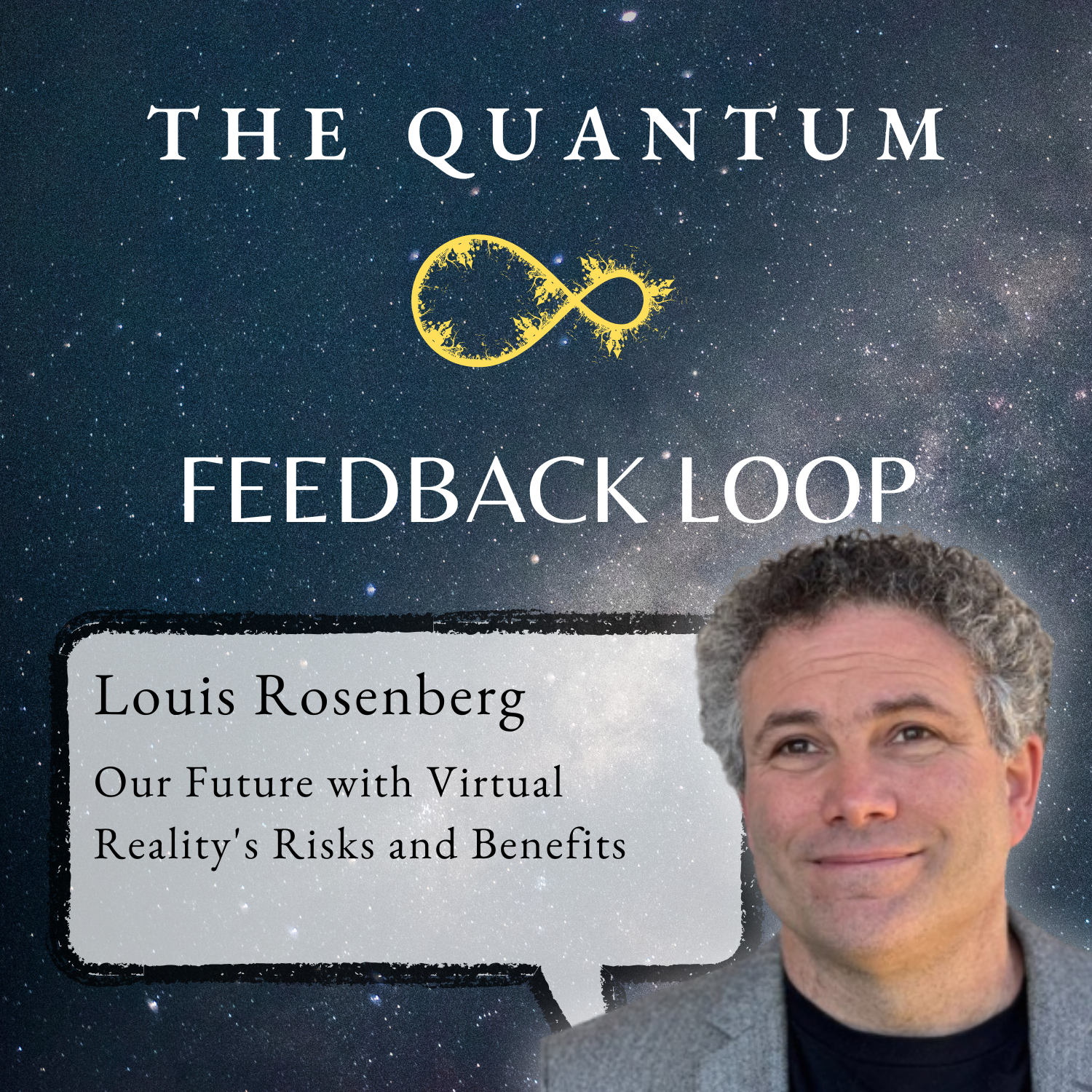
Louis Rosenberg on our Future with Virtual Reality's Risks and Benefits

The Quantum Feedback Loop was pleased to welcome back Dr. Louis Rosenberg, an engineer, researcher, inventor, and entrepreneur who was a pioneer in virtual reality technology in the early 1990s. Louis speaks about his new book, Our Next Reality, in which he and co-author Alvin Graylin present the benefits and risks of virtual reality. Louis traces VR's development from early days to present, when the technology's combination with AI is quickly enabling it to create immersive experiences that consumers may not be able to differentiate from reality. As Meta, Google, and other companies race to commercialize VR, Louis makes a number of recommendations for laws that could protect our immersive rights and help to realize the many benefits that VR could deliver in the very near future. For more on Louis and his company Unanimous AI, which is developing technology to connect groups and amplify their collective intelligence modelled on the biological principle of swarm intelligence, listen to our discussion with Louis in early 2024 at https://rss.com/podcasts/quantum-feedback/1402711/.

May 14, 202551 min

Lindsay House: Leading 20,000 Citizen Scientists to Uncover Dark Energy’s Secrets

Astronomer Lindsay House returned to the podcast to update us on her citizen science project called Dark Energy Explorers. Around the globe, 20,000 explorers are using data from the world’s third largest telescope to observe patterns in the movement of galaxies from between 9-11 billion years ago, to understand how the expansionary force of dark energy operates. As Lindsay explains, dark energy, which comprises 70% of the universe’s mass, is undetectable to our instruments but exerts an expansionary force by adding space between physical objects. Since 1998, we’ve known that the universe is expanding more rapidly over time, at rate that was thought to be a constant rate of acceleration. However, new evidence is pointing to an unexpected reduction in the speed of expansion. What function is dark energy exercising in time, if dark energy's force can both increase and decrease the rate of universal expansion? Would dark energy's variability lead to a revision of the “lambda-CDM” model of cosmology, which is based on a constant expansion rate? The observations of the Dark Energy Explorers community from 159 countries, sharing knowledge translated into 9 languages, are contributing to expanding understanding of the still-mysterious expansionary force of dark energy. The Dark Energy Explorers are, as Lindsay says, the humans “in the loop,” as the capabilities of AI and machine learning help to make vast numbers of groundbreaking connections with astronomical data. Hear Lindsay tell the story of Dark Energy Explorers, and how scientists are coming to understand more about dark energy, the fascinating and invisible force of expansion.

March 30, 202538 min

The Fascinating World of Mathematics at the Fields Institute, with Dr. Deirdre Haskell

We speak with Dr. Deirdre Haskell, Director of the Fields Institute for Research in Mathematical Sciences at the University of Toronto, about how mathematics applies to so many aspects of our daily lives and is at the forefront of the latest developments in science and technology. The Fields Institute brings together specialists in different mathematical branches from around the globe to integrate knowledge and expand the frontiers of mathematics. Mathematics touches all of us, whether it’s with GPS navigation, medical and astronomical imaging, modelling for climate change and finance, or artificial intelligence with its Large Language Models like ChatGPT. Explaining the relevance of mathematics in a way that’s accessible to all, Deirdre brings us into a critically important conversation about the direction of a future that’s increasingly mathematical.

January 28, 202555 min

Keeping Humans in the Technological Loop: a Disscussion with Saima Fancy

Saima Fancy, a privacy specialist, returns to the show for a discussion on the emerging concept and benefits of designing technological processes that keep the “Human in the Loop.” Now, when the complexities of algorithms are multiplying with every new feature and every new interface, it’s critical for good and safe outcomes that humans are able to oversee and, if necessary, override automated processes. Saima calls for a global discussion that focuses specifically on Human in the Loop, and it’s a call that’s especially crucial now, when AI agents, LLMs, and other technological processes are rapidly gaining control of our daily living. The list of functions that we cede to AI grows by the day, and now includes reading, writing, shopping, social calendaring, delivery ordering, and control of household appliances. In this episode, we outline the emerging issues and opportunities that make today the best time to begin figuring out how we remain in our own technological loop.

December 22, 202448 min

Election Monitoring in the Technological Era, with Dr. Ian Batista

2024 was a record-setting year for elections, with nearly half the world’s voters eligible to cast ballots in over 60 nations and the European Union. In some cases, social media and other technological tools have been used to enable bad actors, misinformation, and other challenges to the fairness and transparency of democratic processes. This increases the importance of election monitoring, pioneered by former U.S. President Jimmy Carter who established the Carter Center in 1982. Dr. Ian Batista, who holds a PhD in political science and has worked with the Carter Center in monitoring three elections on two continents, speaks about differences in voting processes and technologies, the importance of voters maintaining trust in the mechanisms, and the ways that technology is being used sometimes to hinder and sometimes to help the exercise of democracy.

October 20, 20241 hr 1 min

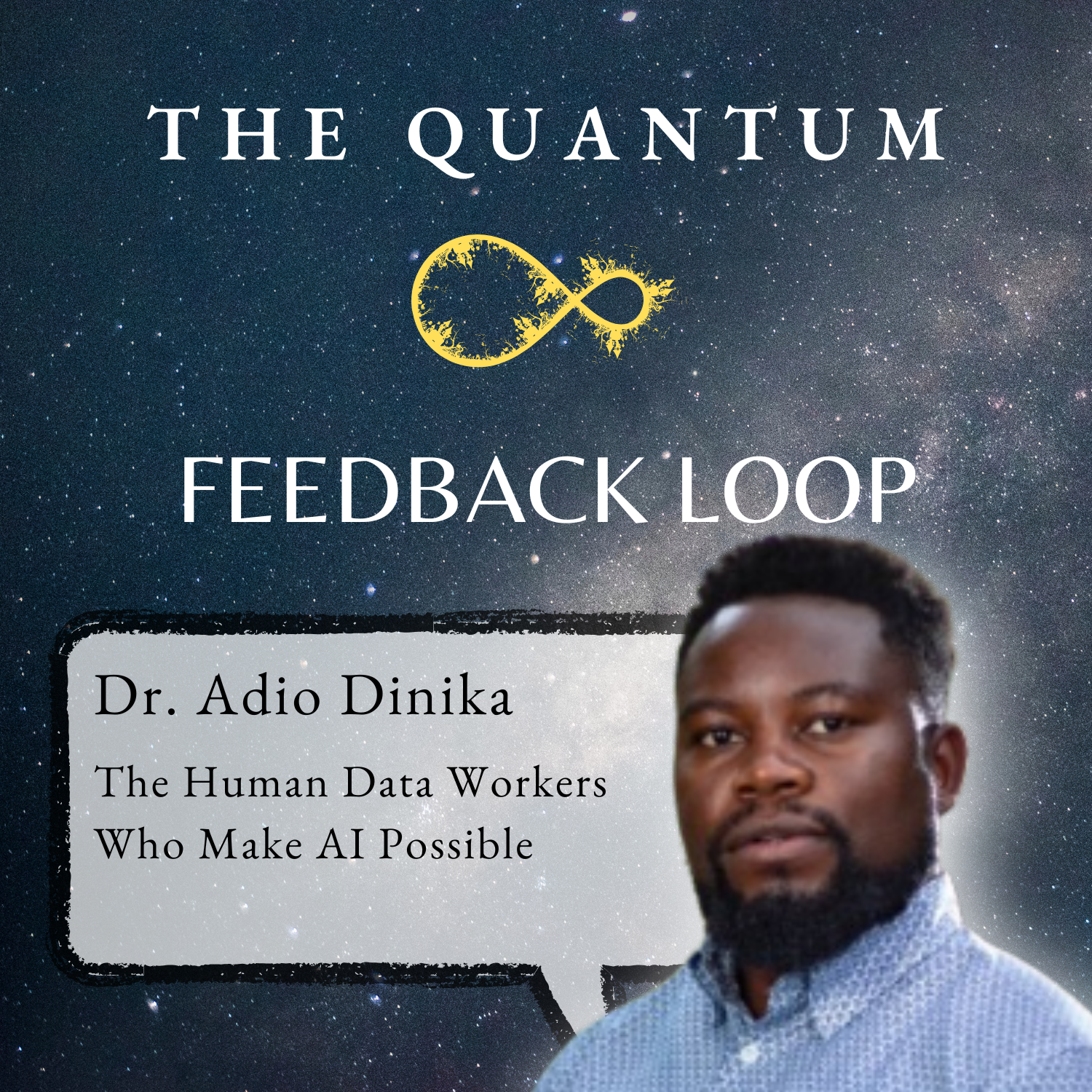
Dr. Adio Dinika on The Human Data Workers Who Make AI Possible

Adio Dinika is a political scientist and researcher for DAIR, the Distributed AI Research Institute that was founded in 2021 by Timnit Gebru after her termination as technical co-lead of the company’s Ethical Artificial Intelligence Team. Adio takes us behind the scene to give us a sense of the working conditions of many thousands of people, mainly in the lower-wage areas of the global south, whose task it is to filter massive data sets for machine learning and software applications that we use every day, by labelling images and flagging harmful content. Adio discusses the sometimes desperate challenges that these people face, and the work that DAIR is doing to bring the issues to public awareness and advocate for fair treatment of the humans who make AI possible.

September 23, 202456 min

Dr. Federico Carollo on the Intriguing Present and Future Potential of Time Crystals

Dr. Federico Carollo is a researcher at the University of Tübingen who is exploring a new, dynamic phase of matter called time crystals. First theorized by Nobel Prize laureate Frank Wilczek a dozen years ago, time crystals are quickly becoming practical reality. Federico explains how they operate, the different varieties of time crystals, and their potential uses for sensing, measurement, and other applications as a new platform for probing physics. Although time crystals aren’t perpetual motion machines, as the analogy is sometimes applied, we consider some of the technologies that could emerge and the exciting future as the science of time crystals evolves.

August 28, 20241 hr 4 min

Twesh Upadhyaya on the Frontiers of Quantum Thermodynamics

Twesh Upadhyaha takes us on a tour of the science of thermodynamics as it has developed over two centuries, exploring the latest discoveries in the changes of energy and its various forms of heat and work at the smallest quantum level of atoms and molecules. Twesh is a PhD candidate at the University of Maryland, where he's a researcher in the Quantum Steampunk Laboratory. Join Twesh in exploring the frontiers of thermodynamics in the hidden world of energy at the microscopic level, the fascinating connection of quantum thermodynamics with information theory, the discovery of what he calls “an entire family of constraints” within the second law of thermodynamics at the quantum level, and the open question: “What does entropy even mean at the quantum level?”

August 15, 20241 hr 3 min

Schweickart Prize Winner Joe DeMartini on Hunting for Asteroids in the Sun’s Shadow to Defend Earth

Joe DeMartini is the first recipient of the Schweickart Prize, awarded by the B612 Foundation for his innovative proposal to detect and track asteroids during twilight hours. Joe’s proposal could significantly enhance planetary defence by locating asteroids in the large section of the sky that’s difficult for telescopes to observe because of the sun’s light. Joe talks about the details of his proposal, about meeting Apollo 9 astronaut Rusty Schweickart who founded the B612 Foundation, and about the asteroid Apophis which will pass between Earth and the moon in just under 5 years, on April 13, 2029.

July 29, 202449 min

Arushi Nath: A Young Citizen Scientist Speaks About Asteroids and Defending Earth

Arushi Nath is a high school student who developed a passion for asteroid research when she attended the biennial Planetary Defense Conference in 2021. Since then, Arushi has been applying her coding skills in hunting for asteroids and contributing many new findings to the objects that astronomers are tracking as potential hazards to our planet. Arushi explains her work around NASA's DART mission, which successfully tested the ability of a probe to impact and redirect a moonlet orbiting a faraway asteroid, and she discusses the national and international conferences she has attended. Those interested in the asteroid collision simulation that Arushi mentions can find it on NASA's website at https://cneos.jpl.nasa.gov/pd/cs/pdc23/. Arushi is looking forward to the next Planetary Defense Conference in 2025, and we're looking forward to hearing more from this extraordinary young citizen scientist who offers a very bright and hopeful voice for the future.

Is this your show?

Claim this listing to keep it up to date, reach guests who want to pitch you, and manage bookings with Guestify.

Claim this listing

More Technology podcasts