
Find partners
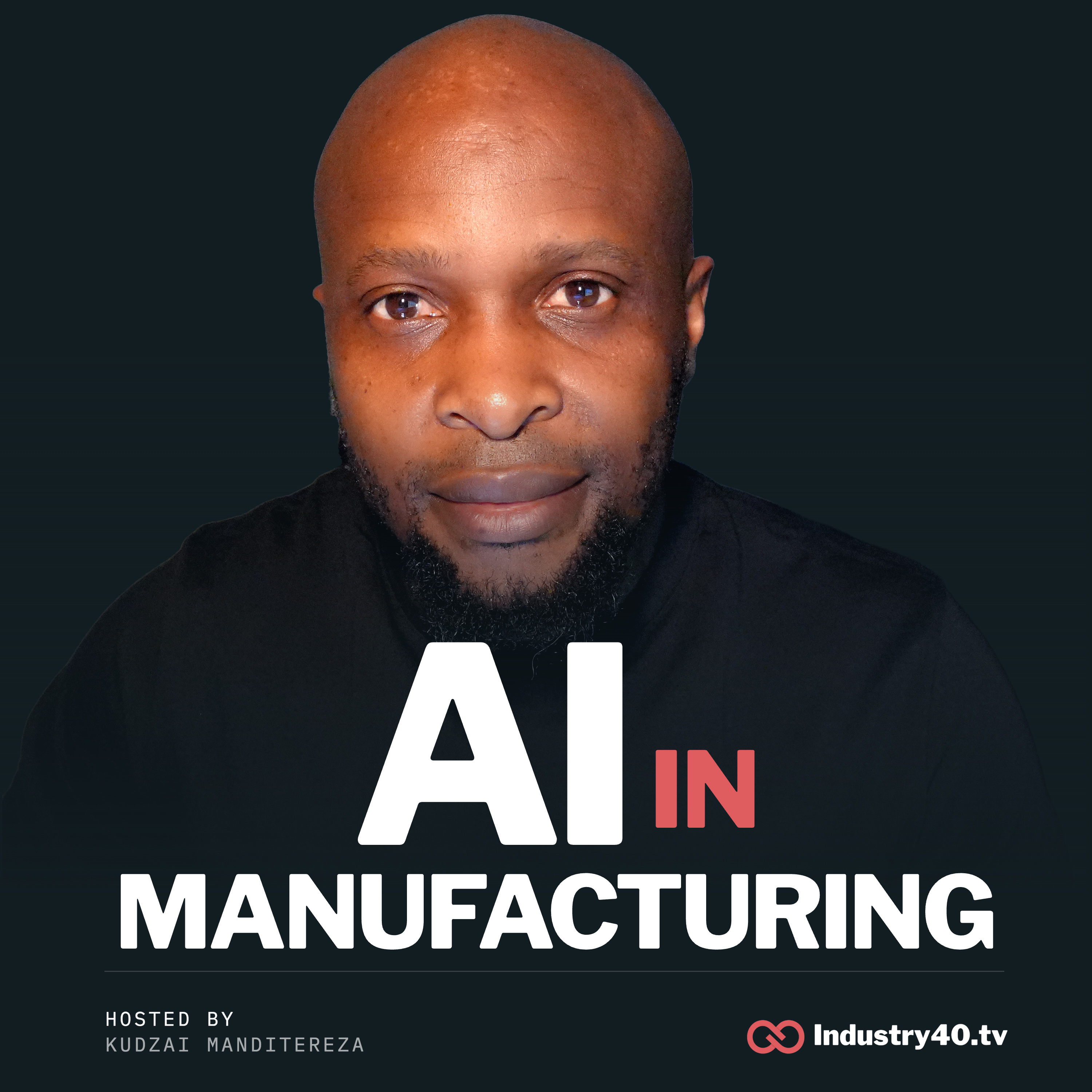
Industry40.tv: AI in Manufacturing

Industry40.tv: AI in Manufacturing

Hosted by Kudzai Manditereza

TechnologyInterviews guests

Episodes

97

Latest episode

May 2026

Language

EN

About the show

AI in Manufacturing brings together industry leaders, technologists and practitioners to explain how AI is actually being built and applied across industrial operations. Hosted by Kudzai Manditereza, the podcast explores the architectures, technologies and real-world implementations shaping industrial AI. From connectivity, industrial data infrastructure and semantic technologies to data platforms, AI agents and operational applications. For manufacturing engineers, architects, technology leaders and anyone working to turn industrial data and AI into measurable operational impact.

Listen to episodes

60 recent
August 27, 2025Episode 5652 min

Time-Series Data Quality and Reliability for Manufacturing AI: Bert Baeck - Timeseer.AI

Most data-quality initiatives focus on things like freshness or schema. That works for IT data, but not for sensor data. Sensor data is different. It reflects physics. To trust it, you need contextual, physics-aware checks. That means spotting: → Impossible jumps → Flatlines (long quiet periods) → Oscillations → Broken causal patterns (e.g., valve opens → flow should increase) It’s no surprise that poor data quality is one of the biggest reasons manufacturers struggle to scale AI initiatives. This isn’t just data science, it’s operations science. Think of data quality as infrastructure: a trust layer between your OT data sources and your AI tools. Making that real requires four building blocks: 1. 𝐒𝐜𝐨𝐫𝐢𝐧𝐠 – Physics-aware anomaly rules, baselines 2. 𝐌𝐨𝐧𝐢𝐭𝐨𝐫𝐢𝐧𝐠 – Continuous validation at the right cadence (real-time or daily) 3. 𝐂𝐥𝐞𝐚𝐧𝐢𝐧𝐠 & 𝐕𝐚𝐥𝐢𝐝𝐚𝐭𝐢𝐨𝐧 – Auto-fix what you can; escalate what you can’t 4. 𝐔𝐧𝐢𝐟𝐨𝐫𝐦𝐢𝐳𝐚𝐭𝐢𝐨𝐧 & 𝐒𝐋𝐀𝐬 – Define “good enough” and enforce it before data is consumed Why it matters: ✅ Data teams – Less cleansing, faster delivery ✅ AI models – Reliable inputs = repeatable results ✅ Ops teams – Catch failing sensors before downtime ✅ Business – Avoid safety incidents, billing errors, bad decisions In the latest episode of the AI in Manufacturing podcast, I sat down with Bert Baeck , Co-Founder of Timeseer.AI , to discuss time-series data quality and reliability strategies for AI in manufacturing applications.

June 18, 2025Episode 4745 min

AI Agents for Industrial Sales and Application Engineers: Fay Goldstein - Co-Founder and CEO, Folio

Industrial teams still rely on fragmented and manual processes to match complex product specs with use-case-specific needs. Take this example: You're selling a vision sensor to a factory. To get it right, you need to know: ⇨ What’s the size and speed of the conveyor line? ⇨ Is the plant located in Munich or Arizona? ⇨ Will this sensor withstand that temperature range? ⇨ What PLC is the customer using — Siemens or Rockwell? ⇨ Will the sensor integrate without conflict? ⇨ Are there newer models in the portfolio that fit better? ⇨ Can it be installed without disrupting production? Now imagine trying to answer all of that... ⇨ Using PDFs. ⇨Email chains. ⇨ Gut instinct. ⇨ And hoping Bob from Engineering isn’t on vacation. With an AI Agents trained on your connected industrial knowledge: ✅ All technical documentation, manuals, spec sheets, CAD drawings, becomes queryable ✅ Reps and engineers can ask natural-language questions and get verified answers ✅ Compliance, compatibility, and environmental fit can be checked in seconds ✅ Human experts stay in the loop, but no longer stuck in the weeds I recently sat down with Fay Goldstein Co-Founder and CEO of Folio to discuss the application of AI Agents for Industrial Sales and Application Engineers. ABOUT FOLIO: Folio’s AI platform empowers industrial sales and application engineers by turning technical specs, configuration data, and application info into instant answers, recommendations, and agentic workflows, speeding work, cutting errors, and boosting revenue for industrial manufacturers and distributors. Learn more at www.folio.build ABOUT FAY: Fay Goldstein is the Co-Founder and CEO of Folio, an AI-powered platform that transforms how manufacturers and distributors sell and support complex and technical industrial product portfolios. Before founding Folio, she spent her summers managing direct and online sales at local automotive AC condenser and compressor shop, led strategic GTM and communications at an automotive telematics data company, and worked at an early-stage venture capital firm, where she supported dozens of early-stage startups on their initial GTM and communication strategies. Fay graduated magna cum laude from Florida International University and holds an MBA from Reichman University. CONNECT WITH FAY 🌐 Website: https://www.folio.build/ 💼 LinkedIn: https://www.linkedin.com/in/faygoldstein/

December 4, 2024Episode 1256 min

Real-Time Industrial Process Optimization and Control with AI: Aldo Ferrante- Sorbotics LLC

-

January 22, 2026Episode 6144 min

Driving Operational Excellence in Manufacturing with Practical AI: Mickey Shaposhnik - Next Plus

Traditional MES platforms were built for a manufacturing world that no longer exists. They assume stable product lines. They assume you have time for lengthy implementations, tolerance for complexity, and operators who can navigate digital forms while running production. But here's the challenge. Today's manufacturing reality is different: ⇨ Markets demand the flexibility to shift from 1.5-liter bottles to 1-liter bottles overnight ⇨ Low volume, high mix production is now the norm ⇨ Tribal knowledge is retiring faster than it's being captured ⇨ Workers stay 2-3 years, not 20, making traditional training models obsolete The cost of this disconnect? ❌ Frontline workforce unable to contribute operational intelligence at scale ❌ ROI delayed by complexity, not capability ❌ Two-year deployment cycles for basic systems ❌ Digital initiatives stuck in pilot purgatory That's why leading manufacturers are rethinking execution from the ground up, shifting from monolithic systems to AI-native, human-centric platforms built for today's workforce reality. This new approach is effective because it’s built with an AI-native mindset, not a digitized version of paper-based processes ✅ AI-generated SOPs from video, cutting engineering time by 80% ✅ Learning systems that surface troubleshooting guidance from historical fault data ✅ Human-centric design that captures operational intelligence without disrupting workflows ✅ AI-powered interfaces that enable natural interaction; think voice, not dropdowns ✅ Rapid deployment measured in weeks ✅ Scalable without complexity; connect thousands of machines without lengthy integrations The companies winning today aren’t planning more; they’re executing faster and adapting continuously. In this episode of the AI in Manufacturing podcast, I speak with Mickey Shaposhnik , Founder and CEO of Next Plus , about how practical, AI-powered frontline execution is redefining operational excellence. Watch/Listen now

August 6, 2025Episode 5359 min

Autonomous AI Agents for Industrial Process Optimization: Bryan DeBois - RoviSys

Can AI agents really make decisions in high-stakes industrial environments? Generative AI agents, on their own, do not have a robust understanding of cause-and-effect for real-world decision-making. However, when combined with Deep Reinforcement Learning, AI agents gain the ability to reason, learn from interaction, and make decisions that solve operational problems in complex, real-world environments, like the plant floor. Case in point. Bryan DeBois and his team at RoviSys developed an Autonomous AI agent to manage a notoriously difficult glass bottle production process, where small disruptions like temperature fluctuations can quickly push the process out of specification. Here’s how they approached it: ✅ 𝐒𝐭𝐞𝐩 1 - 𝐌𝐚𝐜𝐡𝐢𝐧𝐞 𝐓𝐞𝐚𝐜𝐡𝐢𝐧𝐠 They captured the knowledge and decision-making strategies of expert human operators and used this to train the AI agent, essentially teaching it how to respond to different operating conditions. ✅ 𝐒𝐭𝐞𝐩 2 - 𝐃𝐞𝐜𝐢𝐬𝐢𝐨𝐧 𝐒𝐮𝐩𝐩𝐨𝐫𝐭 𝐌𝐨𝐝𝐞 Initially, the agent didn’t control the process directly. It simply made recommendations. Operators reviewed the suggestions and gave feedback using a simple green/red button system. This built trust and allowed the team to validate the AI’s decisions without risk. ✅ 𝐒𝐭𝐞𝐩 3 - 𝐂𝐥𝐨𝐬𝐞𝐝 𝐋𝐨𝐨𝐩 𝐂𝐨𝐧𝐭𝐫𝐨𝐥 Only after months of successful operation in support mode did they enable full automation. Even then, strict safety measures were in place: ⇨ Limited control authority ⇨ Clearly defined operating boundaries ⇨ Automatic handover to human operators if conditions exceeded the agent’s training The Results: ⇨ Human operators typically needed 7–20 minutes to bring the process back into spec ⇨ The AI agent consistently did it in under 5 minutes ⇨ And it maintained safety by operating strictly within validated limits In the latest episode of the AI in Manufacturing podcast, I sat down with Bryan, Director of Industrial AI at RoviSys, to dive deeper into how manufacturers can leverage AI and autonomous agents to optimize manufacturing operations and improve efficiency

March 11, 2026Episode 661 hr 1 min

Causal Models and Agentic AI in Manufacturing: Michael Carroll - LNS Research

# AI in Manufacturing Podcast — Episode Show Notes ## Episode Details - **Podcast Name:** AI in Manufacturing Podcast (Industry40.tv) - **Episode Title:** Unlocking Productivity With Casual Models and Agentic AI in Manufacturing - **Host:** Kudzai Manditereza - **Guest:** Michael Carroll - **Guest Title/Role:** Strategic Advisor & Fellow COO Council at LNS Research; Chief Strategy Officer at Trek AI - **Target Audience:** Manufacturing data leaders, COOs, VP of Operations, IT/OT solution architects, and digital transformation professionals --- ## 1. EPISODE SUMMARY Agentic AI is not another digital tool to add to the manufacturing technology stack — it is a fundamentally different species of software that treats decisions, not transactions, as the atomic unit of work. In this episode, Michael Carroll, Strategic Advisor at LNS Research and Chief Strategy Officer at Trek AI, explains why US manufacturing productivity has been flat since 2010 despite massive investments in digital tools, and why agentic AI with causal reasoning represents the structural fix. Carroll draws on his 15 years leading digital transformation at Georgia Pacific to reveal how the real productivity killer is not a lack of data or technology, but a cognitive overload crisis combined with organizational permission bottlenecks that drain value from companies in real time. He introduces a practical diagnostic framework — mapping inferencing load and permission load — that any operations leader can apply today to identify where value is leaking from their organization and where agentic AI can deliver immediate impact. --- ## 2. KEY QUESTIONS ANSWERED IN THIS EPISODE - Why has US manufacturing productivity been flat since 2010 despite massive digital investments? - What is agentic AI, and how is it fundamentally different from traditional manufacturing software like MES and ERP? - What is causal reasoning, and why does it matter more than explainable AI for manufacturing decisions? - How does the permission architecture in manufacturing organizations destroy value and slow decision velocity? - Where should COOs and VPs of Operations start when preparing their organizations for agentic AI? - Why do alignment meetings signal that a company's numbers can't be trusted? - How should IT and OT organizations restructure their relationship to enable competitive advantage? ---

October 6, 2022Episode 2854 min

Ep 28 Predictive Analytics in Manufacturing - Maciek Wasiak, CEO Xpanse AI

I invited Maciek Wasiak for a podcast conversation on Predictive Analytics in Manufacturing and he delivered a masterclass. ​ Maciek is the CEO and Founder of Xpanse AI, a company that develops technology that rapidly accelerates Data Science delivery by replacing manual data science with AI-driven processing ​ Here's the outline of our conversation: ​ ✅ Xpanse AI ✅ Introduction to Predictive Analytics ✅ Real-World Data Science Use Cases in Manufacturing ✅ Semiconductor Fabrication Predictive Analytics Solution Demo ✅ Traditional vs Automated Predictive Analytics ✅ Predictive Analytics Workflow Based on AI and ML ✅ Identifying and qualifying plant-floor data sources for Predictive Analytics ✅ Managing plant-floor data variety for Predictive Modelling ✅ Predictive Modelling Techniques ✅ Meeting plant-floor real-time requirements with ML Processes ✅ Role played by domain-level expertise in Predictive Analytics ✅ Role Played by Industrial System Integrators in Predictive Analytics implementation ✅ Working with AI and ML platforms for non data scientists

September 28, 2023Episode 421 hr 8 min

Ep 42 Data Driven Optimization in Process Industries - Jim Gavigan, President, Industrial Insight

Had the pleasure of hosting Jim Gavigan on my latest podcast episode, where we deep-dived into "Data-Driven Optimization in Process Industries." We discussed leveraging data for efficiency, the challenges of data quality, and choosing between foundational principles and cutting-edge ML algorithms. Jim also highlighted the significance of tools and strategies in this sphere, emphasizing the urgency of digitizing domain knowledge in the face of an impending knowledge drain. Jim, is the President and Founder of Industrial Insight, Inc. where he helps industrial companies turn data into actionable information to deliver tangible results for their organization. Here is the outline of our conversation: ✅ Principles of Data-Driven Process Optimization ✅ Opportunities in data-driven optimization and use case ✅ Challenges faced by industries when implementing data-driven optimization strategies? ✅ Overcoming the hurdles of data quality and fidelity? ✅ First principles vs. Multivariate data analysis vs. ML algorithms? ✅ Evaluating readiness to effectively integrate AI/ML in process optimization ✅ Tech stack for data-driven optimization ✅ Impending knowledge drain, and capturing domain knowledge into digital tools.

April 30, 2026Episode 711 hr 4 min

Scaling Industrial Intelligence with I3X Common API: Matthew Parris - GE Appliances

# AI in Manufacturing Podcast — Show Notes ## Episode: Scaling Industrial Intelligence with the I3X Common API **Podcast Name:** AI in Manufacturing Podcast (Industry40.tv) **Episode Title:** Scaling Industrial Intelligence with the I3X Common API **Guest Name:** Matthew Parris **Guest Title/Role:** Director of Quality Test Systems, GE Appliances; Leading Contributor to the I3X Specification **Host:** Kudzai Manditereza --- ## 1. Episode Summary This episode explores how the Industrial Information Interoperability Exchange (I3X) common API is poised to become the universal interface for accessing manufacturing data across software platforms. Matthew Paris, Director of Quality Test Systems at GE Appliances and a leading contributor to the I3X specification, explains why the manufacturing industry has lacked a standardized way to retrieve information from Level 3 and Level 4 software systems — and how I3X solves this by leveraging simple, proven IT technologies: HTTP and JSON. Paris draws a compelling analogy between I3X and the early web browser revolution, comparing the I3X Explorer tool to Netscape's role in breaking down walled-garden internet portals. The conversation covers how I3X differs from OPC UA and MQTT, why a vanilla MQTT broker is insufficient for a true Unified Namespace, and how standardized interfaces accelerate AI deployment in manufacturing. Listeners will gain a clear understanding of where I3X fits in modern industrial architectures and why now is the time to get involved with the specification while it's in beta. --- ## 2. Key Questions Answered in This Episode - What is I3X and what problem does it solve for manufacturers? - How is I3X different from OPC UA and MQTT? - Why is an MQTT broker alone not sufficient for a Unified Namespace (UNS)? - How does I3X enable manufacturers to scale from data visibility to operational AI? - Where does I3X fit in a modern industrial architecture alongside UNS and MQTT brokers? - Why does I3X support OPC UA Part 5 information models, and how should manufacturers think about data typing? - How will I3X achieve vendor adoption without a chicken-and-egg problem?

March 5, 2026Episode 651 hr 12 min

Context Engineering for Building Reliable Industrial AI Agents: Zach Etier - Flow Software

Podcast Name: AI in Manufacturing Podcast (Industry40.tv) Episode Title: Context Engineering Techniques for Building Reliable Industrial AI Agents Guest: Zach Etier, VP of Architecture at Flow Software Host: Kudzai Manditereza Episode Summary This episode explores context engineering — the discipline of curating and managing the information supplied to AI agents — and why it is the key to building reliable industrial AI systems. Zach Etier, VP of Architecture at Flow Software, joins host Kudzai Manditereza to break down why simply pumping more data into an AI agent's context window actually degrades performance through dilution, hallucination, and lost instructions. Zach walks through three core context engineering techniques — persisting context, summarization/compaction, and isolation via sub-agents — and explains how each one maps to real manufacturing use cases like automated shift-handover reports. The conversation also covers the practical differences between skills, MCP servers, and sub-agents, and why deterministic code should handle calculations while agents handle orchestration. Finally, Zach makes the case that knowledge graphs with formal ontologies will become essential data architecture for scaling industrial AI across the enterprise. Whether you are evaluating your first agent pilot or planning multi-site deployment, this episode provides a concrete framework for engineering context that agents can reliably act on. Key Questions Answered in This Episode What is an industrial AI agent, and how does it differ from a chatbot or general-purpose LLM? Why does giving an AI agent more context actually reduce its performance? What is context engineering, and why is it replacing prompt engineering for agentic AI? What are the three core techniques for managing an AI agent's context window in manufacturing? How should you decide when to use skills vs. MCP servers vs. sub-agents? Why should deterministic code handle calculations instead of letting the AI agent compute them? How do knowledge graphs and ontologies enable enterprise-scale industrial AI?

Is this your show?

Claim this listing to keep it up to date, reach guests who want to pitch you, and manage bookings with Guestify.

Claim this listing

More Technology podcasts