Find partners
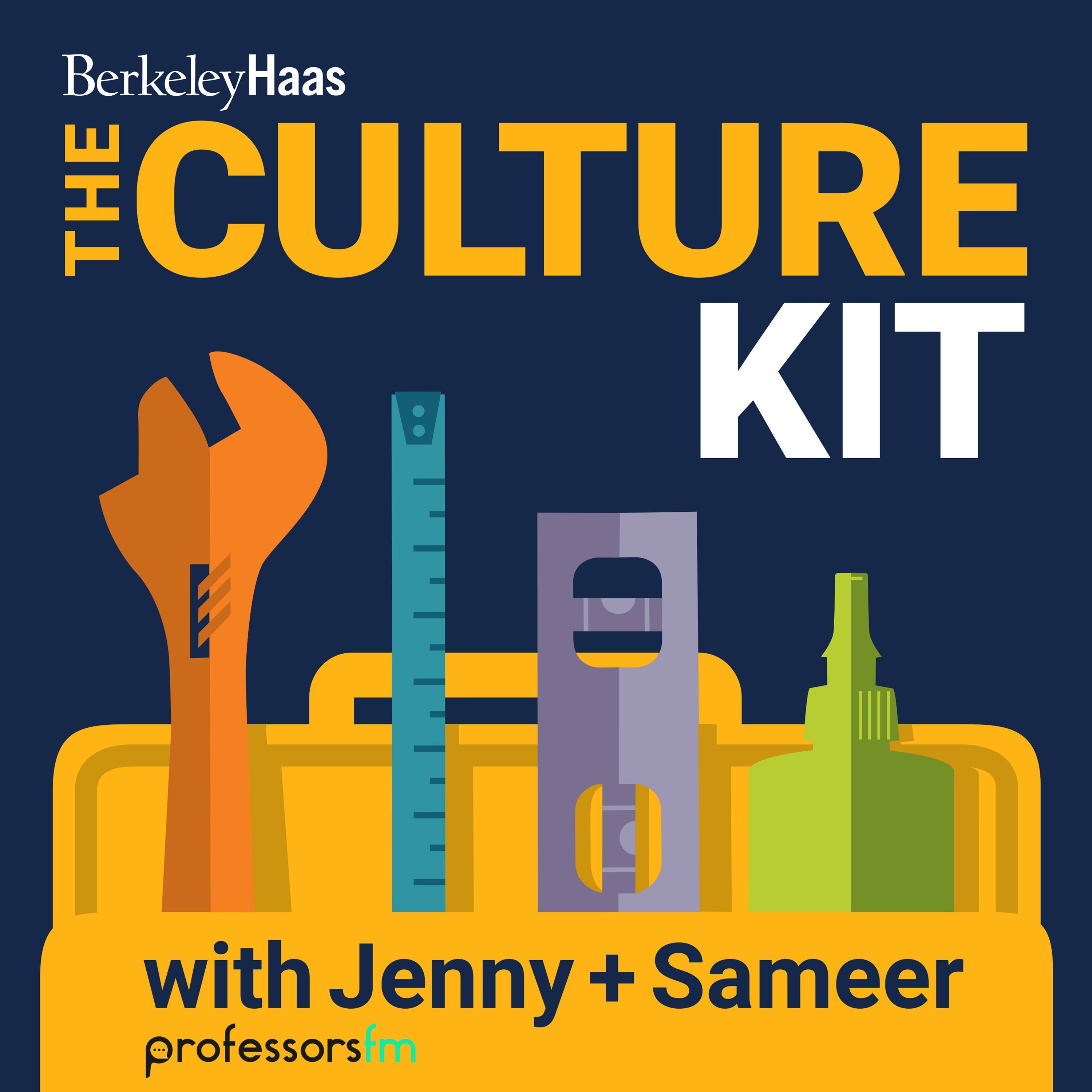
The Culture Kit with Jenny & Sameer

The Culture Kit with Jenny & Sameer

Hosted by Berkeley Center for Workplace Culture and Innovation

Episodes

31

Latest episode

May 2026

Language

EN

About the show

The world of work is a work in progress, from keeping remote teams engaged to integrating new AI tools to fostering feelings of belonging among all employees. UC Berkeley Haas Professors Jenny Chatman and Sameer Srivastava—experts who have dedicated their careers to studying and advancing workplace culture—answer questions about the most vexing problems your organization is struggling with today. Jenny & Sameer share insights and tools based on evidence from the latest research, and offer concrete steps you can take to fix your company’s culture. Listen and subscribe to The Culture Kit with Jenny & Sameer wherever you get your podcasts. The Culture Kit with Jenny & Sameer is produced by UC Berkeley's Haas School of Business and Professors.fm.

Listen to episodes

31 recent
May 19, 202632 min

Healthcare Has a Culture Problem. Can AI Help Fix It?

Healthcare organizations don't just have an efficiency problem—they have a culture problem. Siloed specialists, misaligned incentives, and fragmented decision-making leave patients frustrated and clinicians burned out. Jonathan Kolstad is a professor of economic analysis and policy at UC Berkeley Haas and is one of the country's leading health economists. He’s the founder and faculty director of the Center for Healthcare Marketplace Innovation (CHMI), a joint center between Haas and UC Berkeley’s College of Computing, Data Science, and Society. CHMI’s executive director is Ted Robertson, who specializes in designing and building healthcare products with the best mix of human and AI insights in decision making.  On this episode of The Culture Kit, Jon and Ted join organizational culture expert and co-host Jenny Chatman, Dean of the Haas School, to explain why healthcare’s broken structure is ultimately a culture problem, and how AI—deployed in the right way—might help fix it.  (Note: Co-host Sameer Srivastava was out of town for this episode.) 3 Main Takeaways: Healthcare's fragmentation is baked into the incentive structure, creating professional subcultures that work against patients and each other. AI has the potential to reduce burnout in healthcare providers and give patients a higher quality standard of care.  General-purpose AI isn't enough: healthcare needs models trained on real clinical decision-making, not medical textbooks. Read the full transcript of this episode on our website: https://haas.berkeley.edu/culture/culture-kit-podcast/posts/healthcare-has-a-culture-problem-can-ai-help-fix-it *The Culture Kit with Jenny & Sameer is a production of Haas School of Business and is produced by University FM.* Show Links: Center for Healthcare Marketplace Innovation  Jonathan Kolstad - Berkeley Haas Jonathan Kolstad  - personal website Ted Robertson- Berkeley Executive Education Ted Robertson - New leaders aim to bring AI solutions for health and climate to society” College of Computing, Data Science & Society - UC Berkeley How Berkeley Haas research fueled a company that could save Medicare patients from costly mistakes Learn more about the podcast and the Berkeley Center for Workplace Culture and Innovation at www.haas.org/culture-kit. *The Culture Kit with Jenny & Sameer is a production of Haas School of Business and is produced by University FM.* Hosted by Simplecast, an AdsWizz company. See pcm.adswizz.com for information about our collection and use of personal data for advertising.
May 5, 202625 min

The Office Has to Earn It: How Physical Space Shapes Organizational Culture

The office has never been just a place to work, it both reflects and shapes an organization’s culture. The furniture, the light, the layout, the ratio of private to shared space—all of it sends signals, whether leaders intend them to or not.  Paul Cooper and Christopher Good have spent their careers translating between what organizations say they value and what their spaces actually communicate. Paul is a principal at the architecture firm, TEF Design, and has spent 30 years designing places where people come together. Christopher is Chief Creative Officer at One Workplace, a workplace design and furnishings company, with the philosophy that no one should have to come into an office by default anymore, the office needs to earn it.   On this episode, Paul and Christopher join organizational culture experts Jenny Chatman and Sameer Srivastava to discuss what offices should look like now in the age of remote and hybrid models, why rents in one AI-centric San Francisco neighborhood have doubled why downtown office space sits empty, and the unknowns of designing for the future as AI takes off.  *The Culture Kit with Jenny & Sameer is a production of Haas School of Business and is produced by University FM.* 3 Main Takeaways: One solution does not fit all spaces. Come up with some guiding principles, as a team, that align with the overall mission and vision for that space’s design. Ask why your workplace exists. If it’s about people, own that, invest in it, and design for what their needs are. Design for the in-between experiences. When workers aren’t at their desks or in a conference room, how does the design of the space create moments for connection? Read the full transcript of "The Office Has to Earn It: How Physical Space Shapes Organizational Culture." Show Links: Paul Cooper, TEF Design Christopher Good | LinkedIn Finding shared meaning through propinquity | Christopher Good | TEDxPleasanton Embracing the Hybrid Future: Innovative Strategies for Cultivating Workplace Culture (One Workplace) How to bridge the gap between workplace design and culture (Culture Amp) Learn more about the podcast and the Berkeley Center for Workplace Culture and Innovation at www.haas.org/culture-kit. *The Culture Kit with Jenny & Sameer is a production of Haas School of Business and is produced by University FM.* Hosted by Simplecast, an AdsWizz company. See pcm.adswizz.com for information about our collection and use of personal data for advertising.
April 21, 202630 min

Jeanne Tsai on the Invisible Standard That’s Governing Your Organization: Emotions

Culture doesn’t just shape behavior; it shapes the emotional states people value. Those values operate largely below the surface and can drive some of the most consequential decisions organizations make—who gets hired, who gets promoted, who looks like a leader, and increasingly, how we design AI. For 30 years, psychologist Jeanne Tsai, the Dunlevie Family Professor at Stanford University and director of the Stanford Culture and Emotion Lab, has been building the science of how culture shapes emotion and its implications for decision-making, health, and how people are perceived. She joins organizational culture experts Jenny Chatman and Sameer Srivastava to discuss why it’s important for leaders to understand and examine this unwritten standard for how employees feel at work. 3 Main Takeaways: Name and examine your organization’s emotional ideal—and as a leader, think about how that might be at odds with your employee’s own personal emotional ideal. Consider the possibility that your evaluation of a job candidate or employee might be a reflection of your emotional ideal rather than just a reflection of their merit or performance. Understand that emotional misreads are often cultural misreads, and leaders should not view those differences as character judgments. Show Links: Jeanne Tsai | Stanford University Stanford Culture and Emotion Lab Americans are obsessed with Alyssa Liu. Here’s a big reason why. (San Francisco Chronicle) Leader choices reflect cultural differences in ideal affect more during organizational growth than decline (Emotion) Should job applicants be excited or calm? The role of culture and ideal affect in employment settings (Emotion) Cultural variation in the smiles we trust: The effects of reputation and ideal affect on resource sharing (Emotion) How culture shapes what people want from AI (Proceedings of the 2024 CHI Conference on Human Factors in Computing Systems) Read the full transcript on The Culture Kit website. *The Culture Kit with Jenny & Sameer is a production of Haas School of Business and is produced by University FM.* Learn more about the podcast and the Berkeley Center for Workplace Culture and Innovation at www.haas.org/culture-kit. *The Culture Kit with Jenny & Sameer is a production of Haas School of Business and is produced by University FM.* Hosted by Simplecast, an AdsWizz company. See pcm.adswizz.com for information about our collection and use of personal data for advertising.
April 7, 202624 min

Melissa Valentine on Assembling Your ‘Avengers’: Flash Teams in the Age of AI

We tend to treat organizational structures—such as job titles, departments, and reporting lines—like furniture: always there, moved around a bit, but rarely questioned. But what if AI is about to redesign the whole office? And in a world where you have humans and agents working alongside each other, how can leaders build a cohesive culture?  Stanford professor Melissa Valentine anticipated some of these changes in her book, Flash Teams: Leading the Future of AI-Enhanced, On-Demand Work. In this episode of The Culture Kit, Melissa joined organizational culture experts Jenny Chatman and Sameer Srivastava to discuss how AI and online labor markets are enabling leaders to assemble teams, solve problems, and then disband at superhero speeds. They also explore tensions between algorithmic decision-making and human structures, the challenges of deploying AI agents alongside humans, and how to recognize the “invisible labor” that keeps everything running smoothly. Melissa is an associate professor of management science & engineering at Stanford University and a senior fellow at the Stanford Institute for Human-Centered AI. *The Culture Kit with Jenny & Sameer is a production of Haas School of Business and is produced by University FM.* 3 Main Takeaways: Hierarchy isn’t going anywhere, but departments might. While hierarchy will remain essential for accountability and coordination, departments as we know them are likely to blur and collapse as AI puts design, engineering, and product capabilities in everyone’s hands. Adopt a mindset of “experts everywhere all the time.” Instead of thinking in terms of “expert scarcity,” leaders should recognize how easy it’s becoming to assemble the right talent—human or AI—for any given challenge. Management is now org design. The core management loop of scoping a problem, assembling resources, and evaluating the outcome is accelerating and becoming more like a design practice. Leaders aren’t just managing people anymore; they’re architecting the structures of work teams. Read the full transcript of "Melissa Valentine on Assembling Your ‘Avengers’: Flash Teams in the Age of AI." Show Links: Melissa Valentine's Website Faculty Profile | Stanford University Flash Teams: Leading the Future of AI-Enhanced, On-Demand Work When an AI ‘Agentforce’ Enters the Workforce: Generative AI, Employment Relations, and the Changing Social Contract  (Journal of Organization Design) Who Pays the Cancer Tax? Patients’ Narratives in a Movement to Reduce Their Invisible Work (Organization Science) The Algorithm and the Org Chart: How Algorithms Can Conflict with Organizational Structures — Proceedings of the ACM on Human-Computer Interaction (CSCW) Learn more about the podcast and the Berkeley Center for Workplace Culture and Innovation at www.haas.org/culture-kit. *The Culture Kit with Jenny & Sameer is a production of Haas School of Business and is produced by University FM.* Hosted by Simplecast, an AdsWizz company. See pcm.adswizz.com for information about our collection and use of personal data for advertising.
March 24, 202631 min

Jack Goncalo on What Organizations Get Wrong About Creativity—and What It's Costing Them

Most organizations say they want to foster creativity. But decades of research by Jack Goncalo, PhD 04, reveals they misunderstand it in fundamental ways: Leaders often implicitly reject novel ideas and penalize creative people when they’re up for leadership roles.  In our Season 5 kickoff, Goncalo unpacks the science behind why—and shares some genuinely counterintuitive findings: the conditions we think suppress creativity sometimes do the opposite. And the costs of creative work? They show up in places no one is tracking—including what your employees might eat and drink after a big brainstorm. Goncalo joins organizational culture experts Jenny Chatman and Sameer Srivastava to discuss why the bias against creativity is worst precisely when organizations need it most, why constraints and even social rejection can actually fuel original thinking, and why asking people to be creative all day has downstream consequences leaders aren't accounting for. *The Culture Kit with Jenny & Sameer is a production of Haas School of Business and is produced by University FM.* Jenny & Sameer’s 3 Main Takeaways: When building teams, look for the people who have a history of not fitting in or seeing things the way everyone else sees them. Build norms, not just freedom:  provide a framework that guides people and gives them a set of expectations that make them feel comfortable sharing their creative ideas. Create deliberate processes for assessing novel ideas that counteracts any evaluation bias. Show Links: Jack Goncalo faculty bio at Gies College of Business The bias against creativity: Why people desire but reject creative ideas (Psychological Science) Creativity from constraint? How political correctness influences creativity in mixed-sex work groups (Administrative Science Quarterly) Outside advantage: Can social rejection fuel creative thought? (Journal of Experimental Psychology) Are two narcissists better than one? The link between narcissism, perceived creativity and creative performance (Personality and Social Psychology Bulletin) Your soul spills out: The creative act feels self-disclosing (Personality and Social Psychology Bulletin) Creativity Connects: Generating Creative Ideas on Behalf of a Brand Increases Feelings of Connection (Personality and Social Psychology Bulletin) Creative Ideation Activates Disinhibited Reward-Seeking and Indulgent Choices (Journal of Personality and Social Psychology) Learn more about the podcast and the Berkeley Center for Workplace Culture and Innovation at www.haas.org/culture-kit. *The Culture Kit with Jenny & Sameer is a production of Haas School of Business and is produced by University FM.* Hosted by Simplecast, an AdsWizz company. See pcm.adswizz.com for information about our collection and use of personal data for advertising.
December 2, 202536 min

Glenn Carroll and Jenny Chatman on How to Make Your Organizational Culture Great

On this special episode, Sameer turns the tables on Jenny and puts her in the guest chair to talk about the new book she wrote with Stanford Professor Glenn Carroll – Making Organizational Culture Great: Moving Beyond Popular Beliefs, out April 2026. Based on decades of research, Glenn and Jenny’s book takes on the myths, clichés, and wishful thinking about organizational culture and replaces them with what works. In this interview, they give Sameer a sneak preview of some of the top tips in the book and how leaders can start building a great organizational culture today. Learn more about The Culture Kit and find the full transcript: https://haas.berkeley.edu/culture/culture-kit-podcast/*The Culture Kit with Jenny & Sameer is a production of Haas School of Business and is produced by University FM.*4 main takeaways from Sameer’s interview with Jenny and Glenn:Get a spreadsheet: Be deliberate and serious about culture: treat culture like anything else in your organization that you prioritize. That means tracking!Don’t start and end with announcing your values: Be consistent and comprehensive in the changes you make in an organization. Embed cultural values into every process your organization has.Be aware that culture can change: Be willing to continually drive it and cultivate it into the kind of culture you’re hoping for. Be patient and don’t expect overnight success.The science is easy to understand, but executing is hard. Understand the science to operate from a position of confidence.Show Links:Making Organizational Culture Great: Moving Beyond Popular Beliefs by Jennifer Chatman and Glenn Carroll (April 2026)Glenn Carroll’s Stanford faculty profileGlenn Carroll’s personal websiteJenny Chatman’s UC Berkeley Haas faculty profileJenny Chatman’s personal websiteParsing organizational culture: How the norm for adaptability influences the relationship between culture consensus and financial performance in high-technology firmsFitting In or Standing Out? The Tradeoffs of Structural and Cultural Embeddedness,Making Great Strategy: Arguing for Organizational AdvantageStop Hiring for “Cultural Fit” Learn more about the podcast and the Berkeley Center for Workplace Culture and Innovation at www.haas.org/culture-kit. *The Culture Kit with Jenny & Sameer is a production of Haas School of Business and is produced by University FM.* Hosted by Simplecast, an AdsWizz company. See pcm.adswizz.com for information about our collection and use of personal data for advertising.
November 11, 202526 min

Erica Bailey on Authenticity at Work—Beyond the Buzzword

Should you bring your “whole self” to work? Why does authenticity matter for organizations? And what does being “authentic” even mean? On this episode of The Culture Kit, Jenny and Sameer sit down with their colleague Erica Bailey, whose research is changing how we think about authenticity and leadership. Bailey, an assistant professor in the Management of Organizations Group at UC Berkeley Haas, talks about why she began studying authenticity,  generational differences in attitudes about authenticity at work, and how we might preserve our human value in the age of AI. Learn more about The Culture Kit and find the full transcript: https://haas.berkeley.edu/culture/culture-kit-podcast/*The Culture Kit with Jenny & Sameer is a production of Haas School of Business and is produced by University FM.*3 main takeaways from Jenny & Sameer’s interview with Erica Bailey:Focus on your own authenticity and less on convincing others: Most people’s perception of your authenticity has more to do with their own preconceived notions and less about who you really are. Spend more energy on learning about who you are, at work and in your relationships.Leaders should seek to create a respectful environment:yLeaders foster authenticity in others by valuing their contributions and setting norms of genuine respect and engagement—rather than mandating people to be “authentic” with their managers. Find authentic peer relationships: Authenticity is best nurtured through trusted, horizontal relationships at work. Find peers who earn and nurture your vulnerability and meet you with authenticity in return. Show Links:Erica’s website: http://ericarbailey.com/“The preeminence of communality in the leadership preferences of followers,” By Rebecca Ponce de Leon and Erica Bailey, Journal of Personality and Social Psychology, 2025: https://psycnet.apa.org/record/2025-76072-001“What do workers really want in a leader?” By Erica Bailey, Haas News: https://newsroom.haas.berkeley.edu/research/what-do-workers-really-want-in-a-leader-new-study-challenges-stereotypes/“Positive—More than unbiased—Self-perceptions increase subjective authenticity.” By Erica Bailey and Sheena Iyengar, Journal of Personality and Social Psychology, 2023: https://psycnet.apa.org/record/2024-18545-001?doi=1 Learn more about the podcast and the Berkeley Center for Workplace Culture and Innovation at www.haas.org/culture-kit. *The Culture Kit with Jenny & Sameer is a production of Haas School of Business and is produced by University FM.* Hosted by Simplecast, an AdsWizz company. See pcm.adswizz.com for information about our collection and use of personal data for advertising.
October 28, 202533 min

Rebecca Hinds on Overcoming a "Weapon of Mass Dysfunction": Meetings

It doesn’t matter where you work—bad meetings are a universal pain point. But they don’t have to be.Rebecca Hinds is an organizational researcher who has spent the past 15 years helping teams fix their broken meetings—and broken collaboration in general. Hinds has applied her Stanford PhD to the future of work, founding think tanks at two technology companies, and is now the author of the forthcoming book, Your Best Meeting Ever: Seven Principles for Designing Meetings That Get Things Done, out February 2026. Hinds joins organizational culture experts Jenny Chatman and Sameer Srivastava to discuss how bad meetings can degrade your company’s culture, the purpose meetings should actually serve, and how to start treating meetings as your most valuable product—and not an inevitable headache.Learn more about The Culture Kit and find the full transcript: https://haas.berkeley.edu/culture/culture-kit-podcast/*The Culture Kit with Jenny & Sameer is a production of Haas School of Business and is produced by University FM.*3 main takeaways from Jenny & Sameer’s interview with Rebecca Hinds:Hold a “meeting doomsday” once a year—ancel every recurring meeting from employees’ calendars for 48 hours and then add meetings in a way that is effective and essential for the current state of business. Get your communication system in order—Get everyone on the same page about where official communication takes place and what information they can rely on. This will help people evaluate when and whether a meeting should be called. Use AI–When it comes to diagnosing dysfunction in meetings and creating equilibrium in contributions, AI can be your best friend. Show Links:Rebecca Hinds’ website: https://www.rebeccahinds.com/Your Best Meeting Ever: 7 Principles for Designing Meetings that Get Things Done: https://www.simonandschuster.com/books/Your-Best-Meeting-Ever/Rebecca-Hinds/9781668067482 (launching February 3, 2025)The Simple Sabotage Field Manual: https://www.cia.gov/static/5c875f3ec660e092cf893f60b4a288df/SimpleSabotage.pdfMeeting Doomsday / Meeting Overload is a Fixable Problem (Harvard Business Review): https://hbr.org/2022/10/meeting-overload-is-a-fixable-problemThe Collaboration Cleanse / Are Collaboration Tools Overwhelming Your Team (Harvard Business Review): https://hbr.org/2023/08/are-collaboration-tools-overwhelming-your-teamThe Hidden Toll of Meeting Hangovers (Harvard Business Review): https://hbr.org/2025/02/the-hidden-toll-of-meeting-hangovers Learn more about the podcast and the Berkeley Center for Workplace Culture and Innovation at www.haas.org/culture-kit. *The Culture Kit with Jenny & Sameer is a production of Haas School of Business and is produced by University FM.* Hosted by Simplecast, an AdsWizz company. See pcm.adswizz.com for information about our collection and use of personal data for advertising.
October 14, 202548 min

How’s Your Battery? Calm CEO David Ko on Normalizing Mental Health at Work

With the majority of our waking life spent at work, conversations around mental health are crucial for a healthy workplace culture. But how do you open the conversation at work? How can leaders build the trust and psychological safety needed for these conversations? On this special episode, David Ko, CEO of the sleep and meditation app Calm and author of the book Recharge, shares his leadership journey from investment banking to purpose-driven leadership. Since 2022, he’s guided Calm’s work in over 190 countries, supporting millions of people seeking to improve their wellbeing.Ko describes “the battery check,” a simple framework for starting conversations about mental health, describes how burnout happens when leaders don’t explain the “why” behind decisions, and shares some candid personal anecdotes.The conversation is hosted by Professor Sameer Srivastava and led by UC Berkeley Haas students Avanika Lal and Esa Tilija, both MBA 26. The joint Dean’s Speaker Series and Berkeley Center for Workplace Culture and Innovation event took place at the Haas School of Business on September 30, 2025. Three main takeaways from David Ko: 1. Make mental health conversations accessible: Ask "How's your battery?" instead of "How's your mental health?" This simple reframing normalizes discussions that are otherwise difficult to start, creating psychological safety for your team.2. Stop stacking, start subtracting: Burnout happens when leaders keep adding priorities without removing anything or explaining why. When assigning new work, identify what employees should stop doing. Help them understand the "why" to create shared purpose, not just more tasks.3. Listen first, talk last: Be a "Chief Listening Officer" rather than the first voice in the room. Foster open dialogue where employees feel comfortable challenging ideas and speaking up. Learn more about The Culture Kit and find the full transcript: https://haas.berkeley.edu/culture/culture-kit-podcast/*The Culture Kit with Jenny & Sameer is a production of Haas School of Business and is produced by University FM.*Show Links:Recharge: Boosting Your Mental Battery, One Conversation at a Time by David KoThe Recharge PodcastNational Alliance of Mental Illness (NAMI)UC Berkeley Haas Dean’s Speaker Series Learn more about the podcast and the Berkeley Center for Workplace Culture and Innovation at www.haas.org/culture-kit. *The Culture Kit with Jenny & Sameer is a production of Haas School of Business and is produced by University FM.* Hosted by Simplecast, an AdsWizz company. See pcm.adswizz.com for information about our collection and use of personal data for advertising.
September 30, 202532 min

Toby Stuart on Why You Can’t Ignore the Hidden Forces of Social Status in Your Organization

Think your workplace runs on pure merit? Think again. In this season-opening episode, Berkeley Haas professor and leading sociologist Toby Stuart reveals how hidden status dynamics shape whose ideas get heard, who advances, and why meritocracies might be a “nice myth to think about” but nearly impossible to achieve in practice. But that doesn’t mean you shouldn’t try. Stuart, author of the new book Anointed: The Extraordinary Effects of Social Status in a Winner-Take-Most World, joins organizational culture experts Jenny Chatman and Sameer Srivastava to explore how social status quietly drives decisions, what functions it serves in organizations and society, and how leaders can navigate—and reshape—these hidden hierarchies. The takeaway from Jenny & Sameer’s interview with Toby Stuart:No matter how hard they’ve worked to get where they are, leaders should recognize that only part of their status was truly earned. Act with humility, acknowledge the roles that other people have played, and generously share pass along the status you hold.Show Links:Anointed: The Extraordinary Effects of Social Status in a Winner Take Most World, By Toby Stuart"AI will bring back the old boys’ club", By Toby Stuart, Boston Globe/Haas News, July 27, 2025"Could AI Destroy the Value of an Elite Education?", By Toby Stuart, U.S. News, August 27, 2025“The Philosophical Bet We All Need to Make in the Age of AI”, by Toby Stuart, Time, Sept. 29, 2025"The Matthew Effect in Science,” By Robert Merton, Science, 1968“Orchestrating Impartiality: The Impact of "Blind" Auditions on Female Musicians”, By Claudia Goldin, American Economic Review, 2004. Learn more about the podcast and the Berkeley Center for Workplace Culture and Innovation at www.haas.org/culture-kit. *The Culture Kit with Jenny & Sameer is a production of Haas School of Business and is produced by University FM.* Hosted by Simplecast, an AdsWizz company. See pcm.adswizz.com for information about our collection and use of personal data for advertising.

Is this your show?

Claim this listing to keep it up to date, reach guests who want to pitch you, and manage bookings with Guestify.

Claim this listing

More Business podcasts