Find partners
The Conch podcast

The Conch podcast

Hosted by Seafood and Gender Equality (SAGE)

SocietyCultureInterviews guests

Episodes

56

Latest episode

Jun 2025

Language

EN

About the show

The Conch Podcast features interviews with the most inspiring people in the world of seafood. Join Julie Kuchepatov, founder of Seafood and Gender Equality (SAGE), as she interviews people striving to succeed in the sector and the challenges they face - all while working to improve the environmental and social responsibility of the planet's most incredible food source - seafood! _ The Conch podcast is a program of Seafood and Gender Equality (SAGE). Audio production, engineering, editing, mixing, and sound design by Crystal Sanders-Alvarado for Seaworthy. Theme music: "Dilation" by Satan's Pilgrims. Funding generously provided by The David & Lucile Packard Foundation and Builders Initiative.

Listen to episodes

56 recent
June 24, 2025Episode 520 min

Season 5 Recap

On Season 6, Episode 5 of The Conch we're sharing the highlights from Season 5 with Julie, Cameron, and Crystal from Seaworthy!  So what made this final season unforgettable? Women leading the charge in ocean tech, AI, and machine learning to tackle ghost gear and climate change Big conversations on climate justice in fisheries and social justice in seafood OYSTERS. Always oysters. A look at the green crab—one of the most infamous invasive species in the ocean And through it all, The Conch continued doing what it does best: sparking real connections across the seafood world Transcript Episode Guide 00:05 Julie and Cameron from SAGE and Crystal from Seaworthy continue the recap of  five seasons of The Conch podcast! The fifth and final season of The Conch is featured in this episode 01:32 Women are leading the way in ocean tech, AI, and machine learning to address ghost gear and climate change 04:21 Climate justice in fisheries and social justice in food and seafood - trending discussions on this season of the podcast  08:54  This podcast is about growing existing and creating new connections, which we did with aplomb! 09:26 Oysters - yet another overarching theme of this season 10:24 The worst invasive species on the planet - green crabs 12:38 We're reeling in this podcast, but It's not goodbye, just goodbye for now. We learned a lot on this journey, so go check out In Hot Water, a Climate and Seafood podcast, to see how we bring what we've learned to our newest podcast venture Resources:  A HUGE thank you to all the people who joined us in conversation on The Conch throughout the years. To the listeners, THANK YOU for tuning in. Never stop spreading the word - EAT SEAFOOD! Check out In Hot Water, a Climate and Seafood podcast to hear more from Julie, Cameron, and Crystal as we hit the road to explore key seafood producing regions across the U.S. and hear from people working at the intersections of fisheries, aquaculture, seafood, and conservation while grappling with the effects of the global climate crisis. Recommend this episode to one person who is curious about seafood and the ocean.
June 10, 2025Episode 422 min

Season 4 Recap

Episode Guide 00:04 Julie and Cameron from SAGE and Crystal from Seaworthy continue the recap of  five seasons of The Conch podcast! Here's your season four recap 03:16 SAGE's own Cameron and Becca are in the hot seat this season! 03:41 In this season, we touch on aquatic animal welfare - not a totally new topic in seafood 07:09  Where do we draw the line at sentience? 07:27 In season four, we heard from amazing women in seafood, like Tia Clark, Libby Davis, and Anoushka Conception, who introduced seaweed farming to our podcast 12:27 With the release of two papers, guest Katrina Nakamura offers a critical look at the Marine Stewardship Council's eco-labeling of tuna and shrimp farming in India  20:19 Final message: EAT SEAFOOD!  Transcript Resources:  Check out In Hot Water, a Climate and Seafood podcast to hear more from Julie, Cameron, and Crystal as we hit the road to explore key seafood producing regions across the U.S. and hear from people working at the intersections of fisheries, aquaculture, seafood, and conservation while grappling with the effects of the global climate crisis. Recommend this episode to one person who is curious about seafood and the ocean.
May 27, 2025Episode 326 min

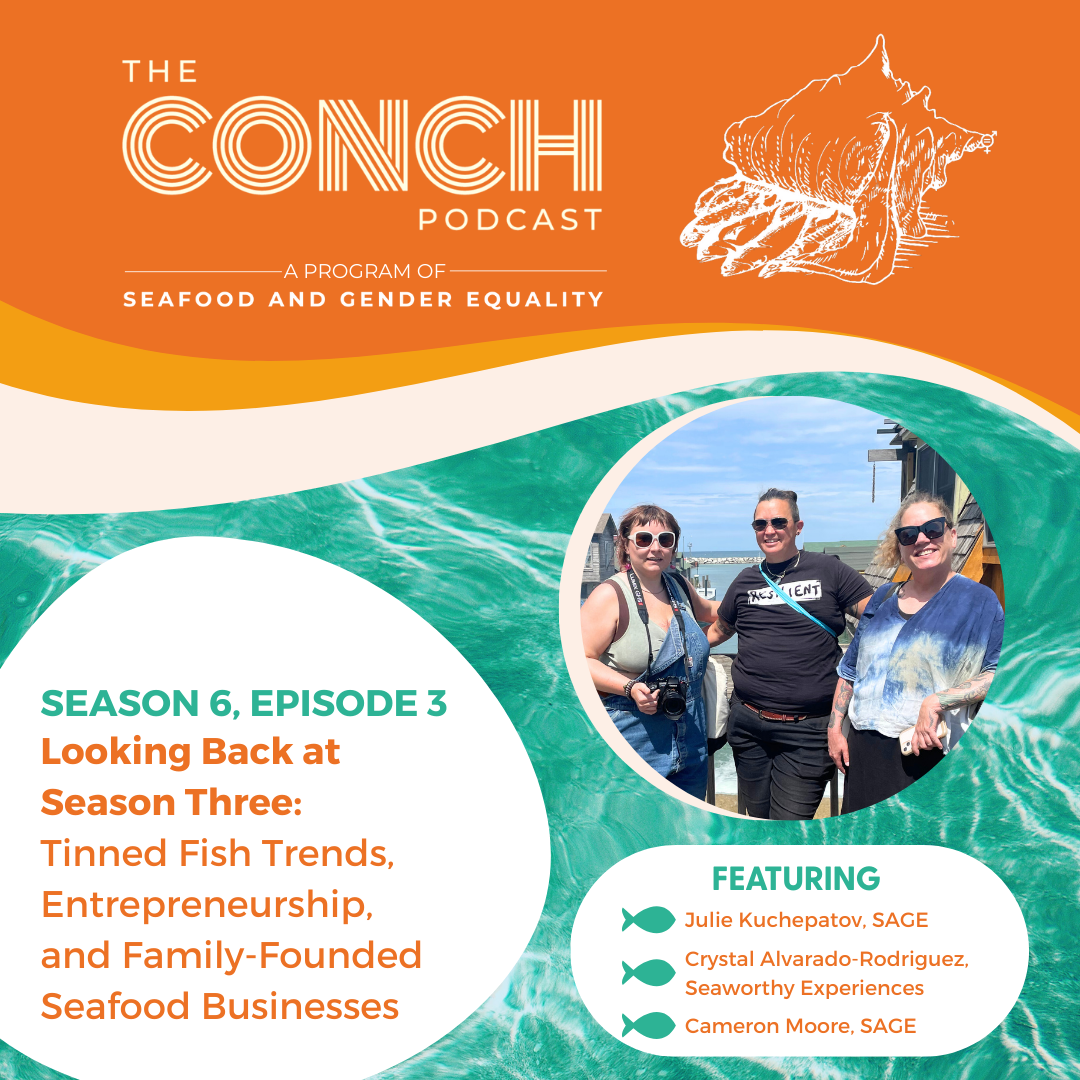
Season 3 Recap

This week in Season 6, Episode 3 of The Conch podcast, we're revisiting Season 3 in our ongoing recap series with Julie, Cameron, and Crystal from Seaworthy! From the rise of tinned fish queens to the grit of seafood entrepreneurs, we reflect on the stories and themes that made our third season unforgettable.  What stood out? Women leading the tinned fish trend The power (and challenge) of family-founded businesses Why people stay committed to seafood despite the obstacles  Plus, catch up on where some of our guests are now! Episode Transcript Episode Guide 00:05 Julie and Cameron from SAGE and Crystal from Seaworthy continue the recap of  five seasons of The Conch podcast! Here's your season three recap 01:22 Women are leading the tinned fish craze 07:57 Another trend from this season - entrepreneurship! 09:59  Why our guests stay in the seafood sector 13:06  A missed opportunity? We didn't interview one person working on traceability in the seafood sector 15:04 Another interesting trend - a good portion of seafood businesses are  family-founded, bringing its own set of challenges when trying to foster change in the industry 21:06 Updates on some of our fantastic guests from season three! Resources:  Check out In Hot Water, a Climate and Seafood podcast to hear more from Julie, Cameron, and Crystal as we hit the road to explore key seafood producing regions across the U.S. and hear from people working at the intersections of fisheries, aquaculture, seafood, and conservation while grappling with the effects of the global climate crisis. Recommend this episode to one person who is curious about seafood and the ocean.
May 13, 2025Episode 219 min

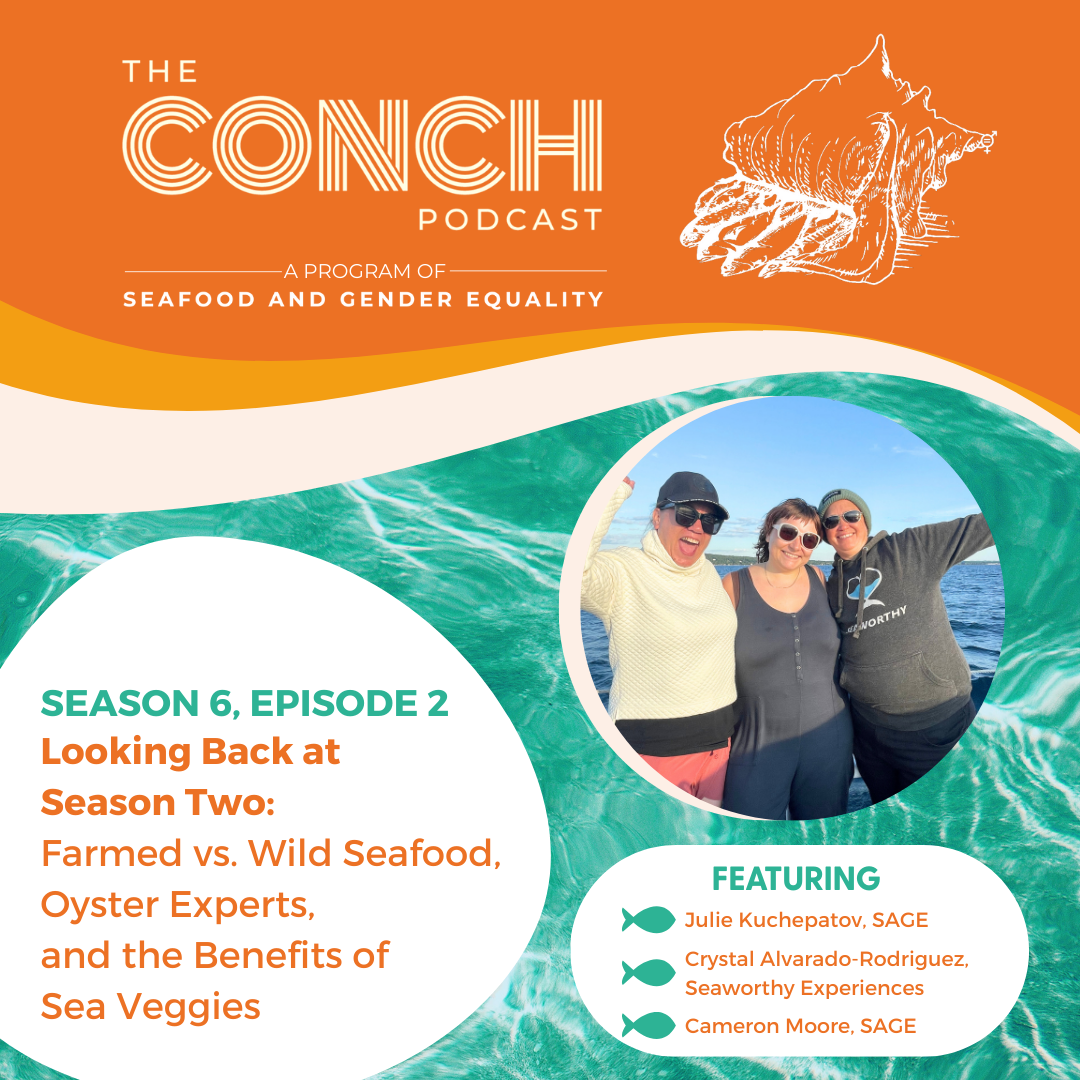
Season 2 Recap

In Season 6, Episode 2 of The Conch podcast, Julie, Cameron, and Crystal from Seaworthy keep the retrospective rolling, this time diving into the highlights of Season 2.  From oyster deep-dives to the balance between wild and farmed seafood, this season was packed with big conversations. Tune in for reflections on seafood as a nutritious food source (not just a commodity), updates on favorite past guests, and plenty of oyster love along the way!  Episode Transcript Episode Guide 00:05 SAGE's Julie and Cameron and Crystal from Seaworthy continue the recap of five seasons of The Conch podcast! This episode features season two 02:47 Finding the balance between farmed and wild seafood 06:38 This season featured several experts in oysters. If you love oysters, this season is for you! 08:05 The nutritional benefits of seafood and sea veggies - an often neglected benefit of seafood when it is viewed solely as a commodity, as opposed to a nutritious food source 13:43  Updates on some of our fantastic guests from season two! Resources:  Check out In Hot Water, a Climate and Seafood podcast to hear more from Julie, Cameron, and Crystal as we hit the road to explore key seafood producing regions across the U.S. and hear from people working at the intersections of fisheries, aquaculture, seafood, and conservation while grappling with the effects of the global climate crisis. Recommend this episode to one person who is curious about seafood and the ocean.
April 29, 2025Episode 129 min

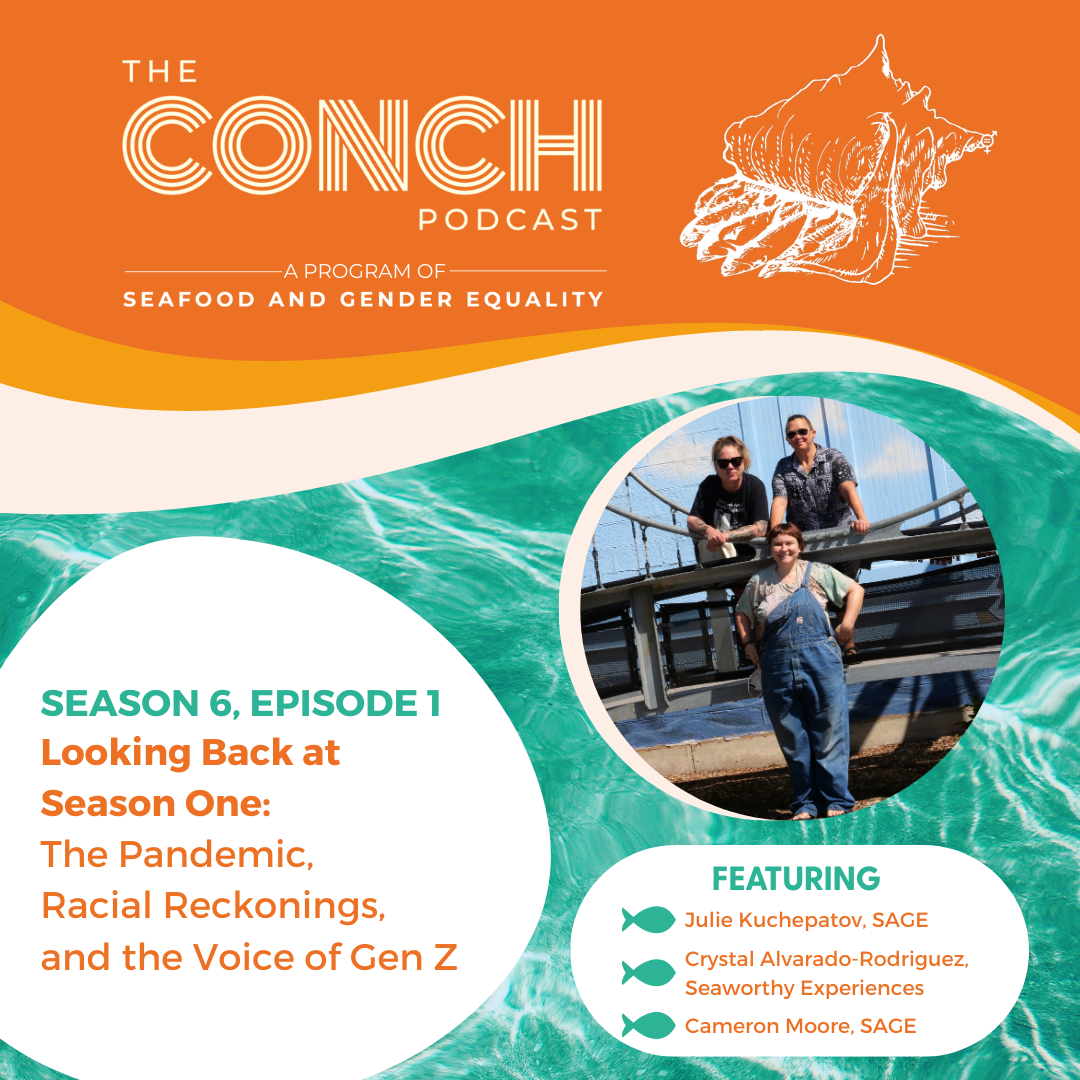
Season 1 Recap

We're kicking things off with a special retrospective series—each episode will look back at a different season of the podcast, starting with the one that launched it all back in late 2021. In this first episode, Julie and Cameron from SAGE join Crystal from Seaworthy Experiences to revisit Season 1 and the big themes that shaped it, including:  How racism fuels forced labor in seafood What's changed since the pandemic  Gen Z's influence on the industry Plus, learn where some of our very first guests are now & hear more about 𝗜𝗡 𝗛𝗢𝗧 𝗪𝗔𝗧𝗘𝗥, the SAGE x Seaworthy podcast series on seafood and the climate crisis. Transcript Episode Guide :05 Julie and Cameron from SAGE and Crystal from Seaworthy are recapping the last five seasons of The Conch podcast!  01:06  The podcast launched in 2021 and the Covid-19 pandemic was a major theme in season one. 03:16 The root cause of forced labor in the seafood sector is racism. Has the seafood industry addressed racism since we started this podcast? 13:04  Cameron, our resident representative of Gen Z, shares what we should know about this up-and-coming generation. 17:30  Fantastic updates on some of our guests from season one! 22:22 Introducing In Hot Water, a Climate and Seafood podcast! First stop on this deep dive into seafood and the climate crisis is the Gulf of Mexico and the coastal bend of Texas. 23:55 We reminisce on the advice given by some of our guests of season one for anyone thinking about starting a career in the seafood sector Resources:  Check out In Hot Water, a Climate and Seafood podcast to hear more from Julie, Cameron, and Crystal as we hit the road to explore key seafood producing regions across the U.S. and hear from people working at the intersections of fisheries, aquaculture, seafood, and conservation while grappling with the effects of the global climate crisis. Recommend this episode to one person who is curious about seafood and the ocean.
July 16, 2024Episode 1038 min

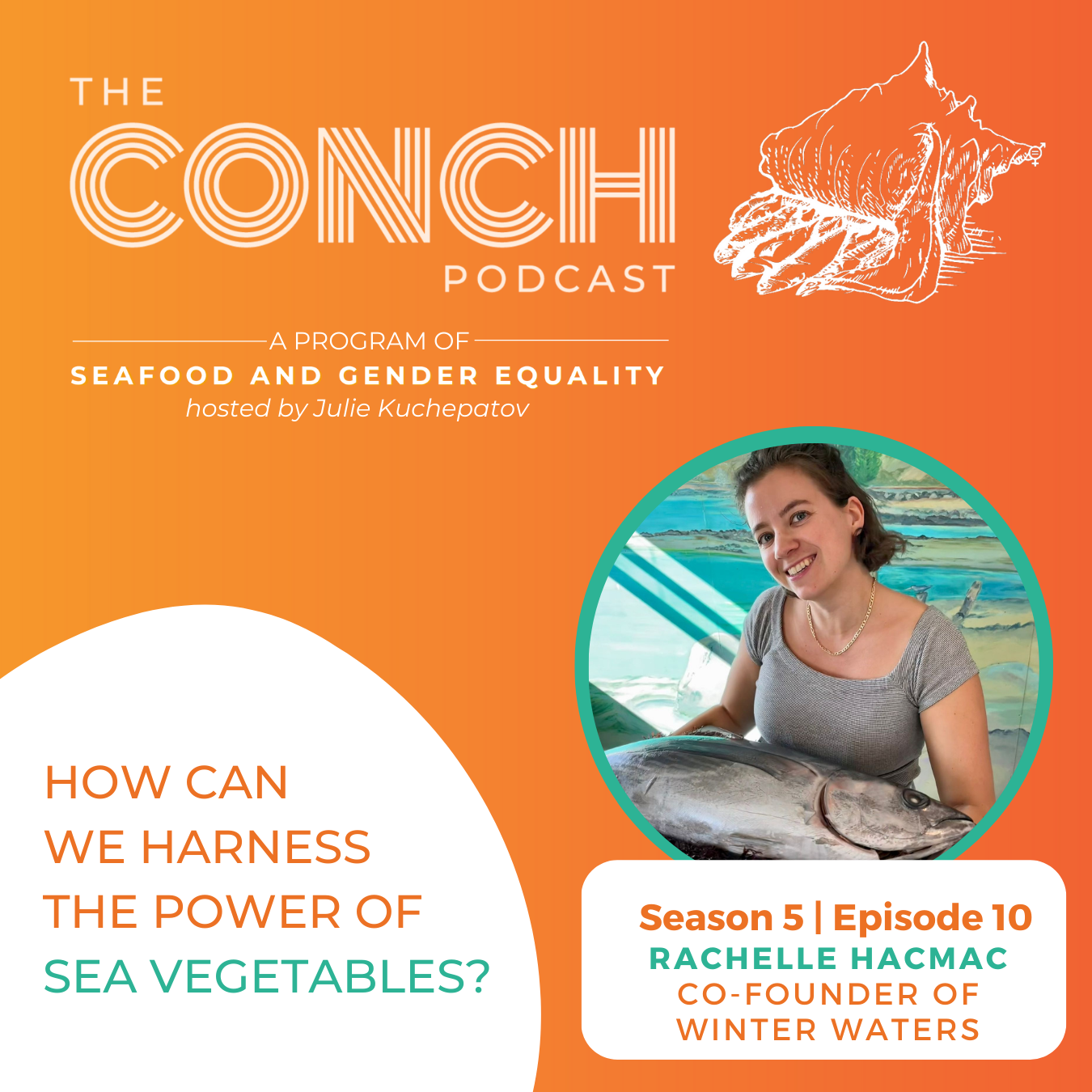
The Conch-Rachelle Hacmac

The world needs to know about the power of ✨𝗦𝗘𝗔 𝗩𝗘𝗚𝗘𝗧𝗔𝗕𝗟𝗘𝗦✨—how they're regeneratively farmed, why they improve our coastal communities, and ways they shine as a culinary ingredient.  🌊🌿 In fact, there's so much to unpack on this fascinating topic that we brought on seaweed advocate Rachelle Hacmac to The Conch podcast!  Rachelle is one of the co-founders of Winter Waters, an amazing seaweed-centric regenerative seafare dining series that is leading this conversation in Oregon.  So hear all about sea veggies—including 3 key things to know when you're looking to try them—by tuning into Season 5, Episode 10! Transcript Episode Guide :00 Intro 01:02 Rachelle Hacmac, one of three founders of Winter Waters, shares why they started this regenerative seafare dining series in Oregon  05:42 There's a great reason why Winter Waters happens in February, one of the gloomiest months of all! 09:00 Seaweed is the new kale 10:21 Seaweed cocktails? Yes please! 11:43 How has the public reacted to Winter Waters? 13:19 Can we farm seaweed in Oregon's waters? 14:55 A deep dive into the connection between wild kelp forests and purple sea urchins (and sunflower sea stars!) 14:57 Winter Waters is also a fundraising tool for deserving nonprofits 19:33 Rachelle shares about the other two co-founders of Winter Waters, Alanna Kieffer and Kristen Penner 21:33 Why are seaweeds having such a big moment and advice for what to do if you want to start a seaweed farm 25:47 The importance of social media for the seafood industry 27:42 Three things you should know when you want to learn more about eating and foraging seaweed 30:39 Amplifying the voices of women in the seafood industry has been an unexpected, yet incredible component of Winter Waters 33:01 Rachelle's sage advice for anyone wanting to break into the seaweed industry 34:04 Shout out to an amazing chef and friend of both SAGE and Winter Waters—Maylin Chavez! 35:23 What's next for Winter Waters?Resources:  Find @winterwaterspnw on Instagram and give a follow and browse the website for more resources, including recipes!! Learn more about the cool efforts of Winter Waters' other founders: Alanna Kieffer and Shifting Tides NW and Kristen Penner and Oregon Coast Visitors Association

July 2, 2024Episode 938 min

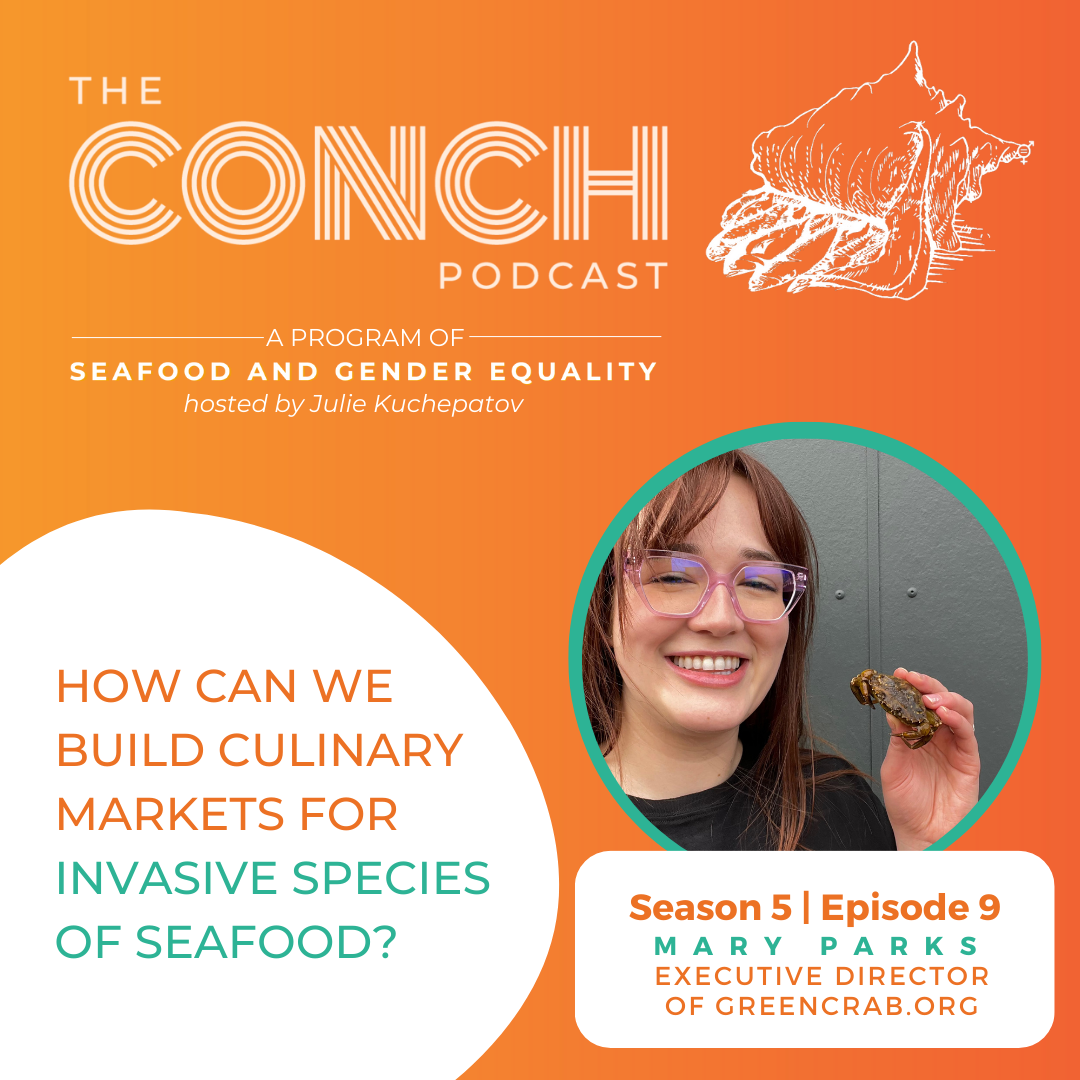
The Conch Podcast - Mary Parks

Have you heard of the GREEN CRAB, which is commonly known as the "world's worst invasive species?" Harming ecosystems and other species, the green crab is bad news—which makes it a great species to eat!  But how do you go about building a culinary market for an invasive species, especially given that many Americans don't stray too far from seafoods like salmon, tuna, and shrimp?  Here to tell us on Season 5, Episode 9 of The Conch podcast is Mary Parks, the amazing Executive Director of Greencrab.org. On a mission to spread awareness of its invasive impact, Mary's taking the green crab from "problem to plate"! Transcript Episode Guide :04 Introducing Mary Parks, Executive Director of Greencrab.org. 01:00  Mary introduces us to the invasive green crab, commonly referred to as the world's "worst invasive species" and shares how they ended up in U.S. waters 04:08 The havoc that green crabs cause to both ecosystems and other animals 06:55  Green crabs are new(ish) to the West Coast 08:37 Mary's journey to start Greencrab.org, a nonprofit that builds and supports culinary markets for European green crab, and also spreads awareness of their invasive impact 12:17 Venetians traditionally eat green crab roe. It's a delicacy! 15:03 Mary shares the fascinating process of molting a green crab 20;00 How to build a market for an invasive species 25:39 Let's say you're a seafood harvester finding a lot of green crab—what do you do? Mary walks us through some critical steps and how Greencrab.org can help 31:23 A lot of communities, like the Khmer, cook green crabs in a variety of exciting ways and it's important to acknowledge these communities in terms of their seafood buying power 35:17 Greencrab.org launched a harvester survey to understand who is participating in the fishery 36:43 Mary gives a shout-out to Isaura Buasier, an incredible chef who is redefining New England's seafood cuisine Resources:  Check out Greencrab.org to learn about the invasive green crab and even which restaurants serve them on their menus! Recommend this episode to one person who is curious about stopping the spread of the world's worst invasive species, the green crab

May 7, 2024Episode 842 min

The Conch- Leslie Canavera

How can we use AI and Machine Learning to support Arctic fishing, shipping, and kelp mariculture—all of which are increasingly impacted by the climate crisis?  Leslie Canavera, a Yup'ik Alaska Native and the CEO of PolArctic, is here to tell us on the latest episode of The Conch podcast!  The PolArctic team developed the "first AI model of its kind to treat Indigenous Knowledge and Western science as equals, training with and validating both knowledge systems." If you're curious to hear how merging these two knowledge bases has helped strengthen the seafood industry in the face of climate change, you won't want to miss Season 5, Episode 8.  You'll learn more about their impactful work and Leslie's journey from getting her Master's in Business Administration to serving in the Air Force to launching PolArctic!  Episode Transcript Episode Guide :00 Intro 01:20 Introducing Leslie Canavera, founder of PolArctic, a company focusing on the Arctic and the ocean, creating custom, cutting-edge artificial intelligence models for forecasting future environmental change 04:19 Artificial Intelligence (AI) is challenging established paradigms in the Arctic environment. Leslie tells us how 05:59 The Arctic is experiencing incredible challenges due to climate change 10:12  Ice patterns in the Arctic are changing due to climate change. Leslie walks us through the impacts on fisheries and communities 13:40 PolArctic recently successfully developed the first AI model to integrate Indigenous knowledge, scientific data, and remote sensing techniques to assess potential inshore fishery locations for an Arctic community 16:15  The Arctic is a data desert 19:00 Parachute science: when we're collecting data sets and asking people for their knowledge, it's important to use CARE and FAIR principles 20:54 Leslie's career journey from growing up in Anchorage, to becoming an AirForce officer, to launching a tech startup 26:25 Leslie's advice to eliminate inequality in the tech sector 30:45 Reshma Saujani said, "We're raising our girls to be perfect, and we're raising our boys to be brave." The challenges of VC funding and the importance of networking and sponsors 39:05 Leslie uplifts Jennifer Brown from Foraged and Found! Resources: Check out PolArctic's website to learn more about solutions to business and policy questions about the Arctic through the use of Artificial Intelligence (AI) and Machine Learning (ML) techniques. Interested in understanding why women-founded companies generate outsized social and financial returns? Read this article. Recommend this episode to one person who is curious about the importance of Indigenous knowledge in developing solutions to the greatest challenges facing our planet.

April 23, 2024Episode 738 min

The Conch- Caroline Ferguson Irlanda

When does a rising tide NOT lift all boats?  How does U.S. militarization affect the people of Palau and their seafood?  And, in what ways do economic, racial, gender, and environmental justice issues intersect in the seafood sector? We've got some mighty BIG questions on the latest episode of The Conch, and THE person to answer them.  On Season 5, Episode 7, Dr. Caroline Ferguson Irlanda shares her eye-opening insights and solutions to pressing challenges. A postdoctoral researcher at Stanford University and the host of Surf and Turf Podcast, Dr. Caroline and her podcast guests are FOUNTAINS of knowledge.  Audio production and sound design by Crystal Sanders-Alvarado for Seaworthy Experiences. Episode Transcript Episode Guide :00 Intro 01:15 Why Dr. Caroline Ferguson Irlanda, postdoctoral researcher, started a podcast called Surf and Turf, a seafood justice podcast 02:18 Caroline shares her conversation with Amal Bouhabib of Southern Migrant Legal Services, who represented local Black workers in the Mississippi catfish sector in a legal case where white South African workers were paid more than the local workers 05:50 Season Two of Surf and Turf focused on the privatization of fisheries through consolidation of catch shares, private equity ownership of fisheries, and illegal privatization of waterfronts 10:04  Racial challenges and how they manifest in the U.S. seafood system 14:01 The question that motivates Caroline in her research: how are the harms and benefits of the seafood trade distributed in fishing communities? She explains a case study of the sea cucumber fishery in Palau 19:38 Caroline supports opposition to the U.S. militarization of Palau through her privilege and nonprofit, Allies for Micronesia Project 23:55  Caroline and coauthors prepared Practical Ways to Implement Gender Sensitive Fisheries and Aquaculture Research in the Pacific to provide researchers training on how to account for gender in research design 27:57  How to lessen inequalities in the seafood sector? Recognize that this is a very gender-diverse sector and women are EVERYWHERE! 29:54 The driving questions behind Caroline's decision to earn her PhD 33:02 Caroline's advice for anyone considering a PhD 35:19 Caroline shouts out some of her incredible podcast guests: feini yin, Queen Quet, Nico Gomez Andujar, Kirby Page and Radhika Sharma Resources:  Check out the incredible Surf and Turf podcast to learn more about the complex and often overlooked issues of access, equity, and justice in the U.S. seafood system Recommend this episode to one person who is curious about the extraordinary people working to create a more just seafood system that nourishes us all.

April 9, 2024Episode 641 min

The Conch- Mavis-Jay Sanders

In what ways do food and social justice intersect? How can we help formerly incarcerated youth develop culinary careers? And why is it so important to support independent Black farmers?  Chef Mavis-Jay Sanders digs into all of this with us on Season 5, Episode 6 of The Conch podcast!  A James Beard Award-Winning chef, culinarian, and storyteller, Chef Mavis-Jay has supported so many wonderful organizations and initiatives, from the Coalition for Sustainable Aquaculture to the Queer Food Foundation (which she helped found!).  So join us for this episode where she shares her insights on how to help communities celebrate the joys of life and humanity through food. Episode Transcript Episode Guide :00 Intro 01:03 Chasing childhood food memories: Mavis-Jay's journey to becoming an award-winning chef 07:48  Letting go of the ego of food: what accolades meant and now mean to Chef Mavis-Jay 12:50 The importance of investing in formerly incarcerated youth 17:06  How to celebrate Black American heritage through food 20:41 Reclaiming Black food sovereignty: what does success look like? 24:01 Supporting Black farmers: where food comes from is as much of an issue of justice and equity as food access is 27:47 Why Chef Mavis-Jay supports the Coalition for Sustainable Aquaculture 31:05 The Queer Food Foundation whose mission is to be a nationwide resource and platform for LGBTQIA+ individuals in food and promote, protect, and fund queer food spaces 35:02 What the restaurant industry can do to lessen inequalities 38:15 Chef shouts out Katherine Miller, whose book At the Table: The Chef's Guide to Advocacy, will positively support generations of chefs Resources:  Find @chefmavisjay on Instagram and give a follow! Check the links for more information about the Queer Food Foundation, the Coalition for Sustainable Aquaculture, and Black Farmer Fund. Explore Katherine Miller's book, At the Table: The Chef's Guide to Advocacy

Is this your show?

Claim this listing to keep it up to date, reach guests who want to pitch you, and manage bookings with Guestify.

Claim this listing