Find partners
The Big Experiment

The Big Experiment

Hosted by Mark Davison

Episodes

27

Latest episode

Nov 2025

Language

EN-GB

About the show

Ever wondered how technology start-ups, well, start-up? For most founder entrepreneurs, it is the biggest experiment they'll ever run. Like most experiments, the result isn't known beforehand and it often doesn't work first time. On a bigger scale, how do big tech companies turn innovative science into profit? Mark Davison interviews founder scientists, executives, investors, communicators, and others in the technology start-up and corporate science ecosystems. Learn how great ideas turned into thriving businesses (or not) from those who made it happen (or didn't). Get business tips, lessons learned, and life lessons straight from the people who know. Inspiring, disastrous, funny: hear what life in a science-driven company is really like. Straight-talking, no nonsense, but conversational style. All technical content is explained for the non-specialist - you don't need a PhD or fluency in jargon and technobabble.

Listen to episodes

27 recent
November 10, 202533 min

Tim Corcoran: Cosmetics from Cyanobacteria

Is the answer to sustainable chemical manufacturing floating in our oceans?Ocean cyanobacteria, like plants, use sunlight as power to help them make complex chemicals.  Traditional industrial chemistry requires a lot of power and can be quite polluting. Cyanobacteria are actually more efficient at producing high-value chemicals, while capturing carbon dioxide rather than releasing it.In this episode I am joined by Tim Corcoran, Founder and CEO at Deep Blue Biotech, who's proving this remarkable claim with a novel approach. His company produces hyaluronic acid, a premium skincare ingredient, using nothing but CO2, sunlight, and seawater-based nutrients. For every tonne produced, approximately 7 tonnes of CO2 are captured. Ingredient costs drop by 50%, and it creates the world's first "ocean-derived" hyaluronic acid, which personal care companies are eager to market.Beyond the compelling science, Tim reveals the strategic thinking that sets Deep Blue apart from failed synthetic biology startups. Rather than chasing commodity markets and competing on price and sustainability, they targeted expensive products first to prove their technology works and generate revenue quickly. We explore the practical realities of photobioreactor design, genetic engineering challenges, and scaling from 5-litre lab batches to 100,000-litre industrial facilities.This venture extends beyond skincare. By starting with high-value products, Deep Blue is building toward their ultimate goal: producing butanol biofuels that could transform Europe's automotive industry while avoiding the land-use competition that plagues ethanol production." Start with something expensive, be competitive quickly, then explore higher-impact molecules.." – Tim CorcoranYou'll Hear AboutFast-growing ocean cyanobacteria discovered near Singapore Why expensive hyaluronic acid beat commodity biofuels Photobioreactors: growing bacteria with light and CO2 Genetic engineering to optimize microbial metabolism 50% cost reduction plus 7 tonnes CO2 captured Scaling from lab to 1,000 litres in Portugal Technology licensing instead of manufacturing company Personal care's lower regulatory barriers versus pharma Managing runway while raising £3-4 million seed round £25 million Series A for commercial-scale production Future applications: butanol biofuels for European cars Portugal versus Iceland for photobioreactor facilitiesConnect with Tim CorcoranLinkedIn - https://www.linkedin.com/in/tim-corcoran-5b10121/ Website - https://deepbluebiotech.com/ Connect with me:LinkedIn: https://www.linkedin.com/in/markdavison100/ If you need any lab equipment:Grant Instruments: https://www.grantinstruments.com/ Grant Instruments on LinkedIn: https://www.linkedin.com/company/grant-instruments-cambridge-ltd/ Produced by Between Tracks - https://www.betweentracks.com/

October 12, 2025Episode 2537 min

From Jellyfish to Wound Healing with Dr Andrew Mearns-Spragg

What if the solution to chronic wound healing has been floating in our oceans for 600 million years?Jellyfish collagen isn't just different from the cow and pig-derived materials used in medicine today. It's actually better at healing human tissue.I sit down with Dr Andrew Mearns-Spragg, Founder and Chief Scientific Officer at Jellagen, who's proving this remarkable claim with hard data. His research shows jellyfish collagen outperforms traditional materials in vocal fold repair, triggers faster transitions from inflammation to healing, and creates longer-lasting tissue structure. The secret lies in what Andrew calls "collagen type zero," an evolutionarily ancient form that our bodies recognise differently, prompting superior healing responses without the prolonged inflammatory reactions seen with mammalian sources.Beyond the compelling science, Andrew reveals how he built the world's first ISO-certified medical device manufacturing plant for jellyfish collagen from scratch. We explore the practical realities of sustainable harvesting (achieving near-zero bycatch), navigating FDA regulations for an entirely novel biomaterial, and convincing investors to back marine biotechnology. This venture extends beyond the laboratory. By harvesting jellyfish blooms caused by overfishing, Jellagen addresses an ecological problem while creating advanced wound care solutions and providing alternative income for local fishing communities struggling with depleted fish stocks."The jellyfish collagen transition to healing was much quicker and longer lasting." - Dr Andrew Mearns-SpraggYou'll Hear AboutWhy jellyfish collagen outperforms mammalian collagen in tissue healingThe challenges of building ISO-certified jellyfish manufacturingHow ancient collagen triggers better immune responsesSustainable harvesting methods with near-zero bycatchTranslating marine biology research into medical devicesThe cost of chronic wound management in healthcareNavigating the FDA regulatory pathway for novel biomaterialsSupporting local fishing communities through jellyfish harvestingFrom angel investment to medical device commercializationPlatform opportunities beyond wound healing applicationsConnect with Dr Andrew Mearns-SpraggLinkedIn - https://www.linkedin.com/in/andrew-m-006bb41/ Website - https://jellagen.co.uk/ Connect with me:LinkedIn: https://www.linkedin.com/in/markdavison100/ If you need any lab equipment:Grant Instruments: https://www.grantinstruments.com/ Grant Instruments on LinkedIn: https://www.linkedin.com/company/grant-instruments-cambridge-ltd/

August 10, 202538 min

Jenny Barnett: New tests and drugs for schizophrenia

Can neuroscience finally catch up with the complexity of mental illness?Society faces a huge and growing burden from mental illness and impairment. Schizophrenia, for example, is a bigger socioeconomic burden than all cancers put together.We have medicines for some of these conditions, but typically they work well for some, not at all for many, and cause side-effects for others. One of medicine's greatest challenges has been identifying exactly which patients will benefit from a treatment before they even start their pills.In this episode I am joined by Jenny Barnett, neuroscientist and CEO of Monument Therapeutics, to explore one of the most pressing challenges in modern medicine: how to develop truly effective treatments for complex, multi-factorial mental health conditions like schizophrenia and cognitive impairment.Jenny shares the work they are doing on neuroscience drug development, revealing how Monument Therapeutics is using cognitive tests and precision psychiatry to target pharmaceutical treatments more effectively.She explains why the current "one-size-fits-all" model of psychiatric medication is failing patients, and how a diagnostic-therapeutic approach could transform lives and health systems alike.We discuss the state of funding for the research, clinical trial challenges and bottlenecks, and the urgent economic and social need for accessible mental health solutions.Don't miss this fascinating glimpse into the next frontier of neuroscience.“Schizophrenia costs society more than all cancers put together.” – Jenny Barnett You’ll hear about:●      How digital biomarkers are revolutionising psychiatric drug development and patient selection●      Why current mental health medications only work for one-third of patients●      The groundbreaking computer-based tests that rats and humans can both perform●      How Monument Therapeutics is targeting cognitive impairment in schizophrenia patients●      The staggering economic impact of mental health disorders on society●      Why precision psychiatry could catch up neuroscience to cancer treatment advances  Connect with Jenny BarnettLinkedIn - https://www.linkedin.com/in/jenny-barnett-4b035826/ Website - https://monumenttx.com/  Connect with me:LinkedIn: https://www.linkedin.com/in/markdavison100/ If you need any lab equipment:Grant Instruments: https://www.grantinstruments.com/  Grant Instruments on LinkedIn: https://www.linkedin.com/company/grant-instruments-cambridge-ltd/

July 27, 202534 min

Paul Beastall: Fuelling our future planet with a zero-carbon biofuel

Forget drilling—what if diesel could be grown instead?In this episode we head into the world of engineered biology with Paul Beastall, CEO of HutanBio. He explains how his team is cultivating an oil-rich microalgae, previously unknown to science, that thrives in desert heat, tolerates high salinity, and could transform the future of sustainable fuel.From modular algae farms that resemble vineyards more than refineries, to carbon-negative bio-oil ready for aviation, shipping, and long-haul transport, this is a story of breakthrough biology meeting global-scale energy challenges.Paul breaks down the tech, the economic viability, and why scale, not science, is now the final hurdle.We need to move away from fossil fuel dependence, and with electrification or hydrogen fuels a system that requires huge industrial change this could be a transition technology that words.Curious how a startup of 15 is challenging the oil industry? Listen now and find out.“This isn’t just green fuel—it’s a carbon-negative replacement for fossil diesel.” – Paul Beastall You’ll hear about:·      HutanBio’s focus on using microalgae to produce sustainable fuels.·      The need for sustainable fuels being increasingly recognised globally.·      How microalgae can absorb CO2 while growing, making it carbon negative.·      Innovative growth techniques include using photobioreactors for efficiency.·      How harvesting involves separating oil from biomass for fuel production.·      Why the economics of sustainable fuels are challenging but necessary for the green economy.·      The carbon footprint of algae-based fuels is significantly lower than fossil fuels.·      Funding is crucial for scaling up production and achieving business goals. Connect with Dr. Ewelina KurtysLinkedIn - https://www.linkedin.com/in/paulbeastall/?originalSubdomain=uk Website - https://hutanbio.com/  Connect with me:LinkedIn: https://www.linkedin.com/in/markdavison100/ If you need any lab equipment:Grant Instruments: https://www.grantinstruments.com/ Grant Instruments on LinkedIn: https://www.linkedin.com/company/grant-instruments-cambridge-ltd/

July 7, 2025Episode 2233 min

Brain-on-a chip? Neurons as future biocomputers with Dr. Ewelina Kurtys

What if the future of computing isn’t silicon... but neurons?In this episode, we explore a radical new frontier where biology and technology come together — programming living neurons as processors.I am joined by Dr. Ewelina Kurtys of FinalSpark, a pioneering scientist bridging neuroscience and AI. We unpack the astonishing potential of bioprocessors—miniaturised clusters of human neurons that can process and store data while consuming a fraction of the energy traditional systems demand.Evelina reveals how her team is learning to "program" neurons using electrical and chemical signals to store information — not to replicate the brain, but to unlock new, energy-efficient forms of computing.We cover the challenges of working with living cells, how neuron-based processors may outpace silicon chips in energy efficiency, and what it means for AI, medicine, and beyond.From sci-fi to serious science, this episode pushes the limits of what's possible in computational neuroscience.“We’re building processors from living cells.” – Dr. Ewelina KurtysYou’ll hear about:·      Neurons being significantly more energy efficient than traditional computing methods.·      How FinalSpark aims to program neurons to perform computational tasks.·      Why maintaining the health of neurons in a lab setting is crucial for research.·      Investment being needed to accelerate the development of neuronal computing.·      Ways neuronal computing has potential applications in drug development and brain interfaces.·      Ethical considerations arise when discussing programming living neurons.·      The future of computing may involve a blend of biological and digital technologies. Connect with Dr. Ewelina KurtysLinkedIn - https://www.linkedin.com/in/ewelinakurtys/ Website - https://www.ewelinakurtys.com/  Connect with me:LinkedIn: https://www.linkedin.com/in/markdavison100/ If you need any lab equipment:Grant Instruments: https://www.grantinstruments.com/ Grant Instruments on LinkedIn: https://www.linkedin.com/company/grant-instruments-cambridge-ltd/

May 11, 2025Episode 2133 min

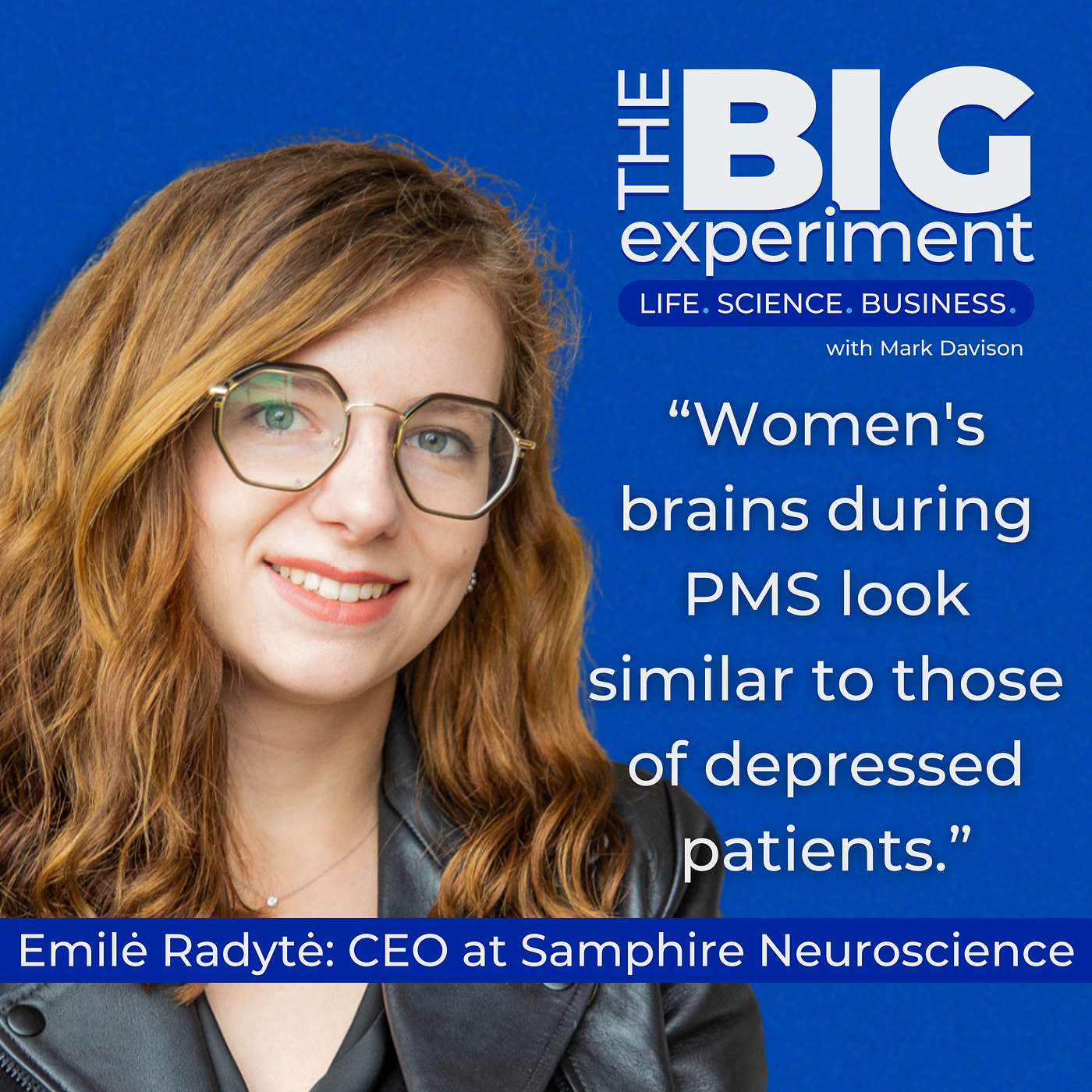
A Brain-Based Revolution in Women's Health: The Nettle Device with Emilė Radytė

Three-quarters of women report that menstrual symptoms impact their daily performance, yet until recently, no one had looked at the brain's role in these symptoms.In this eye-opening episode I am joined by Emilė Radytė, PhD—Harvard and Oxford-trained neuroscientist, Forbes 30 Under 30 honoree, and co-founder/CEO of Samphire Neuroscience.Emilė reveals how a woman's brain during PMS can actually resemble that of someone with depression—with measurable neurological changes that affect mood, decision-making, and pain perception.She shares the fascinating development of Nettle, a groundbreaking medical device that uses gentle brain stimulation technology to address both the mental and physical symptoms of PMS.We explore why women's health issues that don't affect fertility or mortality have been historically neglected, despite severely impacting quality of life. Emilė discusses her mission to help women maintain consistency in exercise routines, workplace performance, and emotional well-being throughout their cycles.Listen now to discover how neuroscience is finally addressing what 76% of women experience monthly but have been told to "just deal with"—and what's next for this pioneering technology.“Women's brains during PMS look similar to those of depressed patients..” – Emilė RadytėYou’ll hear about:·       How Nettle uses low-current neuromodulation to "train" the brain rather than overwrite it·       The clinical trials showing 97% efficacy rates among real-world users·       The engineering challenges of designing for diverse women's needs and hair types·       The rigorous EU medical device certification process it underwent Connect with Emilė Radytė:  LinkedIn - https://www.linkedin.com/in/eradyte/ Samphire Neuro - https://samphireneuro.com/  Connect with me: LinkedIn: https://www.linkedin.com/in/markdavison100/ If you need any lab equipment:Grant Instruments: https://www.grantinstruments.com/  Grant Instruments on LinkedIn: https://www.linkedin.com/company/grant-instruments-cambridge-ltd/ Produced by Between Tracks Media Productions - https://www.betweentracks.com/

February 10, 2025Episode 2037 min

Therapeutic brain-computer-interfaces for glioblastoma, with Dr Elise Jenkins

Electrical monitoring and stimulation could revolutionise diagnosis and treatment for some of the most aggressive brain cancers and intractable neurological diseases.In glioblastoma, a particularly aggressive brain tumour that is hard to treat and almost invariably fatal, the impacts of an effective treatment would be huge.My guest in this episode, Dr Elise Jenkins, is working with a new class of therapeutic brain-computer-interface (BCI) that can measure and disrupt neural signalling within the body. With this technology she and her team are creating breakthroughs in new materials and electronics to develop safe, minimally invasive interfaces to interact with the complex biology of the brain. That will lead to earlier detection of new tumours, and could pave the way for new treatments. Elise shares her journey from aspiring medical doctor to electrical engineer to leading a neurotechnology startup. She discusses the many difficult challenges of engineering tiny bioelectronic devices, and the importance of understanding brain activity in cancer progression for them to be a success.We also touch on regulatory hurdles, funding strategies, and the future potential of the technology in both cancer and non-cancer applications.Elise and her team are looking to create a new approach to healthcare which will change the lives of millions.“We're looking at how to slow down cancer growth.” – Elise JenkinsYou’ll hear about:01:06 - Elise Jenkins and OptoBioSystems02:30 - Elise's Journey into Science and Engineering05:42 - Understanding Bioelectronics and Neural Interfaces09:01 - Exploring Glioblastoma and Its Challenges12:18 - Measuring Brain Activity and Cancer Progression16:30 - The Role of Implants in Cancer Treatment19:14 - Engineering Challenges in Medical Devices22:57 - Wireless Power and Data Transmission Innovations25:20 - Regulatory Considerations for Medical Devices28:14 - Future Directions and Broader Applications33:24 - Funding and Company DevelopmentConnect with Elise Jenkins: LinkedIn - https://www.linkedin.com/in/elise-jenkins-/Opto - https://www.opto.bio/Find out about opportunities with Opto - https://www.opto.bio/teamConnect with me:LinkedIn: https://www.linkedin.com/in/markdavison100/ If you need any lab equipment:Grant Instruments: https://www.grantinstruments.com/ Grant Instruments on LinkedIn: https://www.linkedin.com/company/grant-instruments-cambridge-ltd/

January 13, 2025Episode 1942 min

Che Connon. Lab-grown tissues in medicine, food and fashion

Imagine that we could make tissues indistinguishable from those produced by humans or animals, at will, and at comparable cost to the natural products. With the rate of progress being made, it won’t be imaginary much longer.If we don’t need to kill animals for food, leather, or other products, then we reduce animal suffering. We increase biodiversity because we don’t need to devote huge land areas to feed farm animals. And we help climate change - the meat industry is a huge contributor to greenhouse gases. This dream needs more than cultivated cells. We need to organise them into tissues, with multiple cell types in the correct places and doing the right things. Directing cells to organise into tissue structures such as leather, corneas and cultivated meat has huge implications for medicine, fashion and the food industry.Che Cannon joins me in this episode to share his work in this area. Che is the CEO of BSF Enterprise PLC, and we delve into the intersection of science and business in developing innovative technologies such as this.Che shares the complexity of tissue mechanics and the advantages of bottom-up methods over traditional top-down approaches. We also talk about the environmental benefits and ethical considerations of alternative leathers and cultivated meats. Additionally, Che explains the progress that has been made on the medical device front with corneal repair. On the business side, we also cover the unusual step by the company to raise funds by listing on the stock exchange.There are many practical applications of these technologies, and they are surely the future of sustainable materials in various industries, making these developments hugely important.“Cultivated meat has a good purpose and can lift lots of technologies.” – Che ConnonYou’ll hear about:01:11 Exploring Cell and Material Interaction03:30 Tissue Engineering and Its Applications06:22 The Science Behind Lab-Grown Leather15:31 Cultivated Meat: Innovations and Challenges20:41 Macromolecular Crowding in Cell Culture25:27 The Future of Cultivated Meat28:49 Market Opportunities in Asia31:46 Corneal Repair Technology36:06 BSF Enterprise: A Unique Path to Funding40:01 Future Directions in Research and DevelopmentConnect with Che Connon:LinkedIn - https://www.linkedin.com/in/checonnon/ 3D Bio-Tissues - https://www.3dbiotissues.com/ Kerato - https://kerato.co.uk/ BSF Enterprise - https://bsfenterprise.com/ Connect with me:LinkedIn: https://www.linkedin.com/in/markdavison100/ If you need any lab equipment:Grant Instruments: https://www.grantinstruments.com/ Grant Instruments on LinkedIn: https://www.linkedin.com/company/grant-instruments-cambridge-ltd/

December 16, 2024Episode 1830 min

On the Road! A Quick Tour of Synthetic Biology

In this episode of The Big Experiment, we are live, recording from the Synthetic Biology UK 2024 conference hosted by the Biochemical Society, at Hinxton Hall near Cambridge, home of the famous Genome Campus.Synthetic biology is the practice of manipulating biology to achieve outcomes that don’t occur naturally or in some cases are not naturally possible. Common examples include producing new proteins for therapeutic use, but there are many other applications of lab-derived augmentation of living things.These include making meat without killing animals, altering plant photosynthesis to improve crop production, using bacteria to clean up contaminated soils, making new vaccines and antibiotics before we need them, and many more.See here for the Biochemical Society’s useful resource page on this subject, which has lots of articles and info: Synthetic Biology.There were too many fantastic applications to cover in one show, but I hope this episode gives you an idea of the potential. I take my roving microphone on a tour of the event, talking to researchers showcasing their work. We hear about a wide range of studies including creating affordable CRISPR diagnostics, engineering synthetic microbial communities for enhanced bio-production, and much more.This episode showcases the future of synthetic biology and some of the great advances we can expect. In some cases, as you’ll hear, I hope we don’t ever need to use them.It also highlights some amazingly talented young scientists at the coalface of scientific discovery. The professors of tomorrow.“It’s amazing we can do things in the lab that evolution hasn’t thought of.” – MarkYou’ll hear about:01:10 - What is synthetic biology?04:06 - Therapeutics from engineering biology: how and why 08:11 - Ana Pascual Cambridge Uni - CRISPR diagnostics for all?12:36 - Casey Chen UCL - Making new microbial communities15:58 - Mark's poster tour interlude19:48 - Gabrielle Admans Cambridge Uni - Predicting vaccines before pandemics22:08 - Giuliano Bonfa, Italian Inst Tech - T-rEx fights solid tumours?25:42 - Max Armitage Nottingham Uni - Finding new antibioticsConnect with the Biochemical Society:Website - https://www.biochemistry.org/X - https://x.com/BiochemSocConnect with me:LinkedIn: https://www.linkedin.com/in/markdavison100/ If you need any lab equipment:Grant Instruments: https://www.grantinstruments.com/ Grant Instruments on LinkedIn: https://www.linkedin.com/company/grant-instruments-cambridge-ltd/

December 2, 2024Episode 1739 min

Transforming Cancer Care: The Fight Against Cachexia with Robin Bhattacherjee

Weight loss drugs are in the spotlight. Obesity is a huge and potentially profitable problem, attracting lots of scientific and medical resources.But there are circumstances where avoiding weight loss is crucial and where it is beneficial to put weight on. Cachexia is a serious condition affecting cancer patients, which is characterised by significant weight loss and muscle wasting. Appetite is often suppressed, but just eating more doesn’t work anyway.The resulting frailty and weakening of the body has debilitating effects on the daily lives of cancer patients. Cachexia can even affect the outcome of the cancer itself, both by weakening immune systems and by making it harder for patients to tolerate harsh cancer treatments. Long thought to be just an inevitable side effect of cancer, the condition is now being studied separately with a view to fidnbing new treatments as adjuncts to cancer therapy.One company at the clinical trial stage for treating cachexia is Actimed Therapeutics, and I am thrilled to be joined by their CEO, Robin Bhattacherjee.We discuss the challenges of developing treatments to halt and reverse weight-loss when the mainstream drug industry is going the other way, the innovative approach of Actimed Therapeutics in working with the molecule S-pindolol, and the huge impacts this work can have for the survival rate of cancer patients.Robin also shares insights from his extensive career in the biopharma industry, and gives excellent advice to people starting their career in this field.“This could be transformational for cancer patients.” – RobinYou’ll hear about:00:25 - An introduction to Robin01:59 - Robin on his journey into science06:41 - Advice for starting a career in pharmaceuticals11:15 - What is cachexia?17:01 - Treating cachexia to fight cancer18:40 - S-pindolol the lead molecule explained22:50 - Balancing catabolic and anabolic actions25:31 - Other mechanisms that need targeting26:32 - The progress of clinical trials33:16 - The challenges raising money for anti-weight loss productsConnect with Robin:LinkedIn - https://www.linkedin.com/in/robin-bhattacherjee-4b436613/ Actimed Therapeutics - https://actimedtherapeutics.com/home/ Connect with me:LinkedIn: https://www.linkedin.com/in/markdavison100/ If you need any lab equipment:Grant Instruments: https://www.grantinstruments.com/ Grant Instruments on LinkedIn: https://www.linkedin.com/company/grant-instruments-cambridge-ltd/

Is this your show?

Claim this listing to keep it up to date, reach guests who want to pitch you, and manage bookings with Guestify.

Claim this listing

More Business podcasts