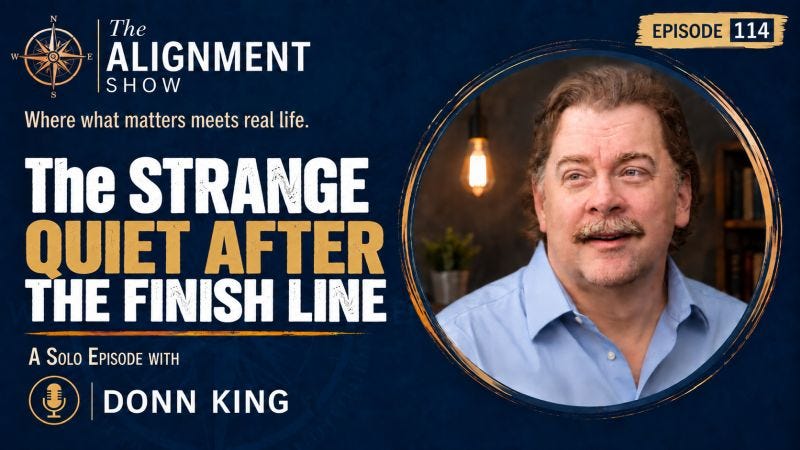
The Strange Quiet After the Finish Line
Have you ever finished something that occupied your life for weeks or months, felt genuinely happy about the accomplishment, and then wondered what to do with yourself? I’ve been experiencing that lately. I recently published my first romantic comedy and finished the draft of the second. What started as a little experiment in writing fiction has grown into a series of six, possibly seven, books. And I’ve discovered that finishing a story brings an emotional experience I hadn’t quite anticipated. There’s satisfaction, certainly. There’s excitement about what comes next. But there’s also a peculiar quiet, almost like the feeling when an airplane lands and you haven’t quite reached the gate. In this episode, I’m exploring that feeling through the experience of writing, but I think it applies to a lot of other things, too. Projects, celebrations, relationships, and the major transitions of life all have their own versions of the finish line. And perhaps we need to pay more attention to what happens afterward. The Big Takeaway Finishing something meaningful doesn’t automatically restore the energy we invested in it. We need energy to begin, to persist, and to finish. But there’s also a fourth part of the cycle worth recognizing: a season of replenishment. Sometimes the most valuable thing we can do after reaching a goal is to allow ourselves a little time to absorb the experience and recover. In This Episode * The three energies of accomplishment. Drawing on Joanna Penn’s framework of starting energy, pushing-through energy, and finishing energy, I explore how different stages of a project call for different kinds of motivation and persistence. * The unexpected letdown of finishing. Even when the experience has been thoroughly satisfying, completing something substantial can leave us feeling a little depleted or disoriented. Accomplishment and letdown can coexist. * Saying goodbye to imaginary friends. Writing fiction means spending hours every day with people I’ve invented. When their story ends, something changes in that relationship. It’s a little like the empty-nest experience, though obviously not equivalent in significance. * Finding new ways to use our energy. I’m responding by exploring new writing projects, returning to editing and publishing, and shifting among what I call the Five Hats of Writing: writer, editor, publisher, marketer, and business person. * The wisdom of a fallow field. Farmers understand that land sometimes needs a season of recovery. Rest isn’t necessarily inactivity, and it certainly isn’t failure. Replenishment belongs in the natural cycle of productive life. * The many kinds of endings. Finishing a major project, celebrating an anniversary, watching children leave home, or experiencing a loss we never wanted all involve transitions. They’re very different experiences, but each reminds us that life changes shape, and we need time to adjust. A Few Things to Try I’ve been thinking about how to navigate the space between finishing one thing and beginning another. Here are a few ideas that might help you, too. * Recognize which kind of energy you need. Are you beginning something, pushing through the difficult middle, or trying to bring it to completion? Different stages call for different approaches. * Pay attention to what changed when you finished. Sometimes the letdown isn’t about exhaustion. It’s about losing a familiar routine, a sense of purpose, or the daily companionship of people who have been part of your experience. * Consider changing activities rather than simply stopping. I’m finding satisfaction in switching from drafting fiction to editing, publishing, marketing, and potentially writing nonfiction. Different activities draw on different kinds of energy. * Give yourself permission for fallow time. You don’t have to fill every available moment with another goal. Recovery and reflection can be worthwhile in their own right. * Ask yourself what you actually need next. Another beginning? Some unfinished details brought together? Or perhaps just a little time to enjoy where you’ve arrived? Quote to Ponder “The energy that gets you across the finish line doesn’t automatically replenish the energy you spent getting there.” I’m learning that there’s meaning in the beginning, in the long middle where we keep showing up, and in finally finishing the work. But there’s also meaning in the quiet afterward. Resources and Links * Joanna Penn: Starting, Pushing-Through, and Finishing Energy — Joanna’s discussion of the different kinds of energy involved in completing a writing project. * How to Write Non-Fiction, by Joanna Penn — An additional discussion of these energies, including the work involved in getting a book into readers’ hands. * The Chemistry Between Us , by Devon Marin — The STEM romantic comedy that started this particular adventure. * Butterfly Copywriting — Val’s approach to taking some of the stress out of creating content for LinkedIn. One Question for You What have you finished recently that left you feeling a little uncertain about what comes next? Maybe it’s a project, a milestone, a family transition, or something else entirely. I’d enjoy hearing about it in the comments, especially if you’ve found ways to honor that space between endings and beginnings. Sometimes, when the airplane lands, you don’t need to rush to the next gate. Maybe you’ve got time to stretch your legs, find a cup of coffee, and simply enjoy being where you are. Article version Have you ever worked on something for so long, with so much energy and attention, that when you finally finished it, you didn’t quite know what to do with yourself? Maybe it was a big project at work. Maybe you spent months planning a wedding or some other major family event. Or maybe you’ve watched a child head off to college, and suddenly a familiar part of your everyday life isn’t there anymore. There’s a peculiar feeling that comes with such endings, even happy ones. I’ve experienced that twice in the past few weeks, and it’s given me something to think about. I’ve been writing novels. Romantic comedies, of all things. And I recently published one and finished the draft of a second one. Right now, we actually have six planned in the series, with an idea for a seventh, but I’ve finished the first two. Now, I’ve been a writer for more than 50 years, but this particular adventure has been something different. And I discovered something about finishing that I think applies to a whole lot more than writing. It has something to do with energy, with the people and things we invest ourselves in, and with what happens after we reach the finish line. And maybe it has something to do with learning when not to keep running. Let’s talk about that. This episode of The Alignment Show is brought to you by The Chemistry Between Us , the new STEM romantic comedy from Devon Marin. Riley is a behavioral scientist who studies relationships. Leo is a science communicator who thinks most problems can be solved if you explain them clearly enough. Then they get handed a microphone, a live audience, and each other. It’s a smart, funny, low-spice romance about two people who are very good at understanding human behavior, right up until their own feelings become part of the experiment. Find The Chemistry Between Us at DonnKing.com/Devon . That’s DonnKing.com/Devon. This episode is also sponsored by my friend Val Roskens Tews—Tews is spelled T-E-W-S, but it sounds like “tease.” Val runs Butterfly Copywriting , and she’s all about taking the stress out of LinkedIn. She calls it stress-free content creation —and honestly, it feels more like having someone in your corner helping you share your message with joy instead of pressure. If you’ve been stuck on what to post or how to show up, check out Val at DonnKing.com/Butterfly . I’ve been trying to find a good way to describe what it feels like to finish a novel, and the image that keeps coming to mind is an airplane coming in for a landing. Think about that for a moment. You’ve been in the air for hours. Maybe you’ve enjoyed the flight. Maybe you’ve been uncomfortable. Maybe there was some turbulence. But you’ve been moving toward a destination, and that movement has occupied your attention. Then the plane descends. Out the window you can see the plane getting closer to the ground, and then you see the edge of the runway rushing by. You feel the wheels touch the runway. There’s that sudden change in sensation as the engines reverse thrust and the plane slows down. You’re still moving, but the flight is essentially over. Then there’s this odd transitional period. You’ve arrived, but you haven’t quite arrived. You’re not flying anymore, but you’re not yet standing on solid ground. And of course, you’ve still got to find your luggage. Somehow, that’s what finishing a novel feels like to me. By the way, my dad knew what it was like to take off and fly, but he didn’t know what landing was like. He was a paratrooper in World War 2, and every single plane he ever got on in his whole life, he had to jump out of. Anyway. A few months ago, I decided to write a romantic comedy, initially just for fun. I’ve written nonfiction books and all sorts of other things over the years, but I wanted to see what happened if I tried my hand at a full-length contemporary romance. Well, one book quickly became two. Then three. And now the series is planned for six books, possibly seven. Apparently, I don’t know when to stop inviting imaginary people into my life. But here’s what surprised me. The more I wrote, the more satisfying it became. I enjoyed the process immensely . The act of writing itself became something I looked forward to every day. I’m a discovery writer, and it was fascinating getting to know these characters, learning how they managed difficulties and challenges and relationships. And then I finished the first novel. Even before publishing it, I started on the second one, and I finished the draft yesterday just a couple of weeks after the first one published. Both times, I experienced this peculiar emotional shift. I was delighted. I was satisfied. I was proud of what I’d accomplished. But there was also this strange little sense of letdown. And it got me thinking. Three kinds of energy One of the people I follow in the writing world is Joanna Penn, an author, podcaster, and independent publishing expert. She’s talked for years about three different kinds of energy involved in completing a book. She calls them starting energy , pushing-through energy , and finishing energy . I find that distinction really useful. Starting energy is the excitement of beginning something new. You’ve got an idea. You can see the possibilities. Everything is fresh and interesting. You haven’t yet encountered all the problems you’re going to have to solve. It’s the energy that gets you off the ground. Starting energy isn’t limited to writing. Think about the excitement of starting a new job, beginning a relationship, launching a business, or deciding to remodel the kitchen. You can almost see the finished result in your mind’s eye, and you’re eager to get started. Then comes pushing-through energy. This is where things get interesting, maybe in the ancient curse way, i.e., “may you live in interesting times.” The novelty has worn off. You’ve discovered that the project is considerably more complicated than you thought. Some of your wonderful ideas turn out to be not quite so wonderful. Plus, now you’re confronted with the necessity of doing the actual work. This is where an enormous number of worthwhile projects stall out. The initial excitement isn’t enough to sustain the effort anymore. You need something different. You need the energy of persistence , of showing up even when the work isn’t particularly exciting. In writing, we sometimes call this the saggy middle. Which, now that I think about it, could describe a number of other conditions I have found associated with getting older. But we’ll leave that alone. Then comes finishing energy. You begin to see the destination. The various threads start coming together. You can sense the shape of the finished work. Suddenly there’s a different sort of drive. You want to bring the thing home. Joanna makes an important distinction here. You might think we’re talking about finishing the book, and it includes that. But in publishing, finishing energy doesn’t stop when you’ve written the last sentence of the first draft. There’s editing, rewriting, production, publishing, and getting the book into the hands of readers. All of that requires energy, too, and that’s a big part of finishing energy. But there’s something about reaching the end of a substantial creative effort that produces a feeling all its own. In my case, I’ve been fortunate. I haven’t had much trouble finding any of those three kinds of energy. Starting was exciting. Pushing through was satisfying. And as I approached the endings of these books, I felt that finishing energy kicking in. I could sense the airplane descending toward the runway. What I hadn’t thought very much about was what happens after the wheels touch down. That’s where my experience of finishing energy has a break in the middle. When the energy changes Joanna Penn has talked about something else that I recognized almost immediately. She describes finishing a book and feeling as though she’s emptied herself into it. For a while, she can have difficulty imagining that she’ll ever write another one. She knows from experience that she will. But that doesn’t make the feeling any less real. She talks about the need to refill the creative well. And here’s something that struck me. The energy that gets you across the finish line doesn’t automatically replenish the energy you spent getting there. You can finish something successfully and still feel depleted. You can be happy about reaching a goal and still feel a little lost when you get there. Those feelings aren’t contradictory. Now, I haven’t experienced the fear that I might never write again. Far from it. I’ve already got more ideas than I know what to do with. Even when I had almost an entire decade of not being able to write, I found that it’s a lifelong addiction, although a positive one. And it honestly never occurred to me that this letdown might be some kind of failure. But I can see how somebody might interpret it that way. After all, we’re surrounded by messages about productivity. Keep going. Keep achieving. Set another goal. Move on to the next thing. So when you finally accomplish something you’ve worked toward for a long time, you might expect to feel nothing but exhilaration. Instead, you may find yourself thinking, “Well. Now what?” I’ve discovered another dimension to that feeling, though, and this one surprised me. Saying goodbye to imaginary friends When I promote my fiction, I sometimes invite people to “come play with me and my imaginary friends.” I’m only partly kidding. A couple of years ago, Ryan Reynolds was in a movie called IF , about imaginary friends. It played with the idea that imaginary companions are important to us as children, and that maybe we shouldn’t be so quick to leave that part of ourselves behind as adults. I think there’s something to that. Fiction is one of the ways adults continue to spend time with imaginary people. We create them, read about them, watch them on screens, and invite them into our emotional lives. And they matter to us. There’s a much bigger conversation to be had about that, and I expect we’ll have it in another episode. But here’s what I’ve noticed in writing these books. For weeks, I’ve spent hours every day with these characters. I’ve listened to their conversations. I’ve watched them make foolish decisions. I’ve worried about their relationships. I’ve tried to understand why they behave the way they do. I’ve watched them surprise me. And yes, I know perfectly well that I made them up. That doesn’t change the experience. They’ve been my daily companions. I’ve even published “interviews” I’ve had with them. And when I finished their story, something changed. It’s a little like the empty-nest feeling when a child leaves home for college. I’m certainly not equating the two experiences in importance or emotional depth. But there’s a resemblance in the sudden change of rhythm. Someone you’ve been accustomed to spending time with every day has moved into a different phase of life. The relationship hasn’t ended, necessarily. But it has changed. In my case, these characters aren’t even gone. I’m writing an interconnected series. Some of them will appear in later books. But the particular story I’ve been living with has reached its ending. I think part of the letdown comes from realizing that I won’t be spending my days quite the same way anymore. That’s worth recognizing, because it’s not limited to books. What comes after the finish line? So I’ve been thinking about how I want to respond to this transitional period. I’ve come up with three things. The first is pretty obvious. I’m starting something new. I don’t know yet exactly what it will be. I’ve got plenty of fiction planned, but I suspect I’ll turn back to nonfiction for a bit. That’s familiar territory for me, and I have several projects waiting for attention. Interestingly, Joanna Penn has talked about using nonfiction as a kind of palate cleanser between fiction projects. I can understand that. Sometimes a change of direction allows you to keep moving creatively without demanding exactly the same kind of energy. It’s a little like changing muscle groups when you’re exercising. I’m still writing, but I have found a deeply different experience in writing fiction than writing nonfiction, maybe because I’m asking something different of myself. The second thing I’m doing is investing in rewriting and the other aspects of publishing . Some time ago, I developed a framework I call the Five Hats of Writing. The idea is that an independent author has to wear five different hats: writer, editor, publisher, marketer, and business person. Even a traditionally published writer these days has to wear four of those five. Each hat involves different skills, different activities, and, I would argue, different kinds of energy. I love the writing hat. Obviously. But I also enjoy editing. I enjoy taking something I’ve written and making it better. I like the process of discovering what works, what doesn’t, and what needs to change. I enjoy the publishing hat, too. Book design, layout, covers, all the decisions that turn a manuscript into a book somebody can hold or read on a screen. And here’s something that makes me a bit unusual among writers. I actually enjoy marketing, though I don’t want it to overshadow the actual writing. I know. Some writers may want to have me examined for liking marketing at all . But I enjoy finding ways to connect a book with the people who might appreciate it. I enjoy thinking about how to communicate what the book offers, and how to help the right readers discover it. So I’m going to invest more attention in doing that effectively with this new book. The business hat is probably my least favorite, particularly the record-keeping part. Tracking expenses and maintaining records don’t exactly make my heart sing. But I understand their importance, and I even find satisfaction in making that part of the operation work well. So, although I’ve finished the initial creative work on these novels, I’ve got plenty of other satisfying work ahead of me. And shifting among those activities gives me a way to keep moving while using different kinds of energy. Although, to be honest, I’m anxious to start on the third book in the series. But the third response may be the most important one. I’m consciously honoring the fallow time. The wisdom of a fallow field Fallow. That’s an agricultural term, and I think it’s a beautiful one. Though my family members for the most part were not farmers, I grew up in a farming community, and I understand a little about the basic concepts. A farmer may allow a field to lie fallow for a season. Instead of planting another crop immediately, the farmer gives the land time to recover. That doesn’t mean the land has become useless, nor does it mean the farmer has given up. It certainly doesn’t mean nothing is happening. The soil is going through processes of recovery and replenishment that can contribute to future productivity. Rest is part of the cycle. I’ve been thinking about that in connection with my writing, but I think the principle goes much deeper. We humans are remarkably good at treating rest as something we have to earn, or worse, as something we have to apologize for. We talk about downtime as though it were wasted time. If we’re not producing something, achieving something, or working toward the next milestone, we begin to feel that we ought to be doing more. But nature doesn’t work that way. There are seasons of planting, seasons of growing, seasons of harvest, and seasons of recovery. We need to recognize that our own lives have seasons, too. Now, I don’t expect to spend the next three months sitting around staring out the window. Although, come to think of it, staring out the window can be a remarkably productive activity for a writer. But I do want to give myself permission to experience this transitional period without immediately trying to fill every available moment. I can begin something new. I can work on editing and publishing. And I can also allow some part of myself to rest. Those things aren’t mutually exclusive. In fact, I suspect that learning to do them together is part of what makes a creative life sustainable. This isn’t just about writing Let me come back to where we started. You may never write a novel. You may have absolutely no desire to write a novel. That’s fine. There are plenty of novels in the world already, although I certainly hope people will keep reading them. But I suspect you’ve experienced something like what I’m describing. Maybe you worked for months on a major project at work. You planned, organized, coordinated, solved problems, and finally brought the whole thing to a successful conclusion. Then you walked into the office the next morning and thought, “What am I supposed to do now?” Or maybe you’ve spent a year helping plan a major family event. Janet and I had a 25th anniversary celebration earlier this year, and there was a lot of preparation involved. When something like that is over, there’s satisfaction in having done it. There are wonderful memories. But there’s also the sudden absence of all those things that had been occupying your attention. As wonderful as it was, mostly what we have now is memories and leftover party supplies in a box. And then there’s the experience of having children leave home. That’s an especially powerful example because it involves so much more than the completion of a project. But the transition illustrates something important. The life you’ve been living has changed. The routines that gave shape to your days have changed. The relationships continue, but in a different form. And you have to discover what comes next. Sometimes, of course, endings aren’t happy. Sometimes they’re painful, or unwanted, or simply complicated. As I’ve mentioned here a few times, our severely disabled daughter passed away back in December, and that was not an ending we wanted. Not every ending feels like a successful landing. But many of them still require us to make a transition, to recognize what’s changed, and to allow ourselves time to adjust. That brings me back to those three kinds of energy Joanna Penn describes. Starting energy. Pushing-through energy. Finishing energy. I think there’s a fourth part of the cycle worth recognizing. It’s not so much another kind of energy as a season of replenishment. It’s the time when we recover the energy we’ve invested, absorb what we’ve experienced, and prepare ourselves for whatever comes next. I think we’d do well to recognize all four parts of that cycle. There’s a tendency to think that the purpose of finishing one thing is simply to make room for starting the next thing. Sometimes it is. But sometimes the space between things deserves our attention, too. The space between One of the things I keep coming back to on this show is the idea of alignment. What does it mean to live in a way that reflects what matters to us? For me, writing matters. Creating matters. Connecting with people matters. But if I value creativity, then I also need to value the conditions that allow creativity to flourish. If I value relationships, I need to recognize that they change over time, and that those transitions deserve attention. And if I value meaningful work, I need to remember that the meaning doesn’t reside exclusively in the moment when the work is completed. There’s meaning in the beginning. There’s meaning in the long middle, where we keep showing up. There’s meaning in finishing. And there’s meaning in the quiet afterward. I think that’s what these past few weeks have been teaching me. I’ve enjoyed writing these novels more than I can easily describe. I’m looking forward to writing more of them. But right now, I’m also allowing myself to notice the strange quiet that comes when a story reaches its ending. I’m going to work on the next things. I’m going to enjoy spending time with my imaginary friends when I return to them. And I’m going to let the field lie fallow when it needs to. So here’s a question I’d invite you to consider. What have you finished recently? What has occupied your time, your attention, perhaps even your identity, for weeks or months or years? And now that it’s finished, what do you need? Maybe you need the excitement of a new beginning. Maybe you need the satisfaction of bringing the remaining details together. Or maybe you need to give yourself permission to enjoy the quiet for a little while. Sometimes when the airplane lands, you don’t have to immediately board another one. We hope, for your sake, you don’t have to run to the next gate like a football player fighting toward the goal line to barely catch your connection. Sometimes it’s good to get off the plane, stretch your legs, and remember why you wanted to make the trip in the first place. And maybe, for a little while, just enjoy being where you are. Maybe there’s time to catch a coffee and read a good book instead of fidgeting and wanting to get on with it. If you get value from the show, consider supporting us in one of the following ways. You can make a one-time contribution or sign up for regular support through Buy Me a Coffee . You can also subscribe on Substack for free OR upgrade to a paid subscription. Your support helps me continue helping you and others, and thank you in advance! All subscribers now receive the following: * The “Big Takeaway” * A bulleted summary of the episode * Practical tips from the episode * A quote to ponder * Prefer text? We turn each podcast into an article. Plus, Founding Members receive ebook copies of all my books as well as a sponsorship message on the podcast at least once a month. That’s our way for saying “thanks for the support!” This is a public episode. If you'd like to discuss this with other subscribers or get access to bonus episodes, visit kingschronicles.substack.com/subscribe