
Find partners
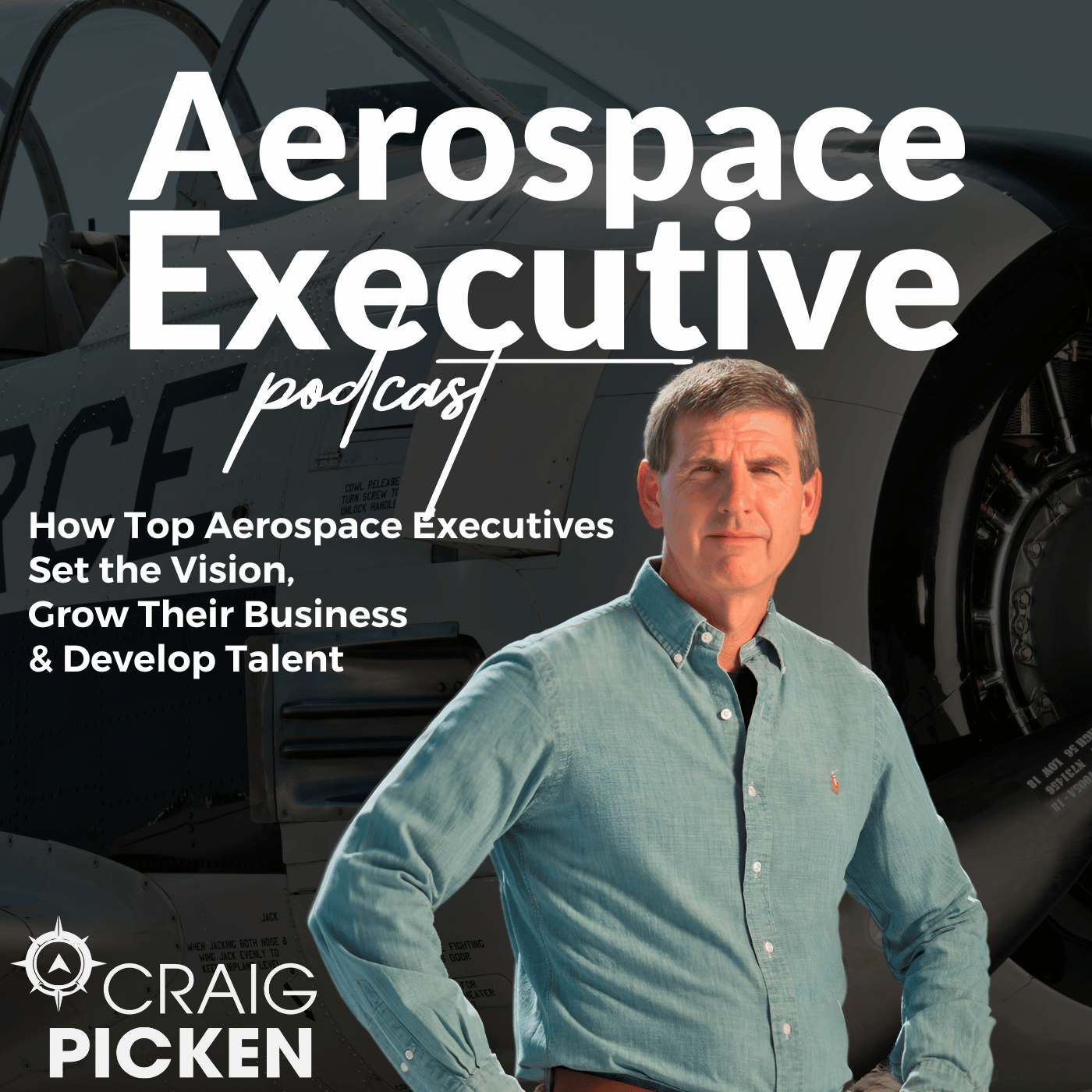
The Aerospace Executive Podcast

The Aerospace Executive Podcast

Hosted by Craig Picken

NewsInterviews guests

Episodes

314

Latest episode

Aug 2026

Language

EN

About the show

How Top Aerospace Executives Set the Vision, Grow Their Business & Develop Talent

Listen to episodes

60 recent
August 13, 2026Episode 31841 min

IPOs Are Back and Changing Aerospace Deals, Here’s Why w/ Nick Fazioli [Replay]

Aerospace has always been a cyclical industry, one sector up, another down, capital moving cautiously between them. That’s not what’s happening right now. Every major sector is ripping at the same time, for completely different reasons. Commercial is coming back online. Aftermarket and MRO have been running hot since COVID. Defense is being pulled forward by geopolitical demand. Business aviation has settled into a stronger, more stable “new normal.” It’s rare to see this kind of synchronized momentum across the entire ecosystem, and when it happens, it changes how capital behaves. For years, aerospace exits were predictable. You built a solid business, ran an M&A process, and sold. IPOs were barely part of the conversation. Industrial manufacturing wasn’t exactly exciting to public market investors. Now, IPOs are not only viable, but they’re also often the better option. Industrial businesses that used to be seen as slow, capital-heavy, and unsexy are suddenly being revalued as AI-proof, infrastructure-critical, and in some cases, direct beneficiaries of the AI boom. And that shift is forcing a new level of sophistication from operators. Because today, you’re not just deciding whether to sell; you’re deciding how to exit in a market with more options than ever before. At the same time, there’s a quiet risk underneath all of this. Fuel prices, geopolitical instability, and supply chain pressure. None of these have gone away. So the question isn’t just how long this run continues; it’s whether operators are actually prepared for the version of the market we’re in now. In this episode, I’m joined by the Global Head of Aerospace and Aviation Investment Banking at Jefferies, Nick Fazioli. He breaks down what’s really driving this moment across aviation, defense, and industrials, and what it means for operators thinking about growth, capital, and exit strategy. You’ll also learn; How “boring” industrial manufacturing became one of the most attractive investment categories Why IPOs are suddenly back, and in some cases outperforming traditional M&A exits How AI is indirectly reshaping aerospace valuations through energy, infrastructure, and supply chain demand The rise of continuation vehicles and why operators now have more exit paths than ever before Where private equity and institutional capital are actually placing bets right now (and why MRO is so competitive) The hidden risks: fuel prices, geopolitics, and consumer pressure, and how quickly they could impact the system Why operators need to become far more strategic, not just in building businesses, but in positioning them for exit About the Guest Nick Fazioli is the Global Head of Aerospace and Aviation Investment Banking at Jefferies, where he leads one of the most active practices across commercial aviation, business aviation, and aerospace services. Over the past 16 years, he’s been at the center of some of the most significant transactions in business aviation, including the sale of Marquis Jet to NetJets and West Star Aviation’s exit to Greenbriar Equity Group. With a front-row seat to M&A, capital markets, and the evolving investor landscape, Nick brings a unique perspective on where capital is flowing and how operators should be thinking about growth and exit strategy in today’s market. Connect with Nick on LinkedIn . About Your Host Craig Picken is an Executive Recruiter, writer, speaker, and ICF Trained Executive Coach. He is focused on recruiting senior-level leadership, sales, and operations executives in the aviation and aerospace industry. His clients include premier OEMs, aircraft operators, leasing/financial organizations, and Maintenance/Repair/Overhaul (MRO) providers, and since 2008, he has personally concluded more than 400 executive-level searches in a variety of disciplines. Craig is the ONLY industry executive recruiter who has professionally flown airplanes, sold airplanes, and successfully run a P&L in the aviation industry. His professional career started with a passion for airplanes. After eight years’ experience as a decorated Naval Flight Officer – with more than 100 combat missions, 2,000 hours of flight time, and 325 aircraft carrier landings – Craig sought challenges in business aviation, where he spent more than 7 years in sales with both Gulfstream Aircraft and Bombardier Business Aircraft. Craig is also a sought-after industry speaker who has presented at Corporate Jet Investor, International Aviation Women’s Association, and SOCAL Aviation Association. Resources For more aerospace industry news & commentary: https://craigpicken.com/insights/ . To learn more about Craig Picken, visit https://craigpicken.com/ .

August 6, 2026Episode 31738 min

Inside FDH Aero’s Billion-Dollar Distribution Strategy w/ Ian Walsh [Replay]

Most people think the aerospace supply chain is crawling back to normal after the pandemic. But that’s not what’s happening. The industry is scaling in a permanently elevated demand environment. Commercial aviation is rebuilding. Defense budgets are structurally higher. New platforms like EVTOL, drones, hypersonics, and space are moving into production. This isn’t a strain; it’s a structural transformation. And in a world obsessed with engines and airframes, the real leverage sits in the smallest parts. At the same time, complexity is rising. Aircraft are lighter, more electronic, and more integrated. Tolerances are tighter, and the margin for error is gone. This is where FDH Aero comes in: distribution reimagined as a strategic capability. In a high-velocity, high-complexity market, reliability becomes a strategy. How is FDH embedding itself within OEM production lines while operating under private-equity intensity? And what kind of leadership does that require? In this special replay episode, I’m joined by the CEO of FDH Aero, Ian Walsh. We unpack how FDH Aero scaled to a billion dollars by mastering the parts that make flight possible. We also discuss why the next decade of aerospace growth may be less about building more airplanes and more about controlling the hardware layer beneath them. You’ll also learn: Why aerospace supply chains aren’t “recovering”; they’re structurally transforming How a single missing bolt can shut down a billion-dollar production line Why distribution is becoming a strategic layer, not just a transactional one The difference between organic growth and inorganic scale in a fragmented supply base How private equity is accelerating consolidation in aerospace and defense Why value creation in PE is about process discipline, not short-term spikes The leadership shift required when moving from public OEMs to PE-backed companies Why smaller, lighter, more electronic platforms will reshape parts demand Where the real upside sits: commercial, defense, business aviation, or emerging platforms How embedding into product development cycles creates long-term supply chain “stickiness.” The mindset difference between statistical improvement and “luck wrapped in chaos.” About the Guest Ian Walsh is the CEO of FDH Aero. He brings over 35 years of executive leadership across the U.S. Marine Corps, commercial and general aviation, defense, and industrial end markets to FDH. Most recently, Walsh served as Chairman, President, and Chief Executive Officer of Kaman Aerospace Corporation, a provider of highly engineered components and subsystems to commercial aviation, aerospace, defense, and medical end-markets. At Kaman, Walsh led the evolution of the global company into customer-centric operating segments. Before that, Walsh was COO at REV Group, Inc., a provider of specialty vehicles and related aftermarket parts, and spent more than 15 years in operational and P&L leadership at Textron, Inc. At both companies, Walsh drove new product development and process optimization. Earlier in his career, he served as an officer and naval aviator in the U.S. Marine Corps with combat tours in Somalia, Haiti, and Bosnia. He is a certified Six Sigma Black Belt in operations and continuous improvement. Connect with Ian on LinkedIn . About Your Host Craig Picken is an Executive Recruiter, writer, speaker, and ICF Trained Executive Coach. He is focused on recruiting senior-level leadership, sales, and operations executives in the aviation and aerospace industry. His clients include premier OEMs, aircraft operators, leasing/financial organizations, and Maintenance/Repair/Overhaul (MRO) providers. Since 2008, he has personally concluded more than 400 executive-level searches in a variety of disciplines. Craig is the ONLY industry executive recruiter who has professionally flown airplanes, sold airplanes, and successfully run a P&L in the aviation industry. His professional career started with a passion for airplanes. After eight years’ experience as a decorated Naval Flight Officer – with more than 100 combat missions, 2,000 hours of flight time, and 325 aircraft carrier landings – Craig sought challenges in business aviation, where he spent more than 7 years in sales with both Gulfstream Aircraft and Bombardier Business Aircraft. Craig is also a sought-after industry speaker who has presented at Corporate Jet Investor, International Aviation Women’s Association, and SOCAL Aviation Association. Resources For more aerospace industry news & commentary: https://craigpicken.com/insights/ . To learn more about Craig Picken, visit https://craigpicken.com/ .

July 30, 2026Episode 31643 min

Aerospace Companies Need a New Kind of Manager w/ Matt Gjertsen

What is the minimum level of leadership an aerospace company needs to survive constant change? Because technical excellence is not enough anymore. Aerospace and aviation companies are being pushed to move faster, scale highly specialized teams, cut through bureaucracy, and make decisions before every variable is known. But many are still promoting great engineers, operators, and technical specialists into management with almost no preparation for the job they are actually being asked to do. Then leadership wonders why information gets trapped, accountability disappears, teams slow down, and high performers burn out. That is the problem behind Matt Gjertsen’s concept of the Minimum Viable Manager. The name sounds modest. The standard is not. At a minimum, managers need to know how to build trust, set clear expectations, and give useful feedback. Without those fundamentals, all the talk about innovation, speed, ownership, and high performance is just noise. You cannot scale technical capability if the people leading it do not know how to align a team, push performance, or create the conditions for others to succeed. And this matters because the aerospace companies pulling ahead are not just hiring better talent. They are building cultures that can move. In this episode, I sit down with Matt, author of The Minimum Viable Manager and former Head of Training and Development at SpaceX. We talk about what aerospace companies can learn from SpaceX about hierarchy, ownership, and execution, and why technical expertise does not automatically produce strong leaders. We also discuss why companies that fail to develop managers alongside their workforce will eventually hit a wall. What You’ll Discover In This Episode Why aerospace companies need a practical definition of effective management How trust, clear expectations, and useful feedback support technical team performance Why strong engineers and operators often struggle when they move into management What SpaceX can teach aerospace leaders about hierarchy, ownership, and execution Why fast-moving companies organize work around outcomes rather than inherited processes How leaders can push technical teams beyond their comfort zones without creating burnout Why responsibility must be accompanied by the authority to make decisions What separates aerospace companies adapting to change from those slowed by bureaucracy Why scaling the industry’s technical workforce also requires developing capable managers About the Guest Matt Gjertsen is the founder of Built Leaders and the author of The Minimum Viable Manager. A former SpaceX learning and development leader, Air Force pilot, speaker, facilitator, and trainer, Matt helps innovative hard-tech companies build leaders capable of guiding teams through complex, high-stakes challenges. Through Built Leaders, he works with aerospace, defense, and energy companies to identify the leadership issues limiting team performance and develop practical, behavior-focused solutions. Over the past four years, his programs have trained hundreds of leaders across more than a dozen organizations. Connect with Matt on LinkedIn , visit https://www.amazon.com/Minimum-Viable-Manager-Essential-Technical/dp/1774587270/ref=sr_1_1 to grab a copy of Matt's new book. About Your Host Craig Picken is an Executive Recruiter, writer, speaker, and ICF-trained Executive Coach. He is focused on recruiting senior-level leadership, sales, and operations executives in the aviation and aerospace industry. His clients include premier OEMs, aircraft operators, leasing/financial organizations, and Maintenance/Repair/Overhaul (MRO) providers, and since 2008, he has personally concluded more than 400 executive-level searches in a variety of disciplines. Craig is the ONLY industry executive recruiter who has professionally flown airplanes, sold airplanes, and successfully run a P&L in the aviation industry. His professional career started with a passion for airplanes. After eight years’ experience as a decorated Naval Flight Officer – with more than 100 combat missions, 2,000 hours of flight time, and 325 aircraft carrier landings – Craig sought challenges in business aviation, where he spent more than 7 years in sales with both Gulfstream Aircraft and Bombardier Business Aircraft. Craig is also a sought-after industry speaker who has presented at Corporate Jet Investor, International Aviation Women’s Association, and SOCAL Aviation Association. Resources For more aerospace industry news & commentary: https://craigpicken.com/insights/ . To learn more about Craig Picken, visit https://craigpicken.com/ .

July 23, 2026Episode 31554 min

The Upstream Metals Strategy Keeping Aerospace Moving w/ Kelly Thomas

The aerospace supply chain does not only break at final assembly. Some of the most important pressure points sit much farther upstream, inside the specialized materials businesses; most of the industry only notices when something goes wrong. High-purity aluminum, specialty alloys, casting capacity, hedging, tariffs, geopolitical risk, and long-cycle inventory decisions all shape whether commercial aviation, defense, and space can keep moving. When demand rises or supply gets disrupted, companies like Vista Metals have to make decisions long before the rest of the market feels the impact. In this episode, I talk with Kelly Thomas, CEO of Vista Metals Group, about the hidden risks inside the aerospace materials supply chain and what it takes to lead a business where capacity, capital, talent, and timing all have to line up before the market is ready. What You’ll Discover In This Episode Why high-purity aluminum has become a critical supply chain issue for aerospace manufacturersHow tariffs, geopolitical risk, and smelter disruptions affect companies far upstream in the supply chain Why hedging can be a make-or-break discipline for companies carrying long-cycle metal inventory How privately held aerospace suppliers can make long-term investments differently from public companies Why Vista Metals has focused on hard alloys, specialty casting, and niche aerospace applications How commercial aviation, defense, and space demand are shaping Vista’s growth outlook Why smaller and privately owned companies often carry supply chain risk that the broader industry may underestimate What leaders need to understand about moving from a large public company environment into a smaller, operator-led business How Kelly Thomas thinks about leadership, feedback, communication, and building a no-politics culture Why sitting in uncertainty may be one of the most important leadership skills in a volatile aerospace market About the Guest Kelly Thomas is the President and CEO of Vista Metals, the world’s largest independent producer of specialty aluminum products for the aerospace, defense, transportation, and industrial sectors. A globally experienced executive with more than two decades in metals and manufacturing, Kelly has built her career at the intersection of finance, operations, commercial strategy, and industrial leadership. She brings deep expertise in global metals markets, risk management, and complex manufacturing environments, along with a values-driven leadership style focused on performance, innovation, and long-term growth. Before joining Vista Metals, Kelly held senior leadership roles at Alcoa and Aleris, where she helped drive global strategy, manage multi-billion-dollar operations, and lead large teams across North America and Europe through periods of transformation and growth. About Your Host Craig Picken is an Executive Recruiter, writer, speaker, and ICF-trained Executive Coach. He is focused on recruiting senior-level leadership, sales, and operations executives in the aviation and aerospace industry. His clients include premier OEMs, aircraft operators, leasing/financial organizations, and Maintenance/Repair/Overhaul (MRO) providers, and since 2008, he has personally concluded more than 400 executive-level searches in a variety of disciplines. Craig is the ONLY industry executive recruiter who has professionally flown airplanes, sold airplanes, and successfully run a P&L in the aviation industry. His professional career started with a passion for airplanes. After eight years’ experience as a decorated Naval Flight Officer – with more than 100 combat missions, 2,000 hours of flight time, and 325 aircraft carrier landings – Craig sought challenges in business aviation, where he spent more than 7 years in sales with both Gulfstream Aircraft and Bombardier Business Aircraft. Craig is also a sought-after industry speaker who has presented at Corporate Jet Investor, International Aviation Women’s Association, and SOCAL Aviation Association. Resources For more aerospace industry news & commentary: https://craigpicken.com/insights/. To learn more about Craig Picken, visit https://craigpicken.com/.

July 16, 2026Episode 31444 min

What Private Equity Really Demands From Leaders w/ Maxwell Salazar

Private equity is no longer a small corner of the market that only dealmakers, investors, and portfolio executives need to understand. It is becoming one of the defining forces in business. More industries are being consolidated. More founder-led companies are being acquired. More executives are being recruited into PE-backed environments. And more leaders are finding themselves operating under a very different set of expectations, timelines, pressures, and performance standards than the ones they were trained for. That means the old “private equity is not my world” mindset is getting harder to maintain. You may sell your company to private equity. You may go work for a PE-backed business. You may be hired to lead one. Either way, it is becoming increasingly important to understand what this environment actually requires. Because private equity is not just a financial model. It is an operating environment. And in that environment, leadership gets tested quickly. The old playbook of buying a business, adding leverage, cutting costs, and exiting quickly is no longer enough. In today’s market, value has to be built. Leaders have to move fast without breaking the business. Founders have to navigate the shift from owner to employee. Boards have to apply pressure without creating misalignment. And executives have to prove they can create measurable results without relying on the systems, resources, and support structures they may have had in larger companies. In this episode, I’m joined by Maxwell Salazar, founder of Salazar Leadership Advisory. We talk about what private equity is really demanding from leaders today, what it takes to succeed in a PE-backed environment, why traditional executive hiring signals can be misleading, and how founders, boards, and operators should think about leadership in a market where private equity is no longer the exception; it is becoming part of the business landscape. What You’ll Discover In This Episode Why private equity is becoming a reality founders, executives, advisors, and operators need to understand How PE-backed environments differ from traditional corporate leadership roles Why the old private equity playbook of leverage, cost-cutting, and quick exits is no longer enough What leaders need to understand before stepping into a PE-backed company Why self-awareness, adaptability, and accountability matter so much under private equity pressure How founders can struggle with the shift from owner to employee after a transaction Why founder transitions are often emotional and psychological, not just operational How leaders can move quickly without triggering resistance inside the business Why boards need to be clear about the mandate before hiring a CEO, COO, CFO, or CRO What companies should actually assess for when choosing leaders for PE-backed environments Why prior PE experience, impressive logos, or successful exits can create false confidence How to tell the difference between someone who managed inside a system and someone who can build in a more ambiguous environment Why the best PE-backed leader may not always be the most charismatic or obvious candidate How board dynamics can either support an operator or make the role harder than it needs to be Why private equity can be one of the best environments for leadership growth, but only for people who understand the pressure, pace, and trade-offs involved. About the Guest Maxwell Salazar is the founder of Salazar Leadership Advisory, where he helps private equity firms make better leadership decisions across their portfolio companies. A business psychologist by training, Maxwell evaluates C-suite leaders, surfaces culture and execution risk, and helps investors understand whether the people they are hiring are equipped to lead through pressure, ambiguity, board scrutiny, and operational change. Before launching his advisory practice, Maxwell served as Head of Executive Assessment at AlixPartners, advising clients across hedge funds, investment banks, and PE-backed companies ranging from $100 million businesses to multibillion-dollar enterprises. In his work, Maxwell focuses on the human side of value creation: how leaders perform when the market shifts, the strategy meets resistance, or the boardroom pressure starts to rise. He helps investors and leadership teams look beyond pedigree, charisma, and past titles to better understand self-awareness, accountability, adaptability, culture fit, and the trade-offs that determine whether an executive can succeed in a private equity-backed environment. Connect with Maxwell on LinkedIn. About Your Host Craig Picken is an Executive Recruiter, writer, speaker, and ICF Trained Executive Coach. He is focused on recruiting senior-level leadership, sales, and operations executives in the aviation and aerospace industry. His clients include premier OEMs, aircraft operators, leasing/financial organizations, and Maintenance/Repair/Overhaul (MRO) providers, and since 2008, he has personally concluded more than 400 executive-level searches in a variety of disciplines. Craig is the ONLY industry executive recruiter who has professionally flown airplanes, sold airplanes, and successfully run a P&L in the aviation industry. His professional career started with a passion for airplanes. After eight years’ experience as a decorated Naval Flight Officer – with more than 100 combat missions, 2,000 hours of flight time, and 325 aircraft carrier landings – Craig sought challenges in business aviation, where he spent more than 7 years in sales with both Gulfstream Aircraft and Bombardier Business Aircraft. Craig is also a sought-after industry speaker who has presented at Corporate Jet Investor, International Aviation Women’s Association, and SOCAL Aviation Association. Resources For more aerospace industry news & commentary: https://craigpicken.com/insights/. To learn more about Craig Picken, visit https://craigpicken.com/.

July 9, 2026Episode 31350 min

Private Aviation Customers Are Changing: Here’s How Sentient Jet Is Adapting w/ Alan Walsh

Private aviation is no longer serving the same buyer, the same use case, or the same expectation set that it was built around twenty years ago. The old assumption was simple: private aviation was mainly for the already-initiated: aircraft owners, experienced charter users, corporate flight departments, or people who already understood the difference between aircraft categories, operating models, and access options. That market still exists, but a new buyer is entering the industry with a very different set of questions. They are wealthier, often younger, more digitally fluent, more time-sensitive, and in many cases completely new to private aviation. That is where the jet card model becomes more than a product. It becomes a bridge between commercial aviation frustration, fractional ownership, charter, corporate flying, and the growing demand for flexible, predictable private aviation access. In this episode, I’m joined by the CEO of Sentient Jet, Alan Walsh. We discuss how one of the original jet card companies is adapting to a changing private aviation market. We talk about how Sentient is thinking about AI, digital transformation, changing demographics, 135 lift, sustainability, World Cup demand, aircraft preferences, and why the future of private aviation may be less about luxury and more about utility, access, and time. What You’ll Discover In This Episode Why the jet card model remains attractive for new entrants who want private aviation access without aircraft ownership or long-term asset commitment How Sentient Jet is balancing digital convenience with a high-touch service model that still depends on human relationships Why Alan Walsh sees AI as an operational efficiency tool, not a replacement for client-facing service How private aviation demand is being shaped by commercial aviation disruption, reduced regional routes, and the need for better time control Why new private aviation users often need education before they need a sales pitch How changing wealth demographics are bringing younger, more digitally native buyers into the market Why bigger, newer, longer-range aircraft remain in demand and what that means for operators and aircraft availability How major events like the World Cup create sustained, multi-leg private aviation demand across several weeks Why sustainability is becoming a more visible consideration for private aviation customers What the industry may look like as technology, vertical integration, and more individualized access models continue to evolve About the Guest Alan Walsh is the President of Sentient Jet, where he is responsible for the overall growth, innovation, and success of the business. He has led the development and transformation of Sentient’s service organization while also helping shape the future of Owner Services at Flexjet. Alan has spent his career at the intersection of customer success, strategy, and client experience. He brings a customer-centric mindset and a strong track record of driving large-scale business, operational, and digital transformation across growth, M&A, turnaround, and AI-enabled strategy. Known for building high-performing teams and using data to improve customer outcomes, Alan brings a strategic view of how private aviation is evolving, from changing customer expectations and digital access to service consistency, safety, and the continued role of the jet card model in the market. Connect with Alan on LinkedIn. About Your Host Craig Picken is an Executive Recruiter, writer, speaker, and ICF Trained Executive Coach. He is focused on recruiting senior-level leadership, sales, and operations executives in the aviation and aerospace industry. His clients include premier OEMs, aircraft operators, leasing/financial organizations, and Maintenance/Repair/Overhaul (MRO) providers, and since 2008, he has personally concluded more than 400 executive-level searches in a variety of disciplines. Craig is the ONLY industry executive recruiter who has professionally flown airplanes, sold airplanes, and successfully run a P&L in the aviation industry. His professional career started with a passion for airplanes. After eight years’ experience as a decorated Naval Flight Officer – with more than 100 combat missions, 2,000 hours of flight time, and 325 aircraft carrier landings – Craig sought challenges in business aviation, where he spent more than 7 years in sales with both Gulfstream Aircraft and Bombardier Business Aircraft. Craig is also a sought-after industry speaker who has presented at Corporate Jet Investor, International Aviation Women’s Association, and SOCAL Aviation Association. Resources For more aerospace industry news & commentary: https://craigpicken.com/insights/. To learn more about Craig Picken, visit https://craigpicken.com/.

July 2, 2026Episode 31235 min

Business Aviation’s Next Chapter: Beyond Range, Speed, and Size

Business aviation has spent decades climbing the same performance ladder: more range, more speed, larger cabins, better engines, better avionics, and more capable aircraft. That evolution created the modern business jet market and pushed the high end into a category that would have been difficult to imagine when the first purpose-built business aircraft entered service. But the next era may not be defined by simply building a bigger airplane. With aircraft like the G800, Global 8000, and Falcon 10X, the upper end of the market is already approaching the practical limits of range, cabin size, and price. Supersonic business aviation remains difficult. New air vehicle concepts may be promising, but business aviation has historically prioritized performance, reliability, and mission utility over radical experimentation. That raises a more important question for business aviation leaders: where does meaningful differentiation come from next? In this episode, I continue the conversation with Kevin Michaels and Richard Aboulafia of AeroDynamic Advisory about Time Machines: Business Aviation’s Dynamic Journey. This second part looks at the future of the market: why the high end keeps marching upward, why the medium-cabin segment may need a new catalyst, how post-COVID usage patterns are changing ownership and operating models, and why the aircraft may increasingly be judged by what it enables onboard. What You’ll Discover In This Episode Why the ultra-long-range business jet market has continued to expand, even when many people once doubted there would be room for multiple players at the high end. How the G800, Global 8000, and Falcon 10X reflect the continued march toward larger, more capable, and more expensive business aircraft. Why business aviation may be approaching a point where range, speed, and cabin size are no longer enough to create meaningful differentiation. How onboard connectivity, virtual workspaces, interiors, avionics, and human-machine interface may become more important to the next era of business aircraft. Why radically new air vehicle concepts may be harder to justify in a market that has historically prioritized performance and mission utility over fuel-efficiency-led experimentation. What the continued rise of ultra-high-net-worth demand reveals about the top end of the business aviation market. Why the medium-cabin and “workaday” jet market may need a new catalyst as the high end keeps pulling away. How business aviation usage has changed since COVID, including the shift away from traditional ownership and toward fractional, managed aircraft, and Part 135 models. Why “business aviation as a service” may become a more important way to understand the market’s next phase. What leaders should watch as aircraft performance, ownership models, customer expectations, and onboard experience begin to define the next chapter of business aviation. About the Guests Richard Aboulafia is a Managing Director at AeroDynamic Advisory, a boutique aerospace and defense management consultancy based in Ann Arbor, Michigan. He is also a Special Advisor on Aerospace & Defense at Eurasia Group and a Fellow of the Royal Aeronautical Society. Since 1988, Richard has tracked aircraft programs, markets, and companies as an analyst and consultant, advising aerospace manufacturers, defense contractors, and financial institutions on commercial aviation, military aviation, and broader aerospace and defense market trends. Before joining AeroDynamic Advisory in 2022, he was Vice President of Analysis at Teal Group. Richard is also a widely published aviation and defense writer, with regular columns in Aviation Week & Space Technology and work appearing in outlets including Foreign Policy, Forbes, The Wall Street Journal, the Financial Times, Professional Pilot, and others. He is the co-author, with Kevin Michaels, of Time Machines: Business Aviation’s Dynamic Journey, a comprehensive look at the people, aircraft, technologies, business models, and market forces that shaped business aviation into the industry it is today. Connect with Richard on LinkedIn. Kevin Michaels is a Managing Director at AeroDynamic Advisory and a globally recognized expert in aerospace manufacturing, MRO, strategy, customer satisfaction, M&A advisory, technology assessment, and market analysis. Across his career, Kevin has advised leading aerospace OEMs, airlines, MRO providers, suppliers, and investors on the strategic and operational forces shaping the aerospace industry. Before AeroDynamic Advisory, he was Vice President in ICF International’s Aerospace & MRO consulting practice and co-founder of AeroStrategy, which was acquired by ICF. He also held roles with Rockwell Collins Government Systems, The Canaan Group, and aero-engine supplier Williams International. Kevin is a columnist for Aviation Week & Space Technology’s Up Front feature, a contributing columnist to Inside MRO and Forbes, and chairs the Industry Advisory Board for the University of Michigan’s Aerospace Engineering Department. He is also the author of AeroDynamic: Inside the High-Stakes Global Jetliner Ecosystem, winner of the 2019 Choice Outstanding Academic Title Award. Connect with Kevin on LinkedIn. Buy the book Time Machines: Business Aviation’s Dynamic Journey on Amazon. About Your Host Craig Picken is an Executive Recruiter, writer, speaker, and ICF Trained Executive Coach. He is focused on recruiting senior-level leadership, sales, and operations executives in the aviation and aerospace industry. His clients include premier OEMs, aircraft operators, leasing/financial organizations, and Maintenance/Repair/Overhaul (MRO) providers, and since 2008, he has personally concluded more than 400 executive-level searches in a variety of disciplines. Craig is the ONLY industry executive recruiter who has professionally flown airplanes, sold airplanes, and successfully run a P&L in the aviation industry. His professional career started with a passion for airplanes. After eight years’ experience as a decorated Naval Flight Officer – with more than 100 combat missions, 2,000 hours of flight time, and 325 aircraft carrier landings – Craig sought challenges in business aviation, where he spent more than 7 years in sales with both Gulfstream Aircraft and Bombardier Business Aircraft. Craig is also a sought-after industry speaker who has presented at Corporate Jet Investor, International Aviation Women’s Association, and SOCAL Aviation Association. Resources For more aerospace industry news & commentary: https://craigpicken.com/insights/. To learn more about Craig Picken, visit https://craigpicken.com/.

June 25, 2026Episode 31142 min

The Aircraft, Engines, and Business Models That Built Business Aviation w/ Richard Aboulafia and Kevin Michaels

Business aviation is often misunderstood because the aircraft are the most visible part of the story. The brands, the cabins, the speed, the ramp presence, and the culture around private aircraft tend to dominate the public imagination. But the industry was not built around image. It was built around utility. From the early aircraft companies in Wichita to the postwar expansion of aviation infrastructure, from Gulfstream’s focus on reliability and customer support to Learjet’s cultural impact, from Cessna’s utilitarian approach to the Falcon 20’s role in the early FedEx story, business aviation evolved around one central promise: giving people and companies control over time. In this episode, I talk with Kevin Michaels and Richard Aboulafia of AeroDynamic Advisory about their book, Time Machines: Business Aviation’s Dynamic Journey. Kevin and Richard trace the forces that shaped the business aviation market across decades. The deeper story is not simply how business jets became faster, more capable, or more recognizable. It is how business aviation became an operating system for access, connecting companies, communities, executives, pilots, manufacturers, service networks, and airports in a way the scheduled airline system never could. You’ll also learn; How Wichita became one of the most important centers in aviation history Why World War II accelerated the business aviation ecosystem by creating pilots, mechanics, infrastructure, air traffic control, and mission familiarity. How early business aviation moved from converted aircraft and surplus DC-3s into purpose-built turbine-powered aircraft. Why Gulfstream’s early success was rooted in understanding the customer's mission: short-field access, reliability, dispatch performance, and customer support. How Learjet became the cultural shorthand for business jets through design, performance, Hollywood visibility, and Bill Lear’s marketing instincts. Why Cessna’s slower, more utilitarian Citation strategy became a winning formula for customers who valued functionality and reliability over pure speed. How Dassault’s Falcon 20 gained early momentum through Pan Am, Charles Lindbergh, Federal Express, and the U.S. Coast Guard. Why engine technology repeatedly expanded what business aviation could become. How fractional ownership changed business aviation by opening access beyond traditional whole-aircraft ownership and flight departments. Why general aviation, airport infrastructure, advocacy, and regulation remain foundational to the health of the business aviation industry. About the Guests Richard Aboulafia is a Managing Director at AeroDynamic Advisory, a boutique aerospace and defense management consultancy based in Ann Arbor, Michigan. He is also a Special Advisor on Aerospace & Defense at Eurasia Group and a Fellow of the Royal Aeronautical Society. Since 1988, Richard has tracked aircraft programs, markets, and companies as an analyst and consultant, advising aerospace manufacturers, defense contractors, and financial institutions on commercial aviation, military aviation, and broader aerospace and defense market trends. Before joining AeroDynamic Advisory in 2022, he was Vice President of Analysis at Teal Group. Richard is also a widely published aviation and defense writer, with regular columns in Aviation Week & Space Technology and work appearing in outlets including Foreign Policy, Forbes, The Wall Street Journal, the Financial Times, Professional Pilot, and others. He is the co-author, with Kevin Michaels, of Time Machines: Business Aviation’s Dynamic Journey, a comprehensive look at the people, aircraft, technologies, business models, and market forces that shaped business aviation into the industry it is today. Connect with Richard on LinkedIn. Kevin Michaels is a Managing Director at AeroDynamic Advisory and a globally recognized expert in aerospace manufacturing, MRO, strategy, customer satisfaction, M&A advisory, technology assessment, and market analysis. Across his career, Kevin has advised leading aerospace OEMs, airlines, MRO providers, suppliers, and investors on the strategic and operational forces shaping the aerospace industry. Before AeroDynamic Advisory, he was Vice President in ICF International’s Aerospace & MRO consulting practice and co-founder of AeroStrategy, which was acquired by ICF. He also held roles with Rockwell Collins Government Systems, The Canaan Group, and aero-engine supplier Williams International. Kevin is a columnist for Aviation Week & Space Technology’s Up Front feature, a contributing columnist to Inside MRO and Forbes, and chairs the Industry Advisory Board for the University of Michigan’s Aerospace Engineering Department. He is also the author of AeroDynamic: Inside the High-Stakes Global Jetliner Ecosystem, winner of the 2019 Choice Outstanding Academic Title Award. Connect with Kevin on LinkedIn. Buy the book Time Machines: Business Aviation’s Dynamic Journey on Amazon. About Your Host Craig Picken is an Executive Recruiter, writer, speaker, and ICF Trained Executive Coach. He is focused on recruiting senior-level leadership, sales, and operations executives in the aviation and aerospace industry. His clients include premier OEMs, aircraft operators, leasing/financial organizations, and Maintenance/Repair/Overhaul (MRO) providers, and since 2008, he has personally concluded more than 400 executive-level searches in a variety of disciplines. Craig is the ONLY industry executive recruiter who has professionally flown airplanes, sold airplanes, and successfully run a P&L in the aviation industry. His professional career started with a passion for airplanes. After eight years’ experience as a decorated Naval Flight Officer – with more than 100 combat missions, 2,000 hours of flight time, and 325 aircraft carrier landings – Craig sought challenges in business aviation, where he spent more than 7 years in sales with both Gulfstream Aircraft and Bombardier Business Aircraft. Craig is also a sought-after industry speaker who has presented at Corporate Jet Investor, International Aviation Women’s Association, and SOCAL Aviation Association. Resources For more aerospace industry news & commentary: https://craigpicken.com/insights/. To learn more about Craig Picken, visit https://craigpicken.com/.

June 11, 2026Episode 31037 min

The Inflection Point for Flight: Inside Electra Aero’s Quiet Revolution in Air Mobility (Replay)

In aerospace, we talk a lot about “the future of flight.” But most of that conversation has been driven by fantasy. Fully electric aircraft that can’t fly far enough, and technologies that look good in a render but can’t sustain the physics or economics of real aviation. That’s why what Electra Aero is building feels like the first practical revolution in modern air mobility. It’s not about escaping airports altogether; it’s about rethinking what access to the air actually means. A platform that combines the short-range flexibility of a helicopter with the efficiency, speed, and safety of a fixed-wing aircraft. A system that can land in 150 feet, carry nine passengers, and fly 1,000 miles…all at a cost per seat mile that rivals a Cessna Caravan. In other words, not a science experiment, but an aircraft for both the Pentagon and Palm Springs. When you look at the infrastructure, the capital, and the technology now converging, from turbo generators to hybrid propulsion, it’s clear the “inflection point” for advanced air mobility is already here. The question isn’t if we’ll see it, but when the iceberg breaks the surface and everyone suddenly realizes how much has already been built underneath. What makes this design different enough for the Department of Defense to back it, and powerful enough to fly missions no existing aircraft can? In this special replay episode, the CEO of Electra Aero, Mark Allen, joins me to dive into what it takes to turn an experimental prototype into a scalable aircraft production company. We also discuss how hybrid-electric flight could redefine how people and goods move between cities in the next decade. You’ll learn: Why “payload-to-range” is the real metric that will define the winners in advanced air mobility How Electra’s hybrid-electric system radically cuts maintenance and lifecycle costs Why vertical takeoff isn’t the future, ultra-short takeoff and landing is How runway independence could transform both defense logistics and civilian travel What it takes to fund deep-tech aviation in a VC world built for SaaS Why the next big shift in aerospace will feel like a “ketchup bottle” moment: slow, then all at once How leadership and team “swing” drive complex innovation when the mission is bigger than any one person About the Guest: Marc Allen is the CEO of Electra Aero. At Electra, Marc is leading the charge in developing hybrid-electric Ultra Short aircraft to define the next level of seamless air travel connectivity. Through direct aviation, Electra is bringing air travel closer to where people live, work, and play – without airports, emissions, or noise. ‍Marc joined Electra after a distinguished career at The Boeing Company, where he held several key leadership roles, including Chief Strategy Officer and Senior Vice President for Strategy and Corporate Development. He led the $5 billion customer finance business before spending nearly a decade on Boeing's Executive Council, where he served as President of Boeing International and oversaw critical enterprise-wide functions. As head of all venture businesses, he led Wisk Aero’s restructuring and full acquisition, focusing on the future of autonomous flight and serving as Chairman. Other roles at Boeing included President of the Embraer Partnership, President of Boeing China, and General Counsel of Boeing International. To learn more, go to http://electra.aero/ or connect with Marc on LinkedIn . About your Host: Craig Picken is an Executive Recruiter, writer, speaker, and ICF Trained Executive Coach. He is focused on recruiting senior-level leadership, sales, and operations executives in the aviation and aerospace industry. His clients include premier OEMs, aircraft operators, leasing/financial organizations, and Maintenance/Repair/Overhaul (MRO) providers, and since 2008, he has personally concluded more than 400 executive-level searches in a variety of disciplines. Craig is the ONLY industry executive recruiter who has professionally flown airplanes, sold airplanes, and successfully run a P&L in the aviation industry. His professional career started with a passion for airplanes. After eight years’ experience as a decorated Naval Flight Officer – with more than 100 combat missions, 2,000 hours of flight time, and 325 aircraft carrier landings – Craig sought challenges in business aviation, where he spent more than 7 years in sales with both Gulfstream Aircraft and Bombardier Business Aircraft. Craig is also a sought-after industry speaker who has presented at Corporate Jet Investor, International Aviation Women’s Association, and SOCAL Aviation Association. Resources: For more aerospace industry news & commentary: https://craigpicken.com/insights/ . To learn more about Craig Picken, visit https://craigpicken.com/ . Check out this episode on our website , Apple Podcasts , or Spotify , and don't forget to leave a review if you like what you heard. Your review feeds the algorithm, so our show reaches more people. Thank you!

June 4, 2026Episode 30950 min

The New Defense Procurement Model: Faster, Smarter, More Investable w/ Meghan Welch

Defense is not just changing because the technology is changing. It is changing because the old way of buying, building, funding, and deploying that technology no longer matches the speed of the threat. For decades, aerospace and defense have been built around massive programs, long procurement cycles, and the assumption that the government could define a requirement, put it out to bid, and eventually get the capability into the hands of the warfighter. But Ukraine, Iran, China, unmanned systems, AI, cyber, and contested logistics have made one thing clear: “eventually” is no longer good enough. The next era will not be defined by one platform or one prime. It will be defined by systems, speed, supply chains, and the middle-market companies that can actually execute. Private equity is moving in, and venture capital is trying to understand defense tech. The primes are being forced to rethink what they build, buy, and divest. And founders who survived years of disruption are now sitting on businesses that may be more valuable than ever. Meghan Welch has a front-row view of all of it. As an investment banker focused on aerospace and defense, she joins me to break down why the industry is in the early innings of a major M&A boom, why the middle market has become the engine of the Defense Industrial Base, and why the companies that can scale, execute, and solve real bottlenecks may define the next era of American defense. You’ll also learn; Why defense is moving away from single-platform thinking and toward systems, software, unmanned technology, and cross-domain capability How Ukraine, Iran, China, AI, cyber, and contested logistics are reshaping the way the industry thinks about future warfare Why traditional defense procurement has struggled to keep pace with commercial technology What OTAs, gauntlet-style competitions, and faster acquisition models mean for defense tech companies Why private capital needs stronger, multi-year demand signals before it can fully lean into national security technology Why the middle market has become the engine of the Defense Industrial Base What private equity sees in aerospace and defense, and why the sector is being treated as a safe-haven investment Why large primes may need to rethink bureaucracy, acquisitions, venture arms, and divestitures How dual-use technology, from Joby to SpaceX, could shape the future of defense logistics, launch, range, and payload Why energetics, precision manufacturing, MRO, maritime, and labor constraints are becoming critical investment and national security issues About the Guest Meghan Welch is the Managing Director of Brown Gibbons Lang & Company (BGL). Brown Gibbons Lang & Company (BGL) is a leading independent investment bank and financial advisory firm focused on the global middle market. The firm advises private and public corporations and private equity groups on mergers and acquisitions, divestitures, capital markets, financial restructurings, valuations and opinions, and other strategic matters. BGL has investment banking offices in Chicago, Cleveland, Los Angeles, Boston, and New York, and real estate offices in Chicago and Cleveland. The firm is also a founding member of REACH Cross-Border Mergers & Acquisitions, enabling BGL to service clients in 30 countries around the world. For more information, visit www.bglco.com or connect with Meghan on LinkedIn . About Your Host Craig Picken is an Executive Recruiter, writer, speaker, and ICF Trained Executive Coach. He is focused on recruiting senior-level leadership, sales, and operations executives in the aviation and aerospace industry. His clients include premier OEMs, aircraft operators, leasing/financial organizations, and Maintenance/Repair/Overhaul (MRO) providers, and since 2008, he has personally concluded more than 400 executive-level searches in a variety of disciplines. Craig is the ONLY industry executive recruiter who has professionally flown airplanes, sold airplanes, and successfully run a P&L in the aviation industry. His professional career started with a passion for airplanes. After eight years’ experience as a decorated Naval Flight Officer – with more than 100 combat missions, 2,000 hours of flight time, and 325 aircraft carrier landings – Craig sought challenges in business aviation, where he spent more than 7 years in sales with both Gulfstream Aircraft and Bombardier Business Aircraft. Craig is also a sought-after industry speaker who has presented at Corporate Jet Investor, International Aviation Women’s Association, and SOCAL Aviation Association. For more aerospace industry news & commentary: https://craigpicken.com/insights/ . To learn more about Craig Picken, visit https://craigpicken.com/ . Check out this episode on our website , Apple Podcasts , or Spotify , and don't forget to leave a review if you like what you heard. Your review feeds the algorithm, so our show reaches more people. Thank you!

Is this your show?

Claim this listing to keep it up to date, reach guests who want to pitch you, and manage bookings with Guestify.

Claim this listing