Find partners
Railway Conversations with Doc Frank

Railway Conversations with Doc Frank

Hosted by Doc Frank

TechnologyInterviews guests

Episodes

112

Latest episode

Aug 2026

Language

EN-AU

About the show

Authentic discussions with interesting people about railway subjects that matter.

Listen to episodes

60 recent
August 12, 202654 min

#111 — Fitting ETCS to a Freight Railway, with Craig Evans

Freight is where the ETCS business case really gets tested. Many freight locomotives were built long before anyone drew a European Train Control System (ETCS) fitment design, and there is no factory fit to fall back on. So the fair question is whether you can retrofit an entire freight fleet without it turning into a nightmare. Recorded during his time leading ERTMS operations at Freightliner, this conversation has Craig Evans explain how one of Britain's largest freight operators is fitting ETCS across more than 185 locomotives and getting 700 drivers ready for it. Craig's answer is that it is hard work but far from unmanageable. Four locomotive types, not forty. One consistent onboard equipment set across every UK freight operator. A learning curve where the tenth fitment is quick even if the first one has you scratching your head. He walks through the East Coast Digital Programme, Britain's largest ETCS deployment, and the collaboration behind it, with freight operators, passenger operators, the infrastructure manager and even the unions pulling the same way. We get into the first full-cab ETCS freight simulators in the UK, and the human side of the change, right down to the veteran driver who did not want ETCS until he saw what it does. If you find it useful, share it with a colleague wrestling with the same questions. For the best way to truly understand ETCS, CBTC and high capacity signalling, all vendor neutral, visit www.docfranktraining.com.

July 29, 202635 min

#110 — Why Digital Signalling Never Got Cheaper, with Andy Harrison

Twenty years ago the promise was simple. Digital train control would get cheaper, and ETCS and CBTC would become the default for every new scheme. Neither happened. Costs keep rising, and the system knowledge keeps migrating into the supply base. My guest is Andy Harrison, a long-time friend and consultant to top railway clients across Great Britain, with four decades in the industry. We get into why the tipping point never came, what changes when the railway no longer holds competence in its own systems, why "change management" is far more than a new job description, and why zero disruption should be the default for bringing new signalling into service, not the exception. Subscribe to the channel "Railway Conversations with Doc Frank" on your podcast platform of choice (YouTube, Apple, Spotify) to get notified first. If are interested in deeper understanding of modern train control, visit my training portal at www.docfranktraining.com . There you find the most comprehensive suite of online courses in advanced railway signalling anywhere. CBTC, ETCS, high capacity signalling, and more. All in one place, all vendor neutral.

July 16, 202636 min

#109 — The World's Most Modern ETCS Runs in India, with Vinay Kumar Singh

When people picture the most advanced ETCS in the world, they think Europe. They should look at Delhi. The Regional Rapid Transit System runs ETCS Level 2 with Hybrid Train Detection, Automatic Train Operation, and LTE radio in place of GSM-R. Every modern feature, in one system. My guest is Vinay Kumar Singh, then Managing Director of the National Capital Region Transport Corporation, the organisation that delivered it. We recorded while the first corridor was still under construction. This February the full 82-kilometre line from Delhi to Meerut opened, covering the distance in under an hour. We talk about the signalling that makes 20 trains an hour possible, and much more in the future, moving freight on a passenger railway, and the three things Vinay says decide whether a megaproject succeeds or fails. All of it off the cuff, no scripted questions. Subscribe to the channel "Railway Conversations with Doc Frank" on your podcast platform of choice (YouTube, Apple, Spotify) to get notified first. If are interested in deeper understanding of modern train control, visit my training portal at www.docfranktraining.com . There you find the most comprehensive suite of online courses in advanced railway signalling anywhere. CBTC, ETCS, high capacity signalling, and more. All in one place, all vendor neutral.

July 1, 20261 hr 10 min

#108 — CBTC Interoperability: Why It's Harder Than You Think, with Dr Alan Rumsey

CBTC has been the world's de facto metro signalling standard for 40 years. In all that time it has never been made interoperable across suppliers, so why is the question suddenly back on the table, and why is it proving so hard to answer? My guest is Dr Alan Rumsey, one of the genuine authorities in this field. Alan chaired the IEEE working group that wrote the original CBTC standard, and he has spent a 45-year career on advanced train control projects across North America, Europe and Asia. We start by getting our terms straight, because in this industry the same word too often means different things to different people. From there we work through the real questions. Why would a railway want interoperable CBTC at all? What does interoperability actually mean once you get specific about it? And if the business case stacks up, how could the industry ever get there? Along the way we look at why New York took 25 years and a fortune to achieve it, why ETCS managed what CBTC has not, and what China's interoperable standard might mean for the established suppliers. If you find this useful, subscribe and pass it on to a colleague who would get something from it. If this conversation has got you wanting to go deeper, visit my training platform at www.docfranktraining.com . There you find the most comprehensive suite of online courses in advanced railway signalling anywhere. CBTC, ETCS, high capacity signalling, and more. All in one place, all vendor neutral.

June 17, 202659 min

#107 — ETCS at Age 35: Why So Slow? With one of its original authors, Bogdan Godziejewski

Thirty-five years ago, a small international team sat down to write the first specification for what would become the European Train Control System. Bogdan Godziejewski was one of them. So when he says ETCS rollout has been disappointingly slow, it carries the weight of someone who has followed the system from its very first idea to today. Bogdan is the immediate past president of the Institution of Railway Signal Engineering (IRSE), Rail Director and Fellow at Mott MacDonald, with more than 40 years of international experience across the Netherlands, Belgium, Australia, Denmark, the USA and beyond. Between 1992 and 1996 he worked at the European Rail Research Institute on the first ETCS system requirements specification. Few people are better placed to take stock of where ETCS now stands. In this conversation we cover why deployment has crawled in the big countries while smaller ones forged ahead, what Belgium did differently to fit its entire network in record time, and why a countrywide vision matters more than the technology itself. We get into repeatability, approvals and testing as the real levers of an industrialised rollout. We also turn to Bogdan's IRSE presidency and his Generation Unlimited theme: bringing younger people into the discipline and building bridges between generations. If you find this conversation valuable, subscribe and share it with a colleague. It costs nothing and helps grow signalling knowledge across the industry. If this conversation has got you wanting to go deeper, visit my training platform at www.docfranktraining.com . There you find the most comprehensive suite of online courses in advanced railway signalling anywhere. CBTC, ETCS, high capacity signalling, and more. All in one place, all vendor neutral.

June 3, 202658 min

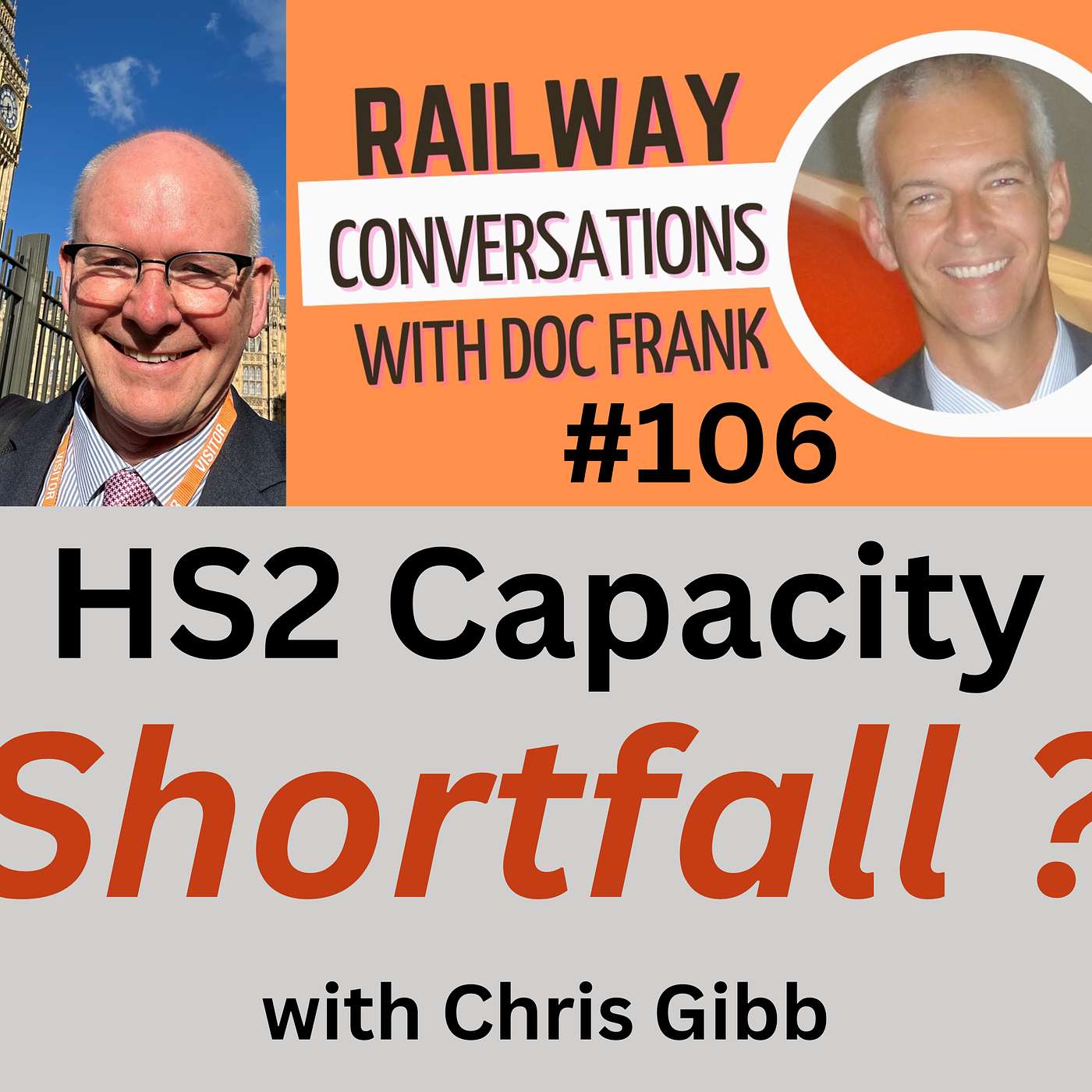
#106 — Why HS2 Needs More Carriages, with Chris Gibb

Chris Gibb spent 45 years in high-profile positions across the British railways. He knows what a successful railway operation looks like — and right now he is publicly challenging the plans for High Speed 2 (HS2). The issue is not the construction. It does not even impact the High Speed Rail service between London and Birmingham, what most people think HS2 is about. It is the impact of the new HS2 train fleet that continues around Birmingham on the West Coast Main Line to the North. Chris foresees a substantial reduction in capacity from today's fleet travelling up North, at times when more, not less, capacity will be needed. And he tries to do something about it before procurement decisions cement a future capacity shortfall. It is a lesson about long-term planning decisions and their consequences. If you find this conversation useful, subscribe and share it. It costs nothing and makes a real difference. When it comes to advancing your understanding of modern train control technologies, nothing beats world-class training. I've partnered with Informa Connect Academy to create what I believe is the most comprehensive portfolio of online training courses in advanced signalling available anywhere. Find out more here: https://docfranktraining.com/courses

May 20, 202648 min

#105 – GSM-R Is Dying. Are Railways Ready for FRMCS?

GSM-R is on its way out. FRMCS — the 5G-based successor for railway radio communications — is on its way in. But the migration from one to the other is anything but straightforward. In this episode, Doc Frank talks to Rob van Looveren from the Netherlands, a railway consultant with hands-on experience in FRMCS specification work for freight trains through the European-funded FENIX project. Together they unpack what the migration from GSM-R to FRMCS actually involves: the technical challenges, the planning complexity, the freight operator funding dilemma, and why a bistandard onboard approach is likely the only migration strategy that really works. The Netherlands context provides a useful European lens — and the comparison with Australia's situation turns out to be more interesting than you might expect. If you find this episode useful, the best thing you can do is subscribe, share it with colleagues, and leave a comment. It costs nothing and makes a real difference. When it comes to advancing your understanding of modern train control technologies, nothing beats world-class training. I've partnered with Informa Connect Academy to create what I believe is the most comprehensive portfolio of online training courses in advanced signalling available anywhere. Find out more here: https://informaconnect.com/academy/rail/

April 29, 202654 min

#104 – High Speed Rail Lessons with Michael Byng

Doc Frank talks to Michael Byng from England. Based on his vast experience from working on high speed rail projects in various countries, including Britain and the Middle East, Michael could share valuable lessons that went way beyond his home turf of cost estimation. If you like Michael’s insightful comments, check out the previous podcast episode 72 with him. And please remember to like, share and subscribe if you have not already done so. In doing so, you’re not only supporting the channel but knowledge growth across the wider railway industry. Thank you for that. Also, if you are interested in world-class education on modern train control technologies and their successful application, check out the world's most comprehensive portfolio of online training courses in this field: https://informaconnect.com/academy/rail/

April 15, 20261 hr 13 min

#103 - The BIG Railway Outlook with Steve Allday

Doc Frank talks to Steve Allday, a renowned and experienced railway consultant from Sydney and regular guest on the show. They talk about three key topics defining the future of railway in Australia and maybe some other countries too. High Speed Rail (of course), interoperable train control with ETCS and the increasing shortage of resources in the rail industry. If you like Steve’s down-to-earth discussion style, check out the YouTube playlist with his other podcast episodes linked at the end of the video version on YouTube. And please remember to like, share and subscribe if you have not already done so. In doing so, you’re not only supporting the channel but knowledge growth across the wider railway industry. Thank you for that. Also, if you are interested in world-class education on modern train control technologies and their successful application, check out the world's most comprehensive portfolio of online training courses in this field: https://informaconnect.com/academy/rail/

March 25, 202657 min

#102 - High Speed Rail in Australia with Tim Parker

Doc Frank talks to Tim Parker, Chief Executive Officer of the Australian High Speed Rail Authority. The conversation addresses various points of criticism towards Australia's quest for High Speed Rail and is aimed to increase transparency around this high-profile national project. The insights from this conversation are valuable for anyone involved in High Speed Rail or similar large infrastructure projects. You can access the business case for the Sydney-Newcastle High Speed Rail here: https://media.caapp.com.au/pdf/j2IbcN94MVkB/4d2b42f4-a09d-457d-ae1d-cf7f8fe872e8/HSRA%20Newcastle%20to%20Sydney%20High%20Speed%20Rail%20Business%20Case%20FINAL_Redacted%202026.pdf If you enjoy railway conversations like this, please like and share this episode and subscribe to this channel. It does not cost you anything and helps to keep going with this podcast, more than you might think. If you are interested in world-class education on modern train control technologies and their successful application, check out the world's most comprehensive portfolio of online training courses in this field: https://informaconnect.com/academy/rail/

Is this your show?

Claim this listing to keep it up to date, reach guests who want to pitch you, and manage bookings with Guestify.

Claim this listing

More Technology podcasts