Find partners
Investology: Investment Management Intelligence

Investology: Investment Management Intelligence

Hosted by Investment Management Intelligence

BusinessInterviews guests

Episodes

131

Latest episode

Aug 2026

Language

EN

About the show

Conversations with technologists, founders, academics, and strategists reshaping how capital is deployed, managed, and optimized. No macro. No trading ideas. Investment management, period. Hosted by George Aliferis, reformed investment banker and founder of Orama: http://orama.tv — thought leadership for those selling to financial institutions. investorama.substack.com

Listen to episodes

60 recent
July 30, 202550 min

[Best Of Investology] The Hard Truth about Agentic AI in Investment Management

[Reposting our most popular episodes during the summer break. This was originally published in July 2025] Marco Aboav, CEO of Etna Research, delivers a contrarian take on the current state of AI and automation in financial services. The real challenge now is not technology, but change management, for operational efficiency. But not as a magic bullet for generating alpha. The real edge comes from domain expertise, data selection, and sophisticated modelling—areas where AI can assist but not replace human judgment. Key Takeaways: * The innovation cycle in AI for finance is already peaking: most essential tools and workflows are already available. * The next frontier is not more technology, but how organizations manage change, optimize teams, and handle data in a world of brutal efficiency. * Incumbents can still fight back against pricing pressure through operational efficiency and smart management decisions. * Big tech companies may struggle to succeed in verticals like finance, where high accuracy and deep integration are required. * The “frontier” is in highly specialized, vertical applications, not in generic AI solutions. About Marco Aboav: Marco Aboav is the CEO and Founder of Etna Research, specializing in the intersection of AI, data, and financial services. With deep expertise in operational efficiency and technology integration, Marco brings a unique perspective on the challenges and opportunities facing the industry today. ”I fell in love with AI's potential to transform investing back in 2009 while wrestling with my engineering PhD. Since then, I’ve spent my career in financial services—across buy and sell-side roles in London—building businesses, managing money, and applying AI to capital markets.” Connect with Marco Aboav: * LinkedIn: https://www.linkedin.com/in/marco-jean-aboav/ * Website: Etna Research About the Show: Investology is a podcast hosted by George Aliferis, CAIA, dedicated to rethinking investment management and uncovering new ways to deliver better outcomes for investors, part of the Investorama investment content platform.Listen on every podcast platform , or on YouTube . About George Aliferis: Founder or Orama, ex-banker, ex-sales, working at the intersection of investment management, media & marketing. LinkedIn: https://www.linkedin.com/in/george-aliferis/ A show produced by Orama: Thought leadership videos and podcasts for knowledge-intensive and regulated industries. https://orama.tv/ Resources Mentioned: * Previous episode with Marco: * Perplexity for Finance: https://www.perplexity.ai/finance * Anthropic’s MCP protocol: https://www.anthropic.com/news/model-context-protocol * Finbourne’s MCP announcement: https://www.finbourne.com/finbourne-unlocks-compliant-agentic-ai-for-the-investment-industry-powered-by-mcp/ * Anthropic for Financial Services: https://www.anthropic.com/solutions/financial-services Etna’s recent publications * Diversification an Ephemeral Illusion: https://etnaresearch.notion.site/Diversification-An-Ephemeral-Illusion-231457fd575a800ead88c99086368e8a?pvs=74 * Backtest Roulette: https://etnaresearch.notion.site/Backtest-Roulette-238457fd575a80dc8c27dc8e7574ed40 Timestamps & Topics: 00:00 – Introduction: Data Challenges 04:00 – Introduction to Agent AI for Data Management 06:39 – Simplifying Data Processes with AI 08:47 – The Role of Data in Gaining Competitive Edge 13:06 – Generative AI in Financial Services: Commodity or Edge? 19:13 – Operational Efficiency and AI Adoption 25:03 – Verticalization and High-Precision Problems 40:30 – The Future of AI in Investment Management This is a public episode. If you would like to discuss this with other subscribers or get access to bonus episodes, visit investorama.substack.com

December 16, 202537 min

[Best of Investology] The Data Behind the $Multi-Trillion Rise of Asset-Based Finance

I’m resharing the most popular episodes of the podcast during the Summer break. As banks retreated after the financial crisis of 2007-2008, Private Credit filled in the gap. What started as a niche within private equity now operates like a global lending system. And it extends beyond corporate balance sheets, asset-based finance , the ability to lend against real, cash-generating assets is growing fast and offers countless opportunities. The real unlock isn’t just capital — it’s the data and technology allowing to manage these assets at scale . Granular, asset-level data enables better underwriting, continuous monitoring, and access to previously illiquid markets. In my conversation with Cesar Estrada, we explored: * How private credit replaced traditional bank lending * Why asset-backed finance is now being unleashed * How to understand the fall of Tricolor and First Brands * And how data and technology could be defining the winners in this market A few highlights from our conversation Asset-based finance - an ever-expanding universe Asset-based finance means that instead of lending against the future cash flows of a company, you’re lending against an asset and the contractual cash flows associated with that asset. That’s a very broad definition, and it can include anything within, the consumer, finance world, buy now, pay later, credit cards, auto loans, student loans, any personal term loans, residential mortgages, home, equity lines of credit, the list, keeps on going on as you move outside of a consumer world into, other types of things. Any type of account receivable, supply chain financing, litigation finance, and then more esoteric stuff like, synthetic risk transfers and other things. And it’s becoming very specialized by verticals: aviation finance, medical equipment finance… It has possibly a larger addressable market than direct lending. It offers a lot of runway for growth for private equity, private credit firms, hedge funds, and insurance companies participating directly in this space. The need for data feeds From a risk management perspective, given the rate of change of a consumer world, loans are being paid, new loans are being issued, loans are being not paid. You want to be monitoring this much much more real time than you do in a corporate book, where you’re getting monthly reporting from the borrower and you are comparing their latest actual financials against the original underwriting thesis against prior periods. And you do that activity once a month. This is not a once-a-month thing. This is a daily thing. You want to see how it’s changing because it’s changing very dynamically. I was surprised that this frequency of data was even a possibility, and Cesar also added that it goes beyond risk management; it also feeds into the creation of funds for private investors with daily NAV and daily liquidity. The frequency of reporting increases, the liquidity choices increase, and the volumes and rate of change in the investment strategies increase. That all compounds to necessitate a very robust, modern technology to process all of that data. The First Brands & Tricolor question Cesar mentioned he didn’t have any specifics on the situation, and when I asked about the data issue, his response from a data management provider was to be expected. It is certainly possible that better data with more accuracy and more frequency could have helped offer a view that those assets were being used as collateral with multiple lenders. […] But I wanted to dig a bit further, and at first, the response confirmed that when a crisis happens, all assets that are linked to it fall at the same time, even if in the long term, there’s dispersion (like banks during the Global Financial Crisis) In terms of how it happened so quickly, so abruptly. Again, pure speculation, I think that those things might have been bubbling without the public knowing for a while. But as soon as a big source of financing decides that you’re no longer creditworthy, all of the other sources of financing follow suit, and it’s very abrupt. You can face a liquidity challenge and go bankrupt. It reminded me that Apollo Global Management shorted First Brands’ credit risk before the company’s fall, showing the information asymmetry that still exists in private credit. This requires a few caveats: First Brands was more direct lending; Tricolor was more linked to asset-based finance; nothing says that Apollo had better data. Yet, until the data-based approach that Cesar described becomes table stakes, it could be an important differentiator. Related episode: About Cesar Estrada: Cesar oversees Arcesium’s investment operations, accounting, and data management solutions for private markets fund managers and institutional investors. Previously, he served as Senior Managing Director and Alternatives Segment Head for North America at State Street – a role in which he drove the growth agenda for a business with approximately $1 trillion in Assets Under Administration (AUA) by leading new product launches, expansion into new client segments, strategic partnerships, and acquisitions. Prior to that, as a Managing Director at J.P. Morgan, Cesar led the Private Equity & Real Estate Funds Services business from launch to $350Bn AUA. While at J.P. Morgan, he also held investment banking roles in New York, London, and Hong Kong. Link: https://www.arcesium.com/authors/cesar-estrada About the Investlogy podcast: Investology is a podcast dedicated to rethinking investment management and uncovering new ways to deliver better outcomes for investors.Listen on every podcast platform , or watch on YouTube . An episode produced by Orama : Accelerate sales to the financial industry with content that builds trust and drives pipeline with sales-driven video strategies. About the Host: George Aliferis, CAIA is the founder of Orama, where he has produced content for financial brands and multinationals, including Amazon, Expedia, Louis Vuitton, and Unilever. Before that, he spent over a decade structuring, marketing and selling complex financial products to institutional clients in Europe and Asia. LinkedIn: https://www.linkedin.com/in/george-aliferis-60078312/ My Investing & Investment Management YouTube Channels * Investorama - Separating Investment Facts from Financial Fiction (YouTube) * Investology - Re-Think Investment Management (YouTube) This is a public episode. If you would like to discuss this with other subscribers or get access to bonus episodes, visit investorama.substack.com
August 12, 20269 min

[Best Of Investology] Equity performance triples when it goes private? Featuring Neuberger Berman | The Skeptic's Guide to Investment Management

Welcome to the Skeptic’s Guide to Investment Management. In each episode, we examine one industry publication through a skeptical, logical, evidence-based lens, with the help of Tim McGlinn , ex-investment consultant, portfolio manager and professor of finance, and founder of the TheAltView . We discuss a Neuberger Berman 2025 report pitching alternative (private) investments in 401(k) plans. The “illustrative” report assumes private equity chosen by Neuberger Berman earns 15.30% per year after fees for 40 years, while US large caps return just 5.77% after fees—making a 10% private equity allocation look like an easy way to retire richer. The private equity boost relies on assuming investors can invest only via co-investments (lower fees), which Tim says isn’t realistic because you typically need to be an LP in funds to access them. They also note the equity forecast is dragged down by assuming active-manager fees and persistent underperformance for decades—odd for a firm selling active equity. Tim contrasts this with AQR assumptions showing private equity (5.1%) below US equities (6.5%). Key takeaway: any 15% long-term promises is an alarm bell. Link to Tim’s original article Neuberger Berman & Alternative Investments More content like this on Substack and YouTube: YouTube: https://www.youtube.com/@investology_podcast Investorama TheAltView Find us on LinkedIn George: https://www.linkedin.com/in/george-aliferis/ Tim: https://www.linkedin.com/in/tim-mcglinn SGIM is an Investology podcast series, produced by Orama: https://orama.tv/ MUSIC CREDITS Brandenburg Concerto No4-1 BWV1049 - Classical Whimsical by Kevin MacLeod is licensed under a Creative Commons Attribution 4.0 license. https://creativecommons.org/licenses/by/4.0/ Source: http://incompetech.com/music/royalty-free/index.html?isrc=USUAN1100303 Artist: http://incompetech.com/ This is a public episode. If you would like to discuss this with other subscribers or get access to bonus episodes, visit investorama.substack.com
July 22, 202632 min

A Tokenized Solution for the $5 Trillion Idle Corporate Cash Problem

There’s no shortage of news about institutions launching tokenized money market funds (MMF): Blackrock, JPMorgan, State Street, BNY, the list goes on. We hear less about adoption . Assets have grown from near zero to $15B, which sounds impressive until you compare it to over $7T sitting in US MMFs today. The chart below shows the efficiency gains tokenization unlocks, but how many participants are feeling the pain of the current T+2, multi-step process acutely enough to move? That question points directly to where the tipping point for adoption will come from. Treasurers feel that pain. But not those at tech firms or Fortune 500 companies — they already have direct access to institutional cash management solutions through their mega-bank relationships. And not Bitcoin enthusiasts parking a volatile asset on their balance sheet. Based on my conversation with Tanner Taddeo, CEO and co-founder of Stable Sea, the real candidate is the most unlikely one. The middle-market treasurer: naturally conservative, not a tech cheerleader, and currently underserved by the infrastructure being built for everyone else. We covered: * The Mid-market treasury gap : Large companies get white-glove capital markets access from major banks, but mid-market/lower-mid-market companies are typically stuck with just a checking account and no access to yield-generating products. * The benefits of tokenization : access the same money market funds but with 24/7/365 trading and near-instant (~10 min) settlement vs. the traditional T+2. * Custody and trust mechanics : for Real World Assets. * Adoption outlook and barriers: what it takes for conservative treasurers to embrace a tokenized solution. And a lot more. Watch it on YouTube or listen on every podcast app . Selected Quotes The problem Stable Sea Solves: “We help companies access capital markets products. We offer money markets, we offer fixed income products and we offer some additional securities through the platform. It’s different from some of the other products that exist on the market today because we give access to tokenized money market funds and tokenized fixed income products. And the value add there is that you can trade those funds twenty-four seven, three sixty-five, and then settlement is near instant. So you don’t have to wait two days, to get liquidity out of some sort of security. , you don’t also have any lockup periods associated with those investments, and there’s also no minimums.” I must say that we discussed tokenization in a couple of previous episodes (see below) of the podcast, and I was never convinced. You can tokenize gold bars and maybe it makes you feel like you own it and other benefits compared but a gold tracker ETP works really well. But here, instant liquidity instead of T+2 for treasuries - I get it. We don’t NEED to understand the technology (only trust it): “When the credit card came out, it was a new technological way to efficiently move money between consumers and merchants and then instill trust between the banks. So if I swipe my card at a Starbucks, Visa can help authenticate and move funds between my bank account and Starbucks' bank account. So there's complexity in virtue of how the technology works, but at the end of the day, it's just a more efficient way to help share value between two counterparties .” Tanner distances his application from the volatile (and often dodgy) world of cryptocurrencies. But Treasurers still need to understand the technology, but you need to present it the right way. Leading with the right narrative: “Treasurers, finance teams, CFOs rightly so, are some of the most conservative people out there. Because the number one golden rule in the corporate treasury handbook is do not lose the company's money. And a lot of the finance teams don't buy on innovation, they buy to de-risk something . So you have to really lead with a narrative of security, and trust and compliance and all those things.” The Theseus Ship of financial infrastructure The global financial system is going to slowly, almost like Theseus’s ship, be replaced, by some of this blockchain and Stablecoin infrastructure. And so we like to lead with with content, but more importantly than content, it's actually sitting down with and convening with people, showing them how the product works, and then just having that conversation. As an avid reader of Greek mythology, I didn’t know the expression , but it’s a very powerful way of thinking of innovation and change management. About Tanner Taddeo: Tanner Taddeo is the CEO of Stable Sea, a company helping enterprises modernize global payments and treasury operations with stablecoins. Tanner started his career in humanitarian finance, worked in investment banking across emerging markets and later helped build real-time payment systems for central banks with a Gates Foundation backed company. He’s also held roles at Plaid and Block’s TBD, shaping the future of open and decentralized finance. At Stable Sea, Tanner brings that experience together to bridge traditional and digital finance while making stablecoins a cornerstone of faster, more inclusive global payments https://www.linkedin.com/in/tanner-taddeo-9b64562a/ https://www.stablesea.com/ Related episodes: About the Investology podcast: Investology is the investment management intelligence show. Where innovators, investors, authors and experts discuss the future of investment management beyond the hype.Listen on every podcast platform , or watch on YouTube . An episode produced by Orama : https://orama.tv/ Thought leadership videos & podcasts. About George Aliferis: Founder or Orama, ex-banker, ex-sales, working at the intersection of investment management, media & marketing. LinkedIn: https://www.linkedin.com/in/george-aliferis/ Our Other Channels * Investorama - Bridging the Institutional Knowledge Gap (YouTube) * Orama’s newsletter & the Unsloppable podcast for marketers and revenue teams in complex industries, like investment management: This is a public episode. If you would like to discuss this with other subscribers or get access to bonus episodes, visit investorama.substack.com
July 2, 202639 min

The Backbone of Global Trade. A Deep Dive Into Shipping.

Shipping fascinates me. The industry usually quietly carries approximately 80% of all internationally traded good. Tankers reach 400m long and carry loads of $200m+ worth of oil. But the best part of it is the 4D multi-year chess game played across the globe, by an industry that can be as profitable as it is cyclical. Watch it on YouTube or listen on the Substack player or every podcast app . Key topics discussed * The math behind 30% returns on $140M assets. * Managing risk in a highly cyclical, capex-heavy industry. * Why Japan and China are rebuilding global oil storage. * The "one-stop shop" model for financial investors in shipping (the Uber of Shipping). Summary Pankaj Khanna, CEO of Nasdaq-listed Heidmar, discusses how shipping and freight underpin the global economy, focusing on oil tanker markets. He shares his path from an Indian merchant navy cadet to CEO and 45% owner, and explains Heidmar’s growth since 2019 from six ships and six people to managing 65 vessels across six global offices with 65 staff. Heidmar is a non-asset-owning, debt-free, “one-stop shop” providing ship acquisition support, financing and corporate setup, technical management (crews, SMS), and commercial management (employment with oil majors and traders enabled by long-standing KYC approvals), earning daily fees and commissions on freight. The discussion covers spot freight economics, investor types, traders’ roles, shipping cyclicality driven by geopolitics, distance and fleet supply, and Heidmar’s long-term digital platform and AI initiatives to optimize operations, alongside the company’s EBITDA-multiple valuation versus NAV. Links Heidmar https://www.heidmar.com/Pankaj Khanna on Linkedin https://www.linkedin.com/in/pankaj-khanna-69746b1/ About Investology: A podcast dedicated to investment management intelligence and uncovering new ways to deliver better outcomes for investors. Audio: https://pod.link/the-fintech-filesNewsletter: https://investorama.substack.com/ About the Host: George Aliferis, CAIA is the founder of Orama, where he produces content for financial brands and tech companies. Before that, he spent over a decade structuring, marketing and selling complex financial products to institutional clients in Europe and Asia.https://www.linkedin.com/in/george-aliferis/An episode produced by Orama: https://orama.tv/Sales-driven video strategies. Accelerate sales to the financial industry with content that builds trust and drives pipeline. TIMESTAMPS 00:00 Pankaj’s Journey to CEO01:20 Heidmar’s Comeback Story04:11 Why Shipping Chose Him06:12 Inside Tanker Management11:06 Investor Returns and Fees17:34 Uber of Shipping Tech Stack22:33 Traders and Market Cycles34:46 Misconceptions about Shipping Thanks for reading Investorama! Subscribe for free to receive new posts and support my work. This is a public episode. If you would like to discuss this with other subscribers or get access to bonus episodes, visit investorama.substack.com
June 12, 202645 min

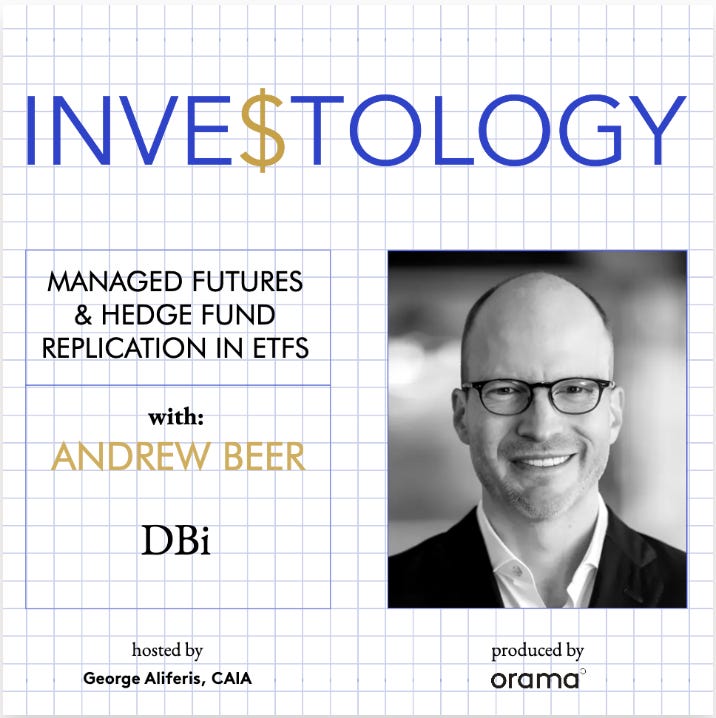
There's Alpha in Simplification (Managed Futures ETF strategies)

Can you outperform the world’s smartest hedge funds by simplifying their strategies? George sits down with Andrew Beer, Co-Portfolio Manager at DBi, to discuss why you can beat hedge funds through simplicity. We deconstruct how managed futures investing strategy can disrupt the industry by delivering institutional-grade alpha within the efficient framework of an ETF. The Narrative Shift: We explore the marketing "theatre" of complexity—the rooms full of PhDs and black-box models—and contrast it with the reality of harvesting macro trends. Andrew explains how moving these strategies from private funds to the ETF wrapper isn't just about lower fees; it's about a fundamental shift in how professionals access Managed Futures (CTAs). Key topics: Replication vs. Selection: Why "copying" the big macro moves of the industry often beats picking individual winners. The Alpha-Fee Gap: How stripping out 400-500 BPS of fees directly translates to investor returns. ETFs as the Great Equalizer: Why the sub-advised ETF model is the future for institutional allocators and wealth managers. Portfolio Construction: The role of CTAs (officially Commodity Trading Advisory but Andrew prefers Contrarian Tactical Alpha) in the traditional 60/40 portfolio. LINKS Andrew Beer on LinkedIn: https://www.linkedin.com/in/andrewdbeer/ https://dbi.co/ About Investology: A podcast dedicated to investment management intelligence and uncovering new ways to deliver better outcomes for investors. About the Host: George Aliferis, CAIA is the founder of Orama, where he has produced content for many financial brands and multinationals like Amazon, Expedia, Louis Vuitton, and Unilever. Before that, he spent over a decade structuring, marketing and selling complex financial products to institutional clients in Europe and Asia. https://www.linkedin.com/in/george-aliferis/ An episode produced by Orama: https://orama.tv/ Sales-driven video strategies. Accelerate sales to the financial industry with content that builds trust and drives pipeline. This is a public episode. If you would like to discuss this with other subscribers or get access to bonus episodes, visit investorama.substack.com
June 1, 20264 min

Your Macro newsfeed is ruining your Macro analysis [SGIM #5]

Welcome to the Skeptic’s Guide to Investment Management. In each episode, we examine one industry publication through a skeptical, logical, evidence-based lens, with the help expert guests. This one is a macro special featuring Dylan Smith from ArcMacro. If you feel there’s “a lot of macro” happening these days. And that the next declaration might “change the macro landscape” . Then the chat is the perfect antidote to help you think straight and remind you that we tend to overstate the impact of political decision. Key takeaway: The macro-driven cyclical and structural processes drive political decision and news. It’s not the other way around.If you'd like to support this show please take a minute to leave a 5-star review on your favourite podcast app. Relevant links Full conversation and notes: https://investorama.substack.com/p/a-macro-framework-for-hybrid-portfolios Sign up to Investology’s free newsletter: https://investorama.substack.com/ Sign up to ArcMacro’s free newsletter: https://arcmacro.substack.com/ George Aliferis: https://www.linkedin.com/in/george-aliferis/ Dylan Smith: https://www.linkedin.com/in/dylan-smith-78284b50/ SGIM is an Investology podcast series, produced by Orama: https://orama.tv/ MUSIC CREDITS Brandenburg Concerto No4-1 BWV1049 - Classical Whimsical by Kevin MacLeod is licensed under a Creative Commons Attribution 4.0 license. https://creativecommons.org/licenses/by/4.0/ Source: http://incompetech.com/music/royalty-free/index.html?isrc=USUAN1100303 Artist: http://incompetech.com/ This is a public episode. If you would like to discuss this with other subscribers or get access to bonus episodes, visit investorama.substack.com
May 22, 202640 min

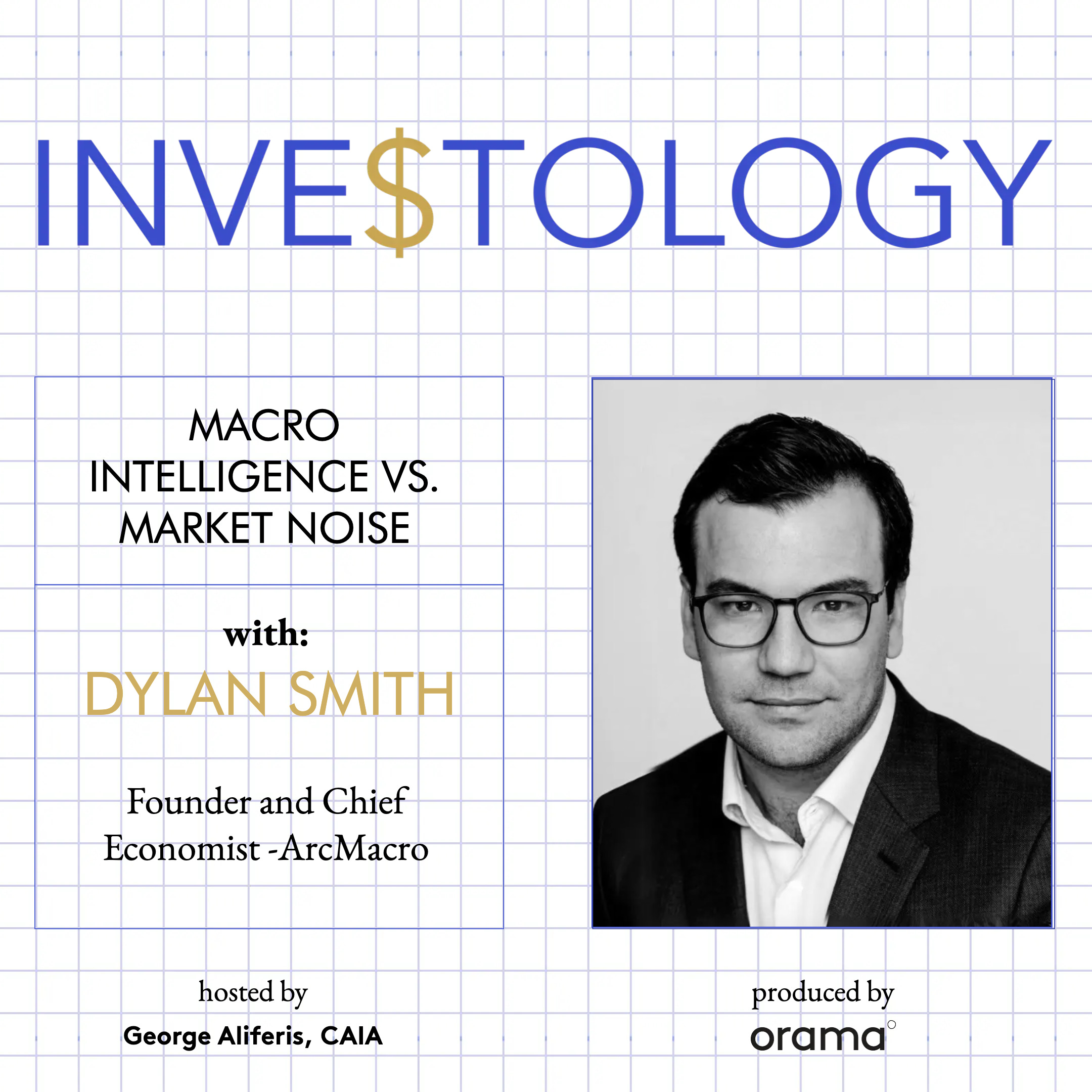
A macro framework for hybrid portfolios

It’s great to be back on the podcasting seat! Watch it on YouTube or listen on every podcast app . This podcast is about gathering investment management intelligence. It’s not an investment podcast where we discuss macro itself. Yet macro matters. This was a rare opportunity to understand how it works for sophisticated hybrid investors, and what goes on behind the scenes by talking to Dylan Smith from ArcMacro ( Tangents on Substack). A few selected quotes from our conversation Macro for private market investors If you have in mind private market performance, […] it's long term and returns are driven by slightly different things, although they are affected by macro. We've re-looked at the economics toolkit. We've kept most of it, but we've shifted the focus to say, okay, we've got to be a lot more long term. We've got to be a lot more structural. That’s Dylan key differentiator. He’s serving private market LPs. But I think his framework is applicable to anyone with a longer term perspective. Signal vs. Noise - 2026 version Every time someone meets me for the first time, it's, "Oh, you're an economist. What a great time to be an economist," like, "There's so much chaos in the world." I did not bring up the famous Lenin quote in the conversation: “There are decades where nothing happens; and there are weeks where decades happen” although I had it in mind after Venezuela, Iran. But the conversation showed me I was making a common mistake: People tend to view often developments almost as entirely political, and I think partly that's the news media's fault because that's their natural lens as they report. We went on to discuss this signal and noise in more depth. But ultimately having a solid macro grounding helps to avoid investment biases. But it doesn’t mean you should only stay the course without doing anything. We also talked about hedging, and shifts in allocation. Assign probabilities Our primary framework is scenario-based. But it's not just sticking our fingers in the air and saying, there's a whole universe of things that could happen. It's based on understanding that, events now chain into the future, and they can branch away. But we can assign pretty good probabilities around that by mixing some fairly sophisticated modeling and data. This is quite different, and a lot more practical from thge traditional perspective of an economist producing ONE forecast, usually with a lot of caveats. AI and the Dunning-Kruger effect in macro AI is about averages, and it's backward-looking. It produces the next most likely token based on its understanding of all the past information. You're trying to think about scenarios, what might happen in the future and what's important about the differences and inflection points. Like, is this a meaningful shift in the kind of structure of the economy? It’s too sophisticated for AI to answer. It will give you an answer, and it will sound confident about it, but there's a huge amount of risk in that. And if you already have certain biases or you're low down on the Dunning-Kruger scale, or you know you're not great at macro, but you get this kind of answer it's very tempting to treat that as the truth and act on it. We covered a lot, and yes of course we spoke about Iran and the Trump administration too. Related episode: About Dylan Smith: Dylan Smith is the independent chief economist for private markets. Combining experience in macroeconomics and alternative investing he delivers insights with the frequency, horizon and granularity that private markets need. https://arcmacro.com/ https://www.linkedin.com/in/dylan-smith-78284b50/ About the Investlogy podcast: Investology is the investment management intelligence show. Where innovators, investors, authors and experts discuss the future of investment management beyond the hype.Listen on every podcast platform , or watch on YouTube . An episode produced by Orama : For fintechs and enterprise vendors selling to financial institutions. We turn your expertise into narratives that build trust and relationships with decision-makers. About George Aliferis: Founder or Orama, ex-banker, ex-sales, working at the intersection of investment management, media & marketing. LinkedIn: https://www.linkedin.com/in/george-aliferis-60078312/ My Other Channels * Investorama - Separating Investment Facts from Financial Fiction (YouTube) * Orama’s newsletter & Unsloppable podcast for marketers and revenue teams in complex industries: This is a public episode. If you would like to discuss this with other subscribers or get access to bonus episodes, visit investorama.substack.com
April 7, 20269 min

Picking above-average managers delivers superior returns. Thank you Mercer! [The Skeptic's Guide to Investment Management #4]

Welcome to the Skeptic’s Guide to Investment Management. In each episode, we examine one industry publication through a skeptical, logical, evidence-based lens, with the help of Tim McGlinn , ex-investment consultant, portfolio manager and professor of finance, and founder of the TheAltView. We discuss a 2025 Mercer report claiming that adding a 20% allocation to private investments (venture capital, private equity, real estate, etc.) could boost target-date fund expected returns by 1% (7.1% vs. 6.1%). The catch: Mercer assumes public markets earn plain market returns, while private assets magically get “above-average manager” performance forever—because everyone’s an above-average driver. Tim also highlights Mercer’s conflict of interest as a consultant that sponsors private equity funds, plus ERISA’s heavy fiduciary burden on employers, making glossy sales pitches even more problematic. Key takeaway: we’re not all above average drivers or fund pickers. Link to Tim’s original article: TheAltView SGIM is an Investology podcast series, produced by Orama: https://orama.tv/ More content like this on Substack and YouTube: YouTube: https://www.youtube.com/@investology_podcast Investorama on Substack TheAltView on Substack Find us on LinkedIn George: https://www.linkedin.com/in/george-aliferis/ Tim: https://www.linkedin.com/in/tim-mcglinn SGIM is an Investology podcast series, produced by Orama: https://orama.tv/ MUSIC CREDITS Brandenburg Concerto No4-1 BWV1049 - Classical Whimsical by Kevin MacLeod is licensed under a Creative Commons Attribution 4.0 license. https://creativecommons.org/licenses/by/4.0/ Source: http://incompetech.com/music/royalty-free/index.html?isrc=USUAN1100303 Artist: http://incompetech.com/ This is a public episode. If you would like to discuss this with other subscribers or get access to bonus episodes, visit investorama.substack.com

March 10, 20267 min

Georgetown University's Unacademic Assumptions [The Skeptic's Guide to Investment Management #2]

Welcome to the Skeptic’s Guide to Investment Management. In each episode, we examine one industry publication through a skeptical, logical, evidence-based lens, with the help of Tim McGlinn , ex-investment consultant, portfolio manager and professor of finance, and founder of the TheAltView. The episode examines a report by the Georgetown University Center for Retirement Initiatives, produced with Willis Towers Watson, that you can find here: https://cri.georgetown.edu/research/ Tim found a headline claim that investors could retire with 17% more, driven by 40 years of compounding, based on the assumption of access to above-average managers for all retirees. Link to Tim’s original article Georgetown & Willis Towers Watson More content like this on Substack and YouTube: YouTube: https://www.youtube.com/@investology_podcast Investorama on Substack TheAltView on Substack Find us on LinkedIn George: https://www.linkedin.com/in/george-aliferis/ Tim: https://www.linkedin.com/in/tim-mcglinn SGIM is an Investology podcast series, produced by Orama: https://orama.tv/ MUSIC CREDITS Brandenburg Concerto No4-1 BWV1049 - Classical Whimsical by Kevin MacLeod is licensed under a Creative Commons Attribution 4.0 license. https://creativecommons.org/licenses/by/4.0/ Source: http://incompetech.com/music/royalty-free/index.html?isrc=USUAN1100303 Artist: http://incompetech.com/ This is a public episode. If you would like to discuss this with other subscribers or get access to bonus episodes, visit investorama.substack.com

Is this your show?

Claim this listing to keep it up to date, reach guests who want to pitch you, and manage bookings with Guestify.

Claim this listing

More Business podcasts