
Find partners
MSF Farm Talk Podcast

MSF Farm Talk Podcast

Hosted by Mallee Sustainable Farming

Episodes

100

Latest episode

Aug 2026

Language

EN-AU

About the show

MSF's Farm Talk Podcast proudly brings Farmers, Researchers and Ag Industry connections together to chat innovative farming practices to help build a sustainable farming future for our Mallee growers. Mallee Sustainable Farming is a farmer-driven organisation specialising in Research, Development and Extension for NSW, VIC & SA's low-rainfall Mallee region. For more information visit: www.msfp.org.au/podcast

Listen to episodes

60 recent
August 13, 202617 min

Lentil Weed Control Part 2: Herbicide Options, Resistance & Soil Chemistry

What are the key herbicide considerations when managing weeds in lentils, and how can growers protect their herbicide options for the future? In Part 2 of the presentation from agronomist and WeedSmart Extension Officer Chris Davey, we continue the discussion on lentil weed management from the Mallee Research Updates. While Part 1 focused on setting lentil crops up for success through rotation, crop competition and the WeedSmart Big 6, this episode takes a closer look at herbicide options, resistance and soil chemistry. Chris explains why chemical control should be considered as part of an integrated weed management strategy, rather than the first line of defence. He discusses the importance of resistance testing, using multiple herbicide modes of action and getting the timing and application right, particularly given the limited post-emergent options available in lentils. The conversation also explores how soil type, herbicide solubility and soil binding influence pre-emergent herbicide behaviour. Chris highlights the added challenges of sandy soils, where the margin between effective weed control and crop damage can be narrow, and explains how rainfall, deep ripping and seeding systems can influence herbicide movement and crop safety. The episode also covers non-chemical options including weed wiping, desiccation and crop topping, harvest weed seed control, and the use of herbicide-tolerant lentil varieties. This episode provides practical insights for growers looking to improve lentil weed control while managing resistance and protecting crop safety. This is Part 2 of a presentation from Chris Davey. In Part 1, Chris explores soil constraints, crop rotation, crop competition and the WeedSmart Big 6. 🎧 Listen to Part 1 first, then continue with Part 2 for a deeper look at herbicide options and resistance management. This podcast episode is supported by the Murraylands and Riverland Landscape Board. Support the show: https://msfp.org.au/about/membership/ See omnystudio.com/listener for privacy information.
July 30, 202610 min

Lentil Weed Control Part 1: Soils, Rotation and the WeedSmart Big 6

Lentils can be one of the least competitive crops when it comes to weed control, but good planning can make all the difference. In this episode of MSF Farm Talk podcast, we revisit the Mallee Research Updates from March, where agronomist and WeedSmart Extension Officer Chris Davey explores practical strategies for managing weeds in lentil crops. This is Part 1 of a two-part series with Chris Davey on lentil weed management. Chris explains why lentils are particularly vulnerable to weed pressure and how decisions made before sowing can set crops up for success. He discusses the importance of crop rotation, improving crop competition and addressing soil constraints to give lentils the best chance of establishing and competing with weeds. The conversation also unpacks the WeedSmart Big 6, a framework for integrated weed management that combines multiple tactics to reduce weed pressure and slow the development of herbicide resistance. From herbicide strategies and double knock tactics to harvest weed seed control, Chris shares practical insights growers can apply to their own farming systems. Whether you're planning your next lentil crop or looking to strengthen your weed management strategy, this episode offers valuable advice to help improve crop competitiveness and support long-term weed control. Stay tuned for Part 2, where Chris explores in-crop weed control options and how to maximise herbicide performance. This podcast episode is supported by the Murraylands and Riverland Landscape Board. Support the show: https://msfp.org.au/about/membership/ See omnystudio.com/listener for privacy information.
July 16, 20269 min

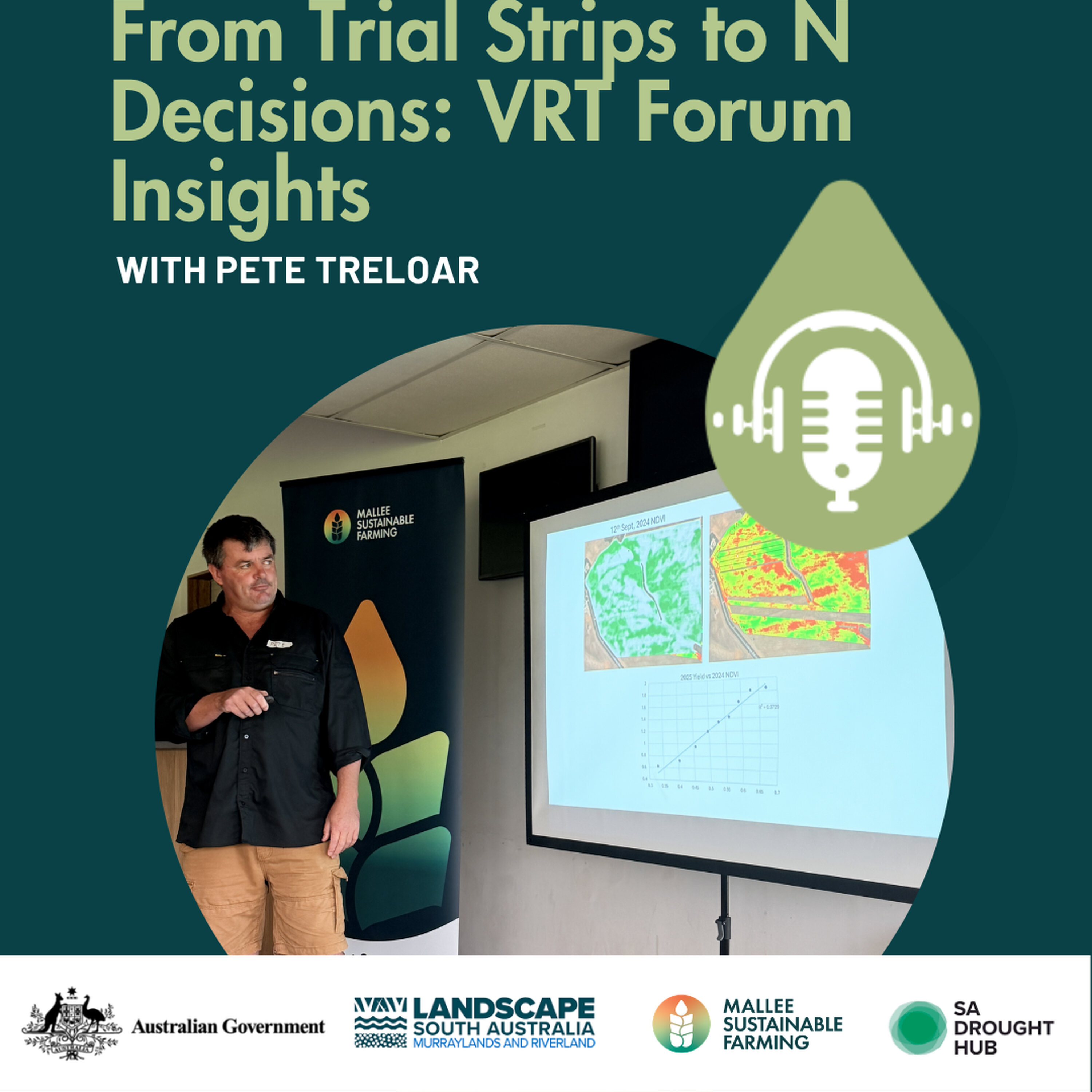
From Trial Strips to N Decisions: VRT Forum Insights

In this episode of the MSF Farm Talk podcast, we revisit Mallee Sustainable Farming's Variable Rate Technology Forum held in Lameroo in March, where Kylie catches up with Pete Treloar after a series of pre-seeding VRT workshops across the South Australian Mallee. Pete shares what recent trial work is revealing about applying phosphorus and nitrogen more strategically using VRT. He explains why many paddocks in a low-yielding season showed little response to additional phosphorus, how test strips can help validate decisions, and why some high-performing soil zones continue to justify greater investment. The conversation also explores how combining soil moisture, nitrogen testing, yield maps and local knowledge can help growers better target inputs, reduce unnecessary fertiliser costs and improve confidence in variable rate decisions across contrasting seasons. Whether you're already using VRT or considering where to start, this episode offers practical insights into making fertiliser decisions that are backed by data and local experience. This podcast episode is supported by the Murraylands and Riverland Landscape Board and the Australian Government through funding from the National Heritage Trust under the Climate-Smart Agriculture Program. Subscribe to MSF Farm Talk so you never miss an episode! Support the show: https://msfp.org.au/about/membership/ See omnystudio.com/listener for privacy information.
July 2, 202620 min

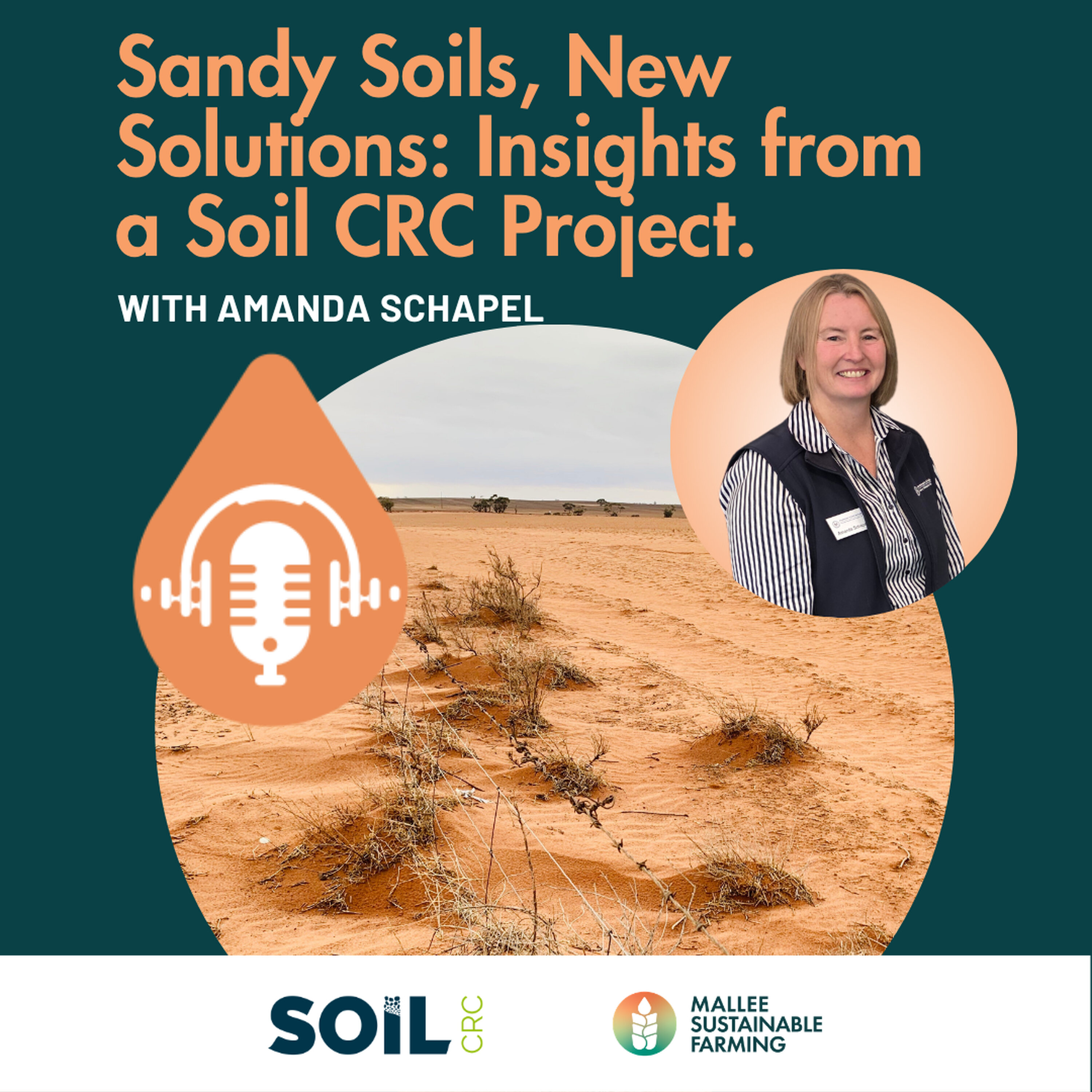
Sandy Soils, New Solutions: Insights from Soil CRC Project

In this episode of the MSF Farm Talk podcast, PIRSA’s Amanda Schapel shares insights from the long-running, collaborative, Soil CRC Sandy Soil Project. The project is investigating how clay and organic amendments can improve the productivity and resilience of sandy soils through literature reviews, pot trials and long-term multi-site field research. Amanda explains why sandy soils can behave so differently depending on factors such as depth to clay, grain size and rainfall environment, while also outlining the multiple constraints often present in sandy systems, including compaction, acidity, water repellence, and poor nutrient and water-holding capacity. Drawing on a review of 89 projects and 270 treatments, the episode explores how organic amendments can rapidly improve deep sandy soils, although benefits may decline after several years, while subsoil clay provides a slower but more persistent productivity response. Amanda also discusses the performance of novel amendments including bentonite, zeolite and compost products, highlighting the importance of matching amendments to specific soil constraints and balancing long-term benefits with cost-effectiveness. Project page with additional resources including research report, fact sheets and webinars: https://soilcrc.com.au/projects/new-amendments-for-sandy-soils/ This work has been supported by the Cooperative Research Centre for High Performance Soils, whose activities are funded by the Australian Government's Cooperative Research Centres Program. Support the show: https://msfp.org.au/about/membership/ See omnystudio.com/listener for privacy information.
June 18, 202611 min

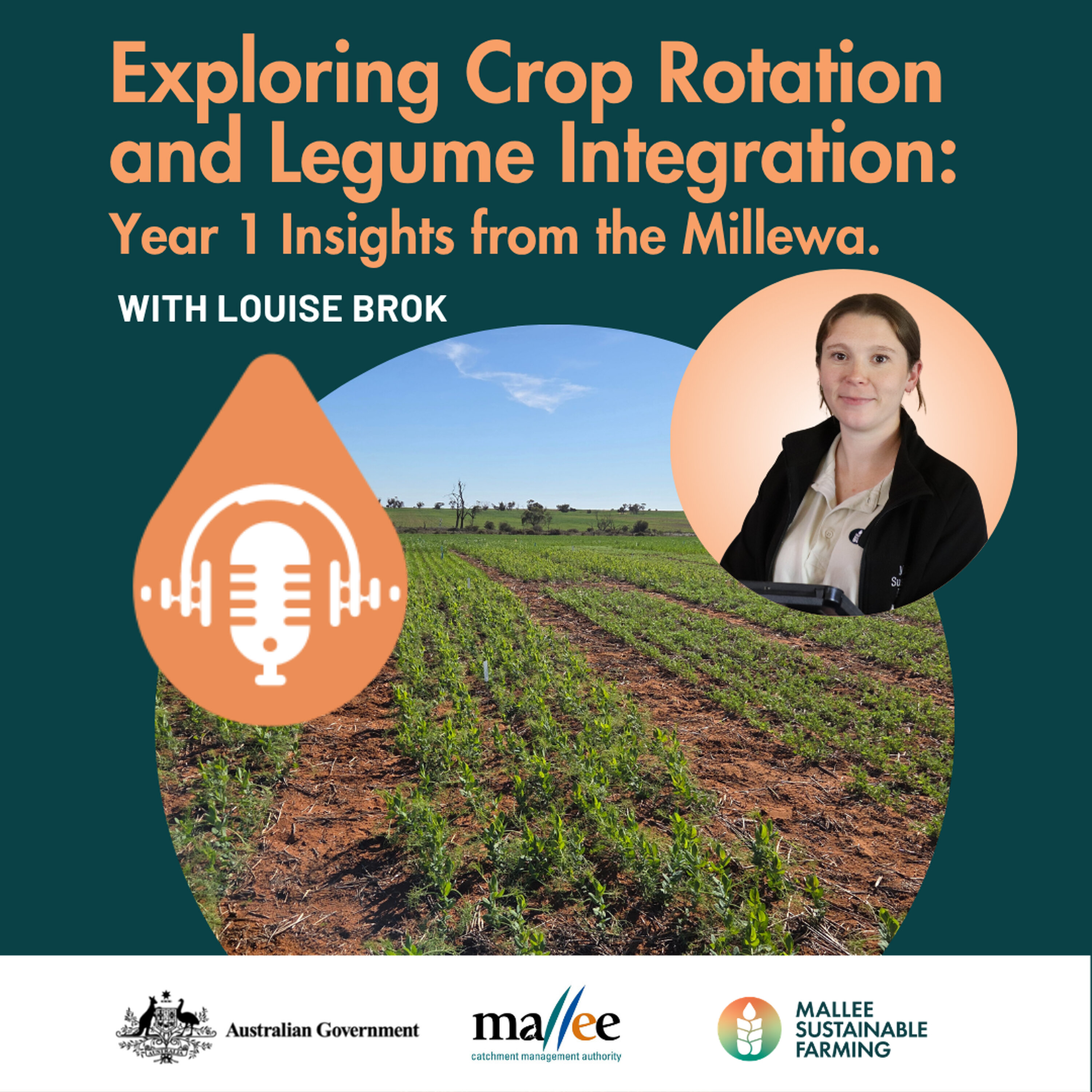
Exploring Crop Rotation and Legume Integration: Year 1 Insights from the Millewa - with Louise Brok

Mallee Sustainable Farming Research Officer Louise Brok shares insights from the Millewa long-term crop rotation trial established in 2025 in the Victorian Mallee. The trial is evaluating pulse-inclusive farming systems, featuring 50% legumes across five fully phased rotations over four years. The project is investigating profitability, nitrogen fixation and fertiliser requirements, and groundcover retention. Designed for the low-organic-carbon sandy soils of the region, the work aims to test and validate farming systems that improve both productivity and resilience in high-risk environments. Despite an extremely dry 2025 season — with crops dry sown on 5 May and receiving only around 90 mm of growing-season rainfall — the trials still delivered valuable early insights. This episode explores the first-year results from the crop rotation and legume integration trial, along with additional demonstrations including wheat–vetch intercropping with varying vetch termination timings and a MAP fertiliser rate demonstration. 📄 Year 1 Results Fact Sheet: Millewa Fact Sheet Year 1 📋 Legume based cropping systems project page: Legume Based Cropping Systems - Mallee Sustainable Farming This project is supported by the Australian Government through funding from the Natural Heritage Trust under the Climate-Smart Agriculture Program. Support the show: https://msfp.org.au/about/membership/ See omnystudio.com/listener for privacy information.
June 4, 202617 min

Navigating Carbon Farming and Emissions Accounting - with Ed Scott

In this episode of the MSF Farm Talk podcast 🎙️, recorded at the March MSF Mallee Research Updates, Ed Scott explores how carbon farming and emissions accounting are evolving in Australian agriculture — and what it means at the farm gate. Ed discusses the shift from carbon credits toward sustainability reporting and Scope 1, 2 and 3 emissions, and why grain buyers and supply chains are increasingly focused on emissions intensity. He also explains how tools like the GAF Tool and AIA platform can help growers benchmark performance over 3–5 years. The conversation highlights practical opportunities to reduce emissions while maintaining profitability, including improving nitrogen efficiency, incorporating legumes, increasing yield potential, and strengthening on-farm data capture and documentation. Ed also links emissions intensity to precision agriculture, discussing variable rate inputs, layering data such as yield, protein, NDVI and soil tests, and the emerging market programs and incentives shaping the future of farming. Emissions Accounting Tools: Greenhouse Accounting Frameworks (GAF) for Australian Primary Industries: Tools | Primary Industries Climate Challenges Centre AIA Environmental Accounting Platform: Home | AIA EAP This podcast episode of the Regional Drought Resilience Planning program is supported by Mallee CMA and Mallee Sustainable Farming, through funding from the Australian Government’s Future Drought Fund and the Victorian Government. Support the show: https://msfp.org.au/about/membership/ See omnystudio.com/listener for privacy information.
May 21, 20269 min

Tackling Mallee Seeps: Insights from the MSF Research Update

Tackling Mallee Seeps: Insights from the MSF Research Update In this episode of the MSF Farm Talk podcast 🎙️, Chris McDonough shares insights from a Mallee Research Update in Victoria on identifying and managing Mallee seeps — areas where perched water tables bring water and salt close to the soil surface, causing ponding, crop loss and bare saline scalds. The discussion covers the importance of early detection, understanding water-table salinity, and practical management strategies to restore affected areas. These include re-establishing living groundcover with salt-tolerant species such as puccinellia and tall wheat grass, and lowering perched water tables by intercepting and utilising excess water with perennial plants like lucerne strips. Chris also highlights a range of tools and videos available on the MSF website, including a five-step decision tree to help growers assess seep type, landscape position, severity and salinity. Explore the Mallee Seeps project pages to learn more about identifying mallee seeps, best-practice management approaches, and grower case studies. Project Page, Resources and Case Studies: Mallee Seeps - Mallee Sustainable Farming Mallee Seeps Decision Tree - Mallee Sustainable Farming Case studies of seeps trial sites in the Victorian Mallee - Mallee Sustainable Farming Evaluation & monitoring methods for Mallee seeps - Mallee Sustainable Farming Mallee Seeps Satellite NDVI Imagery - Mallee Sustainable Farming Soils Connect (Practical Soil Management Resources): Soils Connect | Your Hub for Soil Knowledge & Innovation This podcast episode of the Regional Drought Resilience Planning program is supported by Mallee CMA and Mallee Sustainable Farming, through funding from the Australian Government’s Future Drought Fund and the Victorian Government. Support the show: https://msfp.org.au/about/membership/ See omnystudio.com/listener for privacy information.
May 7, 202611 min

Managing Dry Saline Land: Insights from the MSF Research Updates

Managing Dry Saline Land: Insights from the MSF Research Updates In this episode of the MSF Farm Talk podcast, Chris McDonough shares practical insights from a recent MSF Mallee Research Update in Victoria, exploring how growers can better manage dry saline land and improve crop establishment in challenging conditions. Chris explains how transient subsoil salinity can move to the soil surface during dry periods through capillary rise and evaporation, often making the top 5 cm significantly more saline than the layers below. The episode also unpacks how salinity impacts crops through osmotic stress and toxicity, reducing germination, emergence and plant survival. The discussion focuses on practical management strategies aimed at improving establishment and maintaining ground cover, including: Retaining surface cover such as straw or mulch Using opportunistic rainfall events to aid establishment Avoiding practices that bring saline clay to the surface Considering more salt-tolerant crop varieties This episode provides growers and advisers with practical considerations for protecting soil surfaces, improving resilience and managing productivity on saline-prone soils. Explore the Dry Saline Land project pages to learn more about identifying dry saline land, best-practice management approaches, and grower case studies. Project Pages: Dry Saline Land - Mallee Sustainable Farming Fixing Saline Soils - Mallee Sustainable Farming Case Studies: Case Study 5: Rick Plant | Resilient Soils Saline Soils Case Study How to spread straw Spreading sand vs straw Soils Connect (Practical Soil Management Resources): Soils Connect | Your Hub for Soil Knowledge & Innovation This podcast episode of the Regional Drought Resilience Planning program is supported by Mallee CMA and Mallee Sustainable Farming, through funding from the Australian Government’s Future Drought Fund and the Victorian Government. Support the show: https://msfp.org.au/about/membership/ See omnystudio.com/listener for privacy information.
April 27, 202610 min

Veris Mapping Explained: Seeing Soil pH Differently - with Jordan Ball

Veris Mapping Explained: Seeing Soil pH Differently - with Jordan Ball. In this episode of the MSF Farm Talk Podcast 🎙️Kylie Matthewson catches up with Jordan Ball from AgMap Soil Testing at the recent MSF Pre-Seeding Workshop & VRT Forum at Lameroo in March. Jordan presented on the day on Veris mapping, acidity and other applications. The discussion explores how Veris mapping can help farmers better understand and manage soil acidity variability across their paddocks. Take-home messages: Soil pH variability is common and often underestimated Veris mapping provides precision insights to target lime where it’s needed most Soil acidity is an ongoing challenge—monitoring and management are key Using the right tools supports better input decisions and long-term productivity If you want to hear more, like 👍 and subscribe 🔔 to the MSF Farm Talk Podcast 🚜🎙️ This podcast episode was recorded at the MSF Pre-seeding Workshop & VRT Forum at Lameroo in March and is supported by the Murraylands and Riverland Landscape Board. Support the show: https://msfp.org.au/about/membership/ See omnystudio.com/listener for privacy information.

March 26, 20268 min

Keeping Sandy Soils in Place: Exploring dust control solutions with Shane Phillips – BioCentral Labs

🎙️In this MSF Farm Talk podcast episode, host Sarah Day chats with Shane Phillips, lead chemist at BioCentral Labs, about dust control solutions for sandy soils in broadacre cropping. Shane discusses two products being trialled in the Mallee this year – DustChek, a polymer binding agent, and AquaBoost, a fermented seagrass bacterial product – and how they could help reduce soil drift and erosion risk. For more information on BioCentral Labs products, visit: https://www.biocentral-labs.com/ To learn more about the project, check out the media release: https://msfp.org.au/new-project-funding-secured-as-drought-and-dust-take-hold-in-the-mallee/ Keep an eye out for updates from this project during the growing season. If you want to hear more, like 👍 and subscribe 🔔 to the MSF Farm Talk Podcast. This project is supported by the Murraylands and Riverland Landscape Board with funding from the South Australian Government’s Landscape Priorities Fund, with co-investment from GRDC. Support the show: https://msfp.org.au/about/membership/ See omnystudio.com/listener for privacy information.

Is this your show?

Claim this listing to keep it up to date, reach guests who want to pitch you, and manage bookings with Guestify.

Claim this listing

More Business podcasts