
Find partners
Money On Tap

Money On Tap

Hosted by Ben Brayshaw & Seth Krussman

BusinessExplicit

Episodes

360

Latest episode

Aug 2026

Language

EN

About the show

Hi, and welcome to "Money on Tap", your personal finance headquarters where we bring out the professionals, experience, and some fun in what we call 3 dimensional investing; utilizing insurance, brokerage, and fee-based planning. We believe all investments have merit, all investments have relevance and all investments have their time and place, depending on your goals and appetite for risk. On a weekly basis "Money on Tap" airs live in New England and is rebroadcast multiple times, as well as available on podcast. Our goal is to educate and debate the current relevant financial issues facing today's investors. As planners with Brayshaw Financial Group, LLC, we have over a century of experience among our planners, and find that many people simply cannot engage in healthy and constructive financial planning relationships due to the magnitude of the industry as a whole. As we educate and debate current topics and relate them to everyday concerns, we will help empower you to feel more confident and more aware as an investor. Mentioned on air: Our short sequence-of-returns risk video — watch it at brayshawfinancial.com .Read the companion blog: brayshawfinancial.com/blog Schedule a free consultation: app.greminders.com/t/9f3ce72e/initialconsulta Full Money On Tap episode library: brayshawfinancial.com/money-on-tap Contact Us Phone: 855-226-8551 Email: info@yourmoneyontap.com Office: 116 South River Road, Bedford, NH 03110 Web: brayshawfinancial.com

Listen to episodes

60 recent
August 7, 2026Episode 41056 min

The Return of Value Investing

Value investing spent fifteen years out of fashion. This year, it's beating the index almost everywhere you look — energy up roughly 20%, industrials 17%, healthcare 15%, utilities 14%, financials 12% — while the S&P 500 sits near 8–9%. This week we dig into the return of value investing and what the greatest investors of all time can teach us right now. On this week's Money On Tap, we go deep on the tradition that runs from Benjamin Graham through Warren Buffett and Charlie Munger: buying good businesses at sensible prices, collecting the dividends they pay you, and letting compounding do the heavy lifting. We explain why value went dark from roughly 2009 to 2025 — cheap money was rocket fuel for growth stocks — and why higher interest rates have flipped the script: growth borrows, value pays you. We connect the rotation to worn-out tech traders taking gains, the 401(k) flywheel, and the demographic engine underneath it all — roughly 10,000 baby boomers reaching retirement age every day, all needing present-day income. Plus Pepsi's 53-year dividend streak and a candid conversation about when mutual funds and ETFs stop making sense and direct stock ownership starts. What you'll learn: The sector scoreboard: energy ~20%, industrials ~17%, healthcare ~15%, utilities ~14%, financials ~12%, staples ~9% — vs. the S&P 500 near 8–9% Graham vs. Buffett: buy cheap and sell at fair value, or buy outstanding businesses and hold for decades Munger's rule: "The big money is not in the buying or the selling, but in the waiting" Why low interest rates buried value for fifteen years — and why higher rates brought it back Margin of safety: the idea that protects you when you're wrong Why money is rotating into companies that pay you to own them — dividends over promises The demographic engine: 10,000 boomers a day retiring and the demand for present-day income The compounding story: Buffett's American Express dividends now exceed his entire original investment — every year When funds stop making sense: the case for direct stock ownership at higher net worth Plus Money In The News: SpaceX says it's coming for AT&T, Verizon, and T-Mobile customers — but does satellite cell service actually work? The Treasury has refunded $100 billion in invalidated tariff revenue to companies — and none of it is coming back to you A tale of two housing markets: luxury demand surges while starter-home buyers finally see inventory Want a white paper on this week's topic? Email us at info@yourmoneyontap.com and we'll send it over. Read our most recent Blog Post on this topic here: https://www.fmgwebsites.com/d772de05-9833-44e4-9676-f510f85cef74/blog/the-return-of-value-investing-why-boring-profitable-companies-are-winnin Schedule a free consultation: https://app.greminders.com/t/9f3ce72e/initialconsulta Browse the full Money On Tap library: https://www.brayshawfinancial.com/money-on-tap Contact Us Phone: 855-226-8551 Email: info@yourmoneyontap.com Office: 116 South River Road, Bedford, NH 03110 Web: brayshawfinancial.com Securities and advisory services offered through Osaic Wealth, Inc., member FINRA/SIPC. All other services offered through Brayshaw Financial Group, LLC are independent of Osaic Wealth, Inc. Osaic Wealth, Inc. and Brayshaw Financial Group do not provide tax or legal advice. Index and sector figures cited are approximate year-to-date values as of the air date, drawn from sources believed reliable, and subject to change. Dividend payments are not guaranteed and may be reduced or eliminated at any time. Past performance is not a guarantee of future results. What is value investing and why is it working again in 2026? Value investing means buying strong, profitable, often dividend-paying companies at sensible prices and holding them patiently — the approach built by Benjamin Graham and made famous by Warren Buffett and Charlie Munger. It struggled while near-zero interest rates favored growth stocks, but higher rates flipped the equation: in 2026, value sectors like energy (~20%), industrials (~17%), and healthcare (~15%) are outpacing the S&P 500's roughly 8–9%. The appeal is simple — instead of borrowing to chase growth, these companies pay shareholders real income today, and reinvested dividends compound over decades.
July 30, 2026Episode 40956 min

The Healthiest Bull Market Nobody is Talking About

Your S&P 500 fund says 7% — but over 300 of its stocks are beating the index. This week we dig into the massive broadening of the market that almost nobody in the financial media is talking about, and why we think it's the healthiest thing to happen to this bull market in years.For three years, seven stocks did all the talking. This year, the other 493 are answering. On this week's Money On Tap, we walk through the numbers behind the broadening: the Magnificent Seven still make up roughly a third of every dollar in a cap-weighted S&P 500 index fund — which is exactly why so many statements look stuck at 7% while the equal-weight S&P runs above 14%, the Russell 1000 Value nears 20%, and healthcare and industrials each post roughly 24% year to date. We connect it to the 100-year-old Dow theory (industry makes goods, transportation moves them — and both are near highs), unpack the defensive-stock paradox (staples rallying while nobody calls a recession), revisit the historical pattern from 1983, 1995, 2003, 2013, and 2020 where tech blows out and then leadership broadens — and get practical about what a broadening market rewards most: rebalancing, equal-weight exposure, sector and international diversification, and knowing what your 401(k) actually owns.What you'll learn: Why a third of every S&P 500 index-fund dollar sits in just seven stocks — and what that's done to your return this year The breadth numbers: 300+ stocks beating the index, roughly seven in ten S&P names up on the year The sector scoreboard: healthcare ~24%, industrials ~24%, staples ~11.3%, financials ~9.7%, utilities ~7.6% Why money is rotating, not leaving — and why that's the opposite of how crashes start Dow theory at 100+: what industrials and transports near highs historically signal The defensive-stock paradox: staples leading without a recession call anywhere in sight The rebalancing playbook: taking profits without apology, calendar discipline, equal-weight funds (11.9% vs 10.9% over 20 years) How to broaden with new contributions instead of selling your winners Target-date fund warnings: layered fees, hidden allocations, and no way to rebalance Why this is not a reason to dump technology — proportion, not exit Plus Money In The News: A property-management company bets $200K on AI to make the trades more efficient — filling a labor gap instead of cutting jobs Apple set for its strongest June-quarter sales growth in five years — flat iPhone pricing, a $5 trillion moment, and sitting out the AI arms race The 100-year-old Dow theory says this market isn't done climbing Want a white paper on this week's topic? Email us at info@yourmoneyontap.com and we'll send it over.Read the companion blog: https://www.brayshawfinancial.com/blog Schedule a free consultation: https://app.greminders.com/t/9f3ce72e/initialconsulta Browse the full Money On Tap library: https://www.brayshawfinancial.com/money-on-tap Contact Us Phone: 855-226-8551 Email: info@yourmoneyontap.com Office: 116 South River Road, Bedford, NH 03110 Web: brayshawfinancial.com Securities and advisory services offered through Osaic Wealth, Inc., member FINRA/SIPC. All other services offered through Brayshaw Financial Group, LLC are independent of Osaic Wealth, Inc. Osaic Wealth, Inc. and Brayshaw Financial Group do not provide tax or legal advice. Index and sector figures cited are approximate year-to-date values as of the air date, drawn from sources believed reliable, and subject to change. Past performance is not a guarantee of future results. What is value investing and why is it working again in 2026? Value investing means buying strong, profitable, often dividend-paying companies at sensible prices and holding them patiently — the approach built by Benjamin Graham and made famous by Warren Buffett and Charlie Munger. It struggled while near-zero interest rates favored growth stocks, but higher rates flipped the equation: in 2026, value sectors like energy (~20%), industrials (~17%), and healthcare (~15%) are outpacing the S&P 500's roughly 8–9%. The appeal is simple — instead of borrowing to chase growth, these companies pay shareholders real income today, and reinvested dividends compound over decades.
July 24, 2026Episode 40856 min

Retirement Rescue: The Money Mistakes of Every Decade

Whatever you've done, there's a very good chance you can recover. That's the message of this week's show — and then Ben and Dan get specific, decade by decade, about the mistakes that quietly sink retirements and the moves that rescue them.In this week's Money On Tap, Ben Brayshaw and Dan Michelon walk through the money mistakes of every stage of life. The 20s and 30s: waiting to invest, lifestyle inflation, and treating insurance as a nuisance instead of what it really is — protection of your ability to retire. The 40s — the squeeze years: turning off the 401(k) match to pay the bills (walking away from free money), getting too comfortable with debt, and skipping the tax planning that builds tax-free assets for later. The 50s — the catch-up years: catch-up contributions, the HSA "triple threat," the backdoor Roth, and the fear-driven mistake of going too conservative too soon. And in retirement itself: the light-switch move to cash, target-date funds past their date, scattered old 401(k)s, chasing a "number" instead of an income, and the biggest one of all — no plan for a health change.What you'll learn: Why your 20s and 30s are the most powerful investing decade you'll ever get — and what lifestyle inflation really costs Insurance reframed: insuring well-being, not events — and why long-term care planning protects the healthy spouse The 401(k) match rule for the squeeze years: never walk away from free money When to shift from investment planning to retirement planning — and why the goal is an income number, not a total number The catch-up toolkit for your 50s: 401(k) and IRA catch-ups, the HSA triple threat, and the backdoor Roth Why "too conservative too soon" quietly loses money backwards — and how segmentation puts risk and security in one strategy The bucket strategy in action: a real case of a 60%-bond portfolio, a 4.5% withdrawal rate, and a first-home gift — rescued Foundational expenses: the income planning step most people skip before retiring The health-change plan: estate documents, powers of attorney, and why waiting can mean it's too late to sign Plus Money In The News: Alphabet set for a blockbuster quarter as AI bets collide with spending fears — why this AI buildout isn't the dot-com era Phased tariffs on generic drugs: 90% of U.S. prescriptions are generics, and most aren't made here Fidelity's new number: retirees may need nearly $186,000 for healthcare — up 7.5% in a year Want the Retirement Rescue white paper? Email us at info@yourmoneyontap.com and we'll send it over.Read the companion blog: https://www.brayshawfinancial.com/blog Schedule a free consultation: https://app.greminders.com/t/9f3ce72e/initialconsulta Browse the full Money On Tap library: https://www.brayshawfinancial.com/money-on-tap Contact Us Phone: 855-226-8551 Email: info@yourmoneyontap.com Office: 116 South River Road, Bedford, NH 03110 Web: brayshawfinancial.com Securities and advisory services offered through Osaic Wealth, Inc., member FINRA/SIPC. All other services offered through Brayshaw Financial Group, LLC are independent of Osaic Wealth, Inc. Osaic Wealth, Inc. and Brayshaw Financial Group do not provide tax or legal advice. Figures cited are as of the air date, drawn from sources believed reliable, and subject to change. Past performance is not a guarantee of future results. What is value investing and why is it working again in 2026? Value investing means buying strong, profitable, often dividend-paying companies at sensible prices and holding them patiently — the approach built by Benjamin Graham and made famous by Warren Buffett and Charlie Munger. It struggled while near-zero interest rates favored growth stocks, but higher rates flipped the equation: in 2026, value sectors like energy (~20%), industrials (~17%), and healthcare (~15%) are outpacing the S&P 500's roughly 8–9%. The appeal is simple — instead of borrowing to chase growth, these companies pay shareholders real income today, and reinvested dividends compound over decades.
July 18, 2026Episode 40756 min

Beyond the Index, Winners, Losers, & What's Next

The S&P 500 is up about 10.2% this year. That average is hiding one of the most lopsided markets in a decade: energy up 28%, communication services negative, and the Magnificent Seven — the stocks that carried the market for three years — collectively underwater.In this week's Money On Tap, Ben Brayshaw and Dan Michelon go beyond the index, sector by sector. They walk the 2026 scoreboard — energy +28.1%, technology +26.8%, industrials +16%, with a 30-point gap between the top and bottom sectors — and unpack the year's most important story: the broadening of the market, with 46.3% of S&P companies now beating the index itself, up from 30.5% last year. Then the mechanics most investors never see: why seven stocks absorb a third of every dollar in a standard S&P fund, why the SPY and QQQ share 8–9 of their top 10 holdings, and why your "diversified" ETFs may be the same bundle of stocks in different wrappers. They close with the Fed's looming rate decision — hike odds jumped from 26% to 73% in one month — and the five durable themes they're watching for the second half.What you'll learn: The 2026 sector scoreboard: all 11 sectors ranked, from energy's +28.1% to communication services' −3.1% The broadening of the index: why 46.3% of S&P companies are beating the index — a decade-plus first Why the Mag Seven flipped from engine to anchor (Microsoft down 20%+), and what the index looks like without them The ETF overlap trap: cap weighting, 35–55% in the top 10, and wrappers around the same stocks What a Fed rate hike would do to sector leadership — winners and losers under both scenarios Buffett's warning: "a church with a casino attached," and why down doesn't mean cheap The dials for outperforming: sector weighting, security selection, valuation discipline, income, cash, and tax management Taking gains on purpose: the sequence-of-returns lesson in 2026's −4.3% Q1 and +15.2% Q2 Five second-half themes: electrification, defense, nuclear renaissance, the aging population, and the infrastructure rebuild Plus Money In The News: 73% odds of a Fed rate hike by September — up from 26% just a month earlier — and the two culprits behind it Warren Buffett: it's tough to find value "when everybody is preferring gambling" Blockbuster stock sales — SpaceX's record $75B IPO, Alphabet's $85B raise, SK Hynix ADRs — and whether $500B of new equity can overwhelm the bull market Read the companion blog: https://www.brayshawfinancial.com/blog Schedule a free consultation: https://app.greminders.com/t/9f3ce72e/initialconsulta Browse the full Money On Tap library: https://www.brayshawfinancial.com/money-on-tap Contact Us Phone: 855-226-8551 Email: info@yourmoneyontap.com Office: 116 South River Road, Bedford, NH 03110 Web: brayshawfinancial.com Securities and advisory services offered through Osaic Wealth, Inc., member FINRA/SIPC. All other services offered through Brayshaw Financial Group, LLC are independent of Osaic Wealth, Inc. Index and sector performance figures are as of the air date and subject to change. Past performance is not a guarantee of future results. What is value investing and why is it working again in 2026? Value investing means buying strong, profitable, often dividend-paying companies at sensible prices and holding them patiently — the approach built by Benjamin Graham and made famous by Warren Buffett and Charlie Munger. It struggled while near-zero interest rates favored growth stocks, but higher rates flipped the equation: in 2026, value sectors like energy (~20%), industrials (~17%), and healthcare (~15%) are outpacing the S&P 500's roughly 8–9%. The appeal is simple — instead of borrowing to chase growth, these companies pay shareholders real income today, and reinvested dividends compound over decades.
July 9, 2026Episode 40656 min

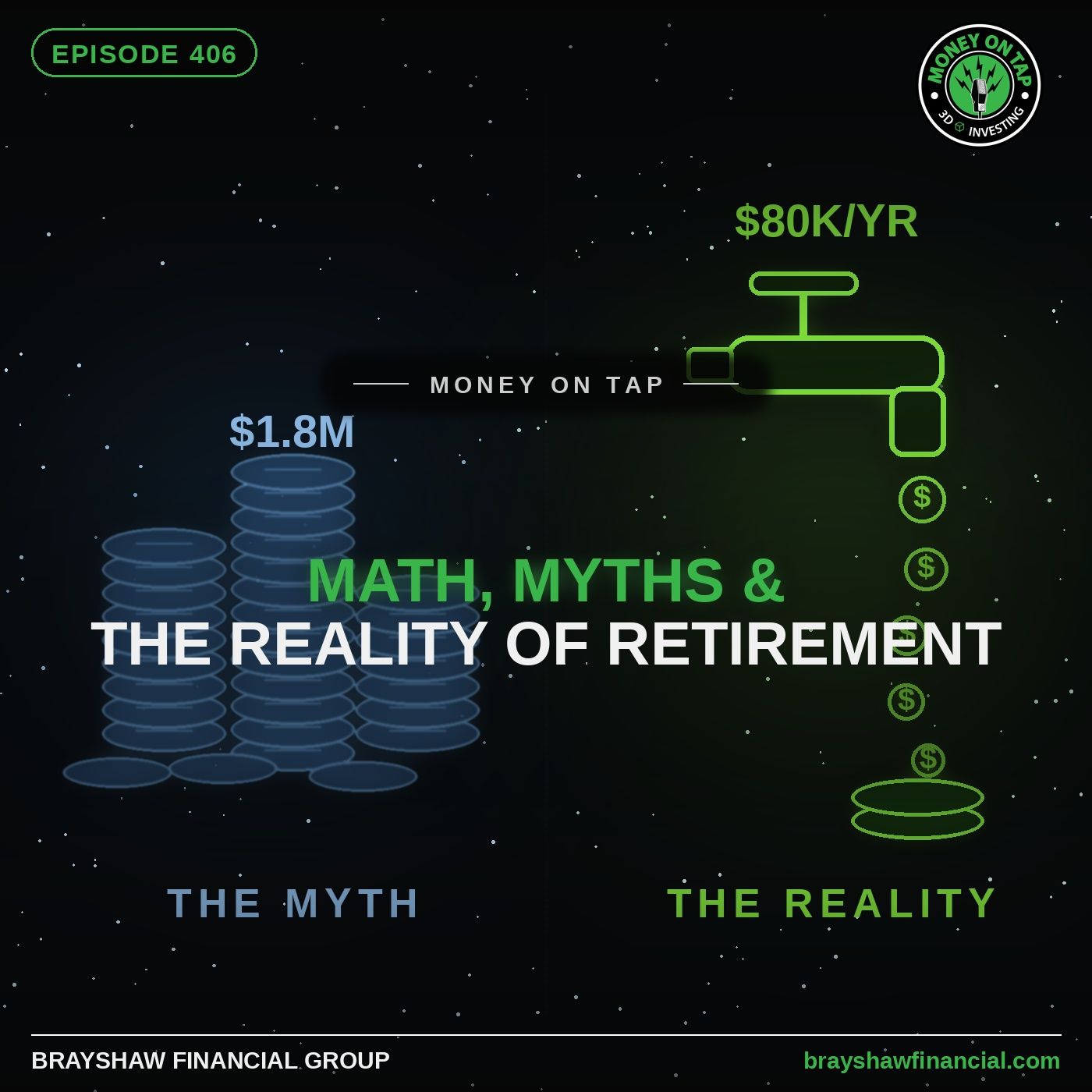
Math, Myths & The Reality of Retirement: Why Income Beats the Magic Number

A new study says the average retired couple needs $1.16 million to retire comfortably. Scary headline — until you do the math. Because retirement was never about reaching a number. It's about the paycheck that number can produce.In this week's Money On Tap, Ben Brayshaw and Dan Michelon take the "magic number" apart piece by piece. They trace where $1.16 million actually comes from — $84,000 in average spending, $37,700 in Social Security, and a 4% withdrawal covering the gap — then show what the headline can't see: sequence of returns risk, the tax code, health events, and the market's habit of dropping 25–30% when you can least afford it. The centerpiece is a tale of three couples: Couple A with $1.8 million and no guaranteed income beyond Social Security, Couple B with $950,000 and a teacher's pension, and Couple C with $900,000 who built their own pension with an annuity — and ended up more secure than the couple with twice the money.What you'll learn: Where the $1.16 million figure really comes from — and why the study converts it to income immediately Why the race-to-a-number mindset is programmed into us, and why it fails in retirement The tax reality: 12% vs. 22% brackets, Social Security taxation, RMDs at 73, Medicare's hidden 3–5% "tax," and climbing capital gains rates The bucket strategy: cash for years 0–3, buffered strategies and dividends for 3–7, growth for 7+ Why 1% of inefficiency on a 4% drawdown is really 25% of your income Couple A vs. B vs. C: how guaranteed income beats a bigger portfolio The timing trap: why buying the annuity after the crash locks in the loss Rewriting the 4% rule with 5–7% joint lifetime annuity payouts Plus Money In The News: SpaceX goes public: Wall Street's sky-high price targets, the trillion-dollar valuation, and why investors stay cautious Trump floats an Australian-style retirement system with 12% employer contributions The IRA saver's match arriving in 2027: who qualifies, and why the income limits are so tight Read the companion blog: https://www.brayshawfinancial.com/blog Schedule a free consultation: https://app.greminders.com/t/9f3ce72e/initialconsulta Browse the full Money On Tap library: https://www.brayshawfinancial.com/money-on-tap Contact Us Phone: 855-226-8551 Email: info@yourmoneyontap.com Office: 116 South River Road, Bedford, NH 03110 Web: brayshawfinancial.com Securities and advisory services offered through Osaic Wealth, Inc., member FINRA/SIPC. All other services offered through Brayshaw Financial Group, LLC are independent of Osaic Wealth, Inc. Annuity guarantees are subject to the claims-paying ability of the issuing insurance company. What is value investing and why is it working again in 2026? Value investing means buying strong, profitable, often dividend-paying companies at sensible prices and holding them patiently — the approach built by Benjamin Graham and made famous by Warren Buffett and Charlie Munger. It struggled while near-zero interest rates favored growth stocks, but higher rates flipped the equation: in 2026, value sectors like energy (~20%), industrials (~17%), and healthcare (~15%) are outpacing the S&P 500's roughly 8–9%. The appeal is simple — instead of borrowing to chase growth, these companies pay shareholders real income today, and reinvested dividends compound over decades.

July 4, 2026Episode 40556 min

The Hidden Companies Powering the AI Revolution: The Picks and Shovels of the Build-Out

Only 20–30% of the AI data centers planned through 2030 are built today. The other 70–80% — the cement, the cooling, the chips, the memory, the power — are still coming. And the companies collecting the profits from that build-out are mostly names the mainstream isn't talking about.In this week's Money On Tap, Ben Brayshaw and Dan Michelon go beyond the Mag Seven and into the hidden companies powering the AI revolution. They trace how the AI trade rotated from the companies spending the money to the companies receiving it — the second-wave winners like Micron, SanDisk, Vertiv, Marvell, and Broadcom — and why Taiwan Semiconductor may be the king of the whole story. Then they go layer by layer through what's still ahead: electrical infrastructure, utilities and nuclear power, engineering, construction materials, and data center REITs.What you'll learn: Why only 20–30% of planned AI data centers exist — and what that means for the next decade of demand The rotation out of the Mag Seven: from speculation and hope to follow-the-money The AI stack, layer by layer: chips, memory (Micron), storage (SanDisk), cooling (Vertiv), networking (Marvell, Broadcom) Why Taiwan Semiconductor is the company nearly every AI player depends on The risks worth respecting: valuation, capex pullbacks, competition, interest rates, and tariffs The layers still to come: electrical, power and grid, engineering, materials, machinery, and data center REITs Why high conviction — knowing why you own what you own — beats chasing every headline Plus Money In The News: Trump Accounts for kids launch July 4: $1,000 at birth, up to $5,000 a year — and the math that could reach seven figures by retirement Which financial stocks actually benefit when interest rates stay high Trump's rare earth agenda hits a milestone as the U.S. Army moves to break China's grip on defense metals Read the companion blog: https://www.brayshawfinancial.com/blog Schedule a free consultation: https://app.greminders.com/t/9f3ce72e/initialconsulta Browse the full Money On Tap library: https://www.brayshawfinancial.com/money-on-tap Contact Us Phone: 855-226-8551 Email: info@yourmoneyontap.com Office: 116 South River Road, Bedford, NH 03110 Web: brayshawfinancial.com Securities and advisory services offered through Osaic Wealth, Inc., member FINRA/SIPC. All other services offered through Brayshaw Financial Group, LLC are independent of Osaic Wealth, Inc. What is value investing and why is it working again in 2026? Value investing means buying strong, profitable, often dividend-paying companies at sensible prices and holding them patiently — the approach built by Benjamin Graham and made famous by Warren Buffett and Charlie Munger. It struggled while near-zero interest rates favored growth stocks, but higher rates flipped the equation: in 2026, value sectors like energy (~20%), industrials (~17%), and healthcare (~15%) are outpacing the S&P 500's roughly 8–9%. The appeal is simple — instead of borrowing to chase growth, these companies pay shareholders real income today, and reinvested dividends compound over decades.

June 25, 2026Episode 40456 min

The Great Wealth Transfer: Will Your Family Be Ready? $124 Trillion Is About to Change Hands

By 2048, an estimated $124 trillion will change hands — the largest transfer of wealth in human history. Roughly $105 trillion to heirs, $18 trillion to charity. And here’s the uncomfortable truth: about 70% of family wealth disappears by the second generation, and 90% is gone by the third.In this week’s Money On Tap, Ben Brayshaw and Dan Michelon dig into what the great wealth transfer really means — not for the economy, but for your family. They unpack why wealth preservation is far more behavioral than investment-driven, what the Vanderbilts got wrong and the Rockefellers got right, and the Warren Buffett principle every parent and grandparent should know. Most importantly, they walk through the four conversations every family needs to have before the money moves — and the simple first step you can take this week.What you’ll learn: Why $124 trillion in motion could be a generational blessing — or a great wealth disaster The statistic that should stop every family cold: 70% gone by generation two, 90% by generation three Why wealth preservation is behavioral, not investment-driven The tale of two fortunes: Vanderbilt vs. Rockefeller The four conversations every family must have before the transfer A practical first step you can take this week — and the BFG white paper that helps you run your own family meeting Plus Money In The News: General Motors and Lockheed Martin announce a new multi-billion-dollar defense manufacturing partnership Jeff Bezos proposes eliminating federal income taxes for the bottom half of U.S. earners — and what it would actually mean “The job interview is broken”: how AI is reshaping hiring on both sides of the table Read the companion blog: https://www.brayshawfinancial.com/blog Schedule a free consultation: https://app.greminders.com/t/9f3ce72e/initialconsulta Browse the full Money On Tap library: https://www.brayshawfinancial.com/money-on-tap Contact Us - Phone: 855-226-8551 - Email: info@yourmoneyontap.com - Office: 116 South River Road, Bedford, NH 03110 - Web: brayshawfinancial.comSecurities and advisory services offered through Osaic Wealth, Inc., member FINRA/SIPC. All other services offered through Brayshaw Financial Group, LLC are independent of Osaic Wealth, Inc. What is value investing and why is it working again in 2026? Value investing means buying strong, profitable, often dividend-paying companies at sensible prices and holding them patiently — the approach built by Benjamin Graham and made famous by Warren Buffett and Charlie Munger. It struggled while near-zero interest rates favored growth stocks, but higher rates flipped the equation: in 2026, value sectors like energy (~20%), industrials (~17%), and healthcare (~15%) are outpacing the S&P 500's roughly 8–9%. The appeal is simple — instead of borrowing to chase growth, these companies pay shareholders real income today, and reinvested dividends compound over decades.
June 15, 2026Episode 40356 min

Retirement Redzone, The Last Mile

Ten straight up weeks, then a sharp pullback — and if you’re two to five years on either side of retirement, the fear is real. This is the Retirement Red Zone: the last mile into and out of your retirement date, and the most fragile window in your entire financial life.This week on Money On Tap, Ben Brayshaw and Dan Michelon turn last week’s market-history conversation into a practical playbook for anyone near retirement: how to avoid the paralysis that wrecked so many retirements in 2008–2009, and what to actually do right now.What you’ll learn: Why a 35-year-old and a 65-year-old should do the opposite thing in a pullback The accumulation-to-distribution switch most people don’t know exists What history says: after 40 sharp selloffs since 1980, markets were higher 75% of the time a year later Sequence-of-returns risk — why the first five years decide everything Building a 1–3 year retirement runway with ~4% cash and T-bills Rebalancing a 60/40 that drifted to 75/25 Diversifying away from a top-10 that’s now 40% of the S&P (8 of them tech) Buffered ETFs — a 20% buffer with a 12–15% cap, explained Foundational income, annuities, and the tax-aware withdrawal piece most firms skip Plus Money In The News: Consumer prices rose 4.2% annually in May — the highest in three years (CNBC, Jeff Cox) Elon Musk poised to become the first trillionaire — and just how much a trillion dollars really is A top JP Morgan strategist’s four ways to prep your portfolio for “considerable danger” (David Kelly) Mentioned on air: Our short sequence-of-returns risk video — watch it at brayshawfinancial.com .Read the companion blog: brayshawfinancial.com/blog Schedule a free consultation: app.greminders.com/t/9f3ce72e/initialconsulta Full Money On Tap episode library: brayshawfinancial.com/money-on-tap Contact Us Phone: 855-226-8551 Email: info@yourmoneyontap.com Office: 116 South River Road, Bedford, NH 03110 Web: brayshawfinancial.com What is value investing and why is it working again in 2026? Value investing means buying strong, profitable, often dividend-paying companies at sensible prices and holding them patiently — the approach built by Benjamin Graham and made famous by Warren Buffett and Charlie Munger. It struggled while near-zero interest rates favored growth stocks, but higher rates flipped the equation: in 2026, value sectors like energy (~20%), industrials (~17%), and healthcare (~15%) are outpacing the S&P 500's roughly 8–9%. The appeal is simple — instead of borrowing to chase growth, these companies pay shareholders real income today, and reinvested dividends compound over decades.

June 11, 2026Episode 40256 min

Risk, Reward, & Record Highs

Nearly every major index is at a record high — and everyone’s asking the same question: is this the beginning of something great, or the end of something that’s gone too far?This week on Money On Tap, Ben Brayshaw and Dan Michelon take that question apart with 75 years of market history, a few statistics that genuinely surprised them, and a clear look at what a record high means for you — whether you’re decades from retirement or already drawing income.What you’ll learn: The Fidelity data showing investing at an all-time high beats investing on a random day Why a record high is usually a signal of a healthy economy, not a top A walk through 1982, 1987, 1995–1999, 2000, 2009, and 2020 Why today’s AI market looks more like 1995 than the 2000 dot-com bubble Why timing the market is a loser’s game — and why taking profits isn’t fear Sequence-of-returns risk — why the first years of retirement decide everything Buffered ETFs — staying in the market with downside guardrails Annuities with lifetime income and long-term-care riders Plus Money In The News: American financial literacy hits a 10-year low — U.S. adults answered just 47% of the TIAA Institute’s 2026 questions correctly (Yahoo Finance, Kerry Hannon) America’s data-center build-out falls behind schedule — Google’s $80B equity raise and what it signals about AI’s real cost (WSJ, Katherine Blunt) Exxon chief warns oil could spike to $160–$170 a barrel as strategic reserves run thin (Fox Business, Robert McGreevy) Mentioned on air: Our short sequence-of-returns risk video — watch it at brayshawfinancial.com .Read the companion blog: brayshawfinancial.com/blog Schedule a free consultation: app.greminders.com/t/9f3ce72e/initialconsulta Full Money On Tap episode library: brayshawfinancial.com/money-on-tap Contact Us Phone: 855-226-8551 Email: info@yourmoneyontap.com Office: 116 South River Road, Bedford, NH 03110 Web: brayshawfinancial.com What is value investing and why is it working again in 2026? Value investing means buying strong, profitable, often dividend-paying companies at sensible prices and holding them patiently — the approach built by Benjamin Graham and made famous by Warren Buffett and Charlie Munger. It struggled while near-zero interest rates favored growth stocks, but higher rates flipped the equation: in 2026, value sectors like energy (~20%), industrials (~17%), and healthcare (~15%) are outpacing the S&P 500's roughly 8–9%. The appeal is simple — instead of borrowing to chase growth, these companies pay shareholders real income today, and reinvested dividends compound over decades.

May 29, 202656 min

Retirement Anxiety: Why So Many Americans Feel Unprepared

61% of Americans now fear running out of money in retirement more than they fear death itself. Half of all U.S. households approaching retirement are at risk of falling short of their current standard of living.This week on Money On Tap, Ben Brayshaw and Dan Michelon sit with the topic that shows up in the conference room more than any other these days: retirement anxiety — and why so many Americans feel unprepared.What you'll learn: The five fears inside retirement anxiety — and which one most plans don't address Why retirement is structurally more anxious today than a generation ago The Honeymoon, the Shock, and the Reframe — the three phases of every retirement Why men, executives, military, and first responders are hit hardest by the identity loss The new 100% income rule (the old 60–70% rule of thumb is dead) The six-part income plan that actually reduces anxiety Sequence-of-returns risk — and why the first five years of retirement determine everything Social Security in 2026: 77% benefit, $1.5T bipartisan proposal, what it means for you Why phased / consulting retirement is the underrated soft landing The emotional plan nobody writes down — hobbies, friendships, purpose, marriage Plus Money In The News: Can the stock market save Social Security? A $1.5T bipartisan proposal from Cassidy and Kaine Ford stock surges on a $2B (becoming $10B) pivot to stationary energy storage with CATL Student loan changes hit July 1 — payments rising $300–$350/month under IBR and RAP plans Free resource: Email us with "Retirement Anxiety white paper" in the subject and we'll send the companion document.Read the companion blog: brayshawfinancial.com/blog Schedule a free consultation: app.greminders.com/t/9f3ce72e/initialconsulta Full Money On Tap episode library: brayshawfinancial.com/money-on-tap Contact Us Phone: 855-226-8551 Email: info@yourmoneyontap.com Office: 116 South River Road, Bedford, NH 03110 Web: brayshawfinancial.com What is value investing and why is it working again in 2026? Value investing means buying strong, profitable, often dividend-paying companies at sensible prices and holding them patiently — the approach built by Benjamin Graham and made famous by Warren Buffett and Charlie Munger. It struggled while near-zero interest rates favored growth stocks, but higher rates flipped the equation: in 2026, value sectors like energy (~20%), industrials (~17%), and healthcare (~15%) are outpacing the S&P 500's roughly 8–9%. The appeal is simple — instead of borrowing to chase growth, these companies pay shareholders real income today, and reinvested dividends compound over decades.

Is this your show?

Claim this listing to keep it up to date, reach guests who want to pitch you, and manage bookings with Guestify.

Claim this listing

More Business podcasts