Find partners
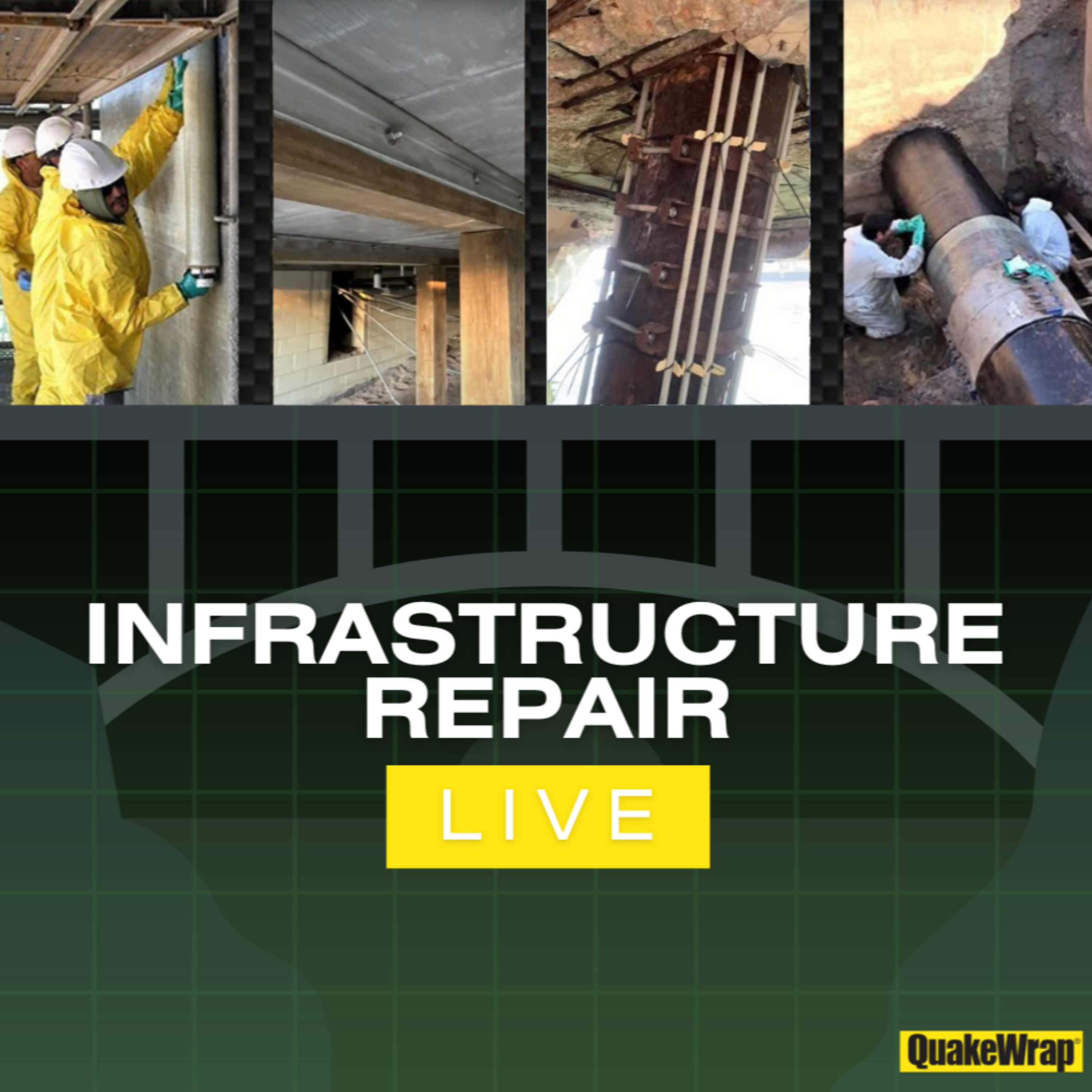
Infrastructure Repair LIVE

Infrastructure Repair LIVE

Hosted by QuakeWrap

BusinessInterviews guests

Episodes

24

Latest episode

Jun 2026

Language

EN-US

About the show

Welcome to the Infrastructure Repair LIVE podcast. On this podcast, you'll learn how to improve your marina docks, sheet piles, columns, piles, and mooring cells from QuakeWrap's CEO Prof Mo Ehsani, and Josh Ahumada. From repair projects to identifying and utilizing innovative solutions—you will understand what it takes to discover, manage, and successfully implement marine infrastructure repair and strengthening that drives long-term success. Through interviews, Q+A, and real-time projects we give you a sneak peek into the data-backed insights we are executing across the world.

Listen to episodes

24 recent
June 18, 202624 min

Epoxy Fill vs. Cementitious Grout: Why Engineers Are Rethinking Timber Pile Repair with PileMedic

Engineers across the U.S. are increasingly specifying epoxy fill over traditional cementitious grout for timber pile repair. In this episode of Infrastructure Repair Live, Professor Mo Ehsani is joined by field engineers Lex and Josh for a live panel and demonstration — breaking down the engineering behind the shift and showing why PileMedic's FRP confinement system paired with epoxy fill is emerging as the superior approach for restoring deteriorated timber piles. What we'll cover: Why epoxy penetrates where grout can't. Low-viscosity epoxy gravity-feeds into borer channels, checks, and decay voids in deteriorated wood — consolidating the remaining timber cross-section into a structural composite. The confinement advantage. PileMedic's seamless FRP shell applies 360-degree uniform hoop stress with no longitudinal seams — eliminating the moisture and oxygen pathways that defeat conventional fiberglass pile jackets. Epoxy grout vs. neat resin — when to use which. A two-component, low-viscosity structural epoxy designed to saturate degraded wood zones, versus a three-component system with aggregate filler — engineered for larger annular cavities. No shrinkage, no porosity, no recontamination. Cured epoxy is non-porous and dimensionally stable. Whether you're specifying your first epoxy-filled pile repair or evaluating it against cementitious alternatives you've used for years, this session gives you the technical detail to make an informed decision. Have questions? Let us know.


March 9, 202635 min

Timber Pile Repair: The Benefits of PileMedic for Marine and Bridge Foundations

Timber piles are still supporting critical infrastructure across the U.S., from waterfront structures and marinas to bridge foundations that may not be fully submerged. In many regions, deterioration is accelerating due to increased biological activity and infestation, creating higher repair urgency and tighter constraints on installation time and budget.In this episode of Infrastructure Repair Live, Mo Ehsani and Josh Ahumada will walk through a field-focused breakdown of timber pile repair using PileMedic, including: How confinement supports structural repair for deteriorated timber piles Why controlling the annular space matters for predictable installation and performance How fill material selection impacts swelling risk and long-term durability Where epoxy grout can make sense, and how economics can shift when the annulus is controlled How timber-adjacent applications like utility poles reflect similar repair principles

December 18, 2025Episode 734 min

Innovations in Culvert Rehab: StifPipe for Circular Culverts (Part 2)

In Part 2 of our culvert rehabilitation podcast series, we are breaking down one of the most innovative FRP technologies in our industry: StifPipe®, QuakeWrap’s patented CFRP honeycomb liner for deteriorated corrugated metal pipe (CMP) culverts. Originally developed from decades of aerospace R&D, StifPipe’s honeycomb core acts like the web of an I-beam, while the inner and outer FRP skins act like the flanges, delivering exceptional stiffness and strength without stacking 10+ layers of carbon fabric. The result is a lightweight, corrosion-proof, stand-alone structural liner that restores the culvert’s load-carrying capacity under soil and traffic loads. In this episode, Mo will walk through: How StifPipe is designed and manufactured using aerospace-inspired honeycomb technology Why this liner resists internal pressure, external soil loads, corrosion, and traffic loads How StifPipe can be built to virtually any size or shape, including non-circular culverts Field installation advantages: lightweight sections, easy assembly, and minimal equipment Real-world case studies like the Arc Terminal project in Alabama and a custom rough-surface liner developed for Hong Kong If you're dealing with aging CMPs or complex culvert geometries, this episode shows why StifPipe is becoming a go-to solution for DOTs and public works teams worldwide.

November 4, 2025Episode 639 min

Innovations in Culvert Rehabilitation: Wet Layup & StifPipe

In this two-part series of Infrastructure Repair Live , we explore advanced, proven methods for rehabilitating deteriorating culverts without costly replacement. Part 1 covers Wet Layup FRP and SPiRe+ for box culverts - a versatile trenchless repair method that restores strength, prevents corrosion, and minimizes traffic disruption. We’ll walk through: How wet layup works in the field Its advantages over traditional methods (lightweight, corrosion-resistant, minimal traffic disruption) Real-world applications where it has saved owners time and money Part 2 will spotlight StifPipe® , QuakeWrap’s patented CFRP honeycomb liner for corrugated metal pipe culverts. StifPipe® was born out of decades of aerospace R&D, using a honeycomb core to deliver stiffness without stacking 10+ layers of carbon fabric. The result: a stand-alone liner that resists internal pressure, external soil loads, and traffic loads , all while reducing material cost and installation time. Whether you’re a bridge engineer, DOT official, asset manager, public works leader, or consultant , this series will give you proven, cost-effective strategies to rehabilitate culverts and pipelines without full replacement OR impact to the flow capacity.

July 22, 2025Episode 528 min

20 - Concrete Repair: Putting QuakeWrap’s SPiRe+ to the test

In this special episode of Marine Infrastructure Live, we'll take an in-depth look at QuakeWrap's latest innovations. We'll share exclusive insights into the company's ongoing research and development, with a focus on the rigorous testing of their SPiRe+ panel system. Listeners will get a behind-the-scenes look as our team performs tests on both the 3-inch thick SPiRe+ panel, which is the most commonly used for marine infrastructure repair, as well as a new 2-inch thick panel that shows promise for innovative applications like fire-resistant roofing for industrial and commercial buildings. We'll walk you through the testing process and demonstrate the performance of these advanced composite materials under load. This episode will give our audience a deeper understanding of the engineering considerations and innovative approaches that go into developing QuakeWrap's cutting-edge solutions. Join us on July 22nd for an engaging and informative live event. Register on the QuakeWrap LinkedIn page to get reminders and updates.

June 2, 2025Episode 431 min

Restoring Corroded Concrete Slabs: From Coasts to the Midwest

In this episode, we'll take an in-depth look at QuakeWrap's work on a critical slab repair project for a beloved oceanfront resort in Pine Knoll Shores, North Carolina. Nestled along the picturesque Crystal Coast, this historic lodge was damaged due to the harsh coastal environment, with corrosion compromising the integrity of its pre-stressed concrete hollow-core slabs. Listeners will learn how QuakeWrap's innovative SPiRe+ system was leveraged to address this challenge, providing a durable, long-lasting solution that not only restored the structural integrity of the building but also safeguarded it against future deterioration. We'll explore the unique engineering considerations and construction techniques employed to overcome the obstacles posed by the seaside location, including the use of stay-in-place forms, strategic reinforcement, and protective measures against saltwater intrusion. We'll also discuss QuakeWrap's work on a slab repair project for an industrial facility in St. Paul, Minnesota. By drawing these parallels, we'll demonstrate the widespread applicability of QuakeWrap's expertise in addressing concrete slab challenges, regardless of a building's location or industry. Listeners will come away with a deeper understanding of the innovative solutions QuakeWrap provides for repairing and protecting corroded slabs, ensuring the longevity and safety of structures in diverse environments. NC YouTube Video: https://youtu.be/NCqWtJArnwo?feature=shared Watch previous Marine Infrastructure Live recordings on YouTube and Spotify: YouTube: https://www.youtube.com/@QuakeWrapInc/featured Spotify: https://open.spotify.com/show/0Xn04ht5V5h44aKcoPqLBc?si=eb2a1d0550df488b Subscribe to our newsletter to be notified of future podcasts, case studies, and speaking engagements. Subscribe here: https://pilemedic.com/contact-us/ Looking ahead, Mo will be joined by special guests on Marine Infrastructure Live. Have a suggestion or want to be a guest? Contact us at info@quakewrap.com

April 25, 2025Episode 331 min

18 - PileMedic for Single Layer FRP Protection

In this episode of Marine Infrastructure Live, Mo Ehsani returns with an insightful discussion on one of the most underutilized yet impactful use cases of QuakeWrap’s PileMedic® system: single-layer FRP jackets used for pile protection. Not every pile reinforcement project demands major structural upgrades. In many cases, engineers and facility managers are simply looking for a fast, reliable way to protect existing piles from future deterioration—without costly, disruptive welding or full-strengthening retrofits. That’s where the power of PileMedic® as a protective jacket shines. In this episode, you’ll learn: When and why to use single-layer FRP jackets for corrosion protection How the installation process differs from load-bearing designs What to consider when designing these jackets for longevity and environmental durability Real-world examples of pile protection How a half-inch annular space filled with epoxy grout can make all the difference This conversation is ideal for engineers, contractors, facility managers, and anyone working on infrastructure in corrosive marine or industrial environments.

March 30, 2025Episode 235 min

17 - Steel Pipe Pile Repair: Lessons from Seattle

Recorded on March 28th - Get an inside look at QuakeWrap's steel pipe pile repair project in Seattle. We will walk through the step-by-step process of how they tackled this high-stakes infrastructure challenge. You'll learn: - How QuakeWrap responded to the facility's initial outreach about failing piles - What the inspection report revealed about the severe corrosion and deterioration - The design process to restore structural integrity without welding - Details on the shear wraps, cross-bracing, and patching of pile wall holes - How QuakeWrap's in-stock materials allowed for a faster turnaround compared to competitors - How we completed this project WITHOUT the need to shut down the pier This podcast will provide valuable insights for engineers, contractors, and facility managers working with marine and industrial infrastructure. Don't miss this inside look at real-world pile repair solutions.

February 17, 202527 min

16 - LIVE from the Jobsite: Repairing Damaged Concrete Column with Carbon Fiber

Join the QuakeWrap team for a LIVE broadcast from a project site in Phoenix, Arizona, where they are using innovative carbon fiber solutions to repair concrete columns damaged by water infiltration and corrosion. In this exclusive, behind-the-scenes look, you'll see firsthand how QuakeWrap's advanced composite materials and techniques are providing an efficient alternative to traditional column repair methods. Mo will guide you through the process, highlighting key differences between wet layup and QuakeWrap's PileMedic system. You'll learn how QuakeWrap is fixing the damaged joints and restoring the structural integrity of these critical infrastructure elements. Discover the unique challenges of this project, including the need to saturate the carbon fiber by hand, and how QuakeWrap is overcoming them. If you LOVE learning about innovative infrastructure solutions, don’t miss this opportunity to get an inside look at real-world infrastructure rehabilitation in action. Register now to secure your spot for this live, interactive podcast event on February 14th.

December 23, 2024Episode 1228 min

15 - Engineering Reflections: Projects, Innovations, and What's Next for 2025

Hey fellow engineers. Let’s wrap up 2024 together! Listen to the final Marine Infrastructure Live of the year, where we reflect on some exciting projects and travels from the last few months. From tackling a challenging slab repair in North Carolina to discussing innovative bulkhead solutions in Miami, this episode is all about the wins, lessons, and what’s next. We'll also give you a glimpse into industry highlights, like the Docks Expo in Nashville. Let’s close out the year by diving into the engineering challenges we’ve tackled and the solutions that are shaping the future. - Field Stories & Solutions: Hear real-world insights from recent projects, including the innovative SPiRe®+ system. - Lessons Learned: Reflect on the challenges and breakthroughs from 2024. - What’s Next: Get a sneak peek into what’s ahead for marine and industrial infrastructure in 2025.

Is this your show?

Claim this listing to keep it up to date, reach guests who want to pitch you, and manage bookings with Guestify.

Claim this listing

More Business podcasts