
Find partners
I Don't Care

I Don't Care

Hosted by Kevin Stevenson

BusinessHealthFitnessInterviews guests

Episodes

181

Latest episode

Jun 2026

Language

EN

About the show

The challenges healthcare executives and administrators face are constantly changing. Host Kevin Stevenson talks with the heroes behind the heroes that are enabling hospitals, urgent care centers and telemedicine operators to spend their time tending to patients, while they handle the logistics.

Listen to episodes

60 recent
September 16, 2022Episode 9526 min

Bringing Medicines to Market Faster Through Analytics & Machine Learning

Traditional medicine isn’t generally taken very seriously in the United States. However, Dr. Andrea Small-Howard, President and CSO at GB Sciences explained that “65% of the world still use traditional medicine either as their sole medicine or in conjunction with Western medicine.” Depending on the source, traditional plant-based medicine dates back as far as 60,000 years whereas Western medicine is a mere 3,000 years old. Kevin Stevenson, I Don’t Care podcast host, sat down with the distinguished Dr. Small-Howard to discuss her work in the plant-based medicine industry. Dr. Small-Howard will also discuss the digital transformation curve with GB Sciences AI-based drug discovery platform PhAROS. This podcast is of great interest due in part to Dr. Small-Howard’s extensive resume. In fact, it is so extensive that the following introduction from her LinkedIn profile barely highlights her expertise.“Dr. Andrea Small-Howard has 25 years of scientific research and executive experience in the biopharma industry supervising research & development, manufacturing, and quality control divisions in the US and China. Dr. Small-Howard has taken novel biological products from ideation through commercialization. She has been named an inventor on seventy+ patent applications, taken the lead in obtaining regulatory approvals from the U.S. Food and Drug Administration (‘US FDA’), and orchestrated commercial licensing deals.”Listeners might think that they would not be able to understand or relate to such a well-educated scientific mind, but nothing could be further from the truth. Dr. Small-Howard is an engaging speaker filled with enthusiasm for her chosen line of work and her mission to normalize plant-based medicine in the United States.“My background is in biochemistry, so I sort of see the world through a different lens and I’ve always been obsessed with the power of plant-based medicines. Traditional medicine is often overlooked as being a really powerful force here in the United States,” said Dr. Small-Howard. The doctor joined GB Sciences in 2014 to take plant-based medicine to the next level by utilizing science to maximize the potential of the cannabis plant
July 1, 2022Episode 9425 min

I Don't Behind the Clinical Trials for Non-Alcohol Fatty Liver Disease that Can Benefit 30% of Americans

The Impact Research Institute (IRI) is Waco, Texas’ resource for extending care options for NAFLD (non-alcohol fatty liver disease.) Nadege Gunn is IRI’s Medical Director and President. She joined Kevin Stevenson on I Don't Care to discuss her and her team’s mission to treat NAFLD and other related diseases and conditions.Dr. Gunn is a Gastroenterologist and Hepatologist whose main passion is the liver. “The liver is an amazing organ,” Dr. Gunn said. “It’s the only organ in the body that you could cut in half, and it can grow back in full size in about three months. The work we do in transplantation and replacing the liver is quite amazing, so that’s why I chose the field in general.”Dr. Gunn helped open IRI in July of 2021. Necessity created the decision to develop the center. While practicing clinical trials in Austin, Texas, Dr. Gunn saw many patients traveling from the Waco area to receive treatment options for NAFLD. With no scan or clinical trial options available to people in Waco and the surrounding area, Dr. Gunn recognized an opportunity to open a clinic to serve the growing needs.Community outreach is critical to the clinic’s role in Waco, TX. When they identify candidates who may have NAFLD, they do a non-invasive scan at the center to determine if the candidate does have the disease. “If they do, then we invite them to maybe participate in a clinical trial because there are no treatments for fatty liver,” Dr. Gunn said.For people wondering if they might have NAFLD, Dr. Gunn said the disease is often asymptomatic in the early stages. “It is when the disease is progressing, when it is starting to injure and harm the liver, that people might start firstly feeling fatigued,” Dr. Gunn said. “They might feel pain in the right upper quadrant of their abdomen and their belly.” Recognizing these warning signs and seeking a diagnosis is critical before full-on cirrhosis of the liver occurs.

June 17, 2022Episode 9315 min

Providing Real-Time Feedback for Virtual Health

In this new episode of I Don’t Care, host Kevin Stevenson sits down with Mike Telem, the Co-Founder of Kemtai, a groundbreaking computer vision platform, to discuss their unique approach to telemedicine.Founded in 2019, the Israeli-based company has been utilizing technology in healthcare even before the Covid-19 pandemic began. “We’ve developed a computer vision exercise platform that can basically provide feedback and guide users in real-time as if a personal trainer or personal physio-therapist trainer was right there with them. We basically turn any device that has a camera into an expert,” said Telem.Using the instructions to help guide the patient, the software is able to track, monitor and direct the patient based on their performance, adjusting to correct imbalances or maladaptive stances.As easy as watching a YouTube video, the Kemtai solution combines the convenience of an at-home activity with the insight of a personal trainer.“This product is all based on software and computer vision and AI,” noted Telem, meaning there are no sensors, logistics, or wearables and any smart device with a camera can use it.Utilizing the knowledge from real physiotherapist or physical therapists, Kemtai is able to provide users with real-time guidance and feedback.While the covid-19 pandemic certainly refocused and accelerated the use of telemedicine, most issues require a healthcare professional to be on the other side of the call. In lieu of this, Kemtai uses it’s advanced computer software recognition system which helps patients adhere to their recovery programs and speed up their recovery process. This makes the platform extremely scaleable.Additionally, the platform can consume any style of movement for particular patients and turn that into an “interactive platform and experience that guides the user, the patient, the member at home even without someone being there.” The software captures and tracks 44 different data points on the human body.As a B2B platform, Kemtai has recently partnered with virtual physical therapy solution RecoveryOne to provide access to more patients across a range of movement spectrums.

June 3, 2022Episode 9220 min

Making a Healthy Difference Through Partnerships with Federally Qualified Health Centers

Federally Qualified Health Centers (FQHC) are community-based healthcare providers that receive funding to offer primary-care services in low-income and underserved communities.On May 18th, 2022, Yuvo Health announced a partnership with four FQHCs. This partnership will enable them to expand these FQHCs reach to even more individuals. Cesar Herrera, CEO & Co-Founder of Yuvo Health, spoke with I Don’t Care host Kevin Stevenson about this exciting opportunity.As Herrera explained, Yuvo Health provides administrative and technology wrap-around services to support federally qualified health centers to enable their transition to value-based care. Rural and hyper-urban areas are two concentrations where FQHCs play a vital role in supporting the communities.Yuvo Health’s mission is personal as well as professional. Herrera was an FQHC patient growing up. His first-hand experience of the importance these centers provide to the community gave him an understanding of what happens to a society that doesn’t have equitable access to primary healthcare.In NYC, where Yuvo Health is based, most private practice doctors don’t accept any insurance. This exclusivity closes the door to many patients who cannot afford private care and magnifies the problem in underserved communities where options are limited. That’s why Yuvo’s announcement is welcome news.“We’ve brought on our first set of FQHC partners with our model launched in downstate NY,” Herrera said. “What Yuvo is, is an IPA and an MSO model. It enables us to establish value-based contracts on behalf of our FQHC partners with managed care entities, and in many cases, these are contracts that our FQHC partners would not be able to establish on their own.”These first four FQHC partners represent a diverse set of the patient population representing the five boroughs of NYC and Long Island, and roughly 40,000 Medicaid lives flowing through their centers every year.

April 15, 2022Episode 9123 min

Tearing Down the Barrier of Prior Authorization Through Automation

If you’ve ever had to chase down a prior authorization before getting your medical procedure approved for coverage, you’re not alone. According to a recent white paper by the American Hospital Association, prior authorization has been found to be a barrier to care, restricting access to coverage for many patients. Paul Shorrosh, founder and CEO of AccuReg is here to change that. Shorrosh sits down with host Kevin Stevenson to talk about the importance of pushing for change and adapting prior authorization automation. According to Shorrosh, automating prior authorization helps hospitals and health systems integrate patient engagement, intake, and access to enable increased revenue. However, insurers have generally refused to automate. Instead, insurers have stayed old school, “So what they use is fax machines, phone calls, emails, and web portals,” said Shorrosh. Prior authorization not only prevents patient care but often results in unpaid bills and coverage denials, “So nothing good comes out of that process especially when a lot of those procedures could be approved by the payer in advance if it were an easier, more automated modern process,” stated Shorrosh.Given there is an existing industry standard, the 278 standard, for electronic authorization, widespread automation should not be an issue. However, Shorrosh said insurers are not being “held accountable to use it.” Shorrosh’s solution is to use a best practice approach involving five steps, in order:1. Identity and demographic validation2. Eligibility and benefit verification3. Prior authorization requirement check4. Submission management platform; submit request to payer5. Retrieving authorization and statusShorrosh said, “We’re not even asking the payers to reduce their requirements,” but pushing for change in an industry that is slow to adapt. To encourage this, Shorrosh said, “I hope that CMS and government entities will help with that, make this electronic.” Automating the prior authorization process not only improves speed of acceptance, but ultimately helps the patient.To learn more visit AccuRegsoftware.com or head to the prior authorization page.

April 22, 2022Episode 9126 min

Behavioral Health Is Stepping Out of the Shadows of Healthcare

Host Kevin Stevenson of the “I Don't Care” podcast talked with Stuart Archer, the CEO of Oceans Healthcare, a behavioral health service provider, about the growth and challenges of behavioral health in hospitals. Currently, the healthcare system is buzzing in behavioral health but there are still some improvements to be made.Even with many advancements and changes in attitudes regarding behavioral health, there’s quite a lot of work to be done in the area, and COVID-19 has coincidentally had some footing in that, said Archer.“Behavioral health is really in many ways still in the shadows of healthcare in general, and the funding decisions we make, and even in some of the decisions we make in our community,” said Archer. “I think if COVID has done one thing, is given us that common thing —  anxiety, stress, all those things that become something that we can all relate to during COVID and maybe in our own ways relate better to behavioral health patients in our communities.”Archer did not originally start out as a professional in behavioral health, and worked his way up by immersing himself within the field. Today, he leads Oceans Healthcare and their mission in partnering with various organizations to bring their inpatient and outpatient services to different communities.But the journey there was an eye-opening one for Archer, who stated that he remained shocked at the disparities that healthcare facilities have in behavioral health. While his company has worked to close those gaps, he acknowledged the biggest improvement in behavioral health was the elimination of state-run psychiatric hospitals and the deinstitutionalization of patients. Archer also credited medical evolution and open-minded attitudes for the huge change.However, the fact remains that most American healthcare facilities are not able to take on the needs of patients who have behavioral health concerns. He contends that mental health is an area that continues to see slow improvement because most facilities and hospitals were not built with the intention to serve patients with chronic health issues, such as behavioral health.In addition, every state has their own funding and budget when it comes to mental health, and for the most part, the country’s prison system continues to house the majority of the patients with behavioral health concerns.However, that tide is seeing some change as Archer pointed out that decreasing the stigmas, and working with hospitals and facilities to connect more with their communities on a more personal level, fostering some real breakthroughs.

April 8, 2022Episode 9029 min

Best-Selling Author Uses Art To To Teach Interpersonal Development

When it comes to improving interpersonal development and character, one doesn’t often think of using art to sharpen their skills. However, attorney and art historian, Amy E. Herman, teaches clients from doctors to FBI agents how to utilize visual intelligence to better problem solve. As an entrepreneur, TED Talks speaker, cancer survivor and author, Herman explained how to strengthen these skills to enhance critical thinking and become more connected with others.Herman described a few of her processes she teaches and the theory behind why they work. For example, one process is what she calls the Four A’s: Assess the situation, Analyze the situation, Articulate your observation, and Act. She explained, “I simply use art as data to give people a new tool to really perfect those four A’s.”Since most of her clients utilize their left brain, which is the side utilized for numbers and analysis, her processes prod them to engage the right brain to see things from other viewpoints. “I think the best things and the best ideas happen on the exit ramp of your comfort zone,” Herman explained. “It refreshes your whole sense of critical thinking.”The basis behind these processes and theories is enhancing human connection. “Human to human, we make connections with people, and it enriches everything – from the service that you get to the conversations that you have – and you never know where that next business is going to come from, and it just makes our engagement that much less superficial,” Herman said.Ultimately, the theme of the episode is: “It’s not all about you.” By taking in multiple perspectives and appreciating making mistakes, Herman hopes clients and listeners will be able to problem solve more quickly and creatively.

March 26, 2021Episode 6032 min

The Innovators Advancing Virtual Care Delivery across North America

Technology has become the true innovator in healthcare, and with great technical and medical minds, the next generation of medical devices is here. Talking about their company’s innovations, Rob Kaul, CEO, and Dr. Sonny Kohli, Chief Medical Officer, of Cloud DX, joined I Don’t Care. 

February 5, 2021Episode 5127 min

What Telemedicine Trends Will Stick Around After the Vaccine Rollout?

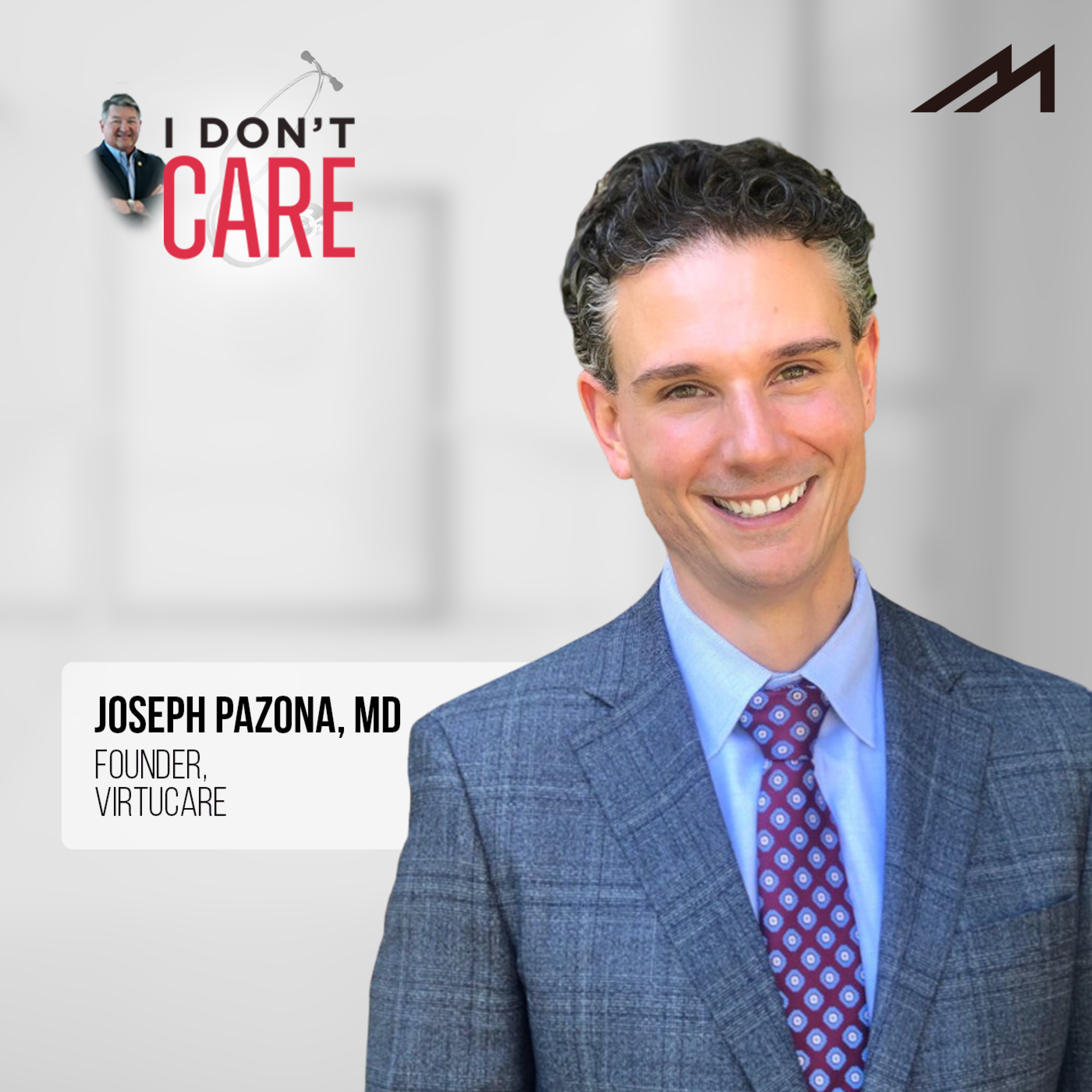
Access to specialty medical care is difficult in such parts of the country. Urologists are even harder to find. He explained, “By 2025, we’ll have a shortage of 7000-9000 urologists. We’re only training about 300 a year and don’t have the supply to meet the demand because of fewer slots in residency programs. Telemedicine is a way to bridge that gap.”Many might think urology wouldn’t work in a virtual care environment. Pazona disagrees. “There are very few times I need to touch the patient physically. A urologist’s greatest asset is their wisdom in an area of medicine where many lack proper education.”Realizing that consumers are battling a broken system with confusion in referrals, insurance, and other barriers, Pazona started VirtuCare. No referral or insurance is required to have a telemedicine visit with a physician.“The platform is consumer-based and has cost transparency. I take patients as far as telemed will go. If they need hands-on, I refer them to a urologist in their area,” Pazona said.As for the future, Pazona believes that telemedicine should continue to be a solution beyond the pandemic. “There is a silver lining because it sparked innovation and forces people to take control of their healthcare decisions,” he added.

January 15, 2021Episode 4821 min

How Physicians Can Overcome Telemedicine Limitations

While there have been many downsides to the unexpected changes we all needed to make in 2020, there were also improvements made to how we work and live. The upsurge in telemedicine is an example of such progress made in the face of adversity. On the latest episode of I Don’t Care, host Kevin Stevenson spoke with Dr. Adam Saltman, Chief Medical Officer, Eko about the integration of telemedicine with digital technology and AI.Telemedicine can allow for more convenient access to care and can help keep patients and health care providers safe. That being said, there are some crucial missing components that can limit the quality of patient care. For example, physicians cannot listen to their patients’ bodies on their own via video conference. Really listening to the patient's heart, lungs, and bowel sounds through a stethoscope can typically only happen face to face. Eko closes this divide between physicians and patients with their digital stethoscopes, which transmit high fidelity sounds to remote physicians in real time as if they were at the bedside. In addition, Eko AI analysis algorithms help physicians screen for AFib and heart murmurs.According to Dr. Saltman, if they have the right technology available to them, physicians can overcome the distance based challenges of telemedicine. “When I listened to physicians say things like, ‘Well, I don't think a Zoom call is a really good physical exam,’ they're right. It's not a good physical exam,” Dr. Saltman said. However, he feels that if he can give them an EKG and therefore can give them heart sounds, lung sounds, bowel sounds, and whatever else they want to listen to, they can make telemedicine work. “Combined with that video, now they feel a lot more comfortable. They're getting a real medical evaluation. And the patients too, they feel that, wow my doctor actually listened to me even though I'm far away,” Dr. Saltman explained.Listen to Previous Episodes of MarketScale’s I Don’t Care Right Here!

Is this your show?

Claim this listing to keep it up to date, reach guests who want to pitch you, and manage bookings with Guestify.

Claim this listing

More Business podcasts