Find partners
High-Impact Growth

High-Impact Growth

Hosted by Dimagi

Episodes

87

Latest episode

Aug 2026

Language

EN

About the show

A podcast for social entrepreneurs, global development funders, nonprofit leaders and anyone grappling with the challenge of how to build solutions that are both immensely impactful and also achieve high-growth. Join Dimagi CEO and co-founder, Jonathan Jackson, along with co-host Amie Vaccaro as we unpack learnings from 20 years building digital solutions for global health and development, explore barriers to and opportunities for high-impact growth, and speak with industry leaders from around the world. Find us at: https://dimagi.com/podcast/

Listen to episodes

60 recent
August 21, 2026Episode 8952 min

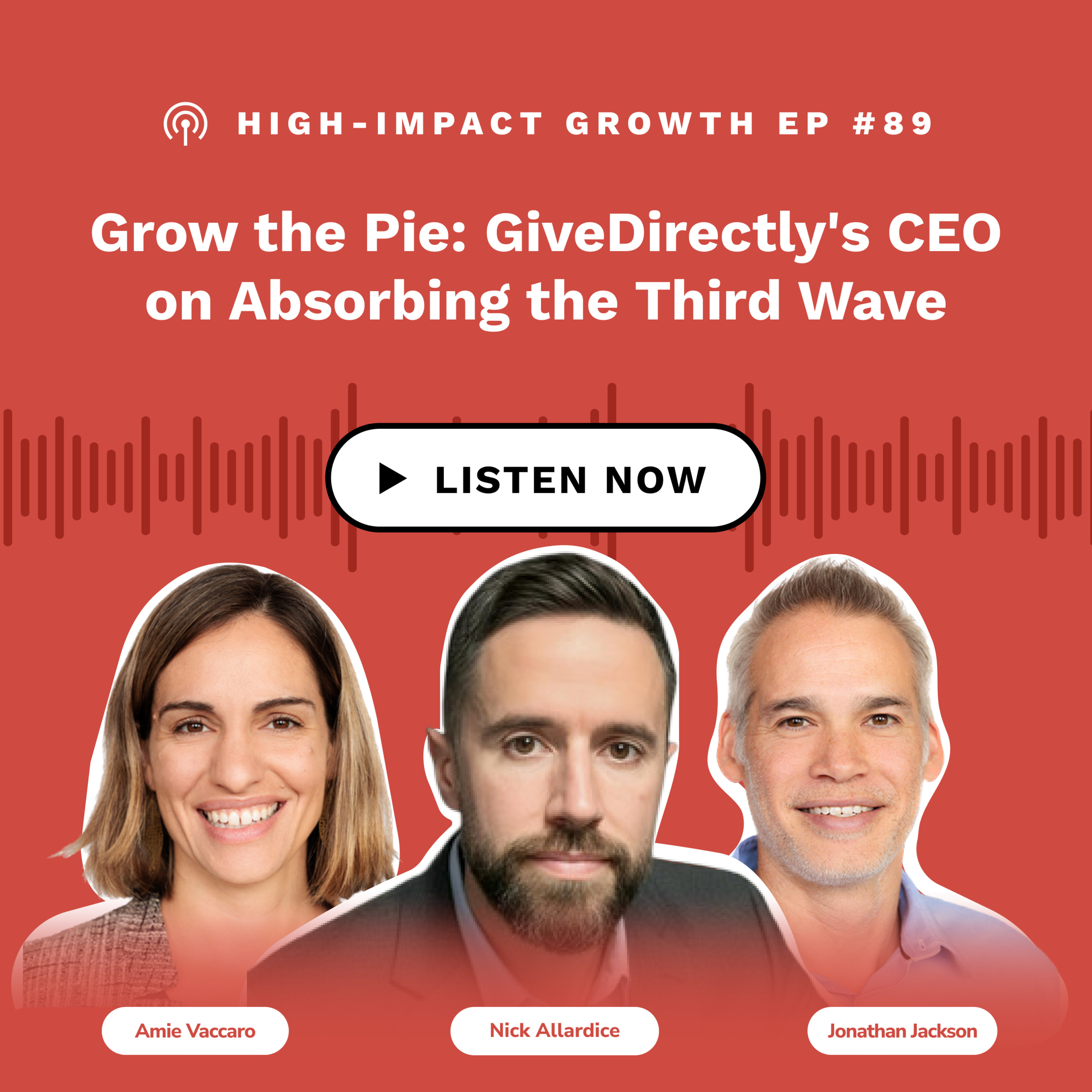
Grow the Pie: GiveDirectly's CEO on Absorbing the Third Wave

Five years ago, they were mid-level software engineers. Today, they hold giving accounts larger than major foundations — and the sector they want to fund may not be ready to absorb the money. Nick Allardice, CEO of GiveDirectly and former CEO of Change.org, joins Amie and Jonathan to unpack his widely discussed article "The Absorption Problem" and what the "third wave" of philanthropy means for global development. Nick explains why the biggest risk isn't money going to the wrong place, but money sitting on the sidelines for lack of credible places to put it — and why he regularly refers major donors to other organizations to "grow the pie, not divide it." The conversation digs into the voltage drop (research suggests 50–90% of programs lose substantial impact as they scale), why nonprofits rarely ask what their total addressable market is, and how GiveDirectly is winding down complexity to prepare to move much larger sums. Nick closes with candid advice for the newly wealthy: give away 10% of your net wealth in year one, learn by doing, and don't disconnect from the joy of giving. Related Resources: The Absorption Problem by Nick Allardice The Overlooked Absorptive Capacity of Locally-Led Organizations by Jonathan Jackson and Neal Lesh The Third Wave of American Philanthropy by Nan Ransohoff Increasing Our 2026 Allocation to GiveWell's Recommendations to $1 Billion by Coefficient Giving The Voltage Effect: How to Make Good Ideas Great and Great Ideas Scale by John A. List Sign up to our newsletter⁠ , and stay informed of Dimagi’s work We are on social media - follow us for the latest from Dimagi: ⁠LinkedIn⁠ , ⁠Twitter⁠ , ⁠Facebook⁠ ⁠⁠, ⁠Youtube⁠ ⁠⁠⁠ If you enjoy this show, please leave us a 5-Star Review and share your favorite episodes with friends. Hosts: ⁠ Jonathan Jackson⁠ and ⁠Amie Vaccaro

August 18, 2026Episode 8846 min

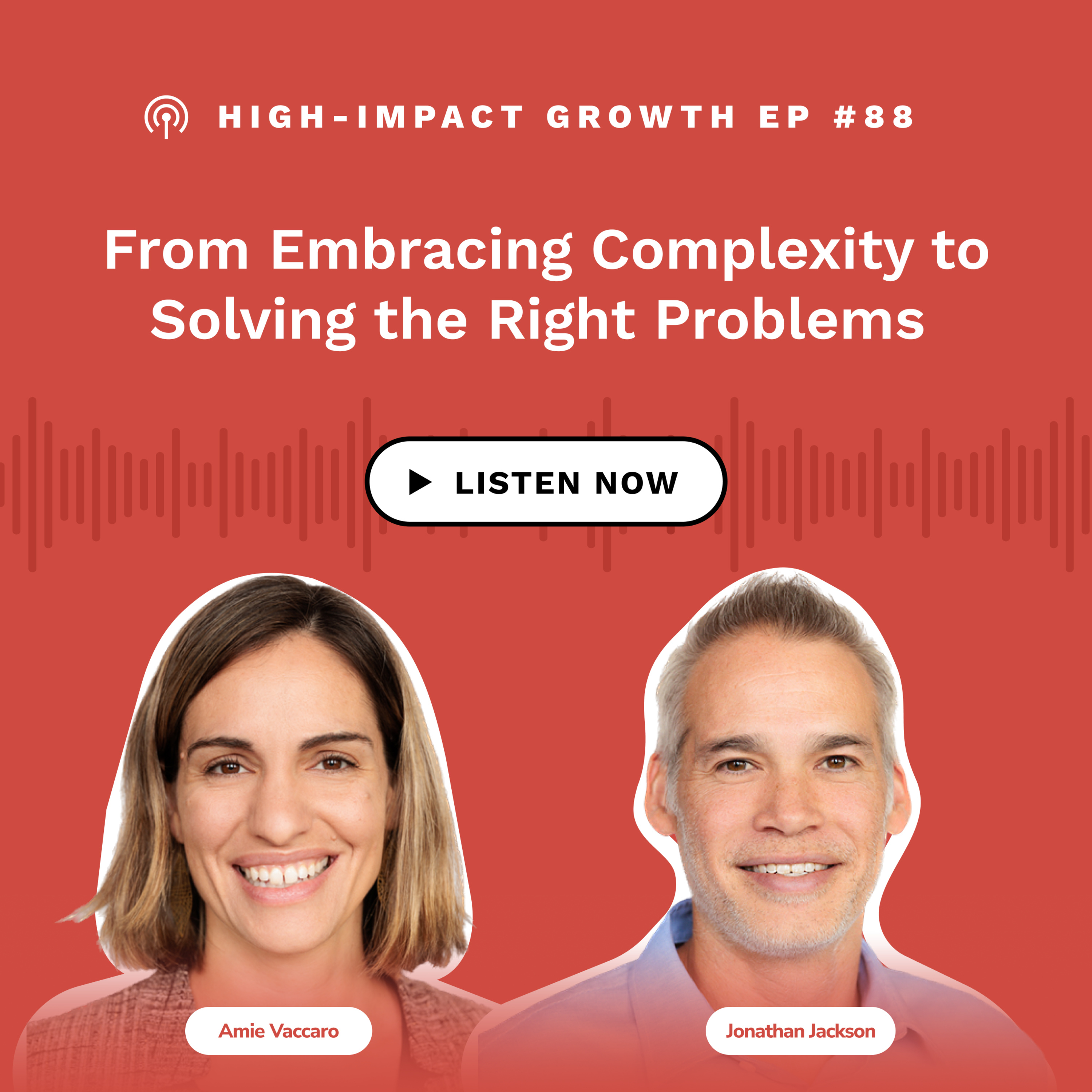
From Embracing Complexity to Solving the Right Problems

Could a funder deploy $100 million in global health tomorrow and know where every single dollar went? Dimagi CEO and co-founder Jonathan Jackson believes verified service delivery finally makes the answer yes. In this candid mid-2026 check-in, Jon joins co-host Amie Vaccaro, VP of CommCare Growth and Strategy, to unpack a year of profound change including why Dimagi retired its longtime value "embrace complexity for impact" in favor of "solving the right problems for impact," and what that shift reveals about affordability in a post-USAID funding landscape. Jon walks step-by-step through a single Connect-enabled home visit, from opt-in push notification to real-time payment, and shares the numbers behind the platform: over 1.5 million verified visits, 200+ local organizations expressing interest, and 80 cents of every dollar reaching frontline workers, local organizations, and commodities. The conversation also explores how AI is putting program design directly into the hands of local organizations, automating roles, not people. As Jon puts it: "When you do a better job today, the system knows it and can offer you even more work tomorrow." Related Resources: Dimagi Connect – Dimagi's verified service delivery platform connecting funders with local organizations and frontline workers. CommCare by Dimagi – The open-source platform for frontline workers that Connect is built on, with a quarter million active users worldwide. GiveWell – The evidence-based charity evaluator whose request for information on post-market malaria rapid diagnostic test surveillance inspired Dimagi's AI-built Connect pilot. Steel Foundation for Hope – An early flagship funder that Amie credits with seeing Connect's potential. Kevin Starr episode of High-Impact Growth – https://dimagi.com/podcast/funders-power-to-change-the-system/ Eric Ries episode of High-Impact Growth – https://dimagi.com/podcast/podcast-eric-ries-good-companies-go-bad/ Kikapu Gardens field visit video – https://drive.google.com/file/d/1MLGVhiA0YCt_NpjuF4Gveu1s3kwygD7-/view Sign up to our newsletter⁠ , and stay informed of Dimagi’s work We are on social media - follow us for the latest from Dimagi: ⁠LinkedIn⁠ , ⁠Twitter⁠ , ⁠Facebook⁠ ⁠⁠, ⁠Youtube⁠ ⁠⁠⁠ If you enjoy this show, please leave us a 5-Star Review and share your favorite episodes with friends. Hosts: ⁠ Jonathan Jackson⁠ and ⁠Amie Vaccaro

August 7, 2026Episode 8756 min

Eric Ries on Why Good Companies Go Bad

What does it really mean to make a profit — and why do so many mission-driven companies eventually betray the very things that made them great? In this episode, Eric Ries, creator of The Lean Startup and founder of the Long-Term Stock Exchange, joins Amie Vaccaro and Jonathan Jackson to discuss his new book Incorruptible: Why Good Companies Go Bad and How Great Companies Stay Great . Eric dismantles the conventional definition of profit and offers a radical replacement — profit as the maximization of human flourishing — then explains "financial gravity," the unconscious pull that bends organizations toward the values of whoever holds the money, whether investors or donors. Through the origin stories of Costco and Novo Nordisk, he shows how "mission lock" structures protected both companies — in Novo Nordisk's case, preserving the research that became Ozempic and creating over $500 billion in shareholder value. The conversation closes with practical power for everyone else: a "no-courage activism" question any job candidate can ask, and why every transaction you make transmits your values. As Eric puts it: "You're not stuck in traffic — you are traffic." Related Resources: https://theleanstartup.com/ ⁠ – Eric's foundational methodology and NYT bestseller on entrepreneurship and continuous innovation. Long-Term Stock Exchange (LTSE) – The stock exchange Eric founded to support companies built for long-term value creation. Answer.AI – The AI R&D lab founded by Eric Ries and Jeremy Howard. B Lab / B Corp Certification – The certification body behind B Corps; Dimagi was the first B Corp/PBC in Massachusetts, referenced in the conversation. Novo Nordisk Foundation – The mission-guardian foundation whose governance structure blocked the merger that would have killed GLP-1 research. Sign up to our newsletter⁠ , and stay informed of Dimagi’s work We are on social media - follow us for the latest from Dimagi: ⁠LinkedIn⁠ , ⁠Twitter⁠ , ⁠Facebook⁠ ⁠⁠, ⁠Youtube⁠ ⁠⁠⁠ If you enjoy this show, please leave us a 5-Star Review and share your favorite episodes with friends. Hosts: ⁠ Jonathan Jackson⁠ and ⁠Amie Vaccaro

July 30, 2026Episode 8642 min

The Last Mile of Family Planning: Lessons from Lafiya in Nigeria

In a single program area in northern Nigeria, contraceptive use climbed from 2% to over 70%. This change wasn't caused by a new technology, but happened because of one new strategy: centering trust. In this episode, Jonathan Jackson and Amie Vaccaro sit down with Klau Pakos, CEO and co-founder of Lafiya, to unpack how their organization closes the "last mile" gap in family planning in some of the hardest-to-reach communities in Northern Nigeria. Women in these communities often already know about contraception, but too often travel hours to a clinic only to be turned away empty-handed. Lafiya's answer is the Lafiya Sisters — trusted local health workers who bring counseling and self-injectable contraceptives directly into communities. Klau shares the visceral reality of women facing extreme maternal mortality risks, walks through how Lafiya became a true partner to the government rather than a vendor with a fixed model, and explains why they resist the pull of shiny new technology until it's proven necessary. As they put it, family planning "brings the foundation for everything else", creating ripple effects across health, income, and autonomy that data alone can't fully capture. A candid, practical conversation for anyone trying to scale impact alongside government systems. Related Resources: Lafiya – Klau's organization, which trains local "Lafiya Sisters" to deliver family planning counseling and self-injectable contraceptives to underserved communities in northern Nigeria. D-Prize – A seed funding organization that awards grants to entrepreneurs testing new business or charity models that distribute proven poverty-intervention technologies Charity Entrepreneurship – An incubator program that helps founders launch high-impact, cost-effective charities. Rethink Priorities: Cost-Effectiveness Analysis of Lafiya Nigeria – The independent modeling Klau references, estimating Lafiya's cost per DALY averted and per maternal life saved. Sayana Press (DMPA-SC) via Pfizer – An all-in-one, self-injectable contraceptive that lasts for three months and is optimized for low-resource environments due to its lack of a cold chain requirement. https://www.fp2030.org/ - A global partnership dedicated to advancing rights-based family planning, which the Nigerian government has contributed to for over a decade. Sign up to our newsletter⁠ , and stay informed of Dimagi’s work We are on social media - follow us for the latest from Dimagi: ⁠LinkedIn⁠ , ⁠Twitter⁠ , ⁠Facebook⁠ ⁠⁠, ⁠Youtube⁠ ⁠⁠⁠ If you enjoy this show, please leave us a 5-Star Review and share your favorite episodes with friends. Hosts: ⁠ Jonathan Jackson⁠ and ⁠Amie Vaccaro
July 23, 2026Episode 8549 min

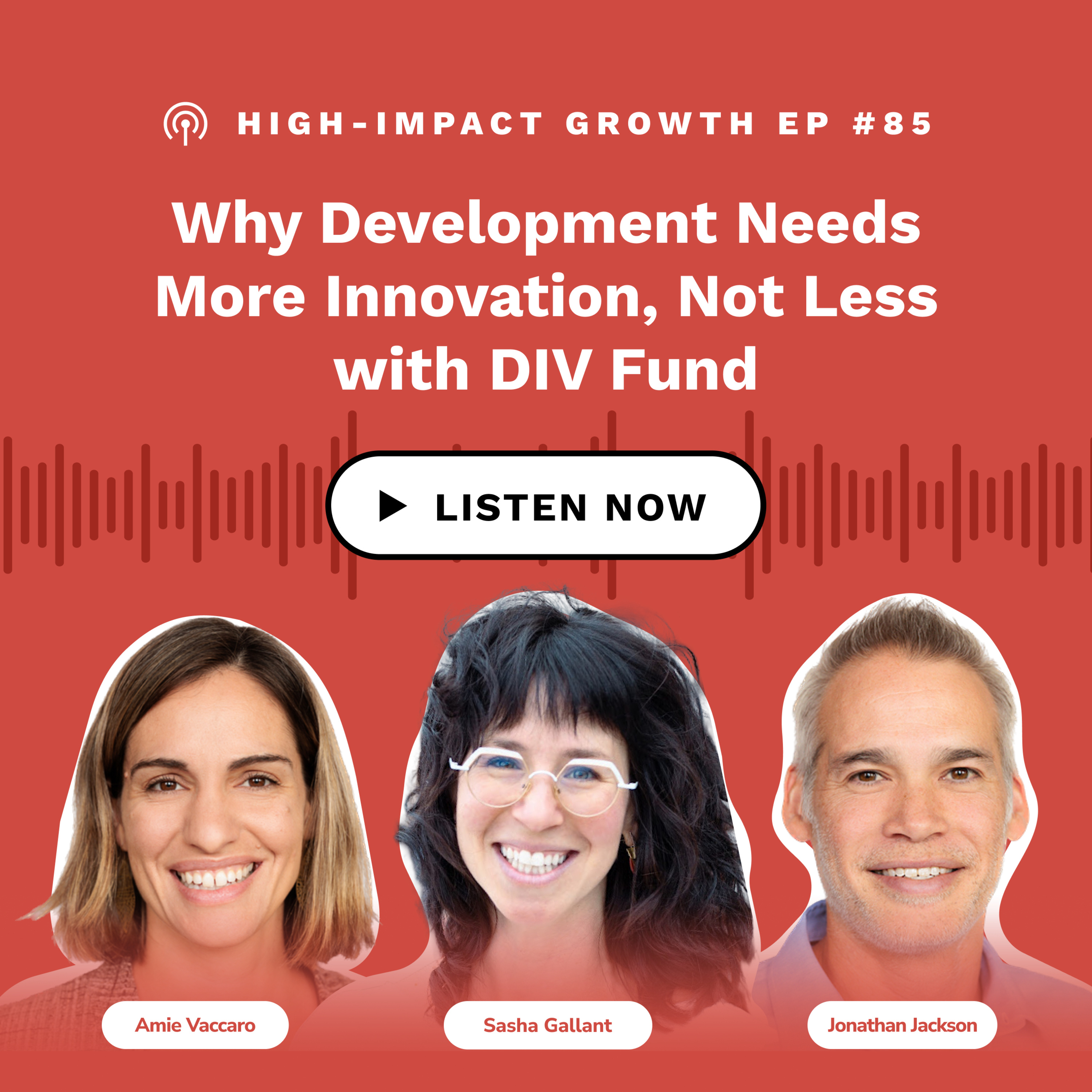
Why Development Needs More Innovation, Not Less with DIV Fund

When USAID was dissolved, Sasha Gallant didn't let the work she'd spent years building disappear with it. As the former head of Development Innovation Ventures (DIV), USAID's evidence-driven innovation fund, Gallant watched stop-work orders freeze over 100 active awards overnight. Rather than let that portfolio die, she did two things: Helped mobilize more than $130 million to keep the most critical, life-saving USAID projects alive through an initiative called Project Resource Optimization , and Co-founded DIV as an independent nonprofit–the DIV Fund –to test and scale new, potentially cost-effective global development innovations. In this conversation with co-hosts Jonathan Jackson and Amie Vaccaro, Gallant unpacks why innovation funding in global development is chronically underfunded, how DIV evaluates ideas on evidence, cost-effectiveness, and potential for scale, and why the biggest wins are often "supremely unshiny": pedagogical tweaks, cheaper CPAP machines, smarter delivery models. She also grapples with a strange moment of dissonance: surviving deep funding cuts just as a new wave of AI-driven wealth approaches the sector. As she puts it, believing we've already found our best solutions is "basically giving up on human progress." For funders, innovators, and development leaders navigating a rapidly changing funding landscape, this episode offers thoughtful guidance on building a future where every dollar creates greater impact. Related Resources: DIV Fund – The independent nonprofit Sasha Gallant co-founded, continuing USAID's Development Innovation Ventures model of tiered, evidence-driven innovation grants. Project Resource Optimization (PRO) – The initiative (hosted by the Center for Global Development) that Gallant helped launch to triage and match donors to the most cost-effective USAID programs left without funding. GiveWell – The charity evaluator referenced for its rigorously vetted "best buy" list of cost-effective global health and development programs. Sign up to our newsletter⁠ , and stay informed of Dimagi’s work We are on social media - follow us for the latest from Dimagi: ⁠LinkedIn⁠ , ⁠Twitter⁠ , ⁠Facebook⁠ ⁠⁠, ⁠Youtube⁠ ⁠⁠⁠ If you enjoy this show, please leave us a 5-Star Review and share your favorite episodes with friends. Hosts: ⁠ Jonathan Jackson⁠ and ⁠Amie Vaccaro

June 26, 2026Episode 8448 min

Who Actually Owns This? Naming What's Broken with Nithya Ramanathan

What does it actually take for a country, government, or community to truly own a technology or an outcome? In this fast-paced and candid episode of High-Impact Growth, Dimagi CEO Jonathan Jackson and co-host Amie Vaccaro welcome back Nithya Ramanathan, CEO and co-founder of Nexleaf Analytics. Moving past polite sector rhetoric, Nithya and Jonathan break down why so many well-intentioned global health initiatives end up in "equipment graveyards" due to a broken "donor-to-hope" value chain. Grounded in her recent Stanford Social Innovation Review piece on country ownership, Nithya unpacks the three critical ingredients of true ownership—financial transaction, genuine control, and intrinsic pride—and advocates for a drastic shift: flipping the historical 80/20 investment split to focus heavily on human operational systems rather than chasing technical perfection. Featuring real-world insights from a recent cross-country ministry workshop on vaccine cold chains, this episode offers an honest look at the iterative dance between technology and policy. The conversation doesn't offer tidy answers, but it pushes the critical questions. Related Resources: https://ssir.org/articles/entry/scaling-global-health-innovations Nithya Ramanathan, Nelima Otipa, and Hosea Kintu lay out a framework for moving from government partnership to country ownership in global health innovation. Referenced directly in the episode. https://www.nexleaf.org/ A non-profit social enterprise co-founded by Nithya Ramanathan that uses data and technology to improve global health systems, particularly vaccine cold chains. https://www.gavi.org/ A global health partnership that co-supported the multi-year vaccine cold chain and operational maintenance initiatives discussed in the episode. Kevin Starr / Mulago Foundation Thought leader behind the concept of "Coke bottle philanthropy" cited by Nithya — the false notion that a single scalable solution can be handed to governments like a product off a shelf. https://dimagi.com/commcare/ Dimagi’s SaaS product designed to support frontline workers and track community health outcomes at scale. Sign up to our newsletter⁠ , and stay informed of Dimagi’s work We are on social media - follow us for the latest from Dimagi: ⁠LinkedIn⁠ , ⁠Twitter⁠ , ⁠Facebook⁠ ⁠⁠, ⁠Youtube⁠ ⁠⁠⁠ If you enjoy this show, please leave us a 5-Star Review and share your favorite episodes with friends. Hosts: ⁠ Jonathan Jackson⁠ and ⁠Amie Vaccaro

May 15, 2026Episode 8349 min

40,000 Health Workers, One AI-Powered Lifeline

What happens when a health extension worker in rural Ethiopia faces a complex case and there's no doctor nearby? This episode goes beyond the AI hype cycle to explore a live, working answer: HEP Assist, a generative AI-powered call center built for Ethiopia's 40,000 health extension workers by Last Mile Health, IDinsight, and the Ethiopian Ministry of Health. Abraham Zerihun, Ethiopia Country Director at Last Mile Health, and Sid Ravinutala, Chief Data Scientist at IDinsight, take us inside the real decisions — from choosing a RAG (Retrieval-Augmented Generation) architecture to stay within Ministry guidelines and reduce hallucinations, to creating a virtual assistant named Hawa to make interactions feel human rather than machine. They discuss the surprisingly nuanced cost model for AI at scale, the importance of government buy-in, and why evaluation should be built in from day one, not treated as an afterthought. With 6,500+ AI-supported consultations already completed and 53% of cases resolved at the community level, this isn't a pilot on paper — it's proof that AI can work at the last mile, in local languages, on high-stakes problems, right now. Related Resources: Last Mile Health – An organization dedicated to saving lives in the world's most remote communities, by partnering with governments to equip professional community health workers. IDinsight – A global advisory, data analytics, and research organization that helps leaders maximize their social impact. The Ethiopian Ministry of Health – The government body leading the digital transformation and AI integration within Ethiopia's national health system. Data.org – A platform for partnerships to build the field of data science for social impact, which provided support for this initiative. Clinton Health Access Initiative (CHAI) – A global health organization mentioned as a previous professional home for both guests Sign up to our newsletter⁠ , and stay informed of Dimagi’s work We are on social media - follow us for the latest from Dimagi: ⁠LinkedIn⁠ , ⁠Twitter⁠ , ⁠Facebook⁠ ⁠⁠, ⁠Youtube⁠ ⁠⁠⁠ If you enjoy this show, please leave us a 5-Star Review and share your favorite episodes with friends. Hosts: ⁠ Jonathan Jackson⁠ and ⁠Amie Vaccaro

April 15, 2026Episode 8250 min

Closing the Gap: Scaling Mental Health Care Through Local Heroes with Pavel Reppo

Imagine a country of 50 million people with only 50 psychiatrists . This staggering treatment gap is the reality in Uganda, but Pavel Reppo is proving that specialized experts aren’t the only ones who can provide life-changing care. As the Executive Director of Finemind and CEO of Matchbox Fund , Pavel brings a rare dual perspective to the conversation, bridging the worlds of grassroots mental health implementation and trust-based philanthropy. In this episode, we dive into how Finemind upskills primary health workers—such as midwives and nurses—to deliver evidence-based mental health support at the point of care. Pavel explains why true impact must be measured by functional recovery —like children returning to school or improved household food security—rather than just clinical depression scores. We also explore the Matchbox Fund’s mission to rewrite the rules of funding by investing in overlooked local organizations and responding to outreach with dignity. This conversation offers a masterclass in ethical leadership , local ownership, and a radical definition of success: scale as the "reduction of the problem," not just the growth of an organization. Related Resources: High-Impact Growth episode featuring Vikram Patel - https://sites.dimagi.com/high-impact-growth-podcast/reimagining-mental-health High-Impact Growth episode featuring Kevin Starr - https://dimagi.com/podcast/funders-power-to-change-the-system/ Finemind - https://afinemind.org/about/ Matchboxfund - https://matchboxfund.org/ Sangath - https://www.sangath.in/ Spring Impact - https://www.springimpact.org/ A WHO-developed psychological intervention for people in communities affected by adversity - https://www.who.int/publications/i/item/9789241506816 Sign up to our newsletter⁠ , and stay informed of Dimagi’s work We are on social media - follow us for the latest from Dimagi: ⁠LinkedIn⁠ , ⁠Twitter⁠ , ⁠Facebook⁠ ⁠⁠, ⁠Youtube⁠ ⁠⁠⁠ If you enjoy this show, please leave us a 5-Star Review and share your favorite episodes with friends. Hosts: ⁠ Jonathan Jackson⁠ and ⁠Amie Vaccaro

February 20, 2026Episode 8145 min

Thinking About Individual Giving? Start Here

As traditional funding sources shift, many nonprofits are asking a hard question: can individual giving become a meaningful and sustainable revenue stream? In this episode of High-Impact Growth , Amie Vaccaro and Jonathan Jackson sit down with Javan Van Gronigen, founder of Donate.ly, to unpack what it truly takes to make that transition work. Drawing from more than a decade in digital fundraising, Javan shares why storytelling—not technology—is the most critical asset nonprofits have, and why so many organizations struggle by committing “random acts of marketing.” The conversation explores how to move from one-to-one fundraising toward scalable, one-to-many models without burning limited budgets, and how testing small bets is essential before going all-in. The group also digs into the evolving role of AI in fundraising—from speeding up content creation and data analysis to raising new ethical questions about authenticity and trust. Whether you’re testing individual giving for the first time or rethinking your entire fundraising strategy, this episode offers a grounded, honest roadmap for navigating a more crowded and uncertain funding landscape. Related Resources: https://www.fiftyandfifty.org/services/engagement-os https://www.donately.com/ https://www.charitywater.org/ https://invisiblechildren.com/ Sign up to our newsletter⁠ , and stay informed of Dimagi’s work We are on social media - follow us for the latest from Dimagi: ⁠LinkedIn⁠ , ⁠Twitter⁠ , ⁠Facebook⁠ ⁠⁠, ⁠Youtube⁠ ⁠⁠⁠ If you enjoy this show, please leave us a 5-Star Review and share your favorite episodes with friends. Hosts: ⁠ Jonathan Jackson⁠ and ⁠Amie Vaccaro

January 22, 2026Episode 8050 min

Beyond “AI for Good”: Building Responsible AI

AI is moving fast in global health and development, but good intentions alone don’t guarantee good outcomes. In this episode of High-Impact Growth , we sit down with Genevieve Smith, Founding Director of the Responsible AI Initiative at UC Berkeley’s AI Research Lab, to unpack what it really means to build and deploy AI responsibly in contexts that matter most. Drawing on a decade of experience in international development and cutting-edge research on AI bias, Genevieve explains why labeling a project “AI for good” isn’t enough. She introduces five critical lenses – fairness, privacy, security, transparency, and accountability – that program managers and product leaders must apply to avoid reinforcing existing inequalities or creating new risks. The conversation explores real-world examples, from AI-driven credit assessments that unintentionally disadvantage women, to the challenges of deploying generative AI in low-resource and multilingual settings. Genevieve also shares emerging alternatives, like data cooperatives, that give communities governance over how their data is used, shifting power toward trust, agency, and long-term impact. This episode offers practical insights for anyone navigating the hype, pressure, and promise of AI in development, and looking to get it right. Responsible AI Initiative – UC Berkeley AI Research Lab – A multidisciplinary initiative advancing research and practice around responsible, trustworthy AI. Mitigating Bias in Artificial Intelligence - A playbook for business leaders who build & use AI to unlock value responsibly & equitably UC Berkeley AI Research (BAIR) – A leading AI research lab focused on advancing the science and real-world impact of artificial intelligence. Fairness, Accountability, and Transparency (FAccT) Conference – A major interdisciplinary conference on ethical and responsible AI systems. UN Women – An organization referenced in Genevieve’s background, focused on gender equality and women’s empowerment globally. International Center for Research on Women (ICRW) – A research organization mentioned in the episode, specializing in gender, equity, and inclusive development. Sign up to our newsletter ⁠ , and stay informed of Dimagi’s work We are on social media - follow us for the latest from Dimagi: ⁠ LinkedIn⁠ , ⁠Twitter⁠ , ⁠Facebook⁠ ⁠⁠, ⁠Youtube⁠ ⁠⁠⁠ If you enjoy this show, please leave us a 5-Star Review and share your favorite episodes with friends. Hosts: ⁠ Jonathan Jackson ⁠ and ⁠ Amie Vaccaro

Is this your show?

Claim this listing to keep it up to date, reach guests who want to pitch you, and manage bookings with Guestify.

Claim this listing

More Technology podcasts