About Decode Econ: The Podcast The economy touches everything — from the price of your morning coffee to the decisions shaping our future. Decode Econ breaks it all down. Hosted by Dr. Abdullah Al Bahrani (“Dr. A”), economist, educator, and storyteller, this podcast makes economics personal, practical, and easy to understand. Each episode explores the trends behind the headlines — inflation, jobs, technology, policy, and the everyday decisions that drive them. Through stories, data, and conversations with thinkers, entrepreneurs, and community leaders, you stay informed.
Listen to episodes
60 recent
October 24, 202657 min
The Leaky Cup: Teaching Economics at Community Colleges, with Meena Beri and Brian Lynch
How do you explain inflation to a student who is working two jobs and raising kids? Brian Lynch hands them a cup of water with holes in it. This week I sit down with Brian Lynch and Meena Beri, co-editors of TRECC (Teaching Resources for Economics at Community Colleges). The newsletter reaches about 3,000 economics instructors, many of whom are the only economist at their college. We talk about: Brian’s leaky cup activity for inflation and purchasing power, and building supply and demand out of pool noodles, string, and painter’s tape Meena’s online students graphing equilibrium with crochet hooks and pipe cleaners The props that flopped, including a tricycle and a karaoke session Why today’s students seem less resilient, and what to do about it. Meena explains her procrastinator-type exercise and how it showed her that students weren’t lazy, they were anxious. Trauma-informed teaching, and why a $90 textbook can push a student out of college The hierarchy in our profession between two-year and four-year faculty, and why it needs to go Meena put it best: relevance and rigor are not enemies. If you teach the only economics course most of your students will ever take, this episode is for you. https://www.decodeecon.com/articles/brian-meena
October 17, 202637 min
Money Habits Start at the Kitchen Table with Stephen Day
After eight years of apps, podcasts, finance influencers, and new high school requirements, the average American adult still gets about half of basic personal finance questions right. Gen Z, the generation that grew up with a budgeting app on every phone, scores 38%. Adults with the lowest scores are twice as likely to be stuck in debt and three times as likely to be financially fragile. One car repair or one missed shift, and everything wobbles. Teaching more does help. Across 76 randomized experiments with more than 160,000 people, those who got financial education knew more and made better money decisions. When Georgia, Idaho and Texas required personal finance in high school, young adults there ended up with higher credit scores and fewer missed payments. So why hasn't the overall number moved? Because knowledge fades. What doesn't fade is habit. I think we've been asking the wrong question. We keep asking what kids should know about money. The better question is when they start practicing money decisions. You don't learn to ride a bike by reading about balance, but learning about money by trial and error gets expensive. So how do kids practice somewhere safe? Dr. Stephen Day has been answering that at his own kitchen table. He and his four kids run a mini economy with real jobs, play money, a household store and, yes, taxes. In this conversation, he walks through how to set one up in an hour on a Saturday, why parents should do chores and get paid too, and what his family says instead of "opportunity cost." We also talk about how he went from academic journals to a book deal with a major publisher. More resources at www.decodeecon.com
October 10, 202639 min
What Students Bring to Day One, with Brandon Sheridan
ABOUT THIS EPISODE Brandon Sheridan is back on the show. In August, he told us the economy was moving sideways. A month and a half later, I asked him if anything had changed. Short answer: not much. Then we got into the conversation I've wanted to have with him for a while: his new paper, with 25 coauthors, on what students bring to the first day of an economics class. If you teach economics, this one is for you.
October 4, 202644 min
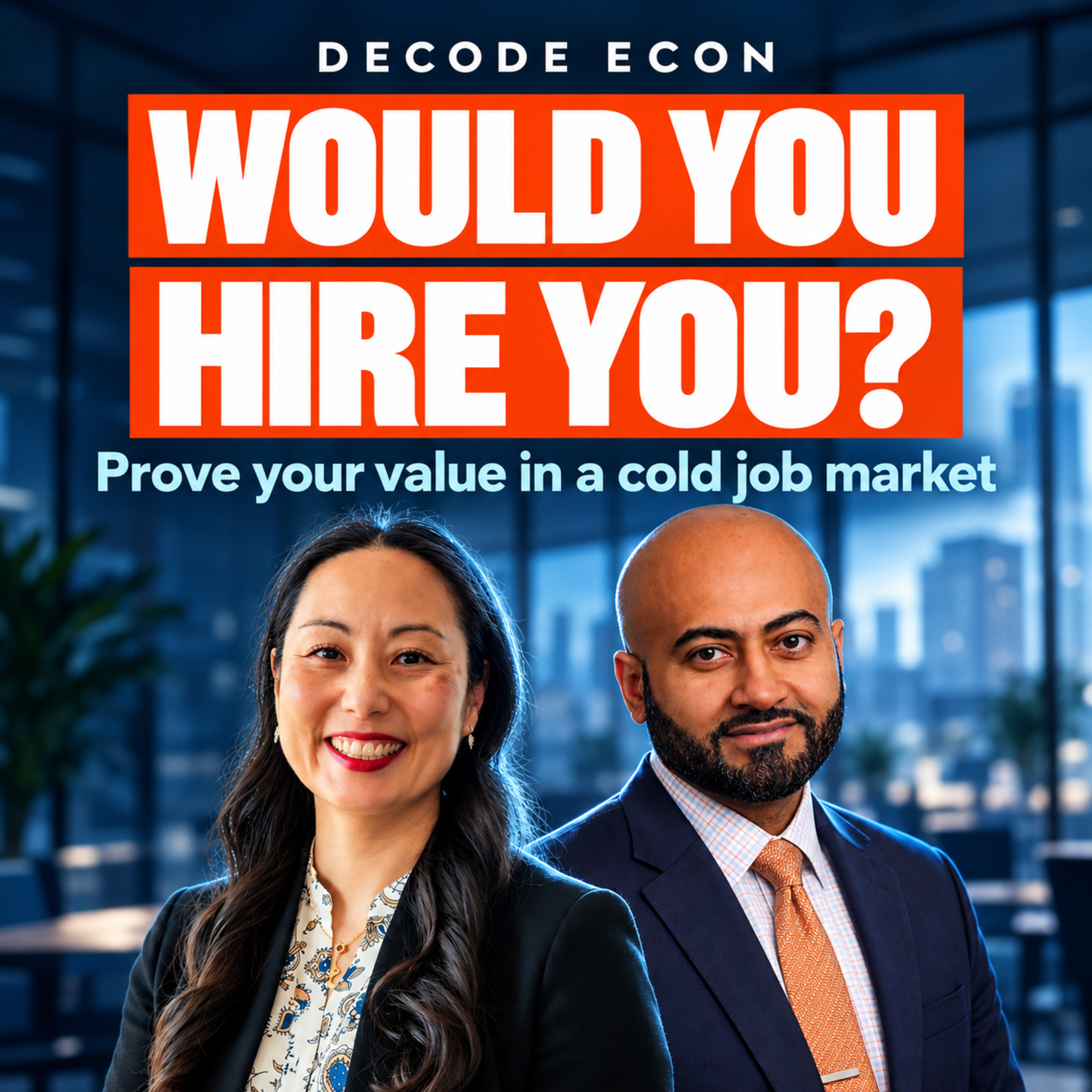
It's a Cold Labor Market
Here’s my takeaway up front: in this job market, you have to prove yourself more than ever. Friday’s jobs report was the last one before the midterm elections, and it was boring. Boring the way a cold labor market is boring. Nobody is getting laid off in big waves. Nobody is getting hired either. This week on the Decode Econ podcast, Dr. Jeni Al-Bahrani joins me to talk about what that looks like on the ground. Jeni teaches the senior capstone at Miami University. In fall 2024, about 80% of her seniors had a job lined up before graduation. This fall, it’s about 30%. Our students want accountability; they want to be challenged, but when you hold them to higher standards, they are pushing back. Jeni called them “Ouchie” moments. If you have noticed that your students are changing, this episode is for you. We also talk about the three hours at the Apple Store, a lesson in switching costs, and a server who told us the pretzels don’t come with butter, not “in this economy.” Our economy is changing, so are your students Read more on substack
September 26, 202637 min
Is Econ Worth It? What do econ majors do and what do they earn?
This week on the Decode Econ Podcast, I sat down with Matt Holian, an economics professor at San Jose State. When Matt was department chair, he needed an honest answer to the question every recruiter gets: what jobs do econ majors actually get? He went looking for the data. Subscribe now Using Census microdata, Matt and his coauthor Kevin Chiu tracked mid-career econ grads (ages 35 to 45, bachelor’s as their highest degree) into the jobs they actually hold. Their paper came out this year in the Journal of Economic Education . Holian, M., & Chiu, K. (2026). Earnings, occupation, and college degree: A focus on the economics major. The Journal of Economic Education , 57 (3), 326-334. Here’s what jumped out at me: Economics is a top-10 earning major, with a median income around $105,000. Seven of the other nine are engineering fields. A quarter of econ grads land in five occupations: managers, financial managers, chief executives, accountants, and personal financial advisors. The other three-quarters are everywhere. Analysts. Sales. Software developers. Teachers. Econ grads working as securities and financial services sales agents earn a median of nearly $298,000. 11.1% of econ majors are self-employed. That’s one of the highest rates of any major. So is the degree doing the work? Matt was careful here, and I respected it. The data can’t tell you that. Economics may attract people who are already comfortable with risk, and those people might have done well in any major. That might be a selection issue. We also got into his textbook, Data and the American Dream , which teaches econometrics by having students replicate real published studies using free software. If you’re a student picking a major, a parent paying for one, or a professor who keeps hearing “what can I even do with this?”, this episode is for you. The research Earnings, occupation, and college degree: A focus on the economics major (Holian & Chiu, 2026, Journal of Economic Education ). The analysis code is archived on OpenICPSR , and you can modify it to look up the top jobs and earnings for any college major. Methods in open policy analysis: An application to California’s building energy codes (Holian, 2023, Contemporary Economic Policy ). Extends the cost-benefit analysis from Chapter 2 of his book. Replication package here . The books Data and the American Dream: Contemporary Social Controversies and the American Community Survey (Holian, Palgrave Macmillan/Springer). Matt’s advice: check your library before you buy. Many university libraries give you the full PDF free through SpringerLink. Replication files on OpenICPSR . Mastering ‘Metrics by Joshua Angrist and Jörn-Steffen Pischke. “The most undergrad-friendly econometrics book out there”, with the same notation as Matt’s book, so the two pair well. Angrist’s free Mastering Econometrics video series goes with it. The data (all free) American Community Survey via IPUMS USA . The largest household survey in the U.S., with college major, occupation, and income. Current Population Survey via IPUMS CPS . The monthly survey behind the unemployment rate. Historical U.S. Census data via IPUMS USA . Goes back to the 1800s with consistent coding. ipumsr , an R package that pulls IPUMS data straight into R. The tools Posit Cloud . Run R in your browser with nothing to install. OpenICPSR . A free archive where researchers post the data and code behind published studies. Find Matt: mattholian.com For economics educators: Matt is exploring an edited volume that expands Data and the American Dream to other IPUMS datasets, one chapter per contributor. If that’s you, reach out to him. Decode Econ grows when readers share it with people they trust. If this edition made something click for you, pass it along. That’s how this works.
September 20, 202634 min
How Studying Abroad Changes the Way You See Economics
In a classroom, I can teach you how the world is supposed to work. Study abroad shows you how it actually works. Dr. Darshak Patel joins me to talk about taking students to Kenya to watch a universal basic income program up close, and why he would rather learn a new country alongside his students than teach one he already knows. Darshak is an Associate Professor of Economics at the University of Kentucky. We met there as graduate students. Since then, we have written many papers together, co-founded The Econ Games, and continue working to make economics accessible to students. In this episode, we cover The importance of global education and how to get started How the Econ Games Started The importance of community in economics Did you study abroad? Tell us in the comments what lesson stuck with you. Show Notes Art of Econ paper- https://papers.ssrn.com/sol3/papers.cfm?abstract_id=2612992 Darshak’s previous podcast appearance https://youtu.be/7clw4vTIi5I?si=cAOI4wMl4um3f3y9 The Fed Decision https://youtu.be/NR12z1Rs07U?si=fDxdDPW6qrPbdSIU Once Brothers- ESPN 30 for 30 paper https://onlinelibrary.wiley.com/doi/abs/10.4284/0038-4038-2013.299 Once Brothers Documentary https://youtu.be/fVw5vnukwJ4?si=TBYhqMkE74IWvS-C
September 14, 202645 min
Development Economics: Micro vs Macro
Development economics explained simply: what's the difference between the macro and micro sides of the field? Development economics sounds like a topic for "somewhere else." It's not. In my latest Decode Econ conversation, I sat down with two economists who study the same big question — how economies, and the people inside them, actually develop — from completely different altitudes. Dr. Amrita Dhar tracks capital flows into emerging markets and, closer to home, how U.S. states split the bill for K-12 schools. Dr. Shreyasee Das studies what happens inside a household in rural India after the lights come on. That second one stopped me. Shreyasee's research on rural electrification found that as women gained more independence, information, and control over their own lives, fertility often dropped — but in some households, so did stability and safety. Progress doesn't move in a straight line. Sometimes it just moves the friction somewhere else. We also got into something I think about a lot: development economics isn't just a lens for poor countries. Flint's water crisis, schools without air conditioning, sewage problems in the rural South — the same forces we study abroad are sitting here in our own zip codes. And we closed on something I want to actually do something about, not just talk about: why the researchers doing this work — especially women — aren't the ones you see on podcasts and panels. That's turning into a real project between the three of us now. Resources Amrita’s Resources 1. Poor Economics by Abhijeet Banerjee and Esther Duflo https://amzn.to/4cIhgFd 2. Analytical Development Economics - Kaushik Basu https://amzn.to/4cBAQTG Shreyasee 1. Amartya Sen's Capability Approach Amartya Sen's Capability Approach https://amzn.to/4gXNf5C 2. Amartya Sen's Tanner Lecture #1: Equality of What https://tannerlectures.org/lectures/equality-of-what/ 3. Amartya Sen's Tanner Lecture #2: Standard of Living https://tannerlectures.org/lectures/the-standard-of-living/ 4. Women's Role in Economic Development by Ester Boserup https://amzn.to/4AbIJsZ
September 7, 202643 min
AI in the Classroom: One Professor's Radical Teaching Experiment
No homework. No midterms. No final exam. In this episode of Decode Econ, I sit down with Dr. Shishir Shakya, an economist at Appalachian State University, who redesigned his entire econometrics and statistics courses around one question: what happens if we stop preparing students for the job market of 2022 and start preparing them for 2028?We get into:Why he cut his curriculum down to the "absolute theoretical minimum" — and how that made his students learn fasterHis AI-based oral exam system that catches understanding gaps multiple-choice tests missThe uncomfortable question I pushed him on: if students can't use AI, why can professors?Why he thinks every student — marketing, supply chain, or otherwise — needs to start thinking like an engineerWhat "flourishing" means in an AI economy, and why creative destruction isn't just a threatIf you're an educator, a student, or just trying to figure out what skills actually matter in an AI-driven labor market, this conversation will change how you think about learning itself.Connect with Dr. Shishir Shakya: https://www.linkedin.com/in/shishir-shakya/ Subscribe to Decode Econ for weekly breakdowns of the economy and your place in it.00:49 – Intro: How AI is disrupting education02:17 – No homework, no midterms, no finals — what replaced them11:22 – The moment AI broke his old teaching model16:05 – Inside his AI-powered oral exam system24:33 – "If students can't use AI, why can professors?"39:06 – Preparing students for the job market of 2028
August 30, 202650 min
The Economics of Entrepreneurship
Startups just had a record funding quarter — $285 billion in Q1 2026. Here's what the headline doesn't tell you: 43% of that went to one company's raise, and the rest of the money is piling into AI. So if you're a student founder building anything else, what does "record year" actually mean for you?I sat down with Dr. Jeni Al Bahrani, who teaches entrepreneurship at Miami University's Farmer School of Business, and Sarah Bosse, a senior who went from a student in Dr. A's class to her TA to her mentee. We get into why entrepreneurs can't outsource economics to their accountant, the pricing mistake Sarah watched half her classmates make as a TA, why rising interest rates change what investors are willing to fund, and why TAM/SAM/SOM is really a demand-estimation problem dressed up as a pitch-deck slide. We also get into why I've stopped calling them "soft skills" — they're durable skills, and they're the actual product of a good entrepreneurship classroom.Timestamps:0:00 – Why should entrepreneurs learn economics at all?10:00 – The pricing mistake that burns first-time founders17:00 – Interest rates, the $285B funding headline, and what it means if you're not building AI33:00 – TAM/SAM/SOM: the market-sizing mistake that isn't really about math44:00 – Why "soft skills" is the wrong word, and what workforce-ready actually meansIf this episode connects to something you're building — or teaching — leave a comment and tell me what's landing.
August 24, 202640 min
Bond Market Warning Signs Explained By Miami Professor Ej Ume
The bond market has been sending us warning signs. I sat down with Monetary Economist EJ Ume from Miami University’s Farmer School of Business to explain what is happening and what it means to you. If you don’t already do so, make sure to connect with EJ on LinkedIn . We would love to hear your thoughts on this conversation. Here is what we discussed EJ walks through three forces pushing long-term yields higher EJ's research and how monetary policy is a "blunt instrument" that hits different people differently Stablecoins and what you need to know about them Career and teaching: EJ's path from Wall Street into academia Papers Referenced Ume, E. (2025). Racial Disparities and Monetary Policy: Evidence from Augmented Taylor Rules. Economic Letters, 257, 112692. https://doi.org/10.1016/j.econlet.2025.112692 Ume, E., & Williams, M.J. (2018). The Differential Impact of Monetary Policy on Blacks and Whites since the Great Recession . Journal of Economics, Race, and Policy, pp 1-13. Burgess, O. & Ume, E. “Stablecoin Flows and Money Market Conditions.” Under review
Is this your show?
Claim this listing to keep it up to date, reach guests who want to pitch you, and manage bookings with Guestify.