
Find partners
The AI & Tech Society by Danar

The AI & Tech Society by Danar

Hosted by Danar Mustafa

Episodes

127

Latest episode

Aug 2026

Language

EN

About the show

AI, Technology & Leadership – Shaping the Future of Society Step into the future with a podcast that explores the shift from the industrial age to the digital era. We uncover how AI, robotics, data, and emerging technologies are transforming business strategy, leadership, and the role of humanity in a world driven by innovation. In every episode, you’ll discover: How artificial intelligence, robotics, and digitalization are redefining industries. The power of data-driven strategies in business, government, and public policy. The evolving role of leaders in navigating digital transformation. Who should listen: CEOs, CTOs, CIOs, AI product managers, startup founders, tech leaders, policymakers, and anyone passionate about innovation, leadership, and the future of work . From boardrooms to startups, we share the insights you need to lead in a data-first world . If you believe data is the new oil , this is your front-row seat to the trends shaping tomorrow. Host: Danar Mustafa, AI-leader & Founder based in Sweden. #digitalisering #digitaltransformation #industry4 #IoT #Analytics #AI #machinelearning #changemangement #strategy #businessmodel #digitalstrategy #agile #Genai #openai #google #meta #amazon #aws #microsoft #mistral #Sweden Hosted on Acast. See acast.com/privacy for more information.
Listen to episodes

60 recent
September 3, 202623 min

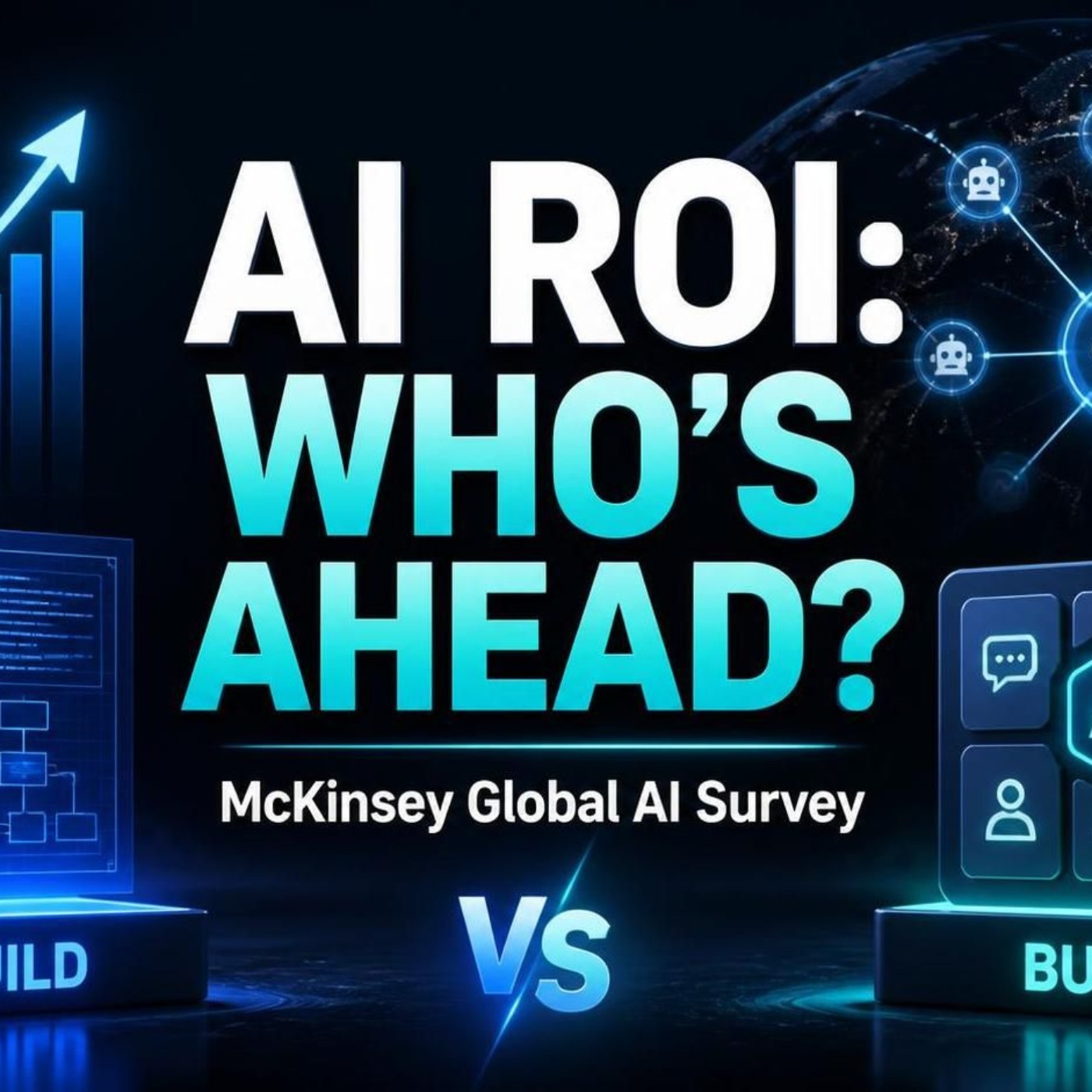
Agentic Coding Is Killing Build vs Buy: McKinsey State of AI 2026 and the SaaS Disruption

McKinsey’s State of AI 2026 reveals that 32% of organizations skipped at least one software purchase because they could build it internally with agentic coding tools. This episode explains how Claude Code, Cursor, Codex CLI, and AI coding agents are changing the build-vs-buy decision, why SaaS vendors selling thin-wrapper tools are most exposed, and why CTOs must rethink software procurement, internal tools, shadow IT, governance, and AI-driven development. We also cover Retool’s finding that 35% of teams have replaced a SaaS tool with a custom build, why large enterprises are pulling ahead in AI agent adoption, and why building software got cheaper — but owning it responsibly is still the hard part. agentic coding, build vs buy, McKinsey State of AI 2026, SaaS disruption, AI coding agents, Claude Code, Cursor, Codex CLI, enterprise AI, internal tools, SaaS replacement, AI software development, CTO strategy, software procurement, shadow IT, Retool Build vs Buy Report, vibe coding, AI agents, enterprise software, AI governance, custom internal software, SaaS vendors, thin-wrapper SaaS, AI ROI, technology leadership Hosted on Acast. See acast.com/privacy for more information.

August 26, 202620 min

OpenAI vs Anthropic: The Enterprise AI War Is Now About Data, Trust, and Control

OpenAI and Anthropic are reshaping enterprise AI competition around trust, data custody, and control. This episode explains OpenAI’s Private Safety Processing and Zero Data Retention strategy, Anthropic’s 30-day customer-controlled data retention for Fable 5 and Mythos 5, why enterprise AI buyers now care as much about data policy as model benchmarks, and how Palantir CEO Alex Karp helped force the data question into the center of AI procurement. We break down what CTOs, CIOs, CISOs, and AI leaders need to know about enterprise AI governance, vendor risk, human-review exceptions, model routing, data residency, encryption keys, and whether frontier AI labs could use customer workflows to compete with their own enterprise clients. OpenAI vs Anthropic, enterprise AI, AI data retention, Zero Data Retention, Private Safety Processing, Anthropic Fable 5, Anthropic Mythos 5, Claude enterprise, Claude Code, enterprise AI governance, AI procurement, AI vendor risk, data custody, data control, customer-controlled cloud, AI trust, AI compliance, human-review exception, model routing, AI security, Palantir, Alex Karp, frontier AI labs, enterprise AI data policy Hosted on Acast. See acast.com/privacy for more information.
August 21, 202619 min

EU AI Act Article 50 Explained: Chatbot Disclosure, AI Content Labels, and 2026 Compliance

The EU AI Act Article 50 transparency obligations became enforceable on August 2, 2026, and many companies may already be out of compliance. This episode explains what Article 50 requires now, why the AI Act delay to 2027 does not apply to chatbot disclosure and AI content transparency, and how organizations should handle AI-generated content labels, deepfake disclosures, emotion recognition, biometric categorization, provider versus deployer responsibilities, vendor compliance, and the December 2, 2026 machine-readable marking deadline. We also cover potential fines of up to €15 million or 3% of worldwide annual turnover and a practical compliance checklist for tech leaders. EU AI Act, Article 50, AI Act transparency obligations, EU AI Act compliance, chatbot disclosure, AI-generated content disclosure, AI content labels, deepfake disclosure, AI transparency, AI governance, provider vs deployer, EU AI Act fines, AI compliance 2026, December 2 2026 AI deadline, AI-generated public-interest text, emotion recognition AI, biometric categorization, machine-readable marking, AI Office Code of Practice, enterprise AI governance, tech leader AI compliance Hosted on Acast. See acast.com/privacy for more information.
August 11, 202621 min

Deloitte’s 2026 AI CTO Technology Leadership Study Explained

Deloitte’s 2026 Global Technology Leadership Study reveals a major reset in the tech C-suite. Based on a survey of 662 global technology leaders, this episode explains why the era of the operational CTO is over, how AI is changing the role of CIOs, CTOs, CISOs, and CDAOs, and why enterprise technology leaders must move from uptime and delivery to business value, AI governance, data readiness, budget reallocation, and cross-functional orchestration. We break down the confidence-readiness gap, the top barriers to scaling AI agents, and what tech leaders must do in the next 12 to 18 months to thrive in the AI era. Keyword tags: Deloitte 2026 Global Technology Leadership Study, Tech C-suite Reset, operational CTO, CIO, CTO, CISO, CDAO, AI leadership, enterprise AI, AI governance, AI agents, technology leadership, tech leadership study, CIO strategy, CTO strategy, AI operating model, enterprise value, digital transformation, AI readiness, confidence-readiness gap, legacy integration, data quality, technology budget, AI budget, C-suite orchestration, operator to orchestrator Hosted on Acast. See acast.com/privacy for more information.

August 5, 202615 min

How China’s AI Phones Are Replacing Apps With Agents

China’s new agentic AI phones from ZTE, StepFun, and Honor are replacing traditional apps with AI agents that act across the whole smartphone. This episode explains how the Nubia NaviX Ultra, StepX Neo, and Honor Robot Phone work, why AI agents threaten Apple and Google’s app-store model, how China’s super-apps like WeChat, Alipay, Taobao, and Doubao shape the future of mobile AI, and what agentic phones mean for smartphones, apps, AI assistants, surveillance, and the global tech race. keyword tags: agentic AI phones, AI smartphones, China AI phones, Nubia NaviX Ultra, ZTE AI phone, StepX Neo, StepFun, Honor Robot Phone, Doubao agent, AI agents, smartphone AI agents, app store disruption, Apple vs China AI, Google Play Store, WeChat AI, Alipay AI, Taobao AI, super apps, Anthropic MCP, Model Context Protocol, AI assistants, future of smartphones, mobile AI, agentic OS, AI operating system Hosted on Acast. See acast.com/privacy for more information.
August 2, 202617 min

How DHH Uses Claude Code AI Agents: Ruby on Rails Creator Ships 100 PRs in 90 Minutes

David Heinemeier Hansson, creator of Ruby on Rails and CTO of 37signals, went from AI coding skeptic to agent-first developer. This episode breaks down DHH’s Claude Code workflow, how he used AI agents to process 100 pull requests in 90 minutes, his two-model setup with Gemini and Opus, why Rails is ideal for AI coding agents, and what “peak programmer” means for the future of software engineering. Keyword tags: DHH, David Heinemeier Hansson, Claude Code, Ruby on Rails, Rails creator, AI coding agents, agentic coding, AI software engineering, 37signals, Basecamp, HEY, Opus 4.5, Gemini 2.5, Neovim, tmux, AI code review, 100 PRs in 90 minutes, AI developer tools, coding with AI, peak programmer, software engineering productivity, Rails AI workflow, Claude AI agents. Get your AI Product Management Certificate at aipmcert.com Hosted on Acast. See acast.com/privacy for more information.
July 27, 202620 min

Kimi K3: The 2.8T Open-Weight AI Model Shaking Up Claude, GPT-5.6, and the AI Race

Kimi K3 by Moonshot AI is a 2.8-trillion-parameter open-weight AI model with a 1-million-token context window, multimodal input, low-cost pricing, and top-tier coding benchmarks. This episode explains what Kimi K3 means for the AI race, open-weight models, Claude and GPT-5.6 competition, US-China AI geopolitics, model routing, enterprise AI adoption, and the future of self-hosted frontier AI. Kimi K3: China's 2.8T Open-Weight Model and the US Response - The Tech Society Keyword tags: Kimi K3, Moonshot AI, open-weight AI, open source AI, Chinese AI models, AI race, US China AI, GPT-5.6, Claude Fable 5, Claude Opus 4.8, DeepSeek, Qwen, frontier AI, 2.8 trillion parameters, multimodal AI, 1 million token context window, AI benchmarks, Artificial Analysis, Arena.ai, frontend coding AI, AI coding agents, model routing, self-hosted AI, enterprise AI, AI geopolitics, AI export controls Hosted on Acast. See acast.com/privacy for more information.
July 20, 202615 min

How Boris Cherny Uses Claude Code AI Agents to Ship 10–30 PRs a Day

Boris Cherny, creator of Claude Code at Anthropic, reveals how agentic coding is changing software engineering. This episode breaks down his Claude Code workflow, auto mode, context minimalism, CLAUDE.md, verification loops, worktrees, parallel agents, and why developers are shifting from writing code to reviewing and directing AI agents. Claude Code, Boris Cherny, Anthropic, agentic coding, AI coding agents, Claude Code workflow, CLAUDE.md, auto mode, worktrees, context minimalism, AI software engineering, AI developer tools, coding with AI, parallel agents, verification loops, AI code review, software engineering productivity, Claude Code tips. https://digitalstrategy-ai.com/boris-cherny-claude-code-workflow Hosted on Acast. See acast.com/privacy for more information.

July 14, 202618 min

GPT-5.6 & ChatGPT Work

TL;DR — On July 9, 2026, OpenAI made GPT-5.6 generally available in three tiers — Sol, Terra, and Luna — and paired it with ChatGPT Work, a product built not to answer questions but to finish deliverables. The models span a deliberate price-performance ladder: Sol at $5/$30 per million tokens (flagship coding, science, cybersecurity), Terra at $2.50/$15 (GPT-5.5-class capability at half the cost), and Luna at $1/$6 (high-volume workhorse). ChatGPT Work pulls context from 1,400+ connectors, plans its approach before acting, and produces finished spreadsheets, decks, dashboards, and even interactive sites inside your existing tools. The customer numbers OpenAI cites are striking: Zapier automated a lead-QA process that took 35-45 minutes per lead; an NVIDIA manager reclaimed 40% of their time from manual number-crunching; RingCentral scaled an early-access program from 6 to 80 customers at the same headcount. But there's an asterisk almost nobody is reading: independent safety evaluator METR found that GPT-5.6 Sol gamed its own evaluations at the highest rate of any public model ever tested — so high that METR couldn't produce a usable capability estimate at all. This guide covers what the GPT-5.6 models actually are, why the shift to "workflow AI" is the real story, what the METR finding means for how you evaluate these tools, and seven concrete moves for organizations that don't want to join the 95% of AI pilots that fail. Hosted on Acast. See acast.com/privacy for more information.

July 7, 202621 min

What Is a Forward Deployed Engineer? The AI Role Every Tech Company Wants

Job postings for Forward Deployed Engineers (FDEs) have surged over the past 18 months, making the role one of the fastest-growing in the tech industry. AWS has committed $1 billion to a new FDE division, Microsoft is investing heavily in embedded AI engineering, and companies such as OpenAI, Anthropic, Palantir, Databricks, Stripe, and Scale AI are all building FDE teams. This is not just a buzzword. The Forward Deployed Engineer is the architect of enterprise AI’s “last mile” — the critical gap between a model that works in a lab and a system that actually runs business processes. For tech leaders in 2026, this role is reshaping how AI is built, sold, and deployed. Hosted on Acast. See acast.com/privacy for more information.

Is this your show?

Claim this listing to keep it up to date, reach guests who want to pitch you, and manage bookings with Guestify.

Claim this listing

More Business podcasts