
Find partners
Capitalisn't

Capitalisn't

Hosted by University of Chicago Podcast Network

NewsInterviews guestsExplicit

Episodes

243

Latest episode

Jun 2026

Language

EN

About the show

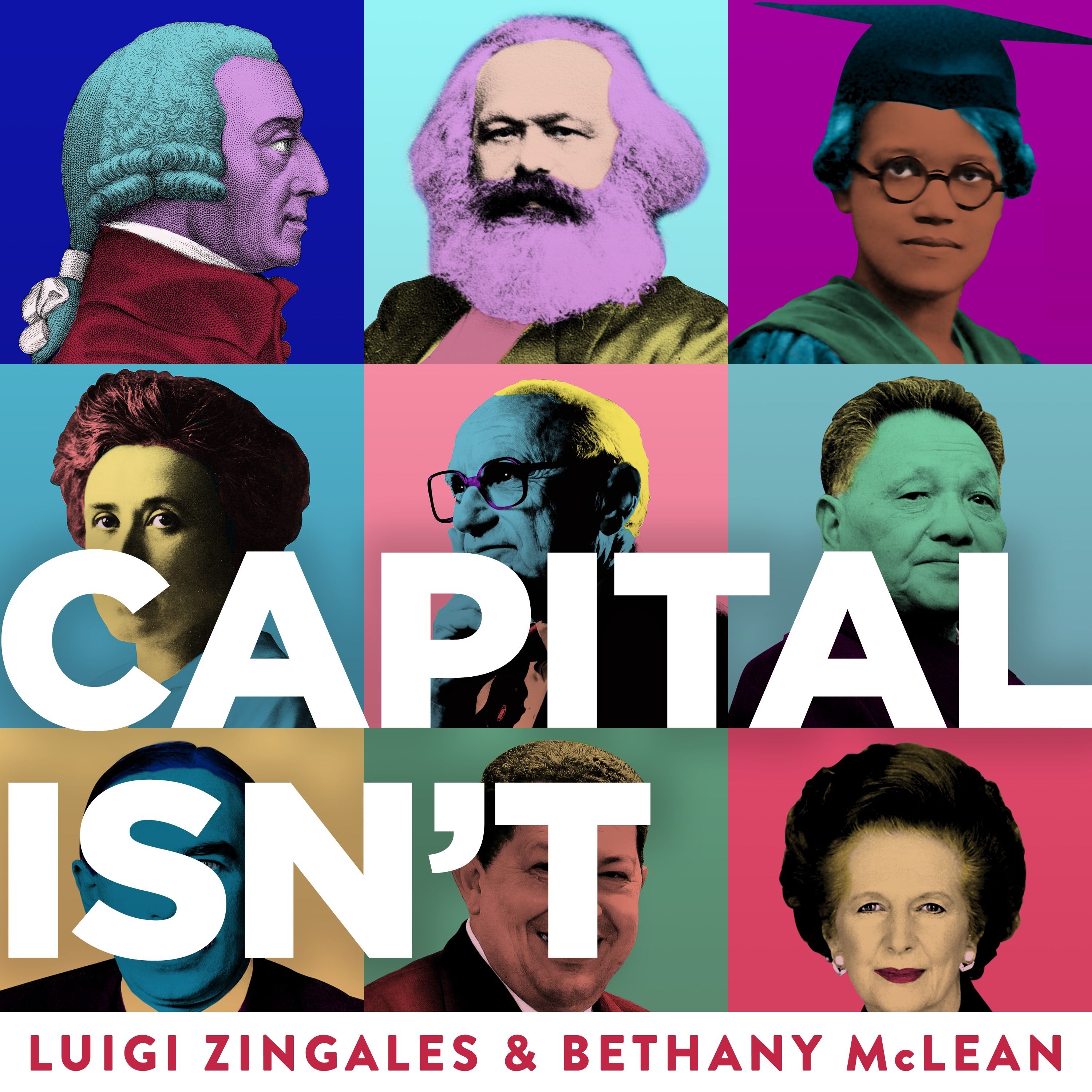
We investigate how capitalism is—or more often isn’t—working in our world today. Hosted by economist Luigi Zingales and business journalist Bethany McLean, our podcast explains why capitalism can go wrong and what we can do to fix it. Send us your questions or comments by emailing capitalisntpod@gmail.com Cover photo attributions: https://www.chicagobooth.edu/research/stigler/about/capitalisnt.

Listen to episodes

60 recent
June 4, 202646 min

Why Corporations Always Win At The Supreme Court - ft. Adam Winkler

Corporations are people in the eyes of the law. But how did that happen, and why does it hand them rights you don't have?  UCLA law professor Adam Winkler, author of "We the Corporations", traces a 200-year campaign by business to win the constitutional rights of human beings. Bethany McLean and Luigi Zingales press him on what Zingales calls an incredible trick. Corporations insist they're separate from their owners when that shields owners from blame, then argue they're like people when they want to spend on elections or dodge a rule.  Winkler traces how the Fourteenth Amendment, written after the Civil War to protect the newly freed, became a tool for railroads and banks instead. He even describes a lawyer who, by his account, lied to the Supreme Court, producing a journal he claimed proved the amendment was meant for corporations.  Zingales pushes on what comes next: could AI itself qualify for legal personhood, and would that shield big tech from blame? When we ask Winkler for a shred of hope that the long arc doesn't simply keep favoring business, the answer is far shorter and blunter than expected.  Connect with us: 📺 Subscribe to our YouTube Channel 📱 Follow Capitalisn’t on Instagram & TikTok ✉️ Email your questions and comments to capitalisntpod@gmail.com Hosted by Simplecast, an AdsWizz company. See pcm.adswizz.com for information about our collection and use of personal data for advertising.

May 28, 202643 min

You Can't Buy Trust - ft. Wikipedia Co-Founder Jimmy Wales

How does a free, decentralized, volunteer-run encyclopedia produce something more trusted than nearly any for-profit institution? Luigi Zingales and Bethany McLean sit down with Wikipedia co-founder Jimmy Wales to explore how the platform organizes global knowledge.  The conversation unpacks how Wikipedia governs itself without a central authority, why consensus beats voting, and what the deliberate vagueness of its rules actually protects against. But is artificial intelligence a looming threat to this system? Wales questions whether these new technologies can actually verify truth without the human feedback loops that correct traditional platforms.  Can the community-driven approach of Wikipedia teach the broader business world how to survive an era of deep digital skepticism? Tune in to discover if spontaneous human order is truly the ultimate defense against an automated future. Connect with us: 📺 Subscribe to our YouTube Channel 📱 Follow Capitalisn’t on Instagram & TikTok ✉️ Email your questions and comments to capitalisntpod@gmail.com Enjoying the show? Please leave us a rating and review on your favorite podcast player! Make sure to subscribe so you never miss an episode. Hosted by Simplecast, an AdsWizz company. See pcm.adswizz.com for information about our collection and use of personal data for advertising.

May 21, 20261 hr 0 min

Is Healthcare Making Capitalism Sick? - ft. Zack Cooper

Are stagnant wages the hidden price tag of a broken healthcare system? On this week's Capitalisn't, Yale health economist Zack Cooper tells Bethany McLean and Luigi Zingales that the U.S. healthcare market is failing because of structural flaws like employer-sponsored insurance, which hides true costs from consumers. He argues this opaque system has quietly become one of the leading drivers of income inequality in America. Cooper explains why standard economic principles break down in healthcare: in one of his studies, the average Manhattan patient drives past six cheaper MRI options to reach the one their doctor recommends. He also shows that when premiums rise equally across a workforce, companies are financially incentivized to lay off lower-wage workers to absorb the cost. And when hospitals acquire physician practices, doctor behavior shifts to maximize hospital revenue, significantly increasing rates of expensive, potentially unnecessary procedures like cesarean sections. Looking ahead, Cooper argues the U.S. will soon face a stark choice to control costs. The system must either roll back employer-sponsored insurance to push more people into the individual market, or expand Medicare to bring more of the public under regulated pricing. If you've ever stared at a medical bill and wondered how those numbers got there, this episode is worth a listen. Connect with us: 📺 Subscribe to our YouTube Channel 📱 Follow Capitalisn’t on Instagram & TikTok ✉️ Email your questions and comments to capitalisntpod@gmail.com Enjoying the show? Please leave us a rating and review on your favorite podcast player! Make sure to subscribe so you never miss an episode. Hosted by Simplecast, an AdsWizz company. See pcm.adswizz.com for information about our collection and use of personal data for advertising.

May 7, 202655 min

How “Muskism” Is Changing American Capitalism - ft. Quinn Slobodian

For the better part of the 20th century, the American economy relied on the steady social peace of "Fordism"—an era of mass production and consumption that helped reconcile capitalism with democracy. Today, a radical new paradigm threatens to upend that equilibrium: "Muskism". While conventional wisdom suggests that Silicon Valley billionaires are libertarians desperate to escape government oversight, historian Quinn Slobodian argues they actually want to achieve state symbiosis by turning the government into a dependent client. This vassalization of the state means private actors absorb critical public functions without any democratic constraints.  Discussing insights from his and co-author Ben Tarnoff's new book, Muskism: A Guide for the Perplexed, Slobodian unpacks how Elon Musk’s worldview is reshaping the global political economy. This episode also dives into the parallels between American tech supremacy and the Chinese economic model. Slobodian posits that the real vulnerability in the United States is not the excess of regulation that the Abundance agenda focuses on, but rather a failure to discipline capital. Connect with us: 📺 Subscribe to our YouTube Channel 📱 Follow Capitalisn’t on Instagram & TikTok ✉️ Email your questions and comments to capitalisntpod@gmail.com Hosted by Simplecast, an AdsWizz company. See pcm.adswizz.com for information about our collection and use of personal data for advertising.

April 23, 20261 hr 5 min

Is Capitalism Delivering For The Majority? - ft. Steve Kaplan

The US economy looks great on paper: high GDP, low unemployment, and booming markets. So why does it feel like the system is broken for so many people? To unpack the disconnect between macroeconomic data and everyday financial anxiety, we’re joined by Chicago Booth professor Steve Kaplan. A staunch defender of the free market, Kaplan argues that despite our collective pessimism, American capitalism is actually delivering unprecedented prosperity. Are we just looking at the data wrong, or is the market failing us? From the staggering costs of the US healthcare system to the lasting scars of the China labor shock, we debate the deepest fractures in our modern economic framework. Recorded alongside the Stigler Center's economic conference "Can Capitalism Be Popular?" the conversation covers how to actually measure an economic system, the U.S. vs. Europe debate, the opioid crisis, health care lock-in, teachers' unions, UBI, and the core tension of the whole show: if capitalism is working, why doesn't it feel that way? Connect with us: 📺 Subscribe to our YouTube Channel 📱 Follow Capitalisn’t on Instagram & TikTok ✉️ Email your questions and comments to capitalisntpod@gmail.com Hosted by Simplecast, an AdsWizz company. See pcm.adswizz.com for information about our collection and use of personal data for advertising.

April 16, 202641 min

Is The College Promise Broken? - ft. Noam Scheiber

For decades, Americans were promised that a college degree guaranteed a secure spot in the middle class. But instead of entering corporate management, many graduates are finding themselves trapped in low-paying service roles with crippling debt. Is this widening gap between expectations and financial realities fundamentally reshaping the modern American workforce? New York Times reporter Noam Scheiber joins the podcast to unpack the core arguments of his new book “Mutiny: The Rise and Revolt of the College-Educated Working Class” about this labor shift. He argues that the psychological injury of these broken promises is sparking a unique wave of workplace activism.  The systemic failure of the college wage premium poses urgent questions for the future of American capitalism. If millions of highly educated citizens feel cheated by the system, the resulting political and economic destabilization could be severe.  Connect with us: 📺 Subscribe to our YouTube Channel 📱 Follow Capitalisn’t on Instagram & TikTok ✉️ Email your questions and comments to capitalisntpod@gmail.com Hosted by Simplecast, an AdsWizz company. See pcm.adswizz.com for information about our collection and use of personal data for advertising.

April 2, 202647 min

The Real Cause Of Wage Stagnation - ft. Arin Dube

Economic models have treated the labor market like a perfectly competitive system where wages naturally align with worker value. Arin Dube, economics professor at the University of Massachusetts Amherst and author of “The Wage Standard”, challenges this long-held assumption. He argues that modern labor markets are riddled with invisible frictions that give employers outsized power over your paycheck.  These uneven power dynamics help explain why salaries at the bottom of the distribution have historically stagnated while the broader economy grew. Dube unpacks decades of data to show what actually happens when minimum wages rise, pushing back against the classic warning that wage floors automatically destroy jobs. Instead, he presents evidence suggesting that higher pay can actually reduce turnover and push workers toward more productive companies.  Hosts Luigi Zingales and Bethany McLean press Dube on the missing pieces of his labor puzzle. Zingales questions whether Dube is ignoring the massive impact of immigration on the supply and demand for low-wage labor. Meanwhile, McLean digs into the elusive concept of fairness, asking whether outsourced corporate janitors should compare their pay to Wall Street bankers or just to other janitors.  Subscribe to our Youtube Channel Follow Capitalisn’t on Instagram & TikTok Send us your questions or comments by emailing capitalisntpod@gmail.com You can find Arin Dube's book "The Wage Standard" here Hosted by Simplecast, an AdsWizz company. See pcm.adswizz.com for information about our collection and use of personal data for advertising.

March 26, 202631 min

Is Everyone Getting Adam Smith Wrong? - ft. Glory Liu

Most people associate Adam Smith with free markets and “the invisible hand”. But does this conventional narrative purposefully ignore Smith’s deep suspicions about monopolies and power?  Georgetown assistant professor Glory Liu argues this narrow interpretation is actually a deliberate historical reconstruction. In her book, “Adam Smith’s America”, Liu reintroduces the famous philosopher as a theorist of power who worried deeply about organized wealth distorting society. She notes that Smith watched early merchants use their disproportionate resources to capture political influence and actively suppress workers.  Hosts Luigi and Bethany debate whether early merchant wealth accumulation truly mirrors the massive capital concentration seen in today's corporate landscape. They also explore the argument that reintroducing moral foundations to economic theory might provide a better foundation for capitalism itself. Subscribe to our Youtube Channel Follow Capitalisn’t on Instagram & TikTok Send us your questions or comments by emailing capitalisntpod@gmail.com  Hosted by Simplecast, an AdsWizz company. See pcm.adswizz.com for information about our collection and use of personal data for advertising.

March 12, 202641 min

Why Human Progress Is Not Inevitable - ft. Carl Frey

We tend to view technological advancement as an unstoppable force that naturally improves our living standards over time. From the printing press to the internet, modern society assumes that groundbreaking ideas will always find their way into the marketplace. However, beneath the surface of our rapid digital expansion, global productivity is actually facing a troubling and persistent slowdown. Many people are beginning to wonder if our relentless push forward is practically sustainable or if we could be approaching a sudden halt. In this episode, Oxford Professor Carl Frey joins the podcast to share the unsettling message of his new book, “How Progress Ends”. He argues that technological progress is far from inevitable and can easily reverse when entrenched institutions block new ideas from transforming society. Frey explores the historical tension between decentralized innovation and centralized bureaucracies, suggesting that both the United States and China might be heading toward a period of stagnation. Instead of a guaranteed bright future fueled by artificial intelligence, we face a reality where corporate power and political self-preservation could permanently trap us in the status quo. This conversation digs into whether our modern institutions are robust enough to foster the next wave of human ingenuity or if they are fundamentally designed to suppress it. Listeners will discover exactly how historical empires have stifled their own growth and why those same warning signs are flashing today.  Subscribe to our Youtube Channel Follow Capitalisn’t on Instagram & TikTok Send us your questions or comments by emailing capitalisntpod@gmail.com  Hosted by Simplecast, an AdsWizz company. See pcm.adswizz.com for information about our collection and use of personal data for advertising.

March 5, 202650 min

The Hidden Economic Dangers Of Supreme Court Overreach - ft. Steve Vladeck

For decades, Americans viewed the Supreme Court as an impartial referee standing above the political fray. However, public trust in this vital institution has recently plummeted to historic lows. Many observers blame a surge in ideological rulings that align with the party of the President who appointed each justice. If the referee is suddenly wearing a team jersey, the fundamental systems of democracy and capitalism begin to break down. Georgetown University Law Professor Steve Vladeck joins Luigi and Bethany to argue that the real culprit isn't just partisan justices, but a complete abdication of responsibility by Congress. Rather than viewing judicial reform as a zero-sum game of packing the court, he proposes that lawmakers must reclaim their constitutional authority to check judicial overreach. He explains how special interest groups have successfully manipulated this power vacuum to reshape American regulations. This perspective completely reframes the crisis from a partisan dispute into a structural collapse of institutional power. This episode explores the hidden mechanisms that allow unaccountable judges to unilaterally rewrite the rules of our economic system, why decades of political complacency allowed this shift and what actionable steps can actually fix it. Vladeck answers whether the business community will ultimately regret enabling a system that erodes the reliable rule of law and why saving our markets may require Congress to finally stand up and do its job. Subscribe to our Youtube Channel Follow Capitalisn’t on Instagram & TikTok Send us your questions or comments by emailing capitalisntpod@gmail.com  Hosted by Simplecast, an AdsWizz company. See pcm.adswizz.com for information about our collection and use of personal data for advertising.

Is this your show?

Claim this listing to keep it up to date, reach guests who want to pitch you, and manage bookings with Guestify.

Claim this listing