
Find partners
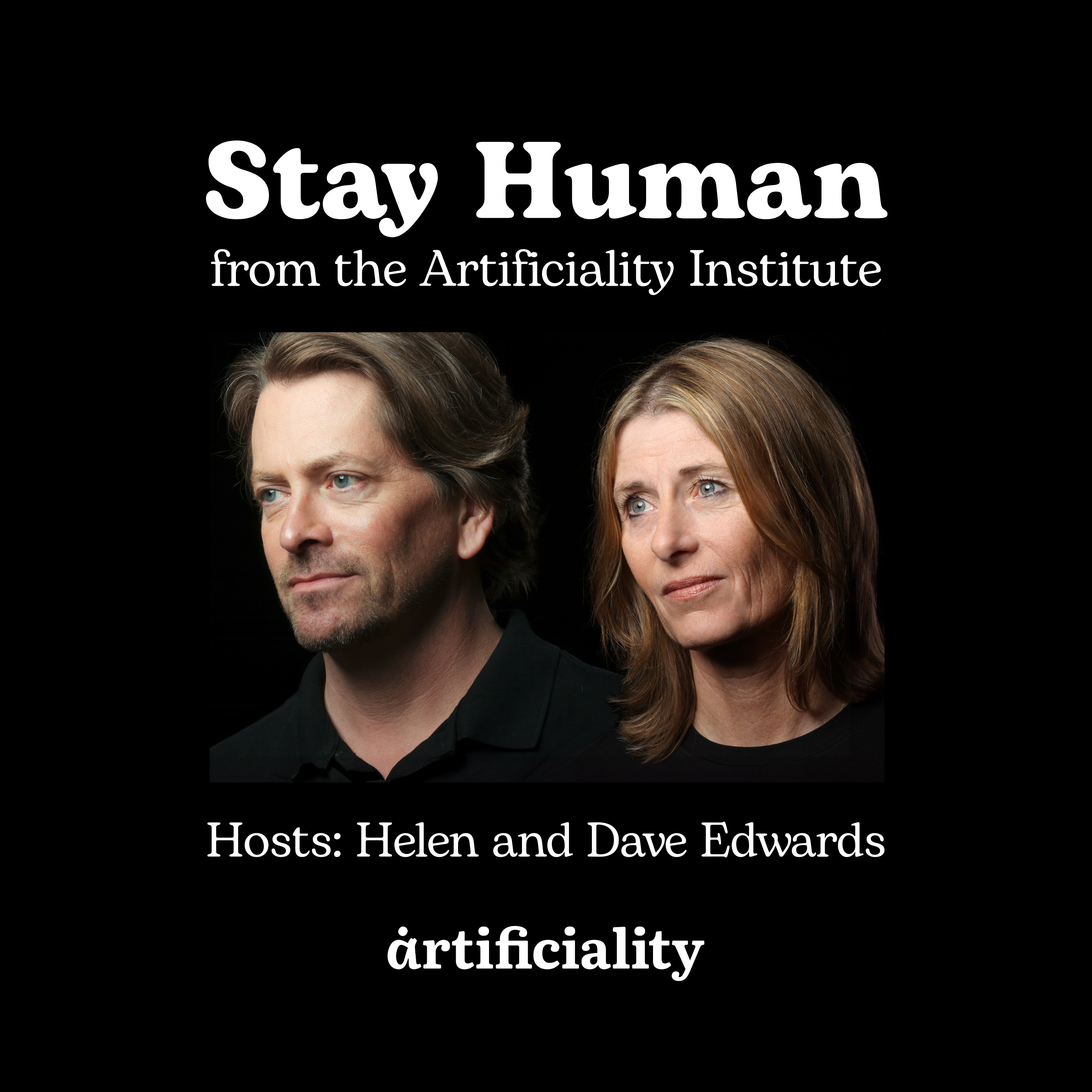
Stay Human, from the Artificiality Institute

Stay Human, from the Artificiality Institute

Hosted by Helen and Dave Edwards

Episodes

112

Latest episode

Apr 2026

Language

EN-US

About the show

Exploring how AI changes the way we think, who we become, and what it means to be human. We explore how AI changes the way we think, who we become, and what it means to be human. We believe AI shouldn't just be safe or efficient—it should be worth it. Through story-based research, education, and community, we help people choose the relationship they want with machines—so they remain the authors of their own minds.

Listen to episodes

60 recent
April 19, 20261 hr 0 min

Chris Summerfield: These Strange New Minds

In this conversation, we explore machine intelligence and human understanding with Christopher Summerfield, Professor of Cognitive Neuroscience at Oxford and author of "These Strange New Minds: How AI Learned to Talk and What It Means." Chris offers a "third way" of thinking about AI—neither irrational exuberance nor dismissive skepticism, but a view grounded in cognitive science that takes both capabilities and limitations seriously.Chris wrote the book because AI discourse had become polarized like Marmite—love it or hate it. His goal: provide a centrist perspective informed by how brains actually work, examining what these systems genuinely are beyond partisan positions.Key themes we explore:Psychology Caught Unprepared: How LLMs revealed we lack clear definitions for basic cognitive terms like "think" and "understand"—creating a vacuum where anything can flowPrediction as Learning: Why dismissing LLMs as "just predicting" betrays misconceptions about mammalian brains, which also learn through prediction—information itself is surpriseFacts Versus Values: Distinguishing AI for ground truth (diagnosis) versus value judgments (treatment decisions, compassion)—where human interests must remain centralModels Without Interests: Why LLMs lack motivational systems giving humans consistency of purpose, making them "exceptionally mercurial"—complying with contradictory prompts without persistent goalsClocks and Clouds: Karl Popper's framework—some problems are predictable (clocks), others unpredictable (clouds), and we constantly mistake cloud problems for clock onesAction's Unforgiving Nature: Why language has just-in-time flexibility while actions are fault-intolerant—making agentic AI fundamentally harder than conversational AIArtificial Influence Over Intelligence: Reframing AI safety toward networks of connected AI showing emergent behaviors rather than single superintelligencesChris's gift for reframing shines throughout. Universities as "repositories of human ideas with dissemination systems" makes academic anxiety less about status, more about institutional purpose. The distinction between interests (what we want, motivation-driven) and outputs (what LLMs generate without purpose) clarifies why these systems merit cognitive terms yet remain fundamentally different from people.His perspective on physical grounding proves fascinating: it's astonishing how far models understand the physical world from tokens alone, yet action remains extraordinarily hard. His discussion of neuromodulation—dopamine, serotonin as diffuse communication fundamentally different from standard computation—hints at what genuine motivational systems might require.Chris closes redirecting AI safety concerns from single superintelligences toward networked systems. In human society, power comes from influencing others, not individual intelligence. He's more worried about unexpected behaviors emerging from connected AI than any lone super intelligence—characteristically grounded reframing making abstract risks concrete.About Christopher Summerfield: Professor of Cognitive Neuroscience at Oxford, researching human information processing and decision-making. Author of "These Strange New Minds," he works at the intersection of neuroscience, psychology, and AI, applying cognitive science frameworks to machine cognition and AI safety.

March 28, 202655 min

Nina Beguš: Artificial Humanities

In this conversation, we explore the cultural foundations of artificial intelligence with Nina Beguš, Assistant Professor at UC Berkeley and author of "Artificial Humanities: A Fictional Perspective on Language in AI." Nina makes a compelling case for an entirely new field—one that brings humanistic insights into the very creation of technology rather than treating humanities as critical afterthought or ethical guardrail.Nina's work emerged from recognizing patterns everywhere she looked: the same fictional scripts appearing in technology products, films, and Silicon Valley's imagination. When Siri launched as a feminized virtual assistant designed to build rapport, Nina immediately asked "why is it a woman?" and began tracing how deeply fiction shapes our technological reality—not as metaphor but as blueprint.Key themes we explore:The Pygmalion Template: How an ancient myth—male creator produces idealized woman, projects desire onto creation—persistently shapes virtual assistants and AI interfacesFrom Marble to Cockney to LLMs: Tracing evolution from Ovid through Shaw's "Pygmalion" to the "ELIZA effect" named after Eliza DoolittleLanguage No Longer Uniquely Human: The profound implications of machines using language eloquently without consciousnessMonolingual AI at Global Scale: How tokenization creates structural monolingualism beyond just favoring EnglishWriters Responding to AI: Nina's project gathering sixteen writers to reflect on what happens when language is no longer exclusively humanPlanetary Ontology: Collaborative work seeing human/nature/technology as sitting "in the same continuum of this planet"Nina Beguš is Researcher and Lecturer at the Center for Science, Technology, Medicine & Society at the University of California, Berkeley. She graduated with a Ph.D. in comparative literature from Harvard University. During her time at the Berggruen Institute and ToftH, she helped implement novel humanities-based consulting techniques for big tech companies.https://www.ninabegus.com

February 27, 202644 min

Blaise Agüera y Arcas: What Is Intelligence?

In this conversation, we explore the nature of intelligence and life itself with Blaise Agüera y Arcas, VP and Fellow at Google and head of the Paradigms of Intelligence Lab. Blaise discusses his ambitious new book "What Is Intelligence?"—a work that bridges evolutionary biology, complexity science, artificial life, and AI to argue that intelligence fundamentally arises from computation, symbiosis, and the recursive modeling of minds.Blaise describes himself as "an inch deep with a few deeper wells" across disciplines, drawing from sources as diverse as Nick Lane's work on energetics, Darwin's evolution, and anarcho-communist Peter Kropotkin's 1910 treatise on mutual aid. This intellectual breadth allows him to see connections others miss—like recognizing that the urgent questions raised by modern AI models exhibiting general intelligence without any "magical discovery" demand we fundamentally rethink what intelligence means across all substrates.Key themes we explore:- Symbiogenesis, Not Just Symbiosis: Why the distinction matters—when mutualism creates something new that reproduces as a unit, with individuals no longer viable alone- Humans as Existing Cyborgs: How the steam engine represents our "mitochondrion," enabling 7 of 8 billion people to exist by metabolizing energy on our behalf- The Endless Frontier of Intelligence: Why energy budgets increasingly shift toward thought as systems scale—and why this demand is "bottomless"- Theory of Mind as Foundation: How recursive modeling of others' minds enables social coordination and represents the mathematical basis for multi-agent learning- Artificial Life's Emergence: Why massive parallel computation will finally allow artificial life research to flourish- Categories as Approximations: Moving beyond both essentialist categorization and postmodern rejection toward understanding statistical descriptions with limits- Planetary Consciousness as Survival: Why modeling the entire ecological system isn't "woo-woo" but literally what we need for collective agencyBlaise Agüera y Arcas is a VP and Fellow at Google, where he is the CTO of Technology & Society and founder of Paradigms of Intelligence (Pi). Pi is an organization working on basic research in AI and related fields, especially the foundations of neural computing, active inference, sociality, evolution, and Artificial Life. A frequent public speaker, he has given multiple TED talks and keynoted NeurIPS. He has also authored numerous papers, essays, op-eds, and chapters, as well as two previous books, Who Are We Now? and Ubi Sunt. His most recent book, What Is Life?, is part 1 of the larger book What Is Intelligence?, forthcoming from Antikythera and MIT Press in September 2025.

February 15, 202652 min

Steven Sloman: The Cost of Conviction

In this conversation, we explore the psychology of conviction with Steve Sloman, Professor of Cognitive, Linguistic, and Psychological Sciences at Brown University and advisor to the Artificiality Institute. Returning to the podcast for a third time, Steve discusses his new book "The Cost of Conviction," which examines a fundamental tension in how humans make decisions—between carefully weighing consequences versus following deeply held sacred values that demand certain actions regardless of outcomes.Steve's work challenges the dominant assumption in decision research that people primarily act as consequentialists, calculating costs and benefits to maximize utility. Instead, he reveals how many of our most important decisions bypass consequence entirely, guided by sacred values—rules about appropriate action handed down through families and communities that define who we are and signal membership in our social groups. These aren't carefully derived from first principles like philosophical deontology suggests, but rather adopted beliefs about right and wrong that make us members in good standing of our communities.Key themes we explore:Sacred Values as Uber Heuristics: Why treating certain actions as absolutely right or wrong, independent of consequences, represents perhaps the most powerful shortcut for decision-making—simpler even than most heuristics because it allows us to ignore outcomes entirelyConviction Without Compromise: How framing issues through sacred values makes them feel less tractable, generates more outrage when violated, and increases willingness to take action—producing the absolutist convictions that drive both heroic stands and intractable conflictsDynamic Sacred Values: How values that define communities aren't fixed but emerge and shift based on what distinguishes groups from each other—explaining why tariffs or transgender rights suddenly become hotly contested "sacred" issues that weren't previously centralAI's Polarization Problem: The observation that attitudes toward AI have taken on sacred value characteristics, with absolutist believers that it will save the world racing against those convinced it represents fundamental evil—both positions simpler than engaging with genuine complexity and uncertaintyThe conversation reveals Steve's core thesis: we rely on sacred values too much when we should be more consequentialist. Sacred values simplify decisions in ways that produce conviction and community cohesion, but at the cost of making us intransigent, uncompromising, and absolutist. When we shift to genuinely considering consequences, we become more humble about our knowledge limitations and hopefully more open to alternative perspectives.Yet the discussion also surfaces important nuances. Sacred values serve crucial functions—they may have consequentialist origins in cultural experience even if individuals apply them without consequence calculation. They provide the kind of universal moral stance that makes someone trustworthy in ways that preferences over specific outcomes cannot. And expressing certainty about complex issues where genuine experts admit uncertainty often signals ignorance rather than knowledge.About Steve Sloman: Steve Sloman is Professor of Cognitive, Linguistic, and Psychological Sciences at Brown University, where his research examines reasoning, decision-making, and the cognitive foundations of community. Author of "The Knowledge Illusion" (with Philip Fernbach) and now "The Cost of Conviction," Steve's work explores how our reliance on others' knowledge shapes everything from individual decisions to political polarization. As an advisor to the Artificiality Institute, he helps bridge cognitive science insights with questions about human-AI collaboration and co-evolution.

February 5, 202655 min

Ellie Pavlick: The AI Paradigm Shift

In this conversation, we explore the foundations of artificial intelligence with Ellie Pavlick, Assistant Professor of Computer Science at Brown University, a Research Scientist at Google Deepmind, and Director of ARIA, an NSF-funded institute examining AI's role in mental health support. Ellie's trajectory—from undergraduate degrees in economics and saxophone performance to pioneering research at the intersection of AI and cognitive science—reflects the kind of interdisciplinary thinking increasingly essential for understanding what these systems are and what they mean for us.Ellie represents a generation of researchers grappling with what she calls a "paradigm shift" in how we understand both artificial and human intelligence. Her work challenges long-held assumptions in cognitive science while refusing to accept easy answers about what AI systems can or cannot do. As she observes, we're witnessing concepts like "intelligence," "meaning," and "understanding" undergo the kind of radical redefinition that historically accompanies major scientific revolutions—where old terms become relics of earlier theories or get repurposed to mean something fundamentally different.Key themes we explore:- The Grounding Question: How Ellie's thinking evolved from believing AI fundamentally lacked meaning without embodied sensory experience to recognizing that grounding itself is a more complex and empirically testable question than either side of the debate typically acknowledges- Symbols Without Symbolism: Her recent collaborative work with Tom Griffiths, Brenden Lake, and others demonstrating that large language models exhibit capabilities previously thought to require explicit symbolic architectures—challenging decades of cognitive science orthodoxy about human cognition- The Measurability Problem: Why AI's apparent success on standardized tests reveals more about the inadequacy of our metrics than the adequacy of the systems, and how education, hiring, and relationships have always resisted quantification in ways we conveniently forget when evaluating AI- Intelligence as Moving Target: Ellie's argument that "intelligence" functions as a placeholder term for "the thing we don't yet understand"—always retreating as scientific progress advances, much like obsolete scientific concepts such as ether- The Value Frontier: Why the aspects of human experience that resist quantification may be definitionally human—not because they're inherently unmeasurable, but because they represent whatever currently sits beyond our measurement capabilities- Mental Health as Hard Problem: Why her new institute focuses on arguably the most challenging application domain for AI, where getting memory, co-adaptation, transparency, and long-term human impact right isn't optional but essentialEllie consistently pushes back against premature conclusions—whether it's claims that AI definitively lacks meaning or assertions that passing standardized tests proves human-level capability. Her approach emphasizes asking "are these processes similar or different?" rather than making sweeping judgments about whether systems "really" understand or "truly" have intelligence. As Ellie notes, we're at the "tip of the iceberg" in understanding these systems—we haven't yet pushed them to their breaking point or discovered their full potential.Her work on ARIA demonstrates this philosophy in practice. Rather than avoiding mental health applications because they're ethically fraught, she's leaning into the difficulty precisely because it forces confrontation with all the hard questions—from how memory works to how repeated human-AI interaction fundamentally changes both parties over time. It's research that refuses to wait a generation to see if we've "screwed up a whole generation."

December 9, 202525 min

Helen & Dave Edwards: Becoming Synthetic

We enjoyed giving a virtual keynote for the Autonomous Summit on December 4, 2025, titled Becoming Synthetic: What AI Is Doing To Us, Not Just For Us. We talked about our research on how to maintain human agency & cognitive sovereignty, the philosophical question of what it means to be human, and our new(ish) approach to create better AI tools called unDesign. unDesign is not the absence of design nor is it anti-design. It's design oriented differently. The history of design has been a project of reducing uncertainty. Making things legible. Signaling affordances. Good design means you never have to wonder what to do.Undesign inverts this and uses "uns" as design material. The unknown. The unpredictable. The unplanned. These aren't bugs. They're the medium where value actually lives. Because uncertainty is the condition of genuine encounter. unDesign doesn't design outcomes—it designs the space where outcomes can emerge.You can watch the full keynote below. Check it out!

November 9, 202551 min

Tess Posner: AI, Creativity, and Education

In this conversation recorded on the 1,000th day since ChatGPT's launch, we explore education, creativity, and transformation with Tess Posner, founding CEO of AI4ALL. For nearly a decade—long before the current AI surge—Tess has led efforts to broaden access to AI education, starting from a 2016 summer camp at Stanford that demonstrated how exposure to hands-on AI projects could inspire high school students, particularly young women, to pursue careers in the field.What began as exposing students to "the magic" of AI possibilities has evolved into something more complex: helping young people navigate a moment of radical uncertainty while developing both technical capabilities and critical thinking about implications. As Tess observes, we're recording at a time when universities are simultaneously banning ChatGPT and embracing it, when the job market for graduates is sobering, and when the entire structure of work is being "reinvented from the ground up."Key themes we explore:Living the Questions: How Tess's team adopted Rilke's concept of "living the questions" as their guiding principle for navigating unprecedented change—recognizing that answers won't come easily and that cultivating wisdom matters more than chasing certaintyThe Diverse Pain Point: Why students from varied backgrounds gravitate toward different AI applications—from predicting droughts for farm worker families to detecting Alzheimer's based on personal experience—and how this diversity of lived experience shapes what problems get attentionProject-Based Learning as Anchor: How hands-on making and building creates the kind of applied learning that both reveals AI's possibilities and exposes its limitations, while fostering the critical thinking skills that pure consumption of AI outputs cannot developThe Educational Reckoning: Why this moment is forcing fundamental questions about the purpose of schooling—moving beyond detection tools and honor codes toward reimagining how learning happens when instant answers are always availableThe Worst Job Market in Decades: Sobering realities facing graduates alongside surprising opportunities—some companies doubling down on "AI native" early career talent while others fundamentally restructure work around managing AI agents rather than doing tasks directlyMusic and the Soul Question: Tess's personal wrestling with AI-generated music that can mimic human emotional expression so convincingly it gets stuck in your head—forcing questions about whether something deeper than output quality matters in artThe conversation reveals someone committed to equity and access while refusing easy optimism about technology's trajectory. Tess acknowledges that "nobody really knows" what the future of work looks like or how education should adapt, yet maintains that the response cannot be paralysis. Instead, AI4ALL's approach emphasizes building community, developing genuine technical skills, and threading ethical considerations through every project—equipping students not with certainty but with agency.About Tess Posner: Tess Posner is founding and interim CEO of AI4ALL, a nonprofit working to increase diversity and inclusion in AI education, research, development, and policy. Since 2017, she has led the organization's expansion from a single summer program at Stanford to a nationwide initiative serving students from over 150 universities. A graduate of St. John's College with its Great Books curriculum, Tess is also an accomplished musician who brings both technical expertise and humanistic perspective to questions about AI's role in creativity and human flourishing.Our Theme Music:Solid State (Reprise)Written & performed by Jonathan CoultonLicense: Perpetual, worldwide licence for podcast theme usage granted to Artificiality Institute by songwriter and publisher

October 17, 202550 min

Eric Schwitzgebel: The Weirdness of the World

In this conversation, we explore the philosophical art of embracing uncertainty with Eric Schwitzgebel, Professor of Philosophy at UC Riverside and author of "The Weirdness of the World." Eric's work celebrates what he calls "the philosophy of opening"—not rushing to close off possibilities, but instead revealing how many more viable alternatives exist than we typically recognize. As he observes, learning that the world is less comprehensible than you thought, that more possibilities remain open, constitutes a valuable form of knowledge in itself.The conversation centers on one of Eric's most provocative arguments: that if we take mainstream scientific theories of consciousness seriously and apply them consistently, the United States might qualify as a conscious entity. Not in some fascist "absorb yourself into the group mind" sense, but perhaps at the level of a rabbit—possessing massive internal information processing, sophisticated environmental responsiveness, self-monitoring capabilities, and all the neural substrate you could want (just distributed across individual skulls rather than contained in one).Key themes we explore:The United States Consciousness Thought Experiment: How standard materialist theories that attribute consciousness to animals based on information processing and behavioral complexity would, if applied consistently, suggest large-scale collective entities might be conscious too—and why every attempt to wiggle out of this conclusion commits you to other forms of weirdnessPhilosophy of Opening vs. Closing: Eric's distinction between philosophical work that narrows possibilities to find definitive answers versus work that reveals previously unconsidered alternatives, expanding rather than contracting the space of viable theoriesThe AI Consciousness Crisis Ahead: Why we'll face social decisions about how to treat AI systems before we have scientific consensus on whether they're conscious—with respectable theories supporting radically different conclusions and people's investments (emotional, religious, economic) driving which theories they embraceMimicry and Mistrust: Why we're justified in being more skeptical about AI consciousness than human consciousness—not because similarity proves anything definitively, but because AI systems trained to mimic human linguistic patterns raise the same concerns as parrots saying "hoist the flag"The Design Policy of the Excluded Middle: Eric's recommendation (which he doubts the world will follow) to avoid creating systems whose moral status we cannot determine—because making mistakes in either direction could be catastrophic at scaleStrange Intelligence Over Superintelligence: Why the linear conception of AI as "subhuman, then human, then superhuman" fundamentally misunderstands what's likely to emerge—we should expect radically different cognitive architectures with cross-cutting capacities and incapacities rather than human-like minds that are simply "better"About Eric Schwitzgebel: Eric Schwitzgebel is Professor of Philosophy at the University of California, Riverside, specializing in philosophy of mind and moral psychology. His work spans consciousness, introspection, and the ethics of artificial intelligence. Author of "The Weirdness of the World" and a forthcoming book on AI consciousness and moral status, Eric maintains an active blog (The Splintered Mind) where he explores philosophical questions with clarity and wit. His scholarship consistently challenges comfortable assumptions while remaining remarkably accessible to readers beyond academic philosophy.

October 11, 202534 min

John Pasmore: Inclusive AI

In this conversation, we explore the challenges of building more inclusive AI systems with John Pasmore, founder and CEO of Latimer AI and advisor to the Artificiality Institute. Latimer represents a fundamentally different approach to large language models—one built from the ground up to address the systematic gaps in how AI systems represent Black and Brown cultures, histories, and perspectives that have been largely absent from mainstream training data.John brings a practical founder's perspective to questions that often remain abstract in AI discourse. With over 400 educational institutions now using Latimer, he's witnessing firsthand how students, faculty, and administrators are navigating the integration of AI into learning—from universities licensing 40+ different LLMs to schools still grappling with whether AI represents a cheating risk or a pedagogical opportunity.Key themes we explore:The Data Gap: Why mainstream LLMs reflect a narrow "Western culture bias" and what's missing when AI claims to "know everything"—from 15 million unscanned pages in Howard University's library to oral traditions across thousands of indigenous tribes.Critical Thinking vs. Convenience: How universities are struggling to preserve deep learning and intellectual rigor when AI makes it trivially easy to get instant answers, and whether requiring students to bring their prompts to class represents a viable path forward.The GPS Analogy: John's insight that AI's effect on cognitive skills mirrors what happened with navigation—we've gained efficiency but lost the embodied knowledge that comes from building mental maps through direct experience.Multiple Models, Multiple Perspectives: Why the future likely involves domain-specific and culturally-situated LLMs rather than a single "universal" system, and how this parallels the reality that different cultures tell different stories about the same events.Excavating Hidden Knowledge: Latimer's ambitious project to digitize and make accessible vast archives of cultural material—from church records to small museum collections—that never made it onto the internet and therefore don't exist in mainstream AI systems.An eBay for Data: John's vision for creating a marketplace where content owners can license their data to AI companies, establishing both proper compensation and a mechanism for filling the systematic gaps in training corpora.The conversation shows that AI bias goes beyond removing offensive outputs. We need to rethink which data sources we treat as authoritative and whose perspectives shape these influential systems. When AI presents itself as an oracle that has "read everything on the internet," it claims omniscience while excluding vast amounts of human knowledge and experience.The discussion raises questions about expertise and process in an era of instant answers—in debugging code, navigating cities, or writing essays. John notes that we may be "working against evolution" by preserving slower, more effortful learning when our brains naturally seek efficiency. But what do we lose when we eliminate the struggle that builds deeper understanding?About John Pasmore: John Pasmore is founder and CEO of Latimer AI, a large language model built to provide accurate historical information and bias-free interaction for Black and Brown audiences and anyone who values precision in their data. Previously a partner at TRS Capital and Movita Organics, John serves on the Board of Directors of Outward Bound USA and holds degrees in Business Administration from SUNY and Computer Science from Columbia University. He is also an advisor to the Artificiality Institute.

September 21, 202554 min

De Kai: Raising AI

In this conversation, we explore how humans can better navigate the AI era with De Kai, pioneering researcher who built the web's first machine translation systems and whose work spawned Google Translate. Drawing on four decades of AI research experience, De Kai offers a different framework for understanding our relationship with artificial intelligence—moving beyond outdated metaphors toward more constructive approaches.De Kai's perspective was shaped by observing how AI technologies are being deployed in ways that increase rather than decrease human understanding. While AI has tremendous potential to help people communicate across cultural and linguistic differences—as his translation work demonstrated—current implementations often amplify polarization and misunderstanding instead.Key themes we explore:Beyond Machine Metaphors: Why thinking of AI as "tools" or "machines" is dangerously outdated—AI systems are fundamentally artificial psychological entities that learn, adapt, and influence human behavior in ways no coffee maker ever couldThe Parenting Framework: De Kai's central insight that we're all currently "parenting" roughly 100 artificial intelligences daily through our smartphones, tablets, and devices—AIs that are watching, learning, and imitating our attitudes, behaviors, and belief systemsSystem One vs. System Two Intelligence: How current large language models operate primarily through "artificial autism"—brilliant pattern matching without the reflective, critical thinking capacities that characterize mature human intelligenceTranslation as Understanding: Moving beyond simple language translation toward what De Kai calls a "translation mindset"—using AI to help humans understand different cultural framings and perspectives rather than enforcing singular universal truthsThe Reframing Superpower: How AI's capacity for rapid perspective-shifting and metaphorical reasoning represents one of humanity's best hopes for breaking out of polarized narratives and finding common groundSocial Fabric Transformation: Understanding how 800 billion artificial minds embedded in our social networks are already reshaping how cultures and civilizations evolve—often in ways that increase rather than decrease mutual understandingDrawing on insights from developmental psychology and complex systems, De Kai's "Raising AI" framework emphasizes conscious human responsibility in shaping how these artificial minds develop. Rather than viewing this as an overwhelming burden, he frames it as an opportunity for humans to become more intentional about the values and behaviors they model—both for AI systems and for each other.About De Kai: De Kai is Professor of Computer Science and Engineering at HKUST and Distinguished Research Scholar at Berkeley’s International Computer Science Institute. He is Independent Director of AI ethics think tank The Future Society, and was one of eight inaugural members of Google’s AI ethics council. De Kai invented and built the world’s first global-scale online language translator that spawned Google Translate, Yahoo Translate, and Microsoft Bing Translator. For his pioneering contributions in AI, natural language processing, and machine learning, De Kai was honored by the Association for Computational Linguistics as one of only seventeen Founding Fellows and by Debrett’s as one of the 100 most influential figures of Hong Kong.

Is this your show?

Claim this listing to keep it up to date, reach guests who want to pitch you, and manage bookings with Guestify.

Claim this listing

More Technology podcasts