Find partners
Airing Pain

Airing Pain

Hosted by Airing Pain

Episodes

164

Latest episode

Jun 2026

Language

EN

About the show

Airing Pain is the online radio programme and podcast from Pain Concern . Each edition we bring together people with chronic pain and top specialists to talk about resources that can help. You can listen to Airing Pain every Tuesday via Able Radio , with all episodes available on demand here and on our website . Or subscribe via Apple Podcasts, Spotify or your favourite podcast app to get the latest podcasts delivered straight to your mobile or tablet. We welcome feedback - rate on your device or fill in our survey . Pain Concern is a charity registered in Scotland SC023559.

Listen to episodes

60 recent
June 2, 2026Episode 15336 min

153: Can nature and mindfulness help pain?

This episode is produced in partnership with the British Pain Society. The interview with Sam Hughes was recorded at their 2025 Annual Scientific Meeting.Can nature and mindfulness help pain?This episode of Airing Pain looks at the interplay between nature and mindfulness, and how they can become part of the pain management toolkit. Nature and neuroscience. Understand the science with Dr Sam Hughes. Learn how nature interacts with pain, and how this interaction works in virtual reality. Greater connections. We join the Edinburgh and Lothians Greenspace Trust on one of their group wellbeing walks. We look at the benefits of building connections with nature, each other and ourselves. Focusing on the here and now. We hear from trained and accredited mindfulness teacher Cath Ashby. Cath explains how the practice of mindfulness can be applied to nature, and what this can do for pain.Contributors:Dr Sam Hughes, a Senior Lecturer in Pain Neuroscience at the University of ExeterElly Kinross, a Woodlands and Greenspace Officer with the Edinburgh and Lothians Greenspace TrustCath Ashby, a trained and accredited mindfulness teacher Pain Concern’s free, online mindfulness sessions

April 7, 2026Episode 15239 min

152: How is pain management changing?

This episode is produced in partnership with the British Pain Society. These interviews were recorded at their 2025 Annual Scientific Meeting. The 2026 Annual Scientific Meeting is just weeks away – register here. Amongst other things, here we tackle the taboo subject of acute period pain, highlight how changes in primary care are improving the pain management landscape, and discuss common misconceptions about opioid use. Does period pain need rethinking? Understand the research with Katy Vincent, Professor of Gynaecological Pain at the University of Oxford. Can a health and wellbeing coach change patient lives? One of the latest developments in pain management, as explained by NHS coach Phoebe Williams.  Do opioids get a fair press? Great for pain from an accident, surgery or fall. But for chronic pain? Dr Jane Quinlan, consultant in pain management, gives an overview and some top tips.  Contributors: Prof Katy Vincent, Professor of Gynaecological Pain at the University of OxfordPhoebe Williams, Health and Wellbeing Coach at NHS Hammersmith & FulhamDr Emma Davies, National Clinical Lead for Persistent Pain at NHS Wales Performance and ImprovementTim Atkinson, Vice Chair of the British Pain Society’s Expert Patient and Carer CommitteeDr Jane Quinlan, Consultant in Anaesthesia and Pain Management at the Oxford University Hospitals NHS Foundation Trust

March 3, 2026Episode 112 min

S2 Ep1: How neurodivergent people experience pain

‘if you’re treating people in pain, you’re treating autistic people in pain’Do neurodivergent people experience pain differently?The simple answer – and the slightly more complicated one Why you, or your patients, aren’t recovering  Building relationships across neurotypes Pain thresholds, pain anxiety, pain communication… With Dr David Moore, Reader in Pain Psychology at Liverpool John Moores UniversityThanks go to the British Pain Society – this interview was recorded at their 2025 Annual Scientific Meeting. Read Pain Matters 91 now.

February 3, 2026Episode 15131 min

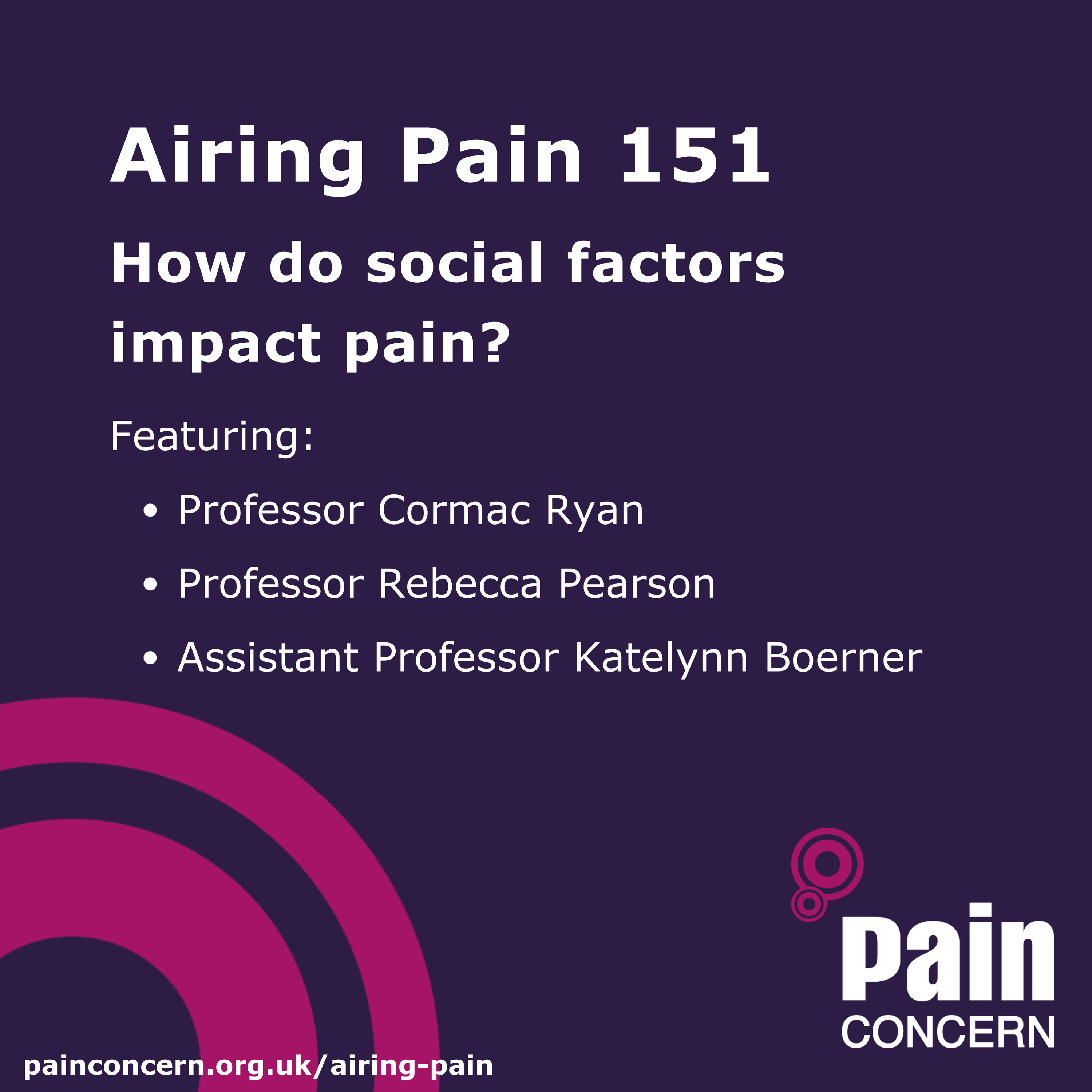
151: How do social factors impact pain?

This episode of Airing Pain explores how social factors impact the onset, experience and treatment of pain.  …understanding how things like your thoughts, your fears, your social interactions influence your biology can be really, really powerful… …you're not just dealing with the pain, you're holding it in for everyone else……we normalise, and even celebrate, different types of pain for different genders…Can stress cause chronic pain? The research, explained… with Cormac Ryan, Professor of Clinical Rehabilitation at Teesside University.What can pain do to relationships? What can relationships do to pain? Pain masking, social withdrawal, the power of attunement… with Rebecca Pearson, Professor of Developmental Psychology and Epidemiology at Manchester Metropolitan University.How do sex and gender affect pain? Sex hormones, gender identity, social modelling… with Katelynn Boerner, Assistant Professor in the Department of Paediatrics at the University of British Columbia. Thanks go to:  The British Pain Society – the interviews in this episode were recorded at their 2025 Annual Scientific Meeting.  If you have any feedback about Airing Pain, you can leave us a review via our Airing Pain survey

September 16, 2025Episode 15043 min

150: How pain education is changing lives

'Now I’m in control of the pain instead of the pain being in control of me'This episode explores the transformative impacts of pain education classes.Featuring excerpts from a live education session, here we look at how a brief, free course—delivered by trained volunteers with lived experience—is empowering people to navigate life with chronic pain.  Listen to hear how patients are learning more about their pain and the toolbox of techniques available to manage it.  These sessions are the result of a unique collaboration between Pain Concern and the NHS. They are available both online and in person (in Glasgow, run by NHS Greater Glasgow and Clyde’s pain management team). Book onto a free class/find out more information.   Watch Prof Lorimer Moseley's explanation of pain, as recommended in this episode.Contributors: Dr David Craig, Joan Melville, Georgina McDonald, Mairi McWilliams, Lindsay McLean, Heather Wallace. This podcast has been produced in collaboration with NHS Greater Glasgow and Clyde.  Pain Concern thanks the following funders for their unrestricted educational grants: Richer Sound; NHS Lothian Charity, The National Lottery Community Fund; The Hugh Fraser Foundation; The Trades House of Glasgow Commonweal Fund.If you have any feedback about Airing Pain, you can leave us a review via our Airing Pain survey.

September 9, 2025Episode 1501 min

150: Trail - Airing Pain 150: Pain Education Classes - Learn to live well with pain

May 21, 2025Episode 14934 min

149: Why pain persists: from childhood trauma to faulty immunity

Airing Pain #149: Why pain persists: from childhood trauma to faulty immunityThis edition of Airing Pain looks at the research into why pain persists, how we can identify people at risk and whether we could prevent it happening.In this episode: How does acute short-term pain turn into chronic, persistent pain? Kathleen Sluka explains that people who experience psychological trauma at young ages are more likely to have chronic pain later in life. What scientists think is happening is that psychological trauma or other stressful events actually change your immune system. Shafiq Skikander adds that a lot of patients with fibromyalgia may have had early life stressors. In addition, when they come to clinic presenting with fibromyalgia, they usually have a history of depression. So how does this happen?Gareth Hathway explains that slowly but surely, our understanding of the basic mechanisms is advancing. We now understand that babies do feel pain, young people do feel pain. It has a long-term consequence. We need a specialist approach to managing pain at every part of the life course. We need to think about how we measure that pain and how we treat that pain.The interviews were recorded at the British Pain Society’s Annual Scientific Meeting, 2024.Contributors: Shafiq Sikander, a professor of sensory neurophysiology at the William Harvey Research Institute, Queen Mary University, London.Gareth Hathway, professor of neuroscience at the University of Nottingham’s’ school of life sciences.Kathleen Sluka, a professor in physical therapy and rehabilitation science at the University of Iowa in the United States.ThanksThe interviews were recorded at the British Pain Society’s Annual Scientific Meeting, 2024. This programme describes research using laboratory animals that is consistent with Pain Concern’s Humane Care and Use of Animals in Medical Research Policy. Additional Resources: You can join our Airing Pain online community:Airing Pain online communityIf you have any feedback about Airing Pain, you can leave us a review via our Airing Pain survey

May 16, 20251 min

Trail - Airing Pain 149: Why pain persists: from childhood trauma to faulty immunity

This edition of Airing Pain focuses on advances in understanding and managing chronic pain, from neuroimmune mechanisms to new diagnostic and treatment approaches.In this trailer, listen to excerpts from the full program on: how does acute, short term pain turn into chronic, persistent pain? Why do early life experiences affect later life pain?  And why do existing tools for measuring pain fall short?

May 2, 2025Episode 1482 min

148: Trail - Airing Pain - Exploring the links between hypermobility and neurodivergence

Full Episode available: 5/3/2025This Airing Pain episode explores how neurodivergent individuals experience pain, potential links to hypermobility, and the need for better education to support conditions like autism and ADHD. Neurodiversity refers to the different ways a person’s brain processes information. It is an umbrella term used to describe a number of conditions including Autism or Autism Spectrum Conditions; ADHD; Dyscalculia; Dyslexia; Dyspraxia, or Developmental Coordination Disorder (DCD), and more.In this episode:  Dr. Clive Kelly discusses research on co-occurring conditions in neurodivergence, highlighting varied symptoms and how pain perception differs among individuals. Dr Jessica Eccles talks about her research into the relationship between joint hypermobility and neurodevelopmental conditions like ADHD and autism.  We hear from Ren Martin, an autistic learning disability nurse and mother of three neurodivergent children, and Ceri Reid of Parents Voices in Wales, advocating for better neurodiversity and mental health services. Throughout the episode, we hear from Imogen Warner, whose writings are featured in the Autistic Girls Network, and who highlights the reality of being a young autistic person. Contributors:  Dr. Clive Kelly, Consultant Physician and Rheumatologist, James Cook University Hospital and University of Newcastle-upon-Tyne.  Dr Jessica Eccles, Reader in Brain-Body Medicine at Brighton and Sussex Medical School.  Ren Martin, neurodevelopmental specialist.  Ceri Reid, neurodivergent mother and founder of Parents Voices in Wales. Imogen Warner, student with lived experience of autism and chronic pain.  Jane Green MBE, founder of SEDSConnective We are immensely grateful to The British Humane Association and The Heather Hoy Charitable Trust whose generous grants made this podcast possible.

May 2, 20255 min

Airing Pain Short - Interview with Jason Wilsher-Mills

Artist Jason Wilsher-Mills has lived with pain and chronic polyneuropathy since he was a child.In this interview he talks about his recent exhibition at the Wellcome Collection in London called "Jason and the Adventure of the 254"

Is this your show?

Claim this listing to keep it up to date, reach guests who want to pitch you, and manage bookings with Guestify.

Claim this listing