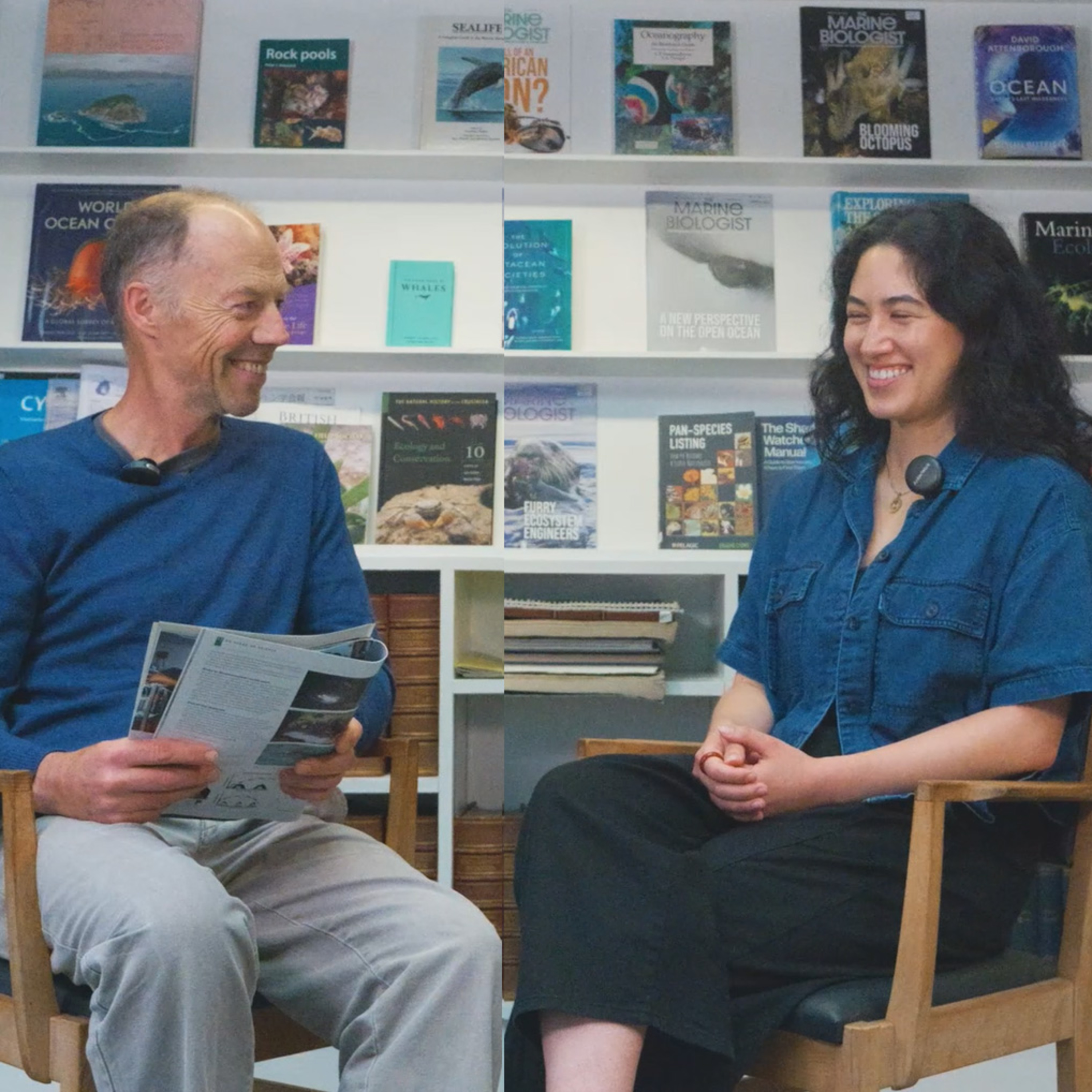
The Marine Biologist Podcast brings you conversations about marine life with leading marine biologists. If you are fascinated by the sea and its inhabitants and want to go deeper, this is the podcast for you. Each episode follows up on an article on cutting-edge science, conservation, or education that appeared in the most recent edition of The Marine Biologist magazine. Visit the magazine website: https://www.mba.ac.uk/magazine/ Join the Marine Biological Association: https://www.mba.ac.uk/membership/
Listen to episodes
21 recent
November 4, 2026Episode 120 min
Fungi: master recyclers at sea
Marine fungi are an overlooked but influential part of the ocean microbiome. DNA sequencing has revealed a vast diversity of marine fungi: floating freely in the water column, inhabiting sediments, and forming close associations with other organisms, fungi are found almost everywhere scientists look. In this episode our guest is PhD researcher Caitlin Dye, who works in the Microbiology and Molecular Ecology lab at the Marine Biological Association. As Caitlin explains, fungi have vital roles in recycling organic matter and helping regulate planktonic communities through parasitism. Caitlin is a PhD student at the MBA with the University of Plymouth.
August 11, 2026Episode 417 min
Mud, glorious mud!
Let’s face it, a muddy seabed is not the most charismatic of settings. And, with a low perceived value for biodiversity, historically mud has not been a high priority for protection. In this episode we meet Zoe Roseby, a sedimentologist working at the University of Exeter. Zoe explains where seabed mud comes from and which areas of mud are vulnerable to disturbance. The seabed sediments around the UK tell the story of the last ice age, changes in sea level, and recent human activities like trawling. We talk about MPAs and protecting mud for climate benefit. But to determine if a mud basin is vulnerable in terms of losing the carbon it stores, it is important to understand its history and the type of carbon held in the mud—which varies from site to site and even within sites. Zoe is a postdoctoral researcher at the University of Exeter working with the Convex Seascape Survey, a five-year project which is run by the University of Exeter and the Blue Marine Foundation and funded by the Convex Insurance Group to investigate carbon in continental shelf sediments. Read Zoe’s research paper to find out more: Vulnerability of blue carbon stocks to disturbance in sediments with low burial efficiency Find out more about the Convex Seascape Survey . Text us your comments and feedback Thanks for listening! If you have any questions you can contact us at the Marine Biological Association here . Join the Marine Biological Association and receive four copies a year of The Marine Biologist , our prestigious and beautifully curated magazine. MBA membership comes with a host of other benefits. Follow us on social: www.facebook.com/thembauk www.instagram.com/thembauk @thembauk.bsky.social
July 21, 2026Episode 325 min
The Power of Plankton
Plankton are the foundation of life on Earth, evolving and shaping the planet over billions of years. In this episode, Vincent Doumeizel, author of The Power of Plankton: How Plankton Made Life On Earth Possible and Why It’s Key To Our Future , talks about plankton and why it is fundamentally important for the survival of life on Earth as we know it. We talk about some of the engaging stories in the book, for example, why did Alain Bombard cast himself adrift in the Atlantic Ocean in rubber dinghy with only a plankton net? Are we Martians? And why hope will play such an important role in the fight to protect ocean biodiversity. The Power of Plankton , the new book from Vincent Doumeizel, bestselling author of The Seaweed Revolution, is published by The Book Social. Thanks for listening! Join the Marine Biological Association and receive four copies a year of The Marine Biologist , our prestigious and beautifully curated magazine. MBA membership comes with a host of other benefits. Follow us on social: www.facebook.com/thembauk www.instagram.com/thembauk @thembauk.bsky.social
June 15, 202633 min
Microplastics in a changing environment
Microplastics are present in the water we drink, the food we eat, and the air that we breathe. In this episode we meet Dr Alice Horton , Senior Research Fellow at the Marine Biological Association and an expert in aquatic microplastic pollution. We have been leaking plastic into the environment for the last 60 or so years and the amount entering the ocean is predicted to triple by 2040. But, as Alice explains, we still understand little of the long-term implications for ecosystems and human health. Alice's research at the MBA is specifically focusing on how microplastics interact with the diverse and complex mix of chemical and climate stressors and how different species will respond under changing global environmental conditions. We also discuss what scientists and policy-makers are doing to tackle microplastics and what we as individuals can do to reduce our exposure. MBA Members get exclusive early access to the video episode. Become a Member today to watch the full podcast first and unlock exclusive member-only benefits. mba.ac.uk/membership Text us your comments and feedback Thanks for listening! If you have any questions you can contact us at the Marine Biological Association here . Join the Marine Biological Association and receive four copies a year of The Marine Biologist , our prestigious and beautifully curated magazine. MBA membership comes with a host of other benefits. Follow us on social: www.facebook.com/thembauk www.instagram.com/thembauk @thembauk.bsky.social
May 13, 20261 hr 8 min
Small-scale is beautiful: building relationships for a sustainable inshore fishing fleet
In this episode, we meet social scientist Sarah Coulthard, and fishermen George Lamplough and Bally Philp who discuss issues facing small-scale fishers. Over 30% of global marine catch comes from small-scale fisheries, contributing to global food security, livelihoods, and resilient communities, and yet the UK's highly valued inshore fishing fleet is in decline. Is this "the last chance saloon for the small-scale fishing industry" ? Sarah, Bally, and George explore the reasons for the decline, discuss fishers' lived experiences, fisheries management and public perceptions. They also discuss the priorities for actions to help ensure a viable future for the fleet. The podcast follows on from the special edition of The Marine Biologist magazine which focuses on inshore and small-scale fisheries. Our guests are involved in the Inshore and Small-Scale Fisheries consortium (ISSF), a group which aims to identify the drivers of decline in the UK fleet, identify what can be done to support fishing lives, and support fishers to be active partners in decision-making. Find out about the work of the ISSF Consortium here . See the press release which details the national symposium for inshore and small scale fisheries, held in February 2026 in Newcastle. ISSF_Symposium_Press_Release.pdf - Google Drive Text us your comments and feedback Thanks for listening! If you have any questions you can contact us at the Marine Biological Association here . Join the Marine Biological Association and receive four copies a year of The Marine Biologist , our prestigious and beautifully curated magazine. MBA membership comes with a host of other benefits. Follow us on social: www.facebook.com/thembauk www.instagram.com/thembauk @thembauk.bsky.social
April 24, 202637 min
An illusion of protection? Marine Protected Areas with Professor Callum Roberts
"We need to consider what an area of sea is capable of when given real protection." Professor Callum Roberts is a world authority on marine protected areas (MPAs). In this podcast, we talk about marine protected areas both in national waters and the high seas. What needs to change in the UK's current approach to marine protected areas (MPAs), and how can the network support healthy and productive fisheries, producing gains, not just costs for the fishing industry? To have a vision for future seas, we have to look back: this is where the conversation turns to shifting baselines and a fascinating look at the momentous changes that have been wrought on the seabed of the Northeast Atlantic over the past 200 years. We also discuss the growing awareness of seabed carbon and the role of MPAs in supporting climate regulation. Callum is also an author, perhaps best known for The Unnatural History of the Sea (Island Press) which charts the effects of 1,000 years of exploitation on ocean life. See also: convexseascapesurvey.com The Convex Seascape Survey project is dedicated to filling knowledge gaps on how the ocean and climate are connected, to inform effective action against the climate crisis. Text us your comments and feedback Thanks for listening! If you have any questions you can contact us at the Marine Biological Association here . Join the Marine Biological Association and receive four copies a year of The Marine Biologist , our prestigious and beautifully curated magazine. MBA membership comes with a host of other benefits. Follow us on social: www.facebook.com/thembauk www.instagram.com/thembauk @thembauk.bsky.social
January 28, 20265 min
The latest octopus update with Dr Bryce Stewart
A new report on the 2025 octopus bloom has just been published. Here, Dr Bryce Stewart, Senior Research Fellow at the MBA and and Associate Professor at the University of Plymouth, talks about the causes and consequences (particularly for the fishing industry) of the octopus bloom, and what the future might hold. The report was funded by Defra, Plymouth City Council, Devon County Council. It is led by the Marine Biological Association with partners at Plymouth Marine Laboratory, University of Plymouth and independent consultant Dr Simon Thomas. The new report is available here . Stewart, B.D., Thomas, S., Smyth, T.J., James, M.K., Sullivan, E., Hall, A.E., Osmond, T. and Sheehan, E.V. 2026. Common octopus ( Octopus vulgaris ) blooms off the Southwest of the UK: History, trends, causes and consequences. Report on Work Package 1: History, causes and consequences of octopus blooms. Marine Biological Association , 104pp. Text us your comments and feedback Thanks for listening! If you have any questions you can contact us at the Marine Biological Association here . Join the Marine Biological Association and receive four copies a year of The Marine Biologist , our prestigious and beautifully curated magazine. MBA membership comes with a host of other benefits. Follow us on social: www.facebook.com/thembauk www.instagram.com/thembauk @thembauk.bsky.social
January 12, 202628 min
Life on the rocks, part 2: The seashore as a window on the ocean
Join us for a fascinating journey through marine science with experimental ecologist Professor Stephen Hawkins. The seashore is most people’s window on the ocean. In this episode, Professor Hawkins reviews the main threats to coastal seas, and asks, how do predictions of impacts on rocky shores hold up a quarter century on? The Marine Biologist podcast goes deeper into topics covered in The Marine Biologist magazine. This episode expands on the article, Looking back looking shoreward, which appeared in the October 2025 edition. Text us your comments and feedback Thanks for listening! If you have any questions you can contact us at the Marine Biological Association here . Join the Marine Biological Association and receive four copies a year of The Marine Biologist , our prestigious and beautifully curated magazine. MBA membership comes with a host of other benefits. Follow us on social: www.facebook.com/thembauk www.instagram.com/thembauk @thembauk.bsky.social
October 24, 202520 min
Life on the rocks, part 1: Six decades of rocky shore ecology with Professor Stephen J. Hawkins.
Podcast Summary (100 words): Join us for Six Decades of Rocky Shore Ecology , a fascinating journey through marine science with experimental ecologist Professor Stephen Hawkins. From his first limpet studies on the Isle of Man to pioneering work on climate change, biodiversity, and eco-engineering, Prof. Hawkins reflects on the evolving story of our coasts. As former Director of the Marine Biological Association, he shares insights into keystone grazers, shifting species, and the power of long-term research. With humour, history, and a deep love for rocky shores, this episode celebrates a lifetime uncovering the hidden dynamics of the intertidal world. Text us your comments and feedback Thanks for listening! If you have any questions you can contact us at the Marine Biological Association here . Join the Marine Biological Association and receive four copies a year of The Marine Biologist , our prestigious and beautifully curated magazine. MBA membership comes with a host of other benefits. Follow us on social: www.facebook.com/thembauk www.instagram.com/thembauk @thembauk.bsky.social
May 20, 202532 min
An interview with Dr Bryce Stewart, scientific consultant on the film Ocean with David Attenborough
In this episode, we’re talking with Dr Bryce Stewart about the power of community-driven marine conservation. Bryce is a Senior Research Fellow at the MBA and Associate Professor at the University of Plymouth. His work on marine protected areas (MPAs) has contributed to world-renowned examples of participatory marine conservation and management, notably around the Isle of Man and the Isle Arran. A productive ocean benefits everyone. Listen in to find out how we can not only have our marine biodiversity but eat it too. For more information about Bryce’s research, visit the MBA website . Become a member of the Marine Biological Association and be part of a global community advocating for the ocean. You'll receive four copies a year of our beautifully produced magazine, The Marine Biologist , and a host of other benefits. For a limited period, you can save 25% on MBA membership. To join, visit www.mba.ac.uk/our-membership/ This offer is valid until the 31st of May, 2025 and applies to the monthly payment option only. Text us your comments and feedback Thanks for listening! If you have any questions you can contact us at the Marine Biological Association here . Join the Marine Biological Association and receive four copies a year of The Marine Biologist , our prestigious and beautifully curated magazine. MBA membership comes with a host of other benefits. Follow us on social: www.facebook.com/thembauk www.instagram.com/thembauk @thembauk.bsky.social
Is this your show?
Claim this listing to keep it up to date, reach guests who want to pitch you, and manage bookings with Guestify.