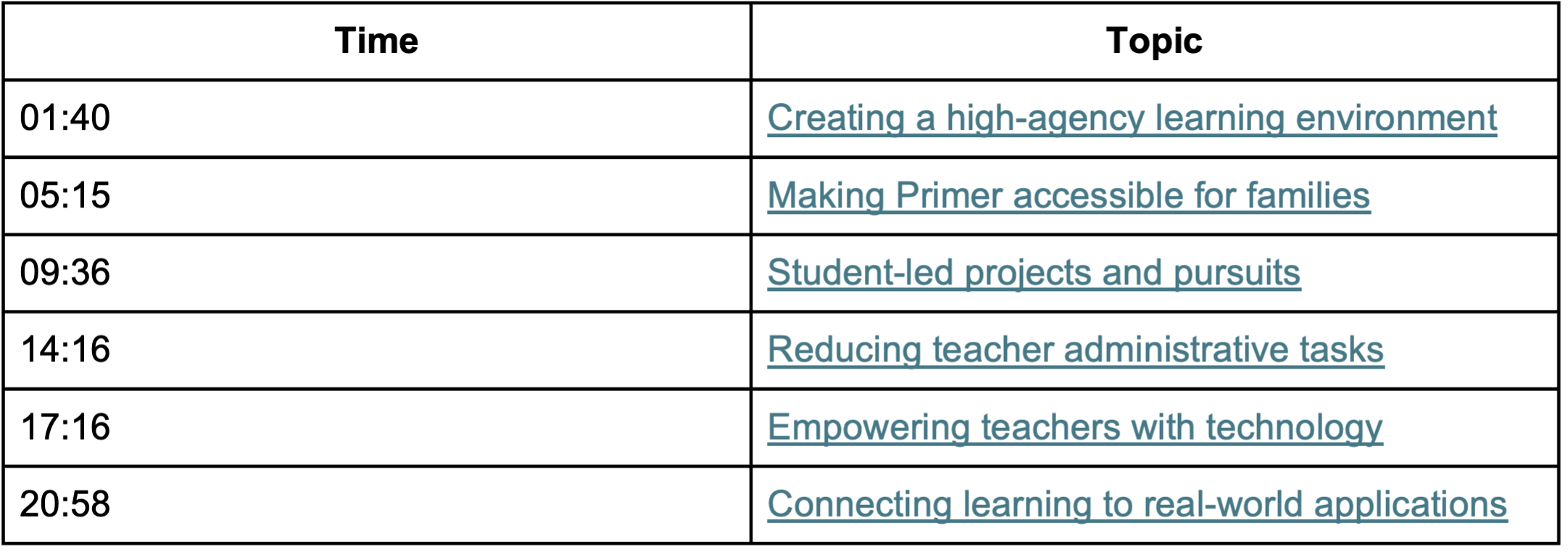
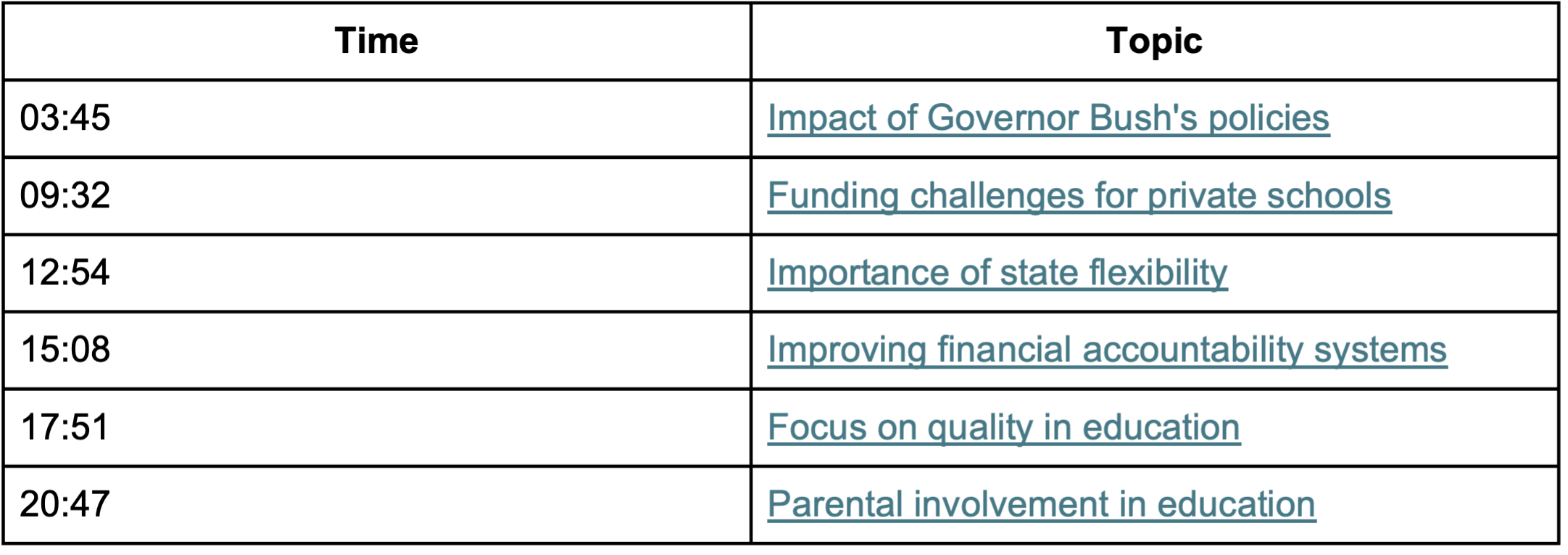
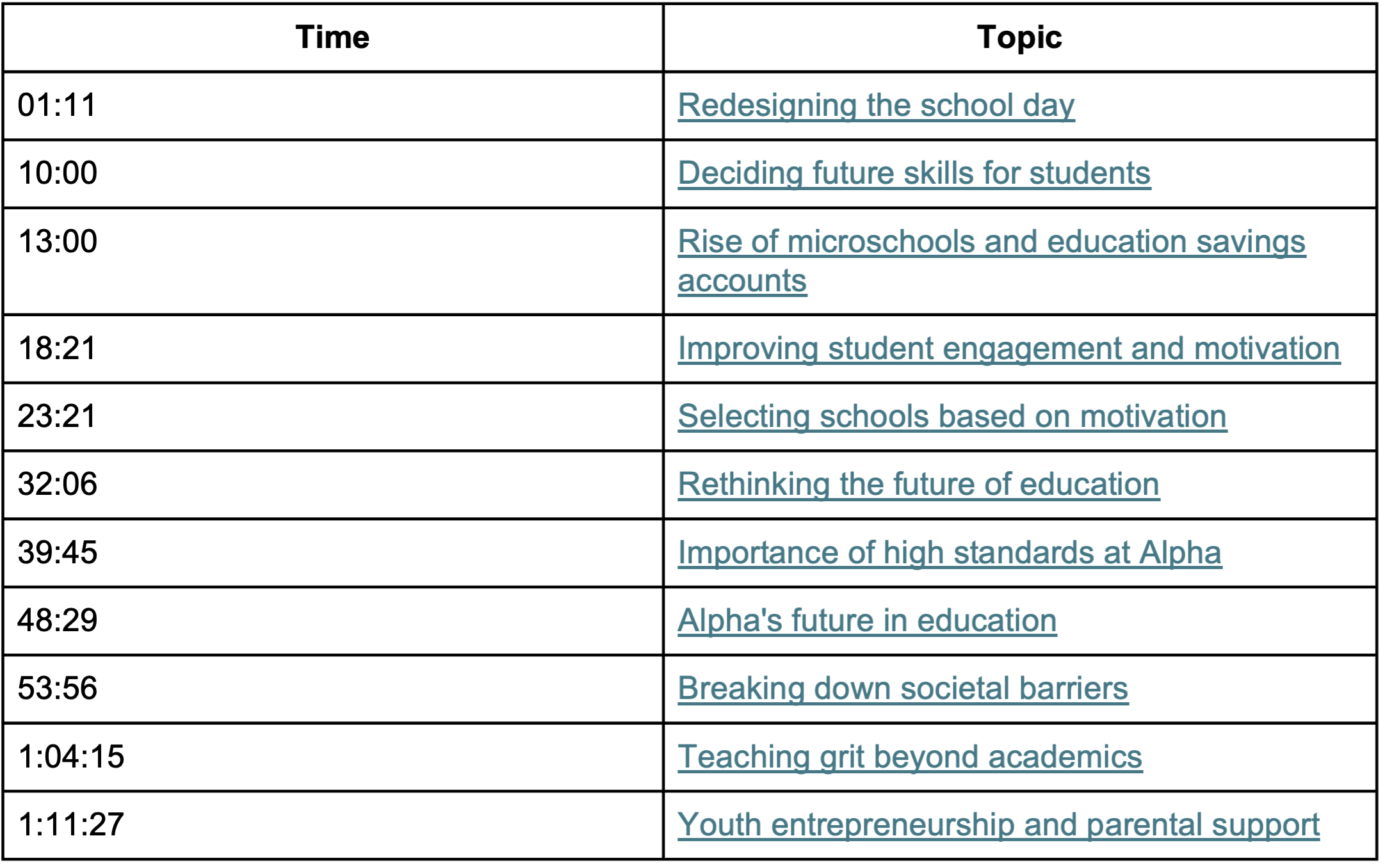
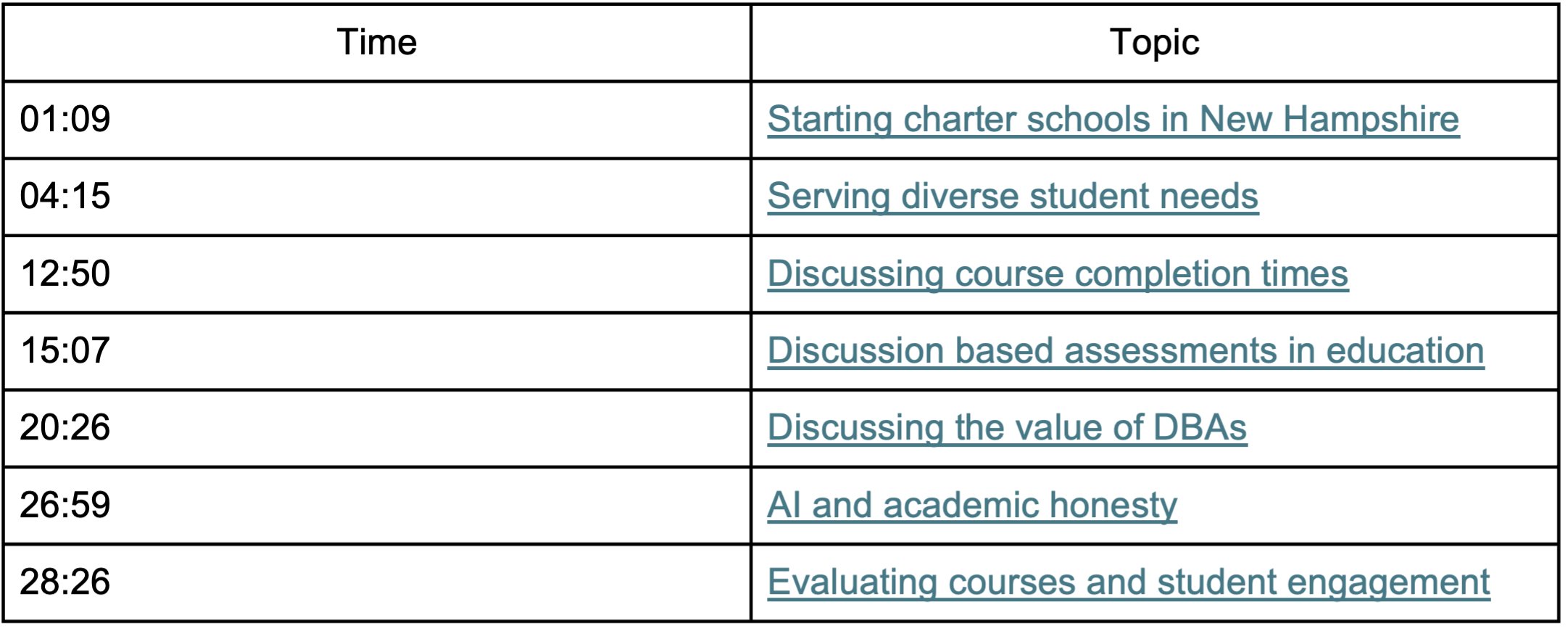
Interviews with the top innovators & changemakers so that you can stay on top of the trends transforming transform learning, education, and the development of talent worldwide so that all individuals can build their passions, fulfill their potential, and live a life of purpose michaelbhorn.substack.com
Listen to episodes
60 recent
August 17, 202622 min
Behind the Explosion in Unconventional Education
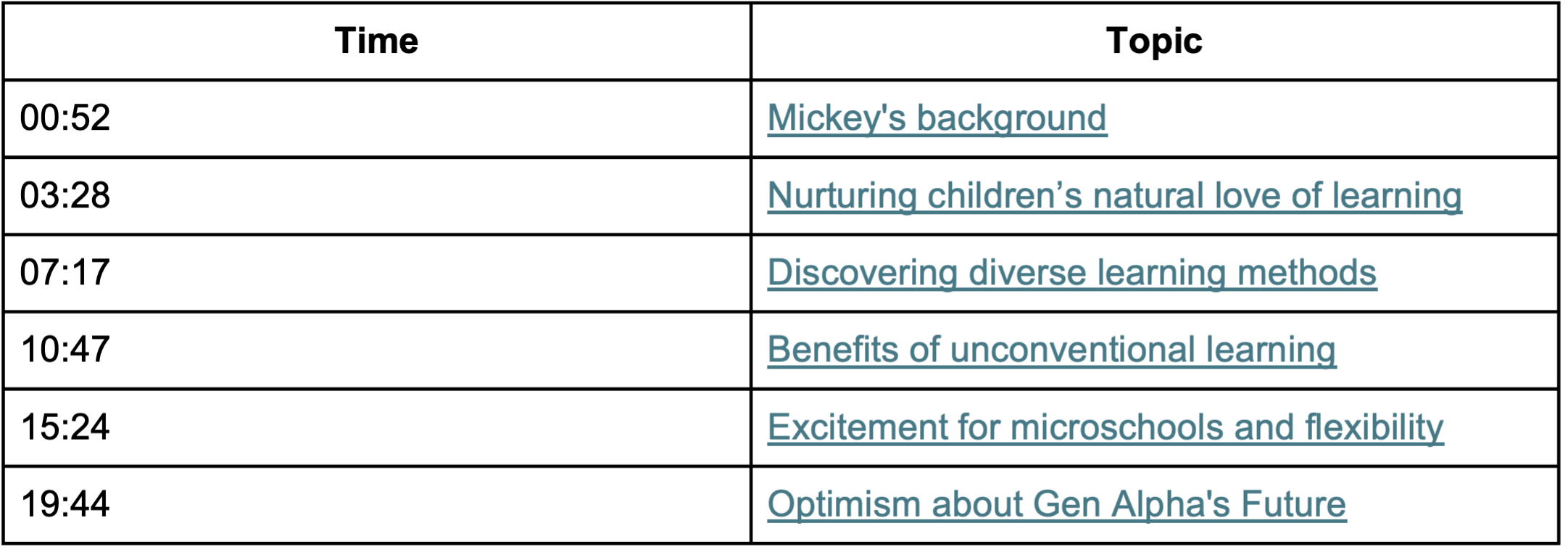
Mickey Revenaugh, co-founder of Connections Academy, is out with her debut book titled School’s Out: Why Families Are Choosing Unconventional Education . She joined me—and a surprise cohost, my daughter Kayla!—to talk about what she learned from reporting and writing the book. Together we explored the rise of innovative schooling models and their impact on student learning and traditional education systems, from unschooling models to project-based learning and more. Mickey shared insights on why families are embracing these diverse educational pathways, discussed the challenges and opportunities with assessment and public funding, and expressed optimism that Gen Alpha’s passion for learning and adaptability will mean a brighter world in the years ahead. Michael Horn Welcome to The Future of Education. I’m Michael Horn. You’re joining the show where we’re dedicated to building a world in which all individuals can build their passion, fulfill their potential, and live lives of purpose. And to help us think through how to do that today, I’m delighted we have a repeat guest, a friend of mine who, from my very first days in the education world, was there ushering me in, none other than Mickey Revenaugh. We had her on the podcast in 2023 when she was, quote unquote, retiring. Introducing Mickey’s background Michael Horn Many folks, Mickey, know you as one of the founders of Connections, of course. But more recently, you were the author of this terrific new book, and congratulations, called School’s Out: Why Families Are Choosing Unconventional Education. I’ve got another copy right behind me. We’re delighted to— Everyone get this book. I will say that upfront. I’m delighted to have you again and talk to you about the book. It’s good to see you. Mickey Revenaugh Thank you. It’s a pleasure to be here. It’s always fun to talk with you, and I can’t believe it’s been 3 years. And I also appreciate your wise guidance as an author because this first time out for me and whoo, has it been a learning experience. Michael Horn I can only imagine, but we’re gonna come back to that in a minute. Before I get started with my questions, I’m gonna out myself. This is the second time this has happened to me in the last couple years where a friend of mine in the education world writes a book, and then before I can even crack it, my daughter literally reads the entire thing spine to spine before I even open the book. And in this case, she actually drafted a bunch of questions for you, and I wondered, could she join us and actually do the interview with me? What do you think? Mickey Revenaugh It would be my pleasure. I’m a little tiny bit intimidated because, you know, kids ask really good questions, but I would love it. Michael Horn They do. They do. And I won’t prep you, but I will bring in Kayla, this is my daughter. Mickey Revenaugh : Hi, Kayla. Nice to meet you. Michael Horn And Kayla’s gonna be in 6th grade, she’s at a Montessori school, and, like I said, she’s poured through this book. And so I’m going to ask the first question and then I’ll turn it over to you to ask a bunch of yours. But Mickey, maybe let’s start here, which is, as we talked about when I had you on the podcast the first time, before starting Connections with that team, that incredible team, you were a writer. You wrote a lot about — you were a journalist. You wrote a lot about education. You wrote a lot about technology in education. You started observing all these things. You quote unquote retire. I’m going to keep saying quote unquote. And then you start investing in writing again. My recollection is you took some classes, you start writing at 5:00 AM. And I guess my big question is, why this book? Why did you decide to go out, report, as Kayla constantly keeps telling me, interview a lot of people, see a lot of different schooling arrangements, Why did you write this book? Nurturing children’s natural love of learning Mickey Revenaugh Well, part of it actually was inspired by the Kayla in my life, who’s my great-niece, Gemma, who went to Forest School for her preschool years. And I had not heard of Forest School. I mean, I was really hip to virtual school and charter schools and all kinds of other things, but Forest School in the Pacific Northwest where it’s just like mud, mud, mud all the time. And I thought, all right, well, I’m really curious about this. Why would her mom choose that? Why would she love it? And so that kind of started me down the path of trying to understand from a family’s point of view, what is the draw of these unconventional forms, which were also at the same time multiplying. As soon as the pandemic lifted a little bit, people were reaching for things that were really different from the normal school that we were all ready to go back to once the pandemic lifted. So my curiosity got the best of me. And I really wanted to kind of follow the questions I had about what would motivate a family to go this direction. And I found out an awful lot of stuff, all of which makes me really optimistic and excited about the future. Michael Horn That’s great. Kayla Horn When you think about the people who will read your book, how do you hope it will impact them in their lives? Mickey Revenaugh That’s such a great question, Kayla. I actually had the experience of being at a little conference of Black homeschoolers over the weekend. And I had multiple moms who were doing homeschooling come up and say, I need this book for my mother-in-law. I need this book for my cousin, because they’re already starting to do the things that are described in the book, but the people in their world just don’t understand it at all. They’re really either confused and befuddled or dead set against it. So what I’m hoping that the book will do is really provide some permission for people to explore and talk about things that they might not have felt comfortable talking about before in terms of how could education be different for their kids. Michael Horn So it occurs to me, we’re going to have to get one for my parents to explain your Forest Schooling, Jewish religious school, Waldorf, homeschool pod, Montessori. I think I’ve got them all. Yeah. We’ll have to explain that. Well, go ahead. Yeah. Kayla Horn So in your book, you describe a lot of different philosophies of schooling. So could you tell us some of what you saw and what surprised you? What excited you? Mickey Revenaugh So one of the things that tied everything together for me was this idea that kids love to learn by their very nature and that school as we have constructed it often stamps that right out of them as they go through the grades. And so almost everything that I covered in the book started with the idea that we should nurture, protect, and support kids’ love of learning and that that might look a little bit different for every kid that we encounter. One size does not fit all. I think that, and that wasn’t a surprise to me, but what surprised me was how many different ways that people found to interpret that. So everything from Forest School in the mud to these road schoolers that traveled around in their RVs all the time, to unschoolers who, one of the people I admire most in the unschooling world, was not an active reader until she was about in 4th grade. Michael Horn Oh wow. Mickey Revenaugh And it took a lot of courage for her and her mom to say, it’s going to be okay. And now she has a master’s degree in social work and she’s working in the mental health field. So it didn’t hold her back. But that was kind of what it came down to, is that every kid’s different, every kid deserves to learn the way that they learn best, and that we as adults need to figure out better ways to accommodate that. Kayla Horn So you started some of your own schools. What are some of your own philosophies of what a school should look like and how have they changed from seeing all the different schools in your book? Discovering diverse learning methods Mickey Revenaugh So I will confess that I was one of those goody-two-shoes kids in my own schooling. I did everything absolutely right. I sat at the front of the class. I raised my hand to answer every question. The teachers loved me. So it had never occurred to me that there was a different way to learn other than the way that most people learned in my generation. So the 2 things that the schools that I worked with getting started really revealed to me, one is that there’s something really magical in the relationship between a teacher and a student, and that sometimes that teacher is a professional teacher with a degree and certificate. Sometimes it’s a parent, sometimes it’s another kid, but that there’s that social aspect of learning that is human to human. It might be mediated by technology, so we might be learning from each other via the internet like this, but there is something really incredibly powerful and magical about that. And the other is that almost everyone does better when their schooling is tailored to how they learn best. Some of us have taught ourselves through the years to accommodate whatever’s out there, and we do our best to play school, right? But everybody learns better if the learning environment is set up for the way they learn the best. And so the virtual schools that I worked on, I worked on some blended schools that I was really excited about where they were macro-microschools, I guess. They were schools of like 150 kids. The micro schools of today are more like 15 kids, but the same idea of like really personalized, really surrounded by love and individualized in terms of how the kids learned. Kayla Horn So you also wrote about virtual schools in your book. What do you think are some of the biggest problems with virtual schools today and how would you fix them so that they can expand? Mickey Revenaugh So I think what we’re seeing is that a lot of virtual schools were the only unconventional option available to an awful lot of people. So if you lived in, let’s say, rural Ohio and your kid wasn’t loving traditional school and you didn’t want to send them to the Catholic school down the street, a virtual school might’ve been your only other choice. That might not have been the best learning environment for that student, but you didn’t really have an option to go someplace else. And so I think virtual schools ended up serving a bunch of kids that, if there were other options available, might not have picked that one. And at the same time, virtual education, when I got started with it, and a little bit like when your dad got started, was about as sophisticated as a rock and a stick. It’s like we just didn’t have a lot of the tools that we have now. And so we did our best to be engaging and make the curriculum interesting and make it fun to work in. It’s still a work in progress. And I think everybody’s experience during the pandemic when we were doing Zoom school or emergency remote instruction was the lowest common denominator virtual education. And unfortunately, that’s what an awful lot of people see as online learning. And that’s where I think a lot of the not so great results are coming from as well. Michael Horn Super interesting. Kayla Horn So in your book, you also wrote about unschooling and project-based learning. How do you think they’re important and helpful for kids later in life? And how do you think those skills, upsides, and even trade-offs will compare to kids who learn everything by being told or by a textbook? Benefits of unconventional learning Mickey Revenaugh Well, my personal theory is that kids who learn through really anything that’s about something they’re passionate about. So where project-based learning is, projects that they define themselves or unschooling where their whole school experience is defined by them are going to be so much better off in the future that we’re heading into than kids who have been traditionally taught. And there’s really 3 reasons for that. The first is that they hopefully still love to learn by the time they get out of school. They love to learn and they know how to learn and they want to keep learning. That is a skill that there’s no way that anyone will thrive or survive in the future without that skill. Secondly, they’re self-motivated, so they don’t need somebody standing over them to say, do this next, do this next, do this next. They kind of do it because they want to and because they’re eager to learn the next new thing. And the third thing is that they’re very resilient and flexible. So if you’re working on a project and that papier-mâché thing that you’re building to house your volcano or whatever it might be, is it working? If you’re a project-based learner, you’ll figure out a different way to do it, and that’s a really important part of the learning process. So I personally think that kids in unconventional education are going to be much better off than kids who are traditionally educated in this very fast-approaching future. Michael Horn I’m curious on that, Mickey. You have a whole chapter about education savings accounts and the publicly financing of these arrays, this explosion of models. And toward the end of that chapter, you have this section on measurement, testing outcomes comparison. I guess my question is twofold. Like, first, maybe give folks a summary of where that debate stands today. You do a good job in the book, I think, of outlining the different streams of thought, if you will, around that question. But I’m curious, like, I’ve started to develop my own more nuanced take, I think, about how this should evolve. But you’re such a keen observer of this space. Like, what’s your own take, around where assessment and measurement should play when public dollars are footing the bill for this explosion of schooling types? Mickey Revenaugh Well, I think the public funding through ESAs and the new tax credit scholarship program that’s forthcoming, that’s not public dollars but kind of public dollars, is really going to bring to a head what we’ve always kind of known about standardized testing, which is it’s a really— talk about a rock and a stick. It’s a rock and a stick when it comes to figuring out what kids know. It’s been the only tool that we’ve had, especially in looking at mass assessment. And so I admire and appreciate those, and especially in the microschool movement that are sort of figuring out a way to do NWEA testing and other things to give parents some comfort that their kids are on track and learning. What I’m really excited about though is I think finally this will bring to fruition something that I’ve been excited about since the ‘90s, which is portfolio assessment. It’s actually having a set of things that kids create that can be evaluated against a rubric and judged based on their output, not on their ability to memorize an answer, I think is going to become more and more important as these forms exist. And by the way, AI gives us the tools to actually evaluate those things that we didn’t before. So people who were working on portfolio assessment in the ‘90s were like, staying up all night sweating bullets, trying to measure things against a rubric. And now I think there’s a possibility that true authentic assessment that we’ve always been really fixated on and never been able to do will arise as the way that we can measure quality and outcomes, especially in a world where Carnegie units and seat time are not going to be any more useful than they ever have been and probably even less so. Michael Horn Makes sense. Kayla Horn So in your book, you wrote about a lot of different school models. Which of them do you think will be the most successful in the future? Mickey Revenaugh Ooh, you’re asking me to pick which one of my children I love the best. Well, I’m excited about all of them. And really what excites me the most is how they connect up with each other, really. So in a lot of states, kids who go to microschools are actually counted as homeschoolers. Because the state doesn’t have a way to figure out what a microschool is. In the state where I live, if you go to a virtual school, you’re a homeschooler, even though you’re in a virtual school. So the categories end up being a little blurry, and I think that’s fine. I think that’s just great. Excitement for microschools and flexibility Mickey Revenaugh The newer forms like microschools, I’m really excited about the energy around them, and really because so many of them are being started by teachers. So imagine your favorite teacher, going off to start her own school based on what she really loves about teaching. That’s a fantastic thing. So that part of the ecosystem really excites me a lot, but I think the other parts of it are gonna be equally powerful because the other thing that we’re seeing is that families are doing a lot of switching and mixing, right? One of the researchers that I talked to said it’s starting to become very common for a family to say, I’m homeschooling Kayla, one year, and then next year she’s going to Montessori, and the year after that she’s going to a charter school, and then she’s going to the regular public school, and then she’s going to come back and homeschool again. And by the way, while she’s homeschooling, we’re going to do some online courses and some community experiences, and we’re going to buy some curriculum. We’re going to mix. So switching and mixing is becoming the norm. So I think it’s all going to blend together in a way that we probably can’t even predict right now. How’s that for avoiding the question? Michael Horn Well, it’s interesting before you ask your next question around what the impact will be, maybe more broadly from that, Kayla. Like, it’s also interesting thinking about your answer on measurement right around that, Mickey, because like the other assumption of standardized tests was it told you about school quality. Mickey Revenaugh Right. Michael Horn If you’ve gone to— you just named 5 different experiences over 5 years, but like, let’s go even deeper. You also said if I’m homeschooling, I might have 10 different providers. To what do we attribute any of those results? Maybe it’s more empowering these measurements of students and parents against their goals of what are you trying to move toward, as opposed to the public sort of looking over your shoulder, it seems. I’m curious your thoughts. Yeah. Mickey Revenaugh And I think it’s really critical. I know that there’s some people that are getting really anxious about how do we know whether it was the Khan Academy lesson that helped this kid master this math concept versus the thing that they did out in the backyard with leaves. I’m not sure I care that much, to be honest with you, as long as it looks like they actually have mastered a concept and we have a way of showing that. And then the portability of that is going to end up being really important. If you really do end up going from setting to setting to setting, your standardized test score becomes less and less relevant every time you make that switch, whereas your portfolio of work becomes more and more relevant. So I mean, I haven’t gone all the way over to where some people are, which is it’s all about the market, right? Parents will tell us what’s good based on what they’re willing to spend their time and money on. I think they will, but I’m not sure that’s completely sufficient. I really would love something that’s portable to the kid that they can then take with them through their life that’s a little bit objective and also speaks to the kind of skills we know they’re going to need. Kayla Horn So with all these new models popping up, do you think the traditional school model will last and do you hope it will? Mickey Revenaugh I’ve been thinking about this an awful lot. I actually believe that all of these unconventional models are going to be the best thing that ever happened to traditional school systems because it’s going to force them to adapt to what families and kids really want. And also, pivot and be resilient in the same way that we’re asking kids to be when they come out of school. We’re asking the system to now figure out a way to adapt to the changing desires of families and frankly, the changing demographics that they’re facing. So, most traditional school systems, their enrollment is going down because people are having fewer kids. Immigration is almost at a standstill. There’s fewer kindergartners showing up to say, I want to go to kindergarten here. So if a school system’s going to survive is going to need to figure out how to bring families in, that might’ve chosen something different. And the only way that they can do that is by adopting some of these forms and figuring out how to make it part of what they offer, as opposed to something that happens over there and they don’t want to have anything to do with it. They’re not going to like it, but I think it’ll turn out to be the best thing that ever happened to them. Optimism about Gen Alpha’s Future Kayla Horn So with all these clever ways to learn, do you feel that when Gen Alpha are the society’s leaders, that our world will be in good hands Mickey Revenaugh I have so much faith in Gen Alpha. I really do. And it’s partly because your generation, which is Gen Alpha, has grown up with this incredible set of tools for learning about anything in the world. And it’s made you really super curious about everything around in the world. And I don’t know a single young person who... We get mad at them sometimes for spending so much time online, but what they’re doing is trying to find out more about stuff they care about. And that makes me really, really, really optimistic about how they’ll approach the problems of the world because they won’t assume they know everything already and they won’t assume that there’s one fix. They’ll know that there’s lots of ways to approach a problem and they’ll be happy to collaborate on it and come up with a good answer. So I hope I live long enough to see Gen Alpha be the leaders of the world. Michael Horn I’m confident you live young. I’m gonna, I’m confident, I’m confident you will. Mickey Revenaugh Yeah, thanks to Red Bull and caffeine, man. Michael Horn Hey, whatever, whatever it takes in your 5:00 AM writing habit. I’ll just say, Mickey, I, you know, just congrats again,, first book, no, you know, big deal. Everyone. Yep. Check it out. Mickey Revenaugh Kayla enjoyed it, then I feel like that’s the highest praise I could possibly ask for. If you liked it too, that’d be great, Michael. Michael Horn But I feel like I’m part of the space, and yet I learned a lot in terms of the texture and the characters and the motivations for a lot of these things that I’ve seen or knew about, certainly. And the reporting’s excellent. Kayla ripped through it in about 24 hours. It took me a little bit longer. Mickey Revenaugh A little longer. Michael Horn I’m a little slower. That speaks to me, not the book. So it’s a very good read. Everyone check it out. Get a copy. School’s Out: Why Families Are Choosing Unconventional Education. Mickey, good luck with the— as the book rolls out, good luck getting the message out. I hope a lot more people, to Kayla’s question, have permission to explore these models from those around them. And just a huge thank you for what you continue to do. Mickey Revenaugh Thank you so much. And Kayla, your dad better watch out because I think you’re coming for his job. Michael Horn Well, I’ll just say huge thanks to Kayla for doing this, joining us. us and being willing to ask these questions as well. I appreciate that. Kayla Horn Thanks. Michael Horn And for all of you out there tuning in, we’ll see you next time on The Future of Education. The Future of Education is a reader-supported publication. To receive new posts and support my work, consider becoming a free or paid subscriber. This is a public episode. If you'd like to discuss this with other subscribers or get access to bonus episodes, visit michaelbhorn.substack.com/subscribe
August 10, 202634 min
Intelligent Training Built for the Frontline
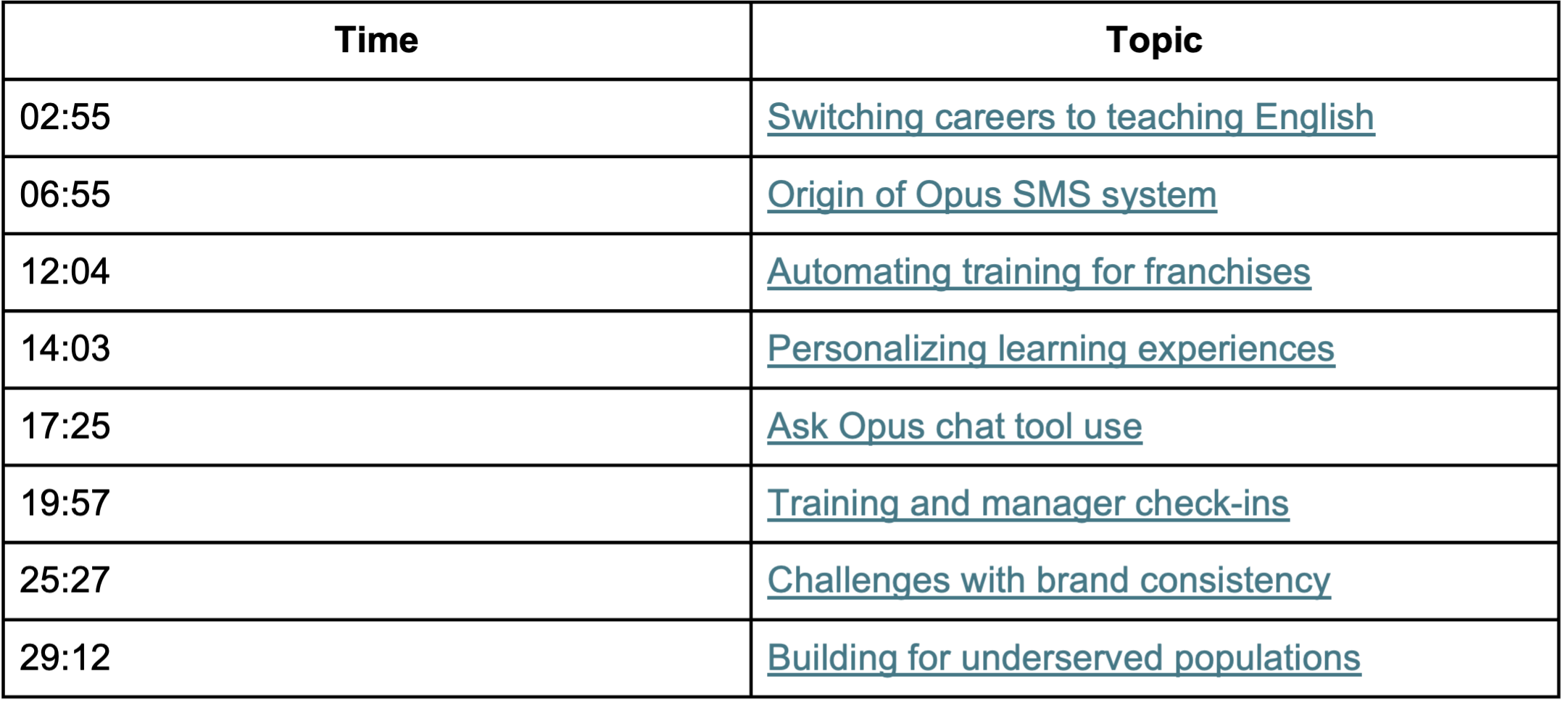
Rachael Nemeth, co-founder and CEO of Opus Training , joined me to share how Opus leverages real operational data to deliver personalized, actionable training in over 130 languages through mobile devices to bridge the learning gap for the 110 million Americans who aren’t desk-based. This was a fascinating conversation, if for no other reason than so few companies focus on these front-line workers and that the training Opus provides isn’t your standard compliance-based stuff, but the education that will most benefit individual employees, teams, and sites based on their actual performance on the job. Rachael shared her own journey from the restaurant industry to building Opus. Our conversation explored the shortcomings of traditional training metrics, the importance of manager enablement, and the need for technology that truly serves and empowers America’s frontline workforce. Michael Horn Welcome to The Future of Education. I’m Michael Horn. You’re joining the show where we’re dedicated to creating a world in which all individuals can build their passions, fulfill their potential, and live lives of purpose. And to help us think through that today, I’m really excited because we get to focus on an area we don’t talk nearly enough, in my opinion, about in the conversation around helping individuals skill up and figure out potential and so forth. And none other than Rachael Nemeth. She’s the co-founder and CEO of Opus Training, which we’re going to hear all about today. But I think the motto is turning training into traction. Rachael, thank you so much for joining us. I’m excited to hear about your story and about Opus. Rachael Nemeth Yeah, thanks for welcoming me. I’m excited to be here. Michael Horn Yeah, you bet. So, why don’t you just start us off, like baseline, you know, tax, like what is Opus Training before we get into the backstory of how you created it? Rachael Nemeth Yeah, so when you think about the 2,100 learning management systems that are in the world today, it’s obviously just from that number, it is a very fragmented market. Opus is a training operating system that’s designed specifically for the 110 million Americans who aren’t sitting at a desk all day. So, it is a big product for a big workforce that is largely underserved. What’s special about Opus, though, is that we aren’t just helping teams create training, which is kind of, you know, a lot of what you see in a traditional learning system. We’re actually helping operators change behavior in their workflow by using live operational data from the business, which we’ll talk a little bit more about. Yeah. But we’re sort of taking knowledge to the next level, knowing that this workforce is changing. Michael Horn Okay, I have so many questions that I’m excited to geek out on this, but let’s back up a little bit. Tell us the story. Most people don’t focus on the frontline, as you said, right? And the people who are not in front of computers when they picture their upskilling or reskilling platforms. How did you decide to build Opus Training? What was the background that you brought to it and the problem that you saw that you wanted to solve? Switching careers to teaching English Rachael Nemeth It was definitely not an overnight, you know, light bulb moment. Maybe just to rewind, so my background is not in tech. It’s actually early. It was not in teaching either. My background’s in restaurants. So, I worked for 13 years in the restaurant industry, most recently for Danny Meyer at Union Square Hospitality Group. Michael Horn Best hospitality anywhere. Rachael Nemeth If you’re a foodie, you know Danny. And before that, I cut my teeth in baking manufacturing. My mom worked in bakeries for 43 years. My grandfather owned a barbecue chain in Kansas City called Don’s World of Beef. So, I have this sort of rich family history of the food service. And candidly, I thought I was kind of destined for it. And also very candidly, I spent my whole life trying to get out of the industry. It is a terrible industry. You’re overworked, you’re underpaid. Michael Horn Listeners know my wife’s,, that’s her background and her industry and Some of the work conditions and personalities, shall we say, are not Danny Meyer. So, yes, I get it. Rachael Nemeth And I still eat spaghetti over the sink. Like, I do not go out to fancy dinners. I still eat on the go because that is the life I’ve lived. But maybe just fast forward to about 10 years ago, I was looking to make a transition. And so, I quit the industry to start teaching English as a second language. My second passion is language. And within a couple of months of teaching and getting my certification and thereafter starting to earn my master’s, I got pulled back into the industry. I got a call from the executive chef of Gramercy Tavern, Mike Anthony, who said, hey, I hear that you teach English and you know restaurants. And I said, yes, what’s your point? Michael Horn Guilty on both, yeah. Rachael Nemeth And I was like, how did you find me? And he said, I want you to teach English to my kitchen team. And I filed for the LLC for ESL Works the next day. Michael Horn Wow. Rachael Nemeth I had always wanted to run a business. I had always wanted to be an entrepreneur. I grew up in a very entrepreneurial family, but I never was chasing an idea. I’m a big believer in ideas that sort of float around and it’s if you catch them, you do. So, I chased it and the next day ESL Works was born. That was 2013. I basically ran a logistics business. I was hiring green, fresh out of college teachers, and I was teaching them how to teach English in restaurants. They were, I was deploying them across all of Manhattan and Brooklyn and Queens to teach a 90-minute English class between shifts. So for anyone listening who has not worked in a restaurant, that is the only time you can effectively teach a classroom training. People have second jobs and kids and commutes and all these other things. That was very successful. I wouldn’t call it a brick and mortar because I didn’t have anything except whiteboards that I was taking on the subway, but it was a really successful services business. And when we got to, you know, a few years in and we really wanted to scale, the only options were franchise or license or digitize and productize. And the latter was obvious to me, but I didn’t know how to do it. So, I spent about 18 months in incubators and testing different products. I ended up landing on a product that delivered English language training over SMS and WhatsApp to frontline teams. At that point, it was still specifically in restaurants, but then this is sort of the untold story. So that was, oh my gosh, you know how when you think back on time, you say 10 years for so long and then you’re like, wait, but 3 years has passed now. Michael Horn 3 years. Well, and I think COVID has accelerated that. Let’s be clear. I was talking to someone, they were like, how long have you been doing X? And I was like, it could be 3 years, but it also could be 6. I’m not sure. Oh yeah, I get it. Origin of Opus SMS system Rachael Nemeth So, so, you know, this is like, I was joking with my aunt the other day, like she was saying, you know, there’s a difference between a biography and a memoir,a memoir is what you recall. And so anyway, this is my memoir of the timing, but COVID happened. So March 13th, I got a call from a customer. We had already launched this SMS product. I was actually in the middle of raising a round of funding, a seed round of funding. And they said, we’re shutting down. And then, of course, you know, the CDC announced and everything shut down, and I said, well, how can I help? And he said, I’m not sure, but like, we obviously don’t need ESL right now. The next day, I went home, called all of our customers, and said, you know, and at that point, the world had shut down. Michael Horn Right. Rachael Nemeth I said, listen, like, we’re not going to invoice you. We know this is a nightmare. Whatever we can do to help, just let us know. So, I can’t take credit for this idea because our customers came up with it, but they said, listen Michael Horn Those are the best ideas though, right? Where your customers bring you to something of real demand and need. Rachael Nemeth Yeah. And this, talk about ultimate need, right? Like, it was the beginning of COVID, everyone was on lockdown, but restaurants were switching their operating model to off-premise. They were online and they needed to keep their employees safe. So, we repurposed The ESL Works SMS product into a COVID safety product that delivered daily SMS messages and quizzes to team members before they went in for their shift so that they knew what was new and how to feel safe and protected at work. It was a public initiative. I had, I think, a quarter of a million dollars in the bank and a prayer and didn’t charge a thing and basically said, we’re gonna just try to help and see what happens. We grew to 20,000 users in 4 weeks. Michael Horn Wow. 20,000 users, meaning like different businesses? Rachael Nemeth Different businesses. Yeah. Again, I mean, this was so lightning fast. Actually, if you go to Wayback Machine, you know, that online, you know, database where you can see old websites, you can probably look up Stop COVID still and see our old website. But we lost the URL long ago. I was like, I don’t want to think about COVID ever again, but But the premise was that a business could go to the website, they could sign up very quickly, they could upload a spreadsheet or CSV of all of their employees’ names, phone numbers, and it would text their whole team instantly in 5 different languages ,these updates. But that was all the validation I needed to know how to scale this thing, right? Now, fast forward, and Opus is no longer on SMS. We have a beautiful mobile app and all these other things, but that’s really the root of Opus. It was this kind of volunteer project. I had amazing engineers who were also volunteering, many of whom still work with us today, but now I pay them. And to your point, it’s sort of like the purest product development story of customers having a real need and meeting them in the moment to get it done. Michael Horn Super interesting. So now you fast forward, you’re working with a lot of restaurants people would know the names of Luke’s Lobster, right? Like Just Salad, the José Andrés Group, right? And restaurant Smashburger, et cetera, et cetera. As I understand it, you probably have many, many, many, many more. And, and you mentioned that you’re doing training based on the, I think you said something like the data that they recognize is most crucial for their own operations. Which I assume is in contrast to training data that someone else once thought was important as a static sort of living thing, as opposed to, which sounds much more emergent based on the needs of the business. But maybe unpack that, tell me where I’m wrong, and how do you build training around that on demand, and if that’s the case? Rachael Nemeth Yeah, and I mean, I’ll give you the quick summary of it, and then maybe we can rewind and just talk about metrics too, because I feel like some metrics are just so backwards these days, but very strong opinions about the word engagement. But basically, I’ll give you like a practical example. Michael Horn Perfect. Rachael Nemeth Imagine that you are a Paris Baguette, right? You’re a fast-growing brand, hundreds of locations, and you get all of this feedback from your guests on Google and Yelp and all these things. And you’re, you really are probably aggregating that data somewhere with your marketing team, right? Like they’re trying to figure out what people like, what they don’t like, how they respond to the brand. The status quo today is that training and operations teams are getting none of that data, but it directly relates to them, right? Those are the teams that they work with every day. So, what we can do at Opus is we can pipe those Google reviews into Opus, and we can analyze it and automatically generate recommendations. Automating training for franchises Rachael Nemeth Based on the trends that we’re seeing against a location, a franchise, an individual, and we can use that to automatically generate a course. You know, maybe it says, hey, you know, Michael, you know, you’re saying that you have this pastry, but none of your team knows what it is. We actually need to train them on it. Or maybe it’s just a retrain, or maybe it’s something like rewarding your team. Hey, you’re getting lots of 5-star reviews. So, think about what difference that makes for your team when all of a sudden the training actually becomes relevant, which is really the challenge with today’s workforce is, and I knew this when I was a manager, your wife probably knows this too, I don’t think people realize how fast service businesses are changing. Michael Horn Yeah. Rachael Nemeth Every day you are looking at the weather to see what your PARS should be and what your inventory should be. You’re seeing if there’s going to be a parade down the street. If 5 people aren’t going to show up, how does that change your operation? So, there’s so much you have to flex. And so, we’re just trying to make it easier for people to respond to that data and activate their team as a result of it. Of course, we have this sort of core product, and we can take training and turn it into really engaging TikTok-style learning experiences. But I always love to nerd out about the recommendation engine because that’s really the kind of core of what we’re trying to do. You hear all these things about training in the flow of work, but a lot of that is candidly like false. That’s not, it’s, it’s just micro-training, which is cool too. Right. Michael Horn Which is surely better than probably like a 9-week course that you could imagine. But yes, right. But, your point is like, this is not only am I actively engaged, but the content itself is much more dynamic relative to whatever the thing that we’ve decided is most important for the business to be getting better at. Personalizing learning experiences Rachael Nemeth We’ve talked so much over the years in learning about personalizing the experience and individualizing the experience, and I don’t think anyone’s really done a great job of it. And I’m not even saying that Opus does a great job of it, but that is the holy grail, I think, that everyone’s trying to seek because classroom training is out, web training is out. We live in an increasingly isolated world where people want to feel more connected. But they don’t have the time to convene. So, how do you make people feel connected to your brand and your customer experience, but also feel like individuals at the same time who have the flexibility to learn? In Opus, they can learn in 130 different languages. They can learn by listening. They can learn by reading if they prefer. 30% of our users prefer to listen to their training and not even look at a screen. So, there’s so much flexibility to how people learn in the modality, but also in the content, which I think is really what we’re doing, where we’re doing some really cool work right now. Michael Horn So, I want to let you show that in a moment, but one thing first, which is it occurs to me what you’ve built is also, I’m assuming it’s like a manager enablement tool as well, because one of the, again, I’m not in the industry, but I hear a lot about it. And one of the things that I see is like, it’s really hard to build really good management that knows, A, how to act and get the most out of your employees, but also like what to say, where, like how to coach, like all those things are really hard. I imagine there’s like a 2-way part of this that you’re enabling, I would think, from what you’ve described. Rachael Nemeth Most training programs fail because of manager accountability. I don’t know the statistic, but I can tell you from experience, that’s why they’re failing, either because you don’t have that top-down buy-in, right? The COO doesn’t view this as important as the L&D team, or because the managers don’t understand why this is so important. And so, we built a mobile experience specifically for that busy manager. And by the way, this isn’t just restaurants, right? It’s all services business. So, think about fitness clubs, And anything that’s sort of a customer-facing, you know, car washes, we work with lots of car washes that it’s all the same problem, right? You need for customers, it’s an increasingly competitive world and you need for customers to come back through the door. Yeah. Michael Horn And your frontline is literally your front door to that experience. Yeah. Rachael Nemeth Correct. And they represent your brand. So, and they’re, you know, they’re young or they’re multi-generational and, You have to cater to a lot of different needs and preferences. So, the manager experience helps enable the manager in a way that it basically gives them a checklist for things they should be looking for when they walk through the door. So, if I’m Michael, I can view that Shirley is behind, and so I need to chat with her. I can view that CJ needs a little bit of coaching, that Ruby needs to be certified in a specific skill. So, think of it as a punch list for managers. They’re spending enough time reacting to the world around them. Ask Opus chat tool use Rachael Nemeth They should have an intelligence tool that helps them coach their team. They have their own coach as well. So, we have a feature, a chat agent, it’s called Ask Opus, where a manager can ask any question they want back to their company’s, you know, knowledge base. And Interestingly, when we released that about 2 years ago, this Ask Opus feature, and our assumption was actually that frontline teams would be using it the most, like the hourly team members. Our top 2 users for that Ask Opus agent are managers and non-English speakers. And you can probably guess why, right? Like, the non-English speakers don’t feel comfortable asking, so they can ask in their native language and get a response in their native language. The managers are getting bombarded with so much new information. all the time that it’s burdensome to remember it. So, the recall is very poor with the managers. So, Ask Opus helps them surface that information very quickly. Michael Horn And also probably without shame that like, I couldn’t remember that arcane thing that came through, right? As well. So, yeah. Rachael Nemeth Absolutely. Yeah. Michael Horn Super interesting. Why don’t, if you’re up for it, I think you can show a little bit of that experience, maybe. I would love to see it. So our audience is always forgiving of these things, but I think it’d be awesome to show a little bit of what this experience looks like and what these learning opportunities that are geared for the frontline actually look like. Because as you said, this can’t be a web course. This can’t be a thing that you sit down at night for 90 minutes, right? Like it’s gotta be as life happens in the consumable chunks when you have an opportunity, I would imagine, on your mobile phone. Rachael Nemeth That’s exactly right. So welcome to the trainee experience. If I am Michael and it’s my, you know, my first day on the job, the most overwhelming thing you can feel as a new hire is sitting in a booth and watching videos for 5 hours and then being told to go straight to the register and, you know, remember everything. So with Opus, you actually have a guideline as a new hire for what you’re expected to learn and when. So this is an example from a customer of ours, and you can see that it’s kind of a branded experience. Each course also includes a quiz. It includes interactive content. So, you can see that this is a very kind of fun, engaging experience. There’s drag-and-drop questions, all that fun stuff. But when I’m done, I want to talk to someone. Training and manager check-ins Rachael Nemeth So, in the course, you have an option to check in with a manager. This is a really simple example on purpose, but we have a lot of customers that are really adamant about coaching their team, and candidly, like, I am too. I don’t believe that we should ever eliminate in-person training. It is so critical to how people receive knowledge and absorb it, but you have to make it easier for managers to know what to coach on. So, as a new hire, I’m looking at this and I say, okay, I need to talk to my manager and answer this question for him. And then in a minute, we’ll go over to the manager mode so you can see what they’re doing. The other thing I can do as a trainee is complete checklists. But you can also see here that all of this can change into any language you want. So I can change this into Lithuanian and the entire experience changes for me. I’m going to change it back to English just to, because I don’t speak Lithuanian. Michael Horn So we can, so us normies can follow along. Rachael Nemeth Yeah. The other thing I might want to do as a trainee is, you know, pull up a quick resource, something like that, but maybe I don’t want to sift through my whole company’s knowledge base. So, maybe I can just ask, you know, what is the newest uniform? We see a lot of employees, this is a really fascinating product because it’s not only just getting you questions in the or answers in the moment, It’s getting you the resource that relates to it. Michael Horn So, it’s giving you an answer, plus if you want to train on it. Rachael Nemeth If you want to go through it again, it’s a brief answer, so you get the question fast, but most employers do not know what knowledge gaps their team has, and Ask Opus helps them identify it. So, they’re making pretty big swings on, you know, what their team might need, but we just had a customer today. It’s a very large, fast-growing brand, and 58% of their Ask Opus responses came back with no resource attached, which meant that their knowledge base is lacking. And I think in their case, what was lacking was recipe data. So, it’s just interesting to see what, you know, a team wants to experience and what they want to know. And so, it’s a really cool way to sort of crowdsource what needs to come next from your team. Michael Horn Well, you’re making me also, a bunch of things are pinging for me, but one of them is a friend of ours, Steve Spear. He did all this research on like what makes Toyota basically better than the Detroit automakers at the time. And one of them was training because what he learned was like, you showed up to the job at Detroit and they were like, okay, watch how I install the front seat. You know, these are the 10 moves I make in 90 seconds. Okay, your turn, go for it. You’re on the line. Whereas at Toyota, they’re like, Okay, when you master step 1, then we’ll go on to step 2. And you realize that’s really hard to do in a frontline job to set up that sort of mastery-based learning environment. If you can surface, to your point, these gaps of an individual, then as a manager, or I suppose as the system, right, both things can do a much better job of saying, hey, Michael, you seem to be constantly checking on the protocol around this or how we greet here or whatever it is. Let’s give you a little bit more support and handholding to make you feel confident and perform as we want our brand to be represented. Rachael Nemeth That’s half the battle, right, is the confidence that someone needs to be able to operate independently in their job. And I feel like that’s a lot of what’s missing from how we talk about learning and talk about training is like, this is about confidence and independence. It is not about mastery. And I think I think that that’s what we’re getting wrong in the conversation right now as it pertains to the frontline. Do people want certification? Of course. Michael Horn Yeah. Rachael Nemeth But there’s so many steps before that that need to happen that we aren’t achieving right now as a collective, as employers, as providers. So, I don’t, I, it always seems so simple to be like, well, you just need to set the standard before. You try to do all this fancy stuff, but that’s the reality. You know, someone just wants to feel good about their job. Michael Horn Yeah. I mean, there’s no, right. I mean, frankly, and students just want to feel like they’re making real progress also in general, right? Like no one wants to feel like the slow, you know, like they’re struggling and never going to get out of something. I’m curious, like the value proposition when you go, it sounds, you know, it’s certainly not just restaurants, anyone that has a frontline workforce you’re selling to at this point, how do they frame the value proposition before they really have experienced with, with Opus? What are they like? Are there metrics that they’re looking for? You mentioned beef with metrics, so I suspect there’s a whole talk track there that’s worth giving you the stage for, so to speak. Rachael Nemeth You want me to start with the beef or? Michael Horn Yeah, why not? Let’s go with the controversy first. And what are the right metrics? Rachael Nemeth Yeah. Michael Horn What should we be— what do they think that they’re looking for? What’s the value prop that they come to you for? And maybe what do they learn along the way in the journey around what they should be looking at? Rachael Nemeth We, You know, most of the time, about 70% of our customers are switching from paper. They’re switching from nothing, and these are large companies, right? So, we work with a 500-unit brand that had nothing, which is incredible because it means you can still grow with all of this. Challenges with brand consistency Rachael Nemeth But when you talk to these businesses and you say, well, what’s the problem? They say, well, I have no visibility. Okay, I get that, but that is not the core business issue. So when you dig in deeper, the number one issue that these businesses are facing is no consistency across their locations. Every location runs your brand standards in the same way across every shift, market, language, what have you, and most brands cannot achieve that. If you walk into a Chick-fil-A tomorrow, you wanna make sure that the chicken tastes the same way it did, you know, across the street, and most of the time you lose customers when that’s not the case. and you lose trust. So, when you really dig deep with these brands, whether it’s a food business or a fitness brand or whatever, it’s all about consistency. My beef with metrics specifically around engagement, adoption is important, and that’s something that we prioritized very early in Opus. Happy to tell that story too, because it’s kind of interesting. Engagement to me is a bad proxy for how your employees are really absorbing information. So, at the executive level, we think about the business metric we’re moving, right? Like faster ticket times, happier customers, what have you. At the field level, we’re really thinking about, once we get the adoption, we’re really thinking about the confidence that your team has in their job. Are they showing, are they, do they keep showing up to work? Michael Horn Sure. I mean, huge issue, right, is turnover and, yeah, and absenteeism. Rachael Nemeth Correct. But what’s interesting is when you talk to these businesses, they’ve already worked turnover into their budget. That’s not a top-line number for them. Yeah, like, this is pretty natural, right? Like, attrition is— when you’re working with 16-year-olds, they’ve got to go back to school. So, you’re going to have. Michael Horn Sure, yeah, it’s assumed. Rachael Nemeth Yeah. So, what it’s really about is knowledge retention. Is, am I seeing the behavior change in my business as a result of this thing? So, when I talk to training directors, their eyes light up because they’re like, I’ve been trying to justify this to my team for years and can’t get the budget for it, but we can prove that we can lower order accuracy issues by 70% in 30 days. We can prove that we can increase or decrease voluntary turnover with managers to zero within a year. Those are the metrics that move the needle. And so, I’m not saying that engagement isn’t there, but it’s just a lagging indicator as far as I’m concerned. Michael Horn Yeah, no, that makes total sense. And I’ve seen plenty of businesses also that have in this world where there’s engagement, but it’s not real engagement, it’s click-throughs, right? As opposed to actual, whatever the desired behavior is, the mastery, the learning, the confidence, whatever it might be, like the underlying actual change, right? It does not in fact happen. Rachael Nemeth And there’s so much cool stuff we can do now with technology to really start to track and trace those things. We’re bullish on integrations with Opus so that, you know, that recommendation engine I was talking about earlier with guest feedback, we’re really excited about what’s next for that product, you know, and hooking into secret shopper programs and point-of-sale systems and scheduling systems. Michael Horn I was about to say, so this isn’t just like feedback, this is POS system, this is everything. Rachael Nemeth Okay. It’s a monster. Yeah. do so much. And frankly, as somebody who is a former teacher in training, it’s about time. Really selfishly, I’m just building the thing that I wanted. Michael Horn Right. When you were trying to do the training or teaching. Building for underserved populations Michael Horn Well, I mean, that’s the perfect product to build is something you know that there’s a real problem that you’ve experienced. Let me ask this question, which is like maybe we zoom out as we start to wrap up here, which is it strikes me that A lot of people don’t build for this population more generally. There are a few exceptions that we could all name, but as you noted, a lot of them are at the exec level or they’re for the folks that are in front of computers or they’re the, you know, like the, I mean, there’s tons of things for digital skills and so forth. Why, in your view, has that not been the case? And why, in your view, have you been able to perhaps transcend those set of reasons that people have maybe not built as much for this, this, this part of the landscape? Rachael Nemeth This is a population that’s always been ignored. A story I love to tell that one of my co-founders told me a long time ago, and he’s an incredible designer. And he said, Rachel, every morning, 110 million Americans wake up and they use the most sophisticated technology on the planet. Their phone, right? It’s this little computer in your hands. They never have seen anything like it before. And then they go to work and they punch in on an old system that’s half broken down all the time. And they’re logging into a POS that doesn’t cooperate. And they’re using all of these systems that aren’t built for them. We owe it to the people who are making the American economy keep running, to provide them with the same technology that we would to people who are working behind a desk all day, because these are the people who are actually not just serving our meals, but keeping like things flowing. And we are at a pretty dangerous point, I think, where if we don’t build for this population, then we’re going to see a real deficit in knowledge gaps, in technology gaps, and that sort of the chasm between, you know, the haves and the have-nots is just going to continue to grow. So, I think it’s about like providing equitable solutions for everyone, and it’s easy to chase the thing that is easy and big. You know, it’s easier to sell to Goldman Sachs than it is to sell to you know, a 200-unit Burger King. Michael Horn Yeah, yeah Rachael Nemeth But we know that this is the majority workforce. We know that this is the bigger opportunity. It’s just the harder problem to solve, which is why it’s taken so long for us to figure it out. It’s why we solved this problem so differently. So, the little story I like to tell people is Opus ran for 2 years without a backend. We optimized the experience for mobile before anything else. There’s no other training platform on the planet that’s done that. They always build for the admin first. And we said, you know what, we’ll figure it out later. Michael Horn Yeah. Rachael Nemeth The first couple of years we were like, you know, man in the machine, sort of like, what do you need? Okay, we’ll build it for you. Yep. Michael Horn Yep. Rachael Nemeth But that’s why— Michael Horn Obsessive about that frontline and mobile experience. Rachael Nemeth Obsessive. They can scan a QR code and get in in 12 seconds. We have the highest adoption rates ever because of the way that we’ve formulated the login experience. And we’re saving, you know, the amount of companies who have admins who are just focused on getting people’s passwords reset. Those days should be over, but they’re not. And so, I hope that that exemplifies like how big of a problem this is, but also just, it’s still largely ignored. And I think we’re just kind of at the, the beginning of what’s possible. Michael Horn Very cool. Well, I’d love to keep track of this and Rachel, huge thank you. For those that want to learn more about Opus Training, where should they check out? Where should they go to stay on top of this story? Rachael Nemeth Yeah, of course. So I, if I had to recommend any 2 things to keep track of Opus Training, go to our website, opus.so, and you can also follow me on LinkedIn. I love chatting and commenting and nerding out about training and being contrarian. So please comment. Tell me how much I’m wrong. Michael Horn This sounds like a good follow. Rachael Nemeth Okay. Michael Horn All right. So now we got more. Fantastic. Rachael Nemeth Challenge me. Michael Horn There we go. There we go. It makes us all better. Rachel, thank you so much for joining us. For all of you tuning in, check it out, learn more, and let’s see how we can invest more in this space and these important people. And just hugely appreciate it as always. And we’ll see you next time on The Future of Education. The Future of Education is a reader-supported publication. To receive new posts and support my work, consider becoming a free or paid subscriber. This is a public episode. If you'd like to discuss this with other subscribers or get access to bonus episodes, visit michaelbhorn.substack.com/subscribe
July 27, 202634 min
Why Teens Don't Want to School Alone
Thomas Arnett from the Clayton Christensen Institute joined me to once again explore why families and students seem to be quite willing to try innovative microschools in the K–8 grades, but considerably more resistant when it comes to high school. Traditional high school experiences, particularly social and extracurricular elements like sports and common rites of passage, continue to hold such strong appeal for most families, even as innovative, personalized, and lower-cost education models expand. Drawing from personal anecdotes and research, we talked about the social and developmental needs of adolescents, the trade-offs families make when considering alternative schooling, and what it might take for disruptive education models to achieve mainstream adoption without reproducing the conventional system’s limitations. I continue to think that thinking through these questions is among the most important facing the emerging sector of innovative, low-cost schools with disruptive potential. Michael Horn Welcome, everyone, to The Future of Education. I’m Michael Horn. You’re joining the show where we’re dedicated to creating a world in which all individuals can build their passions, fulfill their potential, and live lives of purpose. We have a repeat guest. I don’t know if guest is the right word anymore, but Thomas Arnett from the Christensen Institute, friend, and someone I love to geek out on various topics about the future of education. Tom, welcome. Good to see you. Thomas Arnett Good to see you too, Michael. It’s always fun to be here. Always love these conversations. Debating the Purpose of Education Michael Horn Yeah, we’ve got a meaty one today. And I’ll just say, like, we’ve been exploring a couple times on this podcast already and in a lot of our one-on-one conversations as well. Something that I think has stood out to both of us, and I’ll set the table this way and then you can amend it, which is I think we’re both intrigued in a world of education savings accounts that as low-cost private schools, often micro schools but not always, come into the world, that there’s actually a real potential disruptive innovation of schooling as we’ve known it, the creation of new value networks and so forth. And then some of the things we’ve been sort of wrestling over is, okay, they come in at the low end, if you will, people who are overserved by all the offerings of comprehensive district schools. They want a more tailored, customized experience. And now that, you know, they’re sort of government funding, if they don’t choose it, it’s sort of an opportunity cost, if you will, of not taking it. And so these low-cost, at least private schools where you can afford them and then have more money for some other, you know, tutoring, piano lessons, whatever it might be around the sides. Feels like it could be a real disruptive innovation. And certainly the enrollment numbers in a lot of these states that have ESAs have been growing pretty rapidly, Florida, Arizona in particular. And one of the questions we’ve been puzzling over is, okay, so that gets its start there. What’s the upmarket climb such that you can start to serve more complicated problems, more families that require more services without replicating all of the cost and centrality of the school district model where it’s sort of everything for everyone. And in particular, we’ve been looking at this in high school because what I think we’ve seen is kindergarten, first, second grade in particular, there seems to be lots of willingness to make choices that are not in your district school. Middle school, there’s certainly a lot of people willing to do that because middle school in many parts of the country is a pretty bad experience. We don’t have fond memories of it. And then high school, though, a lot of people sort of snap back into a traditional high school. We’ve seen it with our friend and colleague Heather Staker, even like she moved her whole family to Austin, Texas from Hawaii, of all places, to attend Acton Academy for her kids. And then the oldest got to high school and was like, nah, I want football and sort of the traditional high school experience. So, so even there. And I think one of the things we’ve been puzzling over is how do you replicate a few parts of the high school experience, or replicate’s the wrong word, but sort of learn to serve or offer those things that we think people are clamoring for. And I think they fall in a few buckets. One is there’s certainly college fears and pressures, like if I go this alternative route, will I get into a great college? I think the second one is what I would label Friday Night Lights and prom, but it might be better thought of as cultural nostalgia, or we framed it as coming-of-age experiences, rites of passage in a conversation we had about this topic a few months ago with our friend Tyler Thigpen. And he talked about how at the Forest School and Acton Academy in Georgia, they handle this. But what we’ve also noted is it’s not just that, like there is certainly nostalgia at play, but it’s also this sort of clamoring for common experiences that seems to hold people back. And so then the longtime commentator, former schoolteacher, writer, great thinker, Robert Pondiscio , had this very intriguing piece a few months back in May on his Substack that he titled Schooling Alone. It was his commencement address to people at a classical education high school who were graduating. And I guess it struck me because he talked about, his piece was more about the commonalities in curriculum, which we can talk about, but it did strike me that one of the things that I think maybe people are resisting when they, you know, don’t choose different models of high school that might be more personalized or might better engage them or whatever else, it’s maybe that they’re clamoring for commonality. And so— How’d I do on setting the table? And what do you think about that sort of comment? Obviously, Robert’s piece was titled Schooling Alone in a not very subtle homage to Bowling Alone by Robert Putnam. But I guess I wondered, maybe, you know, he’s worried about all the personalization in the curriculum. I guess I wondered, hey, maybe actually people are clamoring for commonality, which is slowing up some of this growth and disruption of some of these new models. Thomas Arnett What do you think? Yeah, I think that sets the table really well and catches anyone listening to this up to, hopefully up to where we’ve been talking about a lot of the things that we’ve talked about. We had to do a lot of table setting about like, here’s what we’ve been thinking about. So the thing I found interesting when I read Robert Pondiscio’s piece was I think schooling for maybe its entire history has had this, it has many purposes and people debate the purpose of education and it’s kind of complicated because we layer so many purposes of education on top of each other. But I think one that traces back a long time is this idea of having a common experience. Now, sometimes that gets, I think, framed unfavorably of like, in the 1800s, it may have been more about cultural assimilation, about getting immigrant groups, minority religious groups to conform to the mainstream American culture by saying, no, you will go to these schools that are going to teach what Protestant kids should learn. But I think a more generous approach is kind of what he talks about in that piece, students need to have, to some extent, he’s arguing they need to read the same books as everyone else and they need to think about the same big ideas so that when we’re having conversations in our civic and political arenas, that we can be speaking the same language and have the same vocabulary to talk to each other. So I find that really interesting, but it was framed in, I think, as someone who thinks a lot about policy and thinks about society and society’s wellbeing, what would you want if you were taking that almost paternalistic role of how do we make sure education is serving our society? But I think there’s an adjacent and very similar, but at the same time really distinctive piece that is related to that, which is just the common experience kids want. So where I think, to me the contrast was like, Pondiscio was talking about we need to teach certain books in school so that we have common literature. And I look at schools that I’ve visited, places I’ve interviewed, the schools my own kids attend, and they want a common experience too, but it’s generally, they’re not thinking about, do I read the same books? Did we all read Mice and Men? Did we all read Animal Farm? It’s more of— Michael Horn This is where I say I have not read Mice and Men and I have to admit it. Thomas Arnett Let’s not say that. Yeah. Okay. Michael Horn I watched the Animal Farm movie. No, go ahead. Thomas Arnett Which version, right? Yeah. Michael Horn The original. Yeah. Not the distorted new one. Thomas Arnett Yeah. But, you know, when I look at my own kids, a lot of it is like, I want to be able to talk to other kids my age and feel like I’m part of the in-group, that I know what they’re talking about. And it shows up in like really funny and subtle, like funny for me to laugh about as an adult, but really important things. Like my kids come home with vocabulary like, you know, that’s low-key fire. I don’t know if your kids are— Michael Horn What does that mean? No, they don’t. What does it mean? Tell me. Yeah. Thomas Arnett Yeah. I don’t know if I’m a good translator, but lowkey is like, like it’s not, it’s cool, but we’re going to like downplay that it’s cool, but it’s really cool. And fire is like, oh, that’s awesome. You know, or buns is like, oh, that’s buns is like, oh, that’s awful. I think, I mean, this is, this is a 40-year-old man trying to translate. Michael Horn They had a great segment on Instagram with Peyton Manning translating the speak, so I’ll believe anything. Adolescents seeking status and respect Thomas Arnett Yeah. But I think that’s a lot of, you know, it’s. That is what a lot of kids are getting out of school is, and I think of David Jaeger’s book, 10 to 25, that I read a couple years ago and has one of those books that’s really stuck in my mind because it had some really deep insights. But he talks about adolescents have developmental objectives that are just wired into their biology and their genes. And just like a baby needs to learn how to crawl, needs to learn how to walk, needs to learn how to talk, He frames it as the developmental objective of adolescence is to figure out how do I earn status and respect? And the reason that’s so important is because humans by and large have, our ability to thrive is strongly connected to our ability to work together, whether it’s a local hunter-gatherer tribe group or whether it’s big corporations or big nations that build the pyramids, that kind of stuff. And so your ability to figure out how do I earn status and respect in a group is essential for you to figure out, how do I contribute to a group such that the group values me, such that the group wants to keep me in so that when the group succeeds, I can succeed with the group? And I think that’s what a lot of this is about that we just underappreciate is that, yes, students want a common experience, but for them, it’s the common experience of figuring out, how do I fit in with other people? How do I feel like I’m a valuable member of the social circles that I’m a part of? I think of homeschooling too. One of the longstanding critiques of homeschooling is like, oh, your kids will be weird. Well, I don’t think that’s necessarily true. It’s not that kids who homeschool don’t learn how to socialize, and there’s plenty of ways in which I think homeschoolers get supplemental experiences that aren’t just, we’re sitting at home all day having our own family culture, and that’s all the world they see. But I think this is what a lot of people are pointing to when they make that critique is like, your kid may homeschool and race ahead in the academics and get all sorts of neat experiences, but they’re missing out on being able to talk about prom, being able to talk about the football game, being able to have that common experience that other people go through so that when they go out in the world, they can fit in with those other people and be parts of teams with those other people and be, you know, fit in in companies and organizations with those other people. So anyway, I’ll pause there because I got— Michael Horn No, no, I have so many questions for you out of that. One is in the conversation with Tyler, in terms of the fit-in part of what you just said, what I took away from it is like they could actually engineer a bunch of those opportunities for students that actually might be better curated and more meaningful, still have friction to be clear. But more meaningful in helping understand, like, learn about who am I? How do I fit in? What do I want to, you know, what’s my mark in the world, if you will, those sorts of questions and purpose. Thomas Arnett Yeah. But I think what I hear you saying is like, what you’re saying is like focused on like the individual identity and individual purpose, right? Do you think, I guess, do you think there’s a distinction there? Michael Horn I guess that’s what I was wondering, it sounds like that can be solved for, but does even that still, you know, and it’s certainly within a community, right? It’s like, there’s a lot of other students in the school. They interact with other schools. There’s athletics and stuff like that. I guess my question is, to your point, are they still missing out on some larger cultural zeitgeist that some kids are saying like, hey, I, you know, actually my discovery is I don’t want to be part of that. But maybe it’s still not enough for others who are sort of clamoring that common experience. Yeah, let’s, let me hold it there and get your take. Thomas Arnett Yeah. Well, I think one thing we should probably complicate the conversation a little bit by saying like, this isn’t just a monolithic, like there’s one mainstream culture and then there’s people on the margins. Like even within conventional high schools, I mean, the whole, all the stereotypes about different cliques within a high school are different versions of people saying like, well, I don’t fit in with that, so I need to find my own group that I belong in. So I don’t think it’s so monolithic. Michael Horn But is that part of the element also? Like, right, there’s fascinating research on nostalgia that in some ways we have when we have pretty bad experiences and we sort of reformat the story in our mind to tell a story of growth and sort of togetherness, whatever. And so maybe some of that navigation and some of that nostalgia is about the fact that like, oh, I just couldn’t make it with that group, but I found my tribe here. Thomas Arnett Right. Michael Horn I don’t know. Thomas Arnett Yeah. Well, I think struggle is a key part of this story. So when I look at micro schools or when I look at even within school district systems, the alternative schools, the hybrid virtual schools, the programs made for homeschoolers, in my research, what I see really consistently is that the people that often pick those programs are making a trade-off. Michael Horn Right. Desire for alternative education options Thomas Arnett And it’s a trade-off they’re willing to accept because there’s something about the conventional school that isn’t working for them, whether it’s the academics, whether it’s the social scene, something’s not working for them. And that struggle drives them to a point where they’re willing to accept, I am giving up something. I’m giving up that Friday Night Lights, that mainstream socialization experience and other things. Maybe it’s also like AP classes or whatever, but I’m giving that up because I want something different. And the struggle is strong enough that it compels me to go look for something different. I just think that that’s not most students. So this is where I think the field could get kind of caught in an eddy if these things may exist that right now are on the margins, but I don’t know that they go mainstream if they always see themselves as distinctive from, different from the mainstream. Michael Horn Yeah. Thomas Arnett And that’s not necessarily a criticism. There’s value to be had in just saying, look, we have this diverse ecosystem that includes a lot of these niche environments, and people find the niche that works for them. But at the same time, I just think it’s important to say to the people that are building those niches, but those niches are never going to become the mainstream. or the main, they’re never going to become the new normal or become mainstream until somehow this gets solved for to where people don’t look at the niche and say like, uh, that’s, you know, some kids, not every kid, but some kids saying like, that’s for the weird kids. I don’t want to go there because I want to be a mainstreamy normal kid. Michael Horn Let me step out of my lane on something I’m not, I don’t know enough about, but I guess I wonder about charters in urban areas, if they’ve figured out something around this, or if maybe the cultural pull is just less right in some of those areas of the commonality as we frame did, at least in the straw man that we framed in this conversation. Because it does seem to me, you know, there’s lots of students who enroll in charter schools that don’t have football teams and, right, like, look like the comprehensive high school. And maybe to your point, the trade-off is like really clear there, right? Like, I don’t want to be in that environment, the district environment, whatever it might be. It’s not safe. It’s like, I got to get out of that. Like, this is my ticket out, whatever it might be. And so therefore it’s like so clear, but if that’s the case, that would suggest also a different sort of growth strategy, if you will, for this low-cost private school unbundled sort of world that’s emerging. I think, what’s your thought on that? Thomas Arnett That would be my guess. Like, I feel like that’s a little bit, I don’t have enough firsthand experience to speak clearly to that of like, why do families that go to some of those charter schools in urban areas that often serve lower-income students. Michael Horn Or even some public schools, right? It’s a high school network, right? And we know that they’ve been oversubscribed historically in most of their schools. So people are certainly running to it. Discussing mainstream versus niche experiences Thomas Arnett Yeah. Well, I don’t think oversubscribed necessarily has to contradict mainstream. You can have a lot of people that want to exit because they’re struggling, and it’s still not the normal. It’s still not the thing that. I think the thing to look at is like, and maybe this is more true in the suburbs or in affluent communities than it is in urban areas, but I think there’s a lot of people that still want the mainstream experience. In fact, I was on a camping trip with some people from our church last week, and I was trying to explain what I do for work, which is always a challenge. But in the middle of that, I thought like, well, let me just open with asking them like, what did you think of your high school experience? And the other men, the other dads that were on this trip, one of them said, well, it depends on which piece you’re talking about. And he was like, if you’re talking about the academics, it was meh. And they all kind of nodded their heads like, yeah, the academics was meh. But they’re like, if you’re talking about my experience on the baseball team or on the football team, that was awesome and I wouldn’t give that up for anything. So I would never pick a different schooling experience if it involved giving that up. And I think this is the reality as much as we kind of talk to people that are in the fringes that are pushing the frontiers. And the people that you and I often talk to see the value of these new models of schooling and we’re excited to see them move forward. I just don’t think that’s most people. I think most people, if you talk to them, they’d say, yeah, high school is meh. At least some of it is, but some of it is a formative experience I’d never want to give up. So yeah, I’d stick with the conventional wisdom. Michael Horn So the meh is worth it. That’s a trade-off worth it to be part of this And I hear in that both formative sort of rite of passage, right? Glory days, but also common experience of like, I know what a comprehensive high school is and what that means. And I guess, you know, the question we asked, right, is can you have, you know, town baseball and sort of town football and other ways to plug into it that are maybe distinct from the schooling piece? But I think what I hear you saying is actually that’s connected though to the schooling piece because it’s sort of you jockeying for position and trying to understand where you fit in within a larger mosaic of society. And maybe actually pulling it out as a separate thing, while it solves for part of that job, actually doesn’t solve for the whole job of an individual. Thomas Arnett Yeah. This is where I feel like I’m pushing my depths in terms of understanding sociology and how that all works. But let me give a quick anecdote. So my middle son, He’s just finished his freshman year in high school. And with both of my high schoolers, I have consistently tried to bring up the topic of, hey, look, you don’t have to go to the regular high school, the high school that’s right across the street from our house. Because they often come back and they’re like, yeah, class is so boring. We do nothing. We just sit around. Can we just skip school? And so I bring up like, hey, we could do different things. We could enroll you in the district’s hybrid virtual program and you could do classes at your own pace and you could do a dual enrollment at the community college and you could have way more flexibility to do the things you’re excited about or to go get a job. And they always push back and they say, no, I don’t want to do that. And in fact, our district has programs where you can do those things and still participate in the sports teams that my kids are on and still go to the prom and still do all that. Yeah, the Tim Tebow rule. Michael Horn Yeah. I know you’re in California, but still. Thomas Arnett Yeah, we don’t quite have Tim Tebow rules, but if you’re within the district, you can do these alternatives within a district and still do some of the mainstream stuff at the regular conventional school campus. But they don’t want it. And when I really pushed one of my sons on it, he was like, well, that’s not where my friends are. And the kids that go there are kind of different. And I don’t see myself as like those kids. I see myself as like my friends. And even if class is boring for 6 hours straight, I get to see my friends at lunch. I get to hang out with my friends before school. I don’t want to— Michael Horn Well, so let me ask you this, which is if they had, they did a little bit for a few years there, go to the not district option in the beginning. and they got pulled back into it. I guess I was wondering if like you saw your tribe as the kids who don’t go to that school, might they have had a different reaction? But that actually was the tribe in which your kids were and they still got pulled back into it. Thomas Arnett Well, I will say when my kids were going, so this was during COVID when they were doing virtual schooling, you know, they were young enough that they didn’t really have that same tribe identity. Like David Yeager’s book is 10 to 25 and they were under 10. And so I don’t think they had quite the same pull. And for their tribe, it was like, Hey, our family, Nana and Papa across the street, people like friends we know from church. Like it was a small circle and that’s all it was. But I will say like when schools were reopening and the option came up of like, do we send the kids back to the conventional school or do we keep ‘em in this virtual school? My wife and I loved the virtual school ‘cause like we went and visited my sister in Hawaii for a month ‘cause we both worked remote. The kids could go to school. It was awesome, right? But my oldest son in particular, the 2 younger kids were like, eh, sure, whatever. They were kind of indifferent. But my oldest son just came to us and he says like, mom and dad, I need to be around friends. It’s not enough to just hang out with my brother and sister and then have some other homeschool kids come over a couple times of the week to play and hang out. I need to be in school. Michael Horn He wanted it in the water. He wanted it in, right? Not the, you arranged for socialization. It was like, no, I’m in socialization and I’m navigating that. Thomas Arnett Yeah. Michael Horn Yeah. It’s interesting. And it’s, it’s certainly true at that age, kids become just like the social, the need for social connection just explodes, right? In a way you just, it’s, it’s fun to watch. Yeah. Thomas Arnett And I think David, gently just make a plug real quick. I think Jaeger’s book just explains that so well. I recommend people go read that book. Michael Horn All right. Well, let me ask this then, which is, so we talked about a bunch of elements here. I guess, where does that leave you in terms of your thinking today, knowing that it’ll change tomorrow of like this burgeoning sector? Thomas Arnett Which is a good thing, right? Michael Horn Yeah. Yeah. Yeah. Like what does upmarket against these things? I think you and I are increasingly thinking that upmarket in some ways is less like, oh, you know, we got technology better so we could better teach this subject or whatever else, but it’s more about all these things. that somehow this burgeoning new sector, if it actually wants to not be niche, has to figure out without replicating entirely the one-size-fits-none architecture of those environments as well. And maybe that’s a trade-off like that just isn’t ready to be broken yet. Thomas Arnett Yeah. Michael Horn And so there isn’t enough market climb there, or maybe there are some ways to start to, you know, continue to sort of take the next rung, if you will, in the steel mill story of jumping into Angola and sort of get, we’re not at cheat still yet, but maybe we can go beyond the lowest rung, if you will. Thomas Arnett Yeah. Yeah. Well, I’m of a couple minds on this, so I don’t, I’ll just lay out my different thoughts on this. And let’s see, you tell me which ones seem reasonable and which ones don’t. I mean, along that trajectory, I think it is valuable to lessen the trade-off. Like I mentioned, my kids didn’t want to go to the district non-conventional program, even though they could participate in sports and things. Cross-participation in education programs Thomas Arnett But I think that that ability to cross-participate does matter to a lot of people. So I think finding ways to, if it’s a program within a district, make sure that the students can get the pieces they want from whichever side of the conventional and innovative realms that they want. Or if it is a private microschool, finding ways to partner to try and offer those comparable types of experiences, recognizing that some families are happy with the trade-off. In fact, your initial adopters are going to be happy with the trade-off, but recognizing also that to become more mainstream, you have to lessen that trade-off for people. So I think that’s important, but I will say, I think where it’s really going to tip has less to do with the program you design or the technology you develop, and it really is more of just a social tipping point. So another book that’s been deeply influential on my thinking is Change: How to Make Big Things Happen by Damon Centola. He’s a professor at the University of Pennsylvania, a sociology professor, and he talks about whenever people— he kind of dispels the common notion that people adopt an idea through just exposure. If you just pay for enough billboards, pay for enough ad space, get enough influencers to talk about your thing, people will get on board. And the point he makes in that book, or one of the key points, is that’s true for memes when there’s no cost of sharing, but whenever people have to make decisions that really involve risk and uncertainty, which education clearly is that kind of a decision, The biggest predictor is not how people weighed the pros and cons and how people weighed the features and benefits. They may tell you that’s the reason they made a choice, but the real reason comes, like the best predictor is, did they look around their social network and see other people like them doing the thing? And that social proof is really the selling point. And so in some ways, I think some of this just has to come from these programs that are on the margins, like growing and growing over time until eventually, in that book, he talks about a tipping point that’s around 20% adoption. When you look around and you see 20% of the people in your social network and people that are similar to you on the dimensions that matter, when you see 20% of those people adopting, that’s when you really start paying attention. And I think some of this is just, it’s going to happen that way. So what that makes me optimistic about is these innovative on-the-margins kind of programs don’t necessarily have to figure out, well, how do we copy football and how do we copy band and how do we copy prom? They may come up with different things than what the conventional system offers, but those things won’t become appealing until they reach kind of that in any given community. So this is where it’s interesting too, is like it doesn’t have to be 20% nationwide. You could see in any given community when you’ve got 20% of your people making those choices, all of a sudden that choice goes from being like, oh yeah, that fringe thing that some people do that are trade-off acceptors to like, oh, that seems kind of normal. That seems kind of mainstream. It doesn’t feel so risky and feels like I’m missing out if I’m not paying attention to it. Michael Horn Super interesting. What I hear in that, I’m going to put in jobs-to-be-done language. Forget about the push and pull for a second. Let’s talk about what’s impeding the change, the switch, or the progress. Habit and anxiety. Habit is the status quo, commonality, football, prom, et cetera. This is what we do, what we see in the movies. But the anxiety is connected to the, are there people like me who are doing this? And it’s more about, it’s less about increasing the pull perhaps of these solutions, and it’s more about reducing the anxiety. And I think in my head until this conversation, I framed a lot of that reduction in anxiety around parents, but for high school, it might be actually reducing that anxiety more around kids’ peers. And that maybe is what we’re not spending enough time Thomas Arnett Yeah, I think that’s true. I think that’s a perfect crosswalk between those ideas of the social proof from that sociology research is a powerful lever for addressing that anxiety and the jobs-to-be-done framework. Rethinking Early Education Narratives Michael Horn Yeah, this is super interesting. One last thought back to the curricular one, because it’s just been on my mind because I’ve been reading a bunch of stuff around what happens in the world of AI with jobs and things of that nature. And one point that stuck with me, Noah Smith wrote this piece on Substack And made the point that humans, yes, far fewer of us do agriculture and in factories, et cetera, et cetera, over time. But actually economic history has seen a huge diversification and explosion in the number of tasks that humans do over time beyond what we could always ever imagine. And so I just say that in terms of if you think back to the 1800s or early 1900s schoolhouse, there was always a dichotomy of developing the individual versus common for society. I think that’s still a thing to navigate, but in terms of connecting people to economic opportunity as part of that equation, you really, I think, do need to acknowledge the explosion in terms of human tasks and prepare for that. And I do think, particularly in K-8, and maybe this is wrong because of what we just said around desire for some commonality in high school of kids, but I do think in K-8 we can do a much better job of the common sort of frameworks that are so important from a paternalistic civic perspective. And I don’t think we do particularly well right now on those in intentional ways. And I just think if we spent a lot more time on narrative building in those early years, and then as you start to get into middle, particularly high school, it can become more exploration and personalization of not just how you learn, but what you learn, and that there actually may be an economic imperative to do so. I know that’s the flip, that’s back to the curriculum part where we started with the Pondiscio prodding, if you will. And I think we’ve done a good job of teasing apart that this is actually a different aspect of it. But I did want to make that point as well and see how that lands for you, because I do think the circumstance is somewhat different now. Thomas Arnett Yeah. Yeah. Well, I think it’s valuable not to think in dichotomies. And I think that’s what you’re pushing us on is like, it’s not everything should be common or everything should be personalized. Like either of those are maybe not good. Michael Horn Yeah. Yeah. And actually I love Khan World School on this, right? Like they do great books, curriculum in high school, and there’s huge room for personalization. Right. And it strikes me that both of those actually are probably quite important because maybe, you know, K-8 is Maybe my sort of narrow view of this, uh, that I just sketched out is a little overly simplistic. I’d readily concede that. Thomas Arnett Yeah. Yeah. Yeah. But I think that I’m pausing because I don’t, I don’t feel like I have anything to add. I think that’s the— Michael Horn No, that works.. That’s, I feel like I learned a lot. I feel like I learned a lot in this conversation. So let’s leave it there. We’ll keep chipping away at this, but I think where we came to at the end hopefully provides a roadmap for those entrepreneurs, not just schooling entrepreneurs, but others working in the ecosystem. to think through how they can pull just a couple more families into this world and lessen the feeling of those trade-offs, if you will. So Tom, thanks as always. Thomas Arnett Just give one anecdote. The thing I look forward to that to me is the sign if this is going that direction is think about all the TV shows and all the movies where the conventional high school is just the thing. In fact, funny little story, we live in California. We don’t have the conventional high school building where you have the hallways with the lockers because all of our buildings, the doors open to the outside. Right. Michael Horn The outdoor design. Thomas Arnett Yeah, yeah, yeah. But my daughter, before she got to middle school, she— well, when she first saw the middle school that my sons went to, she was shocked. She was like, wait, where’s the hallways with the lockers? Because that’s what she’d seen on TV. But to me, the sign of things really tipping is when you start seeing more TV programs that will show different models of schooling. There’s a XQ Institute had an email that went out, I think this week about a TV program called Murder 101 that’s on Amazon Prime now about students at the, I think it’s Elizabethtown in Tennessee. Michael Horn Okay. Thomas Arnett That were like, their class was, their sociology class was a project-based class of like, we’re going to try and solve this 30-year-old cold case serial killer murder. And, you know, you, the building still looks like a conventional school, but the way they’re doing school is very different. And I think that’s, that’s the thing I’m looking for is like, when do we start seeing more of that showing up in like mainstream TV, mainstream movies? Michael Horn Yeah, goes back to Pondiscio’s argument. Are we even watching the same things though? But, I think actually, I actually think at least in terms of entertainment, there still are shows. They don’t occur at the same times, but there still are shows, right, that we’re all told to binge, that my kids somehow find out about and they binge as well on Netflix and so forth, right? And so that, I actually think there is more cultural currency that is common there than we sometimes acknowledge. Thomas Arnett Maybe from just not necessarily from school. Is that what you’re pointing at? Michael Horn Yeah. Not just necessarily from school. And yes, it’s not like, you know, it’s not 5:30 on every weekday we sit down and every, you know, every kid’s watching the show. Yeah. Yeah. Or, you know, or nightly news or like, yes, that stuff is not happening, but there are a lot of shows that escape the zeitgeist and do seem to capture, um, Not everyone like it used to be, perhaps. It’s not Friends, I guess, and Seinfeld, but nevertheless, there are plenty of shows that jump into that stratosphere of everyone talking about it, I think. Thomas Arnett Yeah. So, yeah. Michael Horn All right, Tom, we’ve covered a ton. Huge thanks as always. Thomas Arnett We’ll leave it there. Yeah, this is always fun. Michael Horn Yeah, no, no kidding. And we’ll see y’all next time on The Future of Education. Thanks so much. The Future of Education is a reader-supported publication. To receive new posts and support my work, consider becoming a free or paid subscriber. This is a public episode. If you'd like to discuss this with other subscribers or get access to bonus episodes, visit michaelbhorn.substack.com/subscribe
June 15, 202648 min
Tomorrow Schools: 7 Microschools Offering a Window Into the Future
Four of my former Harvard master’s degree students—Ruben Villarreal-Halprin, Matthew Millikin, Jaysan Shah, and William Wiltshire—joined me to discuss their independent study project exploring seven diverse microschools across the United States: the Village School, Elizabeth City-Pasquotank Public Schools microschool, NuVu, the Levitt Lab, Khan Lab School, Red Bridge, and Alpha School. Several of these I’ve featured here before; others are new. The conversation dove into the range of models, philosophies, and uses of technology and AI within each school to reflect on the spectrum of innovation in schooling, the challenges and opportunities of choice, and the importance of creating learning environments that both lift the floor and blow through the ceiling for students. I look forward to your thoughts and where you all want to learn more! Show Notes: Tomorrow Schools on LinkedIn: https://www.linkedin.com/in/tomorrow-schools-50881b3b6 Michael Horn Welcome to the Future of Education. I’m Michael Horn. You’re joining the show where we’re dedicated to creating a world in which all individuals can build their passions, fulfill their potential and live lives of purpose. And to help us think through that, today I’m, I’m really excited. I’ve got four of my former students. I say former because not only did I teach them several months ago at this point, but they’re all graduates now at, at Harvard. So congratulations to them. They all made it through the rapid fire year that is the Harvard Graduate School of Education experience. But welcome guys. We’ve got Jaysan, Matthew, William, Ruben, all just amazing. You’re all amazing. You all come from really cool different backgrounds with education. And, first, welcome. And then second, I, I’ll say the reason I wanted to talk to you guys is because in the second semester you chose to do an independent study with me for some, you know, inane reason of wanting to continue to work with me, but you did it around a series of microschools that are emerging that in your words, like start to allow us to question the principles of what is a school? What’s the purpose of schooling in this era of AI? What are the things that are most important perhaps, or how can we think about things perhaps differently from how we have? And you did these deep dives into these seven microschools around the country and got to visit and spend time in all of them and create some really cool rapport and reflections around them. And I wanted to dig deeper with you on the podcast about it. So welcome. Maybe let’s start, just go around, if you will, the proverbial virtual studio and, and just sort of give the thumbnail sketch of who you are, your background. Why this was an interesting conversation for you to do research in for an entire semester. And we’ll, we’ll start there. So William, why don’t you jump in first? William Wiltshire Sure, yeah. Thank you so much, Michael, for having us. I was a middle school math and history teacher in New York City before coming to the Harvard Graduate School of Education at a charter school. And charters were thought to be the innovation to traditional education when they kind of started gaining momentum. And in my teaching experience there, I enjoyed my time and loved working with the kids, but there was certainly nothing innovative about the role of a teacher in that school. State test was kind of the North Star and seat time regulations and requirements were super strict. And so as AI was coming on the scene in the world of education. I started kind of expecting change in my role, but not seeing anything meaningful. And so came to Harvard to try to better understand where the profession is moving and kind of where schools in general are shifting and evolving. And met these three great guys in your class in the fall. And we just kind of went 100 miles an hour on this school visits project. And it was incredible. So, really glad to be here. Excited to keep chatting. Michael Horn Yeah, let’s do it. So, Ruben, let’s go to you next. Tell us your background. We didn’t officially intersect pre Harvard, but we kind of did because you were at a school that an organization I was a founding board member had funded. So tell. Tell us a little bit about your background and how you jumped into this. Ruben Villarreal-Halprin Yeah, we were awfully close to running into each other. I spent three years at that school as an assistant principal. It was in Richmond, California. I ran the humanities department there. Prior to that, eight years teaching humanities as well, all around the country. Memphis, Tennessee, San Francisco. Came back to my hometown of Cambridge in the Ed policy program. This project really excited me. My time in schools. I was really just grinding all the time, like William said, like all of these sorts of pressures coming on, coming down from on high, and was constantly looking at my feet, doing one step at a time. And I was just so excited to get in and see schools and some of the things that they were able to do with teaching. And really, for me, this project was all about, like, opening my eyes to what else was out there. It’s so hard when you’re in the classroom, when you’re in the grind of a school day, to really take time to look around at the other amazing things that are happening around the country in schools. And they’re there. They’re happening all over the place. And so this was awesome opportunity to do just that. Michael Horn And what you just said really resonates for me. I’m struck constantly by how many teachers, when you describe sort of personalization or things that are possible, they’re like, there’s no way that could happen. I’m like, have you ever been to a Montessori school? They’re like, all over the place in your community. And to your point, almost no one gets into a school that looks different from their own. So it’s very hard to find the time to see those. All right, let’s go to the man from Australia down under. Matthew, talk to us about your background, getting into this space and in education, coming to Harvard, then in your journey. Matthew Millikin Yeah, yeah, absolutely. Thanks for having me so I was a mathematics teacher, high school teacher in Canberra, Australia the last couple of years. A lot of my work has been around the human skills of learning and growing and developing. And so I was working a lot on self perception and self efficacy within mathematics and that really led me to this human development pathway and program. What really fascinated me with this project and what kind of brought me together with not only to your class, but also with the other guys was this idea that if school looked different, what capabilities can we grow in the students when we are given some time and some space to very clearly teach the skills that are incredibly important, that are going to be more important with the way that the world and technology is developing. So it’s honestly just been a pleasure to not only be in a different country and see how things are done differently, but also really be at the forefront of what, yeah, innovation is looking like. Michael Horn Very cool, Very cool. We’re going to get into that more in just a moment. But Jaysan, give us your background. You’re the man who wasn’t in a school compared to these three guys. So tell us your story. Jaysan Shah Yes, definitely. Yeah, I’m very much the odd one out. I was never a teacher if you don’t count being a student instructor in undergrad. But yeah, I’m a cognitive scientist and I was working in neurotechnology before coming to Harvard, working for a company that had designed its own brain mapping headset. Really interested in studying brains in real life situations. And yeah, a lot of my passion was for how really scientific understanding of how the mind works can be really enabled by new technologies and exciting technologies. So I’m in the technology program. I was in the technology program here at Harvard. And when AI and all these new technologies are really creating some interesting conversations, I thought what better time to move over and to see what it’s actually looking like in exciting, innovative schools. Exploring emerging microschools Michael Horn Very cool. Very cool. Okay, so four very different programs, four very different backgrounds coming into this question of like, what can schooling look like in the future? William, let me start with you here. Why don’t you like, tell us the overview of what you guys actually did. It was like seven different microschools around the country. What was the work itself? What were you looking for as you went in there, there? Why did you guys pick these seven that you did? William Wiltshire Sure. So we sat down early on in the process and really just kind of started big and then whittled down the pool size. And with your network and, and, and support from other teachers, we identified these seven schools around the country that we thought kind of represented the whole spectrum of what microschools are and what they can be. Size, I think is a common through line of all these microschools. But then we also tried to factor in public versus private versus charter and we tried to factor in kind of socioeconomic status of families and we tried to get the whole range. And so we saw some private institutions, $65,000 a year down to the, in public school district, microschool in rural eastern North Carolina and really everything in between. So we’re really pleased with the seven schools that we chose because we did not want to pigeonhole ourselves into one type of emerging school model. Michael Horn And I’m curious, all of you, like, let’s list them, right, and sort of maybe start to plot them against these different ways of thinking about it. You got the Village School, microschool in Virginia. You have Elizabeth City public schools, I think it is in North Carolina, more rural, if I’m not mistaken. You got NuVu, which is a sort of evolved from an after-school program into a high school in Cambridge, Massachusetts. You have the Levitt Lab, which is partnership really with Arizona State University for a new school model. The Khan Lab School, which many people will be familiar with who’ve listened to my past podcasts out of Khan Academy and sort of maybe the best way to say it is like Khan Academy is one thing. It’s sort of a narrow slice of what school is. And Sal has always imagined that schooling is actually a much more comprehensive way of thinking. And so the Khan Lab school is sort of like his manifestation, if you will, of that, Red Bridge, which in some ways spun out of Khan Lab School and has some different things that it leans on in San Francisco. And then the one everyone’s hearing about these days, Alpha School, which of course many locations now increasingly not just in the United States. I think they have global ambitions as well that is spreading pretty rapidly. Help us sort of orient right a little bit on the seven schools. Where would you all put them? And maybe anyone can jump in on this and you guys can sort of pick and put them in different segments as you all might have slightly different perspectives on them as well. I don’t know. Open ended. Who wants to jump in? Yeah, yeah. William Wiltshire I might just kind of circle back to my original introduction. We chose the spectrum of high tuition, no tuition. But we also thought about kind of two factors and made our kind of X, Y axis. And those two variables were human skill development in teaching and then also tech informed student experience. And so when we were choosing these seven schools, somebody else will jump in after. But we really tried to think about what human skills are they pushing, how hard are they pushing them in comparison to the student experience as informed by their use of technology. Michael Horn Who wants to dig in? Yeah, go ahead. Matthew Millikin Yeah, I think just a quick comment. I think it was really interesting. Well, while we did definitely try and get that diversity, I think as well, anyone who’s done lots of different school visits knows that you never quite know what you’re going to take away from any school. And I think it was really clear, even though we were doing research and talking to you and talking to other professors and looking at websites and everything like that the actual heart of each school within kind of those two metrics was quite. I think if we were to like, kind of go through the continuum of where we think they were placed before, I think it would be quite different to what our final answers were. And so, yeah, I think, like, by a little bit of luck, we ended up with this incredibly different set of schools. But yeah, it was super interesting from that perspective is that I don’t think that, while it was. It was something that we tried to do, I think that there was definitely this element of movement as we went and saw them on the ground. Michael Horn I want to stay with that. That’s like really interesting to me, right? That like, you had a certain perception, you had read, you had heard about a lot of these schools. A lot of these schools are buzzy schools, right? They’ve been on my podcast, they’ve been on other people’s podcasts. In the case of Alpha, they’ve been on much bigger people’s podcasts. Help us. You know what surprised you maybe across these seven schools that led you to say, like, oh, I thought it would be here on that continuum, but actually it’s like, were they closer together? Were they further apart? Was something more tech forward than you expected? Help us? What does that mean? Schools’ approach to learning technology Jaysan Shah Yeah, I think I can jump in here a little bit. I was really looking at these schools through the lens of how they’re applying learning sciences and new technologies, specifically things like AI. And I think something that really jumped out at me is that sometimes being tech forward doesn’t necessarily mean that you are using and designing really unique forms of AI, but that you have a really keen understanding of how you want students to be using it and where you think its role is in the school. And I think both of those can count as being very tech forward. It’s really clear when schools have thought deeply about these issues, and I think especially how they’ve thought about what it means to learn and how students learn. And I think really going in, especially schools like Alpha, things like the Khan Lab school, it’s really clear that they have a strong stance on technology and they’re really thinking about the physical tool itself. But then when we went to schools like Red Bridge or Village, where the students might not be using technology as much as they are in those other schools, but they have really clear intentions over what they think its role is in the classroom, it was really exciting. Really shifts my perspective throughout the semester. Michael Horn So maybe let’s start to dig in there. And Ruben, maybe I’ll. I’ll jump with you here and you can pick the one you want to go deep in. I know different ones of you sort of like dug in, if you will, more or less on different models as you designed your full report. But I think, like, for example, I think you did Elizabeth City. Ruben, I think that was one of yours, right? So, like, that’s one model. Where does it sit in this continuum? What does it look like in a public microschool? That seems to be the one that maybe stands out the most in terms of being a district public. It’s not a private structure. Right. It’s. It’s not a whole cloth like reinvention. In some ways, it sits within something we understand. Ruben Villarreal-Halprin Yeah. And it’s a really interesting place to start because we showed up there because of their use of AI. Keith Parker, their superintendent, came to Harvard. He spoke in a forum at AskWith about AI. And we showed up and we were just struck by what we took away from it. Yes, it was an in district microschool, but what really felt innovative about ECPPs was their structures and the way they structure around the community. 25 students, a school bus. They have a rolling field trip permission slip. And so their principal and English teacher has a bus license and can load the kids up at any given moment and take them out into the community. And where we actually first caught up with the school was at the local gym. It’s like a regular fitness center in the middle of the day where they were having P.E. class. And they were in a class that looked like, you know, your 11am Pilates class at your local fitness center. And they were doing real workouts. But it showed the way in which this community was really taking on these students and the way that this school, because of the limitations of sort of. Well, I guess like the 25 students in a public school is extremely expensive. Right. And, to build a microschool in that. And so to counteract that, they built these partnerships. So rather than hiring a PE teacher, they do this. Rather than building an art program or building an art studio, they go to the performing arts center down the street and are taught by the people who run that building. And so we were really struck that their use of AI, which was there, and they did math instruction through Khan Academy was just a small part of the bigger picture. Michael Horn Let’s stay on that for a moment because that’s really interesting. Right. In some ways they’re basically saying, look, we’re not going to pay for a full time music teacher, a full time gym teacher, a full time. Right. But we’re going to take advantage of the resources our community has. Right. If I’m hearing you correctly, to get actually probably far better instruction. I mean, like. Right. These are like crazy professionals probably in some cases for some of these things. And we’re paying for a fraction. Right. Of their time for a 45 minute block a couple times a week maybe or something like that it sounds like. And so that’s how they get the economic model. Does AI also help like with logistics or that, or is it really about the instruction for AI in that model? Ruben Villarreal-Halprin No, it was really about the instruction. They had a portion of their day that was, and we caught it at the end where students are just sitting there with their AI programming, learning math working with those programmings and, and sort of getting feedback through their AI system. But it wasn’t, it didn’t expand beyond that that we saw. Michael Horn All right, so maybe then let’s take that as a departure point and go to Village School or Red Bridge or something like that, which I think, Jaysan, you painted as sort of the opposite end of the AI spectrum from, from some of the. I made an assumption here with what you said, right. That maybe Khan and Alpha, very clear AI instructions, sort of. Ruben, how you were just saying, right, in Elizabeth City that it’s sitting there as that instructional core. We understand what it does. Village and Red Bridge, it sounds like, are different from that. How do you know, what are their models look like, where’s AI used and sort of give us a flavor of the day and what you guys observed. Jaysan Shah Yeah, I can jump in a little bit, but feel free to add to what I’m saying. But I think Village and Red Bridge weren’t using AI for instruction to really make it a little bit more clear based on what Ruben was saying. But I think what’s really interesting is that both Village and Red Bridge have really thought about what the affordances of something like AI are and where some schools are leaning on personalization of AI as their really big betting point. I think Village and Red Bridge are both similarly thinking about the generative use of AI as something that’s really exciting. So how can we let students still be very self-directed in their way they’re using AI, but instruction and the time in the classroom is still very much a very human interaction. And I think it’s really interesting to see how clearly those designers understand AI and how as a result, I think the students are really keenly aware of what the technology is they’re using, the same way that somebody who is using a computer or smartphone in a very deliberate way is using it. We’re seeing that happen with those students as well. Michael Horn Matthew, let me bring you in because you also, I think, spent some time with NuVu, which I’m guessing is the third that has like uses AI sort of in that way of if I’m catching what Jaysan’s saying in terms of creation, right of work as opposed to instruction of work. And I get that can be a false dichotomy, but let’s go with it for a moment. Is that correct, number one? And number two, sort of. What’s your observation off of what Jaysan just said? That and like, how do you make sure these students really know, you know, when I’m using AI well, versus, oh boy, it’s hallucinating on me and doing all sorts of things that are misleading me if I’m a novice, if you will. Learning experiences at NuVu Matthew Millikin Yeah, yeah. So, I mean, I think NuVu was so interesting because I thought there would be more use of AI, but because of their incredibly clear value structure for what they’re trying to teach at NuVu, the fact that they’re trying to teach these skills of being a designer, it very much was kind of sectioned off as a tool for students. And so I think the through line, and particularly Village, Red Bridge, NuVu kind of all had this through line that was it was incredibly clear what learning looked like in every single one of those schools. And not just to the point of it was defined and it was talked about. I think that the students knew what learning looked like. Like every student could describe what it felt like to, within the system of that school, go through that productive struggle or what skills beyond the actual curriculum they were trying to build. An example with NuVu is we were talking to a student who had been there for a couple of years. And they were talking about how in the first year they had really learned how to give and receive feedback and how, how that system was and how it was painful and how it was this, this skill that they learned throughout the year. And then we got into this amazing conversation of how that, learning about that giving and receiving feedback led to his development of other skills like writing and how that mentality and that really deliberate curriculum of skills in students allowed him to use the tools within NuVu to better their own learning rather than something that might take away. And so it was interesting. Like another parallel is, Red Bridge really didn’t have no student facing AI within the school. As Jaysan said, they very much were thinking about what was more important and doing trade offs. But I would say that from those students and the fact that they have this incredible definition and clear structure for what learning looks like by this idea of being in autonomy levels and being an autonomous student, I would say that those students would be better protected in using technology because they have such a clear idea of what learning feels like and looks like. Michael Horn I want to stay on NuVu for one more moment just because in some ways, in terms of what the curriculum is there, I think, and you guys can push back, but I think they’re probably the furthest out in terms of rethinking what a high school curriculum looks like in terms of all these. It’s certainly not subject matter specific. It’s much more design focused, as you said. I think you can correct me if I’m wrong, but I think, like, you could go four years there and never like, you know, study history, quote unquote, per se, help us understand that curriculum a little bit more and how they’ve made those choices. William Wiltshire Yeah, I’d love to jump in. NuVu was mind blowing from that traditional charter school teaching background. But so, so in such a positive way. In their freshman year, the students work in kind of studio sprints. So two, three, four weeks, where their autonomy level is lower. And they are still figuring out what it means to be in school at NuVu . And then by senior year, they have eight weeks to work on these studio projects where it’s largely independent. There are adults in the, in the space for support when needed. But these students, over the course of the four years are really figuring out what it means to research a question deeply, use that tool belt that Matt and Jaysan alluded to with where AI is part of it, but not the entire tool belt, and come to an understanding of a topic or that question or whatever it is at a really deep level and an anecdote that I think underscores this type of learning or this curriculum, like you said, Michael, we went to the end of studio exhibition. So at the end of the eight weeks, the students presented their, what they had been doing for the eight weeks. And like you said, it’s not. There’s no history PowerPoint where kids are like rifling through flashcards like you would traditionally see in a school. This one student I’ll never forget was standing in the front of the room with just a command of the room talking about the environmental factors of waste from car bumpers. And I’ll, if you’ll allow me. This student figured out early on in the design studio that every year something like 3 million tons of plastic waste gets put into the environment because of fender benders. This kid went through the process of doing the research, understanding the question and then working with his adults, figuring out a way to create an alternative bumper with a new type of metal that refixes itself under heat. Blah, blah, blah, blah, blah, blah, blah. This child is not going to be, my bet is he’s not going to be a bumper, a car bumper expert for his entire life. But it was clear as day that he possesses a style of learning that is so deep and so personal and authentic. And that is a, that type of learning is going to benefit him in whatever work he pursues in whatever classroom he’s in for the rest of his life. So that was just something that really struck me from our visit to NuVu. Michael Horn That’s really interesting. And what seems you made a comment when we were talking about this in front of all your peers, William, that like we are pro math and literacy. Right? Like it’s, this is not an either or. Because something that’s incumbent in all of your answers so far is like they are learning knowledge, they are learning these skills and that destination is bigger. That, that doesn’t sound like, you know, you, let’s be candid. You go into some project-based learning schools and like it’s a lot of empty calories in these projects. That doesn’t sound empty at all. It sounds like a lot of depth, if I’m hearing you right. I’d love to hear the contrast or, or, or sort of the vision of what you saw then when you went to Levitt Lab school, which I think is a very different model from, from any of these that are out here today. William Wiltshire Yeah, I can touch on that too. And then some might feel free to jump in, Levitt has an amazing vision for what school can and should be. And my lens, this whole project was thinking about how the role of the teacher is evolving. Levitt has a really impressive vision for what the role of a teacher is. The role of a teacher is not to be the deliverer of facts and knowledge. It is to be the guide of self-directed students and encouraging students and motivating students, forming relationships with students so that they can go deep on whatever it is they care about. And that’s a really exciting idea. In practice, I think it was. They’ve run into the challenge, which is not one of a surprise. But when you hire former teachers in a traditional classroom and don’t undergo the, like a really thorough process of helping them unlearn their teaching habits and unlearn their teaching kind of positionality, you run into issues and miscommunications. And so what does it mean to be self directed in a school? Is there accountability? Is there discipline? What kind of expectations do we have for students if they decide the work that they are kind of putting forth? And so that was a really interesting model to see because it was clear that they were in the process of growing. And so I have full faith that they will pull it off. It’s just there. I mean, as with any new school model, there’s a lot of, a lot of unlearning and growing to be done. Vision and leadership in schools Michael Horn I’m curious and it’s interesting to hear you say that because I think I’ve been to a lot of quote unquote innovative schools over the years where the really good ones have a very, I’m going to use the word good leader, but I’m going to use the word good leader because they understand the why behind the model that they’ve created. And they really spend a lot of time making sure that the whole team, faculty, staff, et cetera, like everyone understands what the vision is, why they’re there, what that means for workflows. Like they don’t take any of that to chance. And when things don’t work in some of these models, it seems like there’s a broken link, maybe at multiple junctures of what I just laid out there. But like at least, at least one or two of them it seems to me, I’m curious because like this, this jumps to Alpha School, I think, which is they go so far as like they don’t want former teachers being quote unquote, their guides, fancy word for teacher with a different name but in a different role. But like that’s a very different sort of vision of that, I can’t remember which two of you wrote up Alpha School, but if someone jumps on, jumps in there, maybe, and sort of paints that contrast with what you just described with Levitt Lab. Jaysan Shah Yeah, I can jump in as one of the writers, but Matt as well. I think something with the Alpha school that doesn’t always get talked enough about is how deliberate the other parts of the day are. I think a lot of people talk about the two hours a day and how students are learning academic content very quickly, performing really well on exams. But as an institution, I think they’ve really done a good job of defining what their principles and purpose are for the life skills that they want students to develop. One of the mantras that we would hear walking around the campus is that they’re building creators and not consumers. And I think that was really embodied by the specific skills that they had chosen. Things like entrepreneurship, things like public speaking and leadership. And I think it goes to show what they really hope teachers are doing in those environments. And a lot of that is modeling, and a lot of that is trying to figure out how students are progressing along those different life skills because they understand why each of the five different life schools that the school has chosen are their guiding principles. And I think something that goes with school choice as well is that families can also decide which life skills speak the most to them. And I know Alpha gets some controversy over the model, over the skills that they’ve chosen, but the fact that it’s so clear what skills they have chosen, I think is also a representation of strong leadership. Michael Horn That’s really interesting to me. It’s something that’s jumping out. Let’s not do every single model. I think we’re going to leave one or two on the cutting room floor, if you will, for a moment. But Ruben, maybe let me go to you on this question, which is like, when I’m hearing these NuVu to Alpha, to, you know, Levitt, like, these are very different visions. Red Bridge, right. Like Elizabeth City, Village School. These are, like, very different visions for what schooling looks like. One of the things that jumps out to me is like, and I’m curious if you’d agree, but you know, someone who’s attracted to NuVu, that’s not every kid. And that’s probably the point in, in some ways. And Jaysan, what you just said, you know, in terms of Alpha, like, if we’re creating entrepreneurs, that probably also doesn’t speak to every single person. And that’s probably also the point. Right? Just sort of curious your reflections on that, Ruben, you know, being an assistant principal at a charter school, right. Like, you’ve seen a lot of different schools and school models themselves trying to be innovative. Is that characterization right about, like, hey, it’s okay that these are not for everyone. And. And what, did anything surprise you around that? Ruben Villarreal-Halprin Yeah, I think. I totally agree. I think in the schools that I worked at, we often. I think our. Our big fault was always concerned with. This is hard to put this in, in a way, but I think we were always concerned. We always raised the floor. We kids were not falling through the cracks. Kids were doing well. But at the same time as doing that, we often constricted the ceiling of where kids could go. And I think these schools really bust through that glass ceiling and say, like, if. If this is the right fit for you, if you’ve found the right place, then the sky’s the limit, because you’ll have the autonomy, the support, the resources that really feed into you as a learner that allows you to accomplish amazing things before you leave 8th grade in some of these cases. And so that, to me, was a super inspiring piece of all this in visiting these schools was for students that found the right school, for families that found the right school, iIt really created incredible opportunities and that they were so different and that it really was like there was an option for every family to do something really incredible with their learning. Michael Horn Jaysan, let me ask you this question, because that’s pretty powerful, what you just described, Ruben. And it seems like the challenge then, or the opportunity maybe, if we’re moving to this, you know, more of a system of, like, lifting the ceiling for every kid is to make sure that the floor also comes up still for every kid as well. And part of that is helping them make choices that are synergistic. Right. With what really makes them tick. Is that right? Is that your observation? Like, it becomes more of a choice and system question than the responsibility of each school to be the right fit for every kid. Or how should we think about that? Jaysan Shah Yeah, I mean, start by saying this is definitely my opinion and be curious to see how. Michael Horn Yeah. Why doesn’t everyone jump in after you out in this? Okay, let. Let’s let everyone have a shot on this. Addressing school discontent and options Jaysan Shah Yeah, I think that a lot of what’s happened in school that has led to some of the discontent that a lot of families are feeling is this overemphasis on standardization of the model, of school, of what students have to learn in. In the classroom. And as a result, I think more options is like a natural reaction to that discontent. I do also think that some of these schools, as much as we may love them, might not actually be the fit for some families. I’m sure that there are families that have come to these schools that have had the most amazing outcomes and some who have had to continue to find a school that was the right fit for their kids. But I think that what’s important is that the process of finding a school and the process of choosing the school right for your child is one where there’s as little friction as possible. So I think from like, a systematic standpoint, like, that might in my mind be like, one of the important places to start to resolve the barriers that families are facing, because I think there’s a lot of knowledge in communities over, like, how learning can occur, what learning can look like, and if we can continue to incentivize that entrepreneurship of these different school models, I’m sure there’s going to be some that continue to rise to the surface as like, the most prime examples, even beyond just the seven we’ve seen. Michael Horn All right, everyone, get in there. Feature bug concerns, worries, excitement. Yeah, go ahead, Matthew. Matthew Millikin I’ve got a. Okay. So I think my perspective from this human development side is that the couple of character skills or human skills that a school builds should be the most important part of this whole continuum. And I want to be clear with like, what that means. I think it’s a deeper level of purpose of schooling than, say, the Alpha school’s life skills. I see like subjects and jobs, life skills or kind of that different level. And then you have this, what characteristics are we building? And, and that’s why I think Red Bridge as a school cuts through is because they have one characteristic which is being an autonomous learner. And like, and like, that is a human skill that they’re building. So I think that that is, that is like, for me, what should be the most important point to connect the students or, and the parents of a community to a school, because it then informs every other level. And so, yeah, I think, I think if you don’t build up from there and then you don’t align people at that, at that deepest level. Well, it’s not. That’s where you do get friction. Michael Horn Ruben and William, I want to hear you both get in this also. And I just want to add off of what Matthew just said, like, in some ways, I think, Matthew, you’re suggesting, like, that’s the new thing that’s in common. And this is something I’ve thought a lot about is like in many ways like prom or Friday Night Lights in America. Right. Different from Australia perhaps because football’s a little harder core where you are. Right. Like those have been what we’ve taken in common and you’re speaking a different language of commonality in some ways. So I’d love your guys’ reflections though. Focus on learner-centric schools Ruben Villarreal-Halprin Yeah, I think, yeah. What Matt said really resonates with me about, about focusing on, on human skills and, and focusing on the learner. I think like these schools and when I think about Village School and Red Bridge in particular, their focus on the learner in front of them, who that learner is and that learner understanding who they are as a person and as a growing learner being and someone who’s, who’s going to spend this time in school understanding like where have I been? What skills am I developing? And then where are my gaps? Where do I go from here? But they really do an incredible job both those schools of pairing that with a strong foundation of reading and math and those foundational skills that we associate with school traditionally. And so they’re able to do both of those things. They’re raising the floor and opening up that ceiling for students to explore in depth those interests. And so they have courses of their day that might look and feel a bit. Well, they look and feel like really solid ELA class. And then there’s a portion of their day designed and, and designated for students to explore their interests and to explore their learning in a deep way that’s, that’s self driven. And then there are those skills that are required to do those things to be a self driven learner are developed as a part of that. It’s not a separate skill. It’s not decoupled from their instructional classes. It’s a part of the whole coherent structure of the school that really thrusts kids upwards. Michael Horn Fair to say that like the knowledge building you just described in mathematics or ELA, it’s viewed as like foundational to that larger question. And then that intent or purpose of what we’re building, that autonomy and self understanding, that’s the consistent thing that appears in every single learning activity. Is that the right way to think about it? Ruben Villarreal-Halprin Absolutely, yeah. Matthew Millikin Cool. Michael Horn All right, William, your turn to worry or get excited. Choosing the right school fit William Wiltshire No, I’ll do a little bit of both. I think I, I think about even some of my family members like say you’ve, your family’s been going to a school for generations and, but for this one kid, it’s not the right fit. And no matter how hard you try to put the square peg in the round hole, like these are formative years of a student’s life where if they’re not in the right fit, it’s doing more harm to the student’s development than if they made it out the other side and figure it out by senior year of high school. Like, that is what’s, what’s the point of that? And I just, on these school tours, I was really just so inspired by knowing that different is okay and different models are more and more becoming less stigmatized. And I just think, I think back to even when I was in school, a different model most likely would have been the right fit for me. And yet it’s a big jump for parents to make to leave what’s familiar for something that’s unfamiliar. So I think that’ll be a really interesting kind of trend to keep an eye on in the next couple of years, what parents make of leaving the comfortable traditional model. And then the thing I think I’m worried about is where higher education kind of fits into this equation. They kind of seem to. Higher ed kind of seems to be in between, causing friction from K through 12 to the job market, where if we’ve got these really inspiring, innovative K through 12 models, but they have to adapt their transcripts or adapt their curricula to appease a higher education institution, and then the student has to then apply to the job market. It’s, it’ll be. That’s one of my worries. I don’t want some, a place like the Village School where it’s all about knowing yourself, to have to change anything about their model to satisfy the needs of higher education. Because I know that when those students from the Village School do make it to the job market, that ability to know yourself is going to do them wonders. So higher education is the biggest question mark I have. Michael Horn Friction. Yeah. And it’s interesting, right? Like if I’m a college, I sure would want somebody who actually knew themselves and could learn autonomously. Like that would be a way more valuable student than the traditional sort of play the game student, if you will, for lack of a better phrase. So. All right, last question for you all as we wrap up here. And, and you guys, it’s a sort of lightning round question, but you can take it where you want. Which is, you know, the thing that’s most surprising to you or the thing that you’re going to take from this as you’ve now graduated and go out into, back into the working world, back into the working world of education. Something you’re going to do with this and take with it in your own careers, and maybe we’ll go the same order through. So, Jaysan, then Matthew, Ruben, William, final word all right? Go for it, Jaysan. Jaysan Shah I think my biggest takeaway from this is that nobody has the answers, but I think the answers lie in trying and trying something different. And I think that the more that people really think deeply about what led to the success in their own life and really try to understand how, how things like research and technology can support that is when we can kind of break away from nostalgia that might be kind of halting other innovations. Reflecting on meaningful practices Matthew Millikin It’s a great question. So I think one big reflection is. And the other’s going to laugh because I pull out this quote all the time is one of my professors uses that what counts cannot always be counted, and what can be counted does not always count quite a lot to push us to ask people what matters. And I think a practice or a thing that I’m going to continually follow through from this project and just based on what we saw and what I can’t unsee is asking people what matters to them and then trying to use that to establish this common ground. Because I think in schools where I don’t think, and to my point earlier about the human skills, I don’t think we’re getting to the ground level, foundational beliefs enough and then building up from that. And so, yeah, I think a practice going forward is I’m going to ask what do you think the purpose of this is? What do you think the purpose of all of it is? And let’s figure out what’s common and build things from there. Ruben Villarreal-Halprin For me, it’s part of the reason why I wanted to do this project with these guys in the first place was to get out there and see it. And I think that’s my biggest takeaway is that these schools, the leaders, the guides and teachers that were most inspiring were those who had gotten out into other schools who had both seen things happening and then came back and made it their own. And I think I am not going to be the same teacher, the same leader after going to see these schools and what they’ve accomplished and what they’re aiming to do. And I think it. You’d be hard pressed as a teacher, as a school leader to go back and not be changed by some of the inspiring things that are happening around the country. William Wiltshire I think I would echo what Jaysan said about just trying will get us to a better understanding of what the purpose of school is. I think, shout out to our friend Aashna who is starting her own school. But the process of building a school right now is very feasible. If you work out the financials, obviously that’s a huge hill to climb. But like people can just build schools now, say this is the thing I care about most, this is what I want my students to be and who I want them to become, or just a general kind of set of principles and just do it. And I think that the more leaders that we see kind of getting to that point, like we just had a cohort of 750 students at Harvard graduate and the vast, vast majority of them are going back into existing institutions. But imagine if a fraction of that class size went off and built what an exciting landscape we’re walking into. So I’m really motivated and hopeful that more children will have more schools that work for them. Michael Horn Amazing guys. And just for those listening, it’s Aashna Mago who’s starting Purpose Schools right in the Bay Area. But just, you know, folks that want to follow the work, look at the report you produced. They can follow Tomorrow Schools on LinkedIn. Is that the best, is that the best way? I’m getting head nods, but. And a thumbs up from Matthew. So cool. All right, so check that resource out. We’ll link to it. All four of you, congratulations on graduating. Congrats on asking the hard questions. Right. It’s a lot easier just to stay on the path, I think, of what’s been. But congrats on sort of asking where the exceptions, those anomalies are, where that can give us a window into how we might rethink what’s been and create a lot more opportunities. And Ruben, I’m going to keep that quote of we’re blowing off the ceiling so that people can just reach their potential. That’s a cool way of thinking about what we’re trying to build here, I think. So huge thank you to all of you and for all of you tuning in. We’ll be back next time on the Future of Education as always. And let’s keep building, folks. Thanks so much. The Future of Education is a reader-supported publication. To receive new posts and support my work, consider becoming a free or paid subscriber. This is a public episode. If you'd like to discuss this with other subscribers or get access to bonus episodes, visit michaelbhorn.substack.com/subscribe
June 3, 202623 min
Inside Primer's Growing Network
Ryan Delk, the founder of Primer, an innovative K–8 private school network focused on accessibility, mastery, and student agency, sat down with me at a Primer school in Florida to help me learn about Primer’s schooling model. Ryan explained how Primer partners with passionate educators to launch flexible, community-focused campuses that prioritize affordability and transparency for families. Our discussion showcased how Primer leverages technology to personalize academics through regular assessment, supports teachers by reducing administrative burdens, and cultivates real-world skills and student empowerment through project-based “pursuits.” And we have clips throughout of teachers and students interacting in the school, as Ryan gave me a tour of the school. I can’t wait to hear all of your thoughts in the comments. Michael Horn Welcome to the Future of Education. As I’ve discussed, for the last decade-plus, we’ve seen a wave of microschools and, more accurately in my view, low-cost private schools, emerge across the country. Many are local schools with one or two sites. But a few have scaling ambitions through different mechanisms—names like Acton Academy, Prenda, OpenEd, Wildflower, KaiPod arguably, Flourish, and a few others. And then there’s another school network with such ambitions called Primer. I had long heard about the Primer model from many folks and knew several of the team members. But I had never had the opportunity to visit a Primer School. Knowing I would have the opportunity to interview Gov. Jeb Bush and Primer’s founder, Ryan Delk, in Florida at a Primer School, I was also excited to visit and learn more about the model. What follows is some of the conversation Ryan and I had and a look into the school itself. For those listening, you’ll miss a lot of the video of the actual schools but you should be able to get the basic flavor. For those watching, I hope you enjoy and learn from the accompanying video of students and teachers. Creating a high-agency learning environment Michael Horn Ryan, I’ve been wanting to see a Primer school for I don’t know how many years now. We’re here, we’re here at Coconut Grove. Tell us about the Primer model. That’s the first thing I always hear when I hear about Primer schools is you have to understand the Primer school model. What is it? Ryan Delk So it’s, I’ll talk about it from the family, teacher and student perspective. So from an educator perspective, Primer exists to empower these great educators who have dreamed of starting a school or want to start a school and want to serve their communities. But that’s a quite arduous process if you want to get a school ground. And so we partner with these great educators, we help them open these schools across Florida, now Alabama, soon Texas. And these are sometimes former administrators, they’re sometimes longtime teachers, sometimes Teach for America alums. But they’re people that see that the traditional system is not meeting kids needs, not meeting the needs of their community. But they really care about figuring that out. And so they, they, they partner with us to open, to open these schools. From a family perspective. Most of our families are in some sort of school situation that they know is not meeting their needs. And they’re typically not the families that can afford to move to a private school. These are really mostly working class, middle class, sometimes low income families that really care about their kids’ education. They’re deeply passionate about this. They believe in education as a driver of upward mobility and the importance of it. But they know that the current setup is not meeting their kids’ needs. And so they seek out Primer. They’re able to attend Primer often for free or for a very low tuition cost per month. And then from a student perspective we really believe in this idea of taking kids seriously. That’s like our sort of North Star from a student experience. And so we’ll talk more about that and I think we’re going to go, go see some kids in action. But this idea of when you create a high agency environment for a student and specifically around academics, you give them transparency into exactly where they’re at. Are they above grade level, behind grade level? And so parents, teachers, students, everyone can see, okay, I’m a grade level ahead in math, I may be a grade level behind in reading. Here’s the game plan. You give them agency over, you sort of give them the opportunity to get, to either get farther ahead or to get onto grade level. And so all the software that we’ve built that powers the school day, is really sort of built with that in mind. And so you have this high agency environment for kids. You have teachers who are really excited about serving their community, and then parents that are motivated to find a better option for their kids. Michael Horn Maybe let’s back up before we actually get to see what that all looks like and just how many schools are in the network? Like, you’re one of a handful of networks that I think of going to scale right now with your model. How many are there? How many students in a school? Like, give us some of those fundamentals, if you will. Ryan Delk Yes. We have 14 campuses across Florida, Alabama and Arizona. We’ll be launching a handful in San Antonio this fall as well, and a few more across Florida. And the average campus is anywhere between 50 and 120 students, depending on the real estate. So it depends on the campus setup and the number of teachers, et cetera. We will open Primers, our model is intentionally flexible from a real estate perspective. And sort of the controlling variable for us is access and cost. And so we have this core value of access as the constraint. And so we start from that place and then we figure out how to deliver a really high quality education in a way that’s accessible for every family. And so we open Primers in spaces like this. We’ll sometimes partner with churches, community centers, charter schools, some property developers, residential developers that want to bring a Primer to a residential community. We’ll do a lot of different things to get Primers off the ground and do it in a way that’s as affordable to every family as possible. Making Primer accessible for families Michael Horn When you say affordable, like, what are we talking about tuition levels and how are, you know, families here? How are they paying? Ryan Delk I think we, I mean, you would maybe know this. It’s hard to know for sure. I think we might be the only private school network in the US that lowered tuition for the majority of our families last year. So the majority of families are paying less for Primer in School Year 25 than they were in School 24. Okay. And my hope is we can keep doing that for a very long time. We’ve never turned away a child for their family’s ability to pay. So if a family comes to us and says, hey, I really want to attend Primer, but 50 bucks a month is too much, like, we will always work with them. We have the Primer foundation that unlocks scholarships for those kids when they need it. And so, so we are, we are really serious about this idea of making this accessible to every family. And then for the families that do pay out of pocket, in addition to their state ESA, they typically pay between $50 and $200 a month. Most families, it’s a sliding scale based on income. And then in some states like Texas, it’s 100% free. So it depends a little bit state by state. But my vision very explicitly is to get Primer to be 100% free or ultra low cost. Some states require some small amount out of pocket, but ultra low cost for every family that attends. And that is, that is our North Star. Michael Horn It’s interesting. Purdue University in the higher ed space got however many plaudits for holding tuition level. You’re lowering it. That’s truly unique, I think. Talk to us about, you know, sort of the day in the life of a student. Right. Are they coming five days a week? What sort of the arc of their day looks like? Ryan Delk Yeah, something we believe that’s really important for these kinds of quote unquote alternative education models. We really want Primer to feel legible to parents, sort of legible to the existing system. So it feels like a school. So we operate from 8 to 3 or 8 to 3:30 every day. Students come five days a week. And so when you’re here, it feels fresh and it feels new and exciting and different, but it still feels like a school. And that’s really important to us. And so for parents that are working that, that, you know, are thinking in terms of a traditional school schedule, Primer fits, you know, exactly what they would expect. The basic day breakdown, and we’ll see some is in the morning, kids are working on core academics. So all core academics at Primer are individualized for the student. And so they join Primer, they take a nationally normed reference test, the NWEA map test. We get a snapshot of where that student is academically. Every student is. There’s no student that is perfectly at the exact same grade level in every single subject. And so we get a snapshot of this student is maybe half a grade level ahead in math, half a grade level behind in writing, on grade level in reading. And then the system builds an academic model for them. And that academic model includes direct instruction from the teacher. So there’s, you know, moments during the day where either the teacher has a small group of students or she’s doing group instruction. There’s also moments during the day where the students might be learning from a virtual instructor. So let’s say they need remedial support in reading. They might be in a remedial math or reading class with another small group of students across the Primer network, virtually with an expert tutor that’s helping them accelerate back on grade level. There’s also points in the day where the student might be working on a learning app or software tutor. Some of the students that are really far ahead, that have mastered concepts and can move quickly. Some students that might need, you know, very specific targeted instruction to a specific concept. And then the fourth sort of modality is students working together. So it might be students reading a book together, discussing it. We really want students to learn this idea of the sort of, we can call it learn how to learn, but this idea of them being able to take agency and ownership over their education even at a very young age and not need a teacher hovering over them to make sure that they’re doing their work, but be able to sit in a group of students and have a robust discussion and understand that they have the freedom to go do that, but also the expectation that they stay on task and, you know, have a fruitful discussion. Michael Horn And then. So that’s the morning block, basically, these fundamentals of all the subjects, I guess, reading, writing, math, science, et cetera. Ryan Delk So, yeah, so science, social studies, history, those happen in the afternoon through pursuits. And so pursuits are sort of are you think of it as i t sort of accelerates over or becomes more robust as kids get older. But we want to figure out what makes every student tick, what are they excited about, what are they intrinsically motivated, and then develop a set of projects that they can work on that align with those interests. And so when kids are younger, you know, these are group projects like, let’s build a community garden. Let’s, you know, learn about local politics and, you know, how a new law is going to, you know, become law in Miami Dade County. Student-led projects and pursuits Ryan Delk These are projects that the primary leader is usually kind of facilitating as a group, but as kids get older, it turns into, let’s start a company, let’s go work on a microbiology research project. Let’s launch a podcast, you know, let’s publish a book on Amazon. And then we have a team that works with both the students, students and the primary leader to set academic milestones for against state standards, against different gaps that the student might have that weave into that project. And so we really want the pursuits time in the afternoon, from a parent perspective, to almost feel like something that you would expect to be paying for as, like, enrichment or after school. But it happens during the school day. And then from a student perspective, this is when they learn that agency and that sort of, you know, by the time they’re in sixth, seventh, eighth grade, it’s, hey, this is, you have two hours today. How are you going to use that time? Are you going to hit your goals? These are really important skills that they learn. And they’re also getting, you know, these academic milestones, plus the ability to work on these projects they’re excited about. Michael Horn And this is a K through 8 model. Right. So it’s those early years and sort of this arc of having more and more agency and into these maybe bigger projects as they get older. And then you mentioned your tech system. So you take the NWEA map in the beginning, it sort of maps out this, what your academic plan is going to look like, how are you measuring mastery and then sort of pulling that back into the system to right size that educational experience. Because I’m assuming not all the kids are moving at the same pace and so forth. Ryan Delk Yeah. So this is probably the thing I’m most excited about that we’re building. We actually just shipped a new version of Academic Progress last week. But the basic idea is we want every teacher, every student and every parent to be operating with the same. There should be no information asymmetry. They should have the same fidelity on how a student is doing. And so we show the parent in our mobile app, on their desktop view every concept, every academic milestone, every concept, every state standard, depending on where they are for that child’s education, exactly where they are, whether it’s on grade level, ahead of grade level, at grade level, and exactly how they’re progressing. And we actually project into the future and say, okay, your child is, let’s say it’s a fourth grader that’s a half grade level ahead in math, by the end of this school year. Here’s exactly where we expect them to be based on their current learning velocity. Or let’s say that it’s a child that’s a grade level behind in reading, based on their current learning velocity. Here’s where we think they’ll be by the end of the school year. And if that says, hey, they’re going to be caught up, that’s really exciting. If it doesn’t, then we’re going to work with that child to set more aggressive goals and the Primer leader is going to be involved in that. They’re going to do that every session, every five weeks and the parent’s going to see that, the teacher’s going to see that, the child’s going to see that, and then it sort of incentivizes them to want to work harder to get on grade level. And so the transparency and fidelity is sort of key to the whole way we think about mastery. And then the actual data itself is coming in from a variety of exit tickets. Virtual instruction for students that might be behind, direct instruction from the PL and their notes, learning apps, like they could go on Khan Academy and take a quiz or Newsela or Frax or different applications we use. And so our system ingests all of that. Michael Horn So basically, lots of measures of assessment, lots of measures of mastery, and you can almost triangulate. Do we really figure out has this kid really mastered? Ryan Delk Exactly. And the thing, you know, the number one thing that alternative schools or whatever you want to call them like to do is come up with these kind of like internal metrics for academic outcomes that are, you know, sort of a black box and sort of shun, you know, third party nationally norm testing. And what we do is we take the NWEA map three times a year. And what that does, and, you know, parents get that data, teachers get the data, students get the data. And what that does is it keeps us honest. And so we have this. Michael Horn You’re looking at your internal metrics and does it line up? Ryan Delk Exactly. So we have daily information on every single student, that every individual Primer leader has a dashboard view of their classroom that sort of aggregates all the student data. Every campus leader has a view of all their classrooms at their campus. And then our academic team has the view of the whole network and they can drill into any campus, individual classroom and an individual student. And then we look at the map data and make sure that it correlates with what we expect. And so we can actually project what we think the MAP score is going to be for each student based on, you know, their learning velocity. And then of course, when those things are, you know, not tied, we adjudicate like, okay, was the kid sick when they took a map test? Did they not sleep well the night before? Like, we’re, we’re sympathetic to those things, but it creates this, I think, very robust picture of how kids are doing academically. And this is, I just think it’s really, really important as part of this kind of low cost, high quality school movement, to be honest about, like, we have to deliver academic outcomes for kids and not shy away from that. Michael Horn And not shy away from it. Everyone is buzzing about AI as, you know, what’s the role of artificial intelligence in what you just described or what you’re developing. Reducing teacher administrative tasks Ryan Delk I’m more excited in the short term and this is a bit of a hot take of how AI impacts the kind of administration. So maybe just zooming out like what I aspire Primer to be for an educator is that we take on all of the sort of crufty bureaucratic administrative junk that you have to do. You know, we’ll talk to educators who say like look, I spend like two hours on the weekends filling up paperwork for different students, like all this crazy busy work. And so I don’t, I don’t know that any Primer leader has ever filled out a piece of paperwork ever. Like I think it’s just all abstracted away for them. And so that is extremely important to us. And so a lot of the ways that we’re using these new models is in empowering the teacher. Like if you think about a teacher’s day, my mental model for this is that you want to maximize the number of minutes where that teacher is doing what only they can do, which is engaging with a student one on one or in a small group or the whole class, investing in a kid, building a relationship, building trust, helping them through some really important learning unlock and when they’re tied up thinking about schedules and rosters and who’s out sick today and all those things, all that takes away both from like a cognitive load perspective but just literally from like a minutes in the day perspective. And so a lot of what we’re doing right now is on the teacher and the parents side creating more robust visibility. But we will test and we will deploy all the latest technology for students. And so we don’t shy away from that. And so if the team will find some really exciting new math AI tutor and we’ll go, if some students want to try it, they’ll try it. We’ll look at the data, we’ll look at the learning velocity. We actually just concluded one which I won’t name here, but didn’t beat the current system. And so we said hey, we’re not going to deploy this. And so it’s not that we’re sort of shying away from the student side, but it’s just that I think my current view is that the underlying models have gotten to the point where they can deliver incredible academic outcomes, but the sort of packaging of it in a way that is accessible to students, that’s multimodal, that meets students exactly where they are and then importantly that creates on the back end has the data architecture to be able to map whatever’s happening in the AI tutor to state standards to learning outcomes. That is still quite messy, but I think we’re like three to six months away from that. And sort of the whole point of the software, or a significant point of software we built is to ensure that we can plug in those best in class tools and deliver for kids when they’re ready. Michael Horn Well, something that seems distinct about your model compared to a lot of the other models I see and hear about right now is that rather than saying we’re going to sort of reduce the number of inputs into a kid’s education, you’re basically saying flowering. If a teacher one on one or in small group with you is the best modality, great, we’ll take that and ingest the data and figure out did you master it, if it’s this software program, if it’s a tutor, whatever it is, and basically the system is sort of taking all these inputs and refereeing or sort of coming up with a picture of mastery. Talk about that philosophy. Because that does seem distinct, I think. Empowering teachers with technology Ryan Delk Yeah, there’s two things that I would say. One is we are big believers in the educator and the teacher as a sort of sacred part of a child’s school experience. I think that’s true for any kid. I think it is especially true for children increasingly that come from one parent households or situations where their home life might not feel as stable. Teachers provide a really important role for those kids, far beyond just the education. And so this idea that like AI is going to replace every teacher, you know, we sort of reject that future. And I care much more about how do we empower teachers to do exceptional work to build these relationships with kids to be, you know, how do you take a, you know, 75th or 80th percentile teacher objectively? And how do you, how do you make them a 99th percentile teacher? How do you give them superpowers? By taking on all this admin work by, you know, we’re starting to do this, this thing called alerts where a teacher can get a ping in real time when a student is struggling with a specific concept. And so imagine a 99th percentile teacher is sort of constantly keeping in their head where each student is, what concepts they’re struggling with and knows when to sit down with them one on one and grab the scratch paper and intervene. Well, what if the software did that for you and said, hey, this student right now in real time, 10 seconds ago was struggling with 3 digit subtraction. I think it’s a really high leverage moment for you to grab some scratch paper and dig into this. Yeah, that’s the kind of thing that we get really excited about. So we’re, that’s sort of our vision for the future. And then I think from a, from a sort of modality perspective, we care a lot about ensuring that what we put in front of kids and the way the school day is structured meets our internal bar for delivering academic outcomes. And so we’re very thoughtful about screen time, we’re very thoughtful about the technology the kids are exposed to. We’re very thoughtful about what we ask of teachers. And so it is, we’re sort of, we’ve built the system to be highly flexible around the best in class tools, but we still have an extremely high bar for what makes it in and what students are exposed to. And that will never change. Michael Horn So we’ve talked about how you measure the fundamentals and mastery around that. You’ve talked a lot about the importance of agency and these other habits or skills right That is going to serve students not just in school but throughout their lives as they try to live choice filled lives. Yeah. How are you measuring and looking at that? Right. Because that seems like an important piece of what you’re doing. Ryan Delk Yeah, we think of those as like the inputs to, you know, there’s academic outcomes and then there’s the inputs to academic outcomes. And so we call them habits of work. And so every time a kid engages, a student engages with a pursuit and other parts of Primer, they know that the habits of work are really important input into the score that they get or the grade that they get. And so, you know, these are things like, you know, is the child showing up engaged? You know, is the student working hard? Are they, are they hitting their goals? Do they have legible goals? And I think that piece of it, I think is an underrated part. So people are focused on the outcomes. What’s the MAP score, what’s the grade levels, gpa. But we care a lot about these inputs, one because I think they are inputs to academic outcomes and they’re important. But to your point, if you’re launching a Shopify store as part of your pursuit, learning how to show up even if you didn’t sleep well the night before and be focused and work hard for 45 minutes or an hour on that is a really important life skill. And if you learn that in sixth grade, that’s going to pay dividends for you well into adulthood. And so we think about them both because they’re important for academic outcomes, but also because they’re just important for life. Michael Horn And it’s the context in the academic outcomes. What’s the connection between, I’m learning the fundamentals of English, math and so forth, and then I get these projects in social studies, science in the afternoon. Is there a connection? Do the students say, like, hey, I’m learning reading so that I can do this thing? Like, do they understand that connection? Connecting learning to real-world applications Ryan Delk Yeah, we had a student. So yes, the high level sort of answer is that we want students to feel a direct connection between what they’re learning academically, unlocking these cool projects that they’re excited about. And the, the point of that is, you know, eventually it’s grows to, okay, I’m gonna go study this thing for four years in college and then go become this, you know, or I’m gonna go to trade school, learn this set of skills and then go, you know, have this profession. And so this, this starting to sort of develop the pattern matching of hey, I can learn this thing in school and then it unlocks this project for me is really important. But what we, what we try to do is we try to both, both have that happen kind of fluidly and natively within the projects, but then also explicitly create that. And so I think last year we had a student that was really interested in statistics or, or math, and they’re really excited about the NFL draft and like how teams were going to, you know, were going to be able to decide who they were going to draft and relative to their current roster and salary caps and all these things. And so I was able to connect her with an NFL team. And we, you know, we were on FaceTime, talking to them about who they were going to draft and why they were going to draft them. And that was like a very, you could tell, the kind of like, eureka moment for her of like, okay, I learned this math, and then I was able to use that math to create this sort of view of what the optimal strategy would be for a draft. And then I actually got to talk to an NFL team about it and have a conversation. And that’s just like a very, very small anecdote. But those are the kind of connections that we want to make for kids. And I think that if we do that, especially fifth, sixth, seventh grade, that’ll pay tremendous dividends. Michael Horn That’s real empowerment. Empowerment indeed. I hope you enjoyed this special edition of the Future of Education as much as I did. Being able to be in a Primer school with the students and teachers live was just a huge treat. So a huge thank you again to Ryan for joining me, and a huge thank you to the whole team at Primer and all the supports behind them that helped make this visit possible. There were a lot of logistics to make all these things come together and they just were absolutely top flight professionals in making it happen. And a huge thank you as always to all of you for joining this special edition. I look forward to hearing about all your reactions and thoughts and comments to the episode. And as always, we’ll see you next time on the Future of Education. The Future of Education is a reader-supported publication. To receive new posts and support my work, consider becoming a free or paid subscriber. This is a public episode. If you'd like to discuss this with other subscribers or get access to bonus episodes, visit michaelbhorn.substack.com/subscribe
May 26, 202621 min
An Explosion in Educational Choice: Reflecting on a Quarter-Century of Change in Florida
I hosted a conversation with former Florida Governor Jeb Bush and Ryan Delk, the founder of the Primer micrschools network, about the evolution of educational choice in Florida and its broader implications for the nation. Our discussion explored the state's journey from the early implementation of school choice policies to the current landscape where over half of Florida's families have the ability to select their children's schools and other educational services. The episode delved into key issues like funding, regulation, accountability, and federalism. Michael Horn Governor, Ryan, welcome to the Future of Education. Thanks for being here. Governor Bush Good to be at a Primer school. Michael Horn Yes, it is indeed. And the history, Governor, of publicly funded widespread universal school choice, educational choice in Florida really gets its start from your time as Governor. You have laws in 1999, 2001, I’d say 2003, with funding following the student to Florida Virtual. You have all these milestones. As you look back now, 2026 at the state of educational choice here, how would you describe where we are in Florida? Where in the movement, if you will, are we right now? Governor Bush We’re not completely there, but we certainly got to scale for sure. When we started, I think we had 80 kids in that, parents went to a private school with public money. And that’s expanded over time. One voucher program, another corporate tax scholar program. Today, over 50% of parents in Florida choose where their kids go to school. It could be we have universal public school choice, we have universal education savings accounts. And so we’re, we’re building what I think is the right way to educate our children by empowering parents. It’s really exciting. Michael Horn And as you noted, we’re sitting in a Primer school, literally one of hundreds of microschools, low cost private schools throughout the state right now. I’m curious, did you envision this sort of education entrepreneurship that we’ve seen when you were Governor? Governor Bush I didn’t envision anything. I hoped that it would happen. My personal belief is that parents deserve to have this power to choose where their kids go to school and if they do that, that there will be schools like Primer, more tools for homeschool kids. Charter schools will emerge. The religious schools that were in decline in terms of providing education to their students would see growth, all of that. I was hopeful it would happen and I’m proud that Florida has been a leader. But it’s also exciting to see it happen across the country. Michael Horn Ryan, you’ve been a direct beneficiary of really the foresight of these policies that I think it’s fair to say. And you also, as I understand it, have quite an intergenerational connection as well when it comes to microschools, educational choice in Florida. What’s your family connection to the story that’s unfolded here that started under Governor Bush? Ryan Delk Yeah, it’s interesting. There’s a very personal connection, but then there’s also this sort of interesting macro connection. And the personal connection is my mom was a public school teacher, so she was very pro public schools. We were zoned for. She took me to kindergarten orientation at the school that we were zoned for. And she quickly realized that it was a failing school. It wasn’t going to meet, you know, her standards for us. We were living with, in my grandparents house at the time in a low income area outside Orlando. We didn’t have, you know, any choice to move. We couldn’t afford private school. And so she just took matters into her own hands. And so she ended up starting one of the first kinds of homeschool microschools in Florida. She got me and my siblings and then about a dozen other kids together and she just willed this thing into existence. And what’s interesting, and this is where it kind of connects to the macro. So I, this incredible education that frankly was like, you know, significantly higher quality than, you know, what I would have, you know, deserved, you know, relative to our socioeconomic status or what you would have expected. And what’s interesting is that she started that right before Governor Bush’s first term. Impact of Governor Bush’s Policies Ryan Delk And so, we sort of experienced, you know, what I think of as the before times and it was very contrarian. We got a lot of questions. I think she was frankly judged by a lot of people, you know, for, for doing what she did. And then when Governor Bush took office, he, you know, sort of decided to, to go to the mat for, you know, a lot of these issues and make it a key priority. And so we, we actually sort of experienced the shift where it was, it was you know, not only just normalized but sort of like celebrated and empowered. And so I now feel this frankly like a real weight and responsibility as sort of the first generation to benefit from these policies. And then now, three decades later, you know, getting to spend my life building schools like this that open up those same opportunities to students with the same, you know, structure and work that, that not only, you know, Governor’s administration, but many, many folks since then have carried the torch to unlock these opportunities for kids. And so the weight of that is not lost on me. And I think it’s quite powerful that we’re sort of seeing the second generation now. The folks that had the, that got these opportunities from, from sort of generation one of these programs now being able to reinvest in the next generation is, is quite exciting. Michael Horn Well, and it’s fascinating, right, that narrative of ostracism almost to norm, to expectation, right, for families. And as I understand it, you all at Primer are thinking a lot about the policy and regulatory landscape and some of the critical questions when it comes to things like microschools and the like, zoning, fire safety codes, things of that nature. I know there have been some big developments over the past couple years in Florida around some of those zoning questions. Can you just update us both on what’s happened, but also why it matters so much? Ryan Delk Yeah, so we are, we’re one of. There’s a lot of people doing great work on this Excel in Ed. There’s a ton of great, great orgs. And so we are one of many people that are working on this issue. There is one, you know, very narrow and perhaps, I think, very underrated, but maybe, you know, kind of unexciting part of the regulatory landscape that I happen to care a lot about, and that is the regulations around new school supply. So there’s an enormous amount of energy that’s gone into what I would articulate as the demand side, unlocking funding for parents, making sure that the funding follows the student. And that’s, you know, as we discussed, many decades in the making. But now that that exists, the reality is that a lot of the regulations around starting new schools, and I learned this firsthand, like the amount of nights and weekends that I spent early on at Primer staring at zoning maps of cities and counties is far more than I ever anticipated. And the reason for that is that there’s all these regulations that sort of, you know, take as a sort of starting assumption that every school is still a, you know, 60,000 square foot, $30 million build to serve 2,000 students. And so in that framework where every single school looks like that, of course there’s traffic studies and school bus parking and very intense building regulations, that all makes sense in that context. But now in this world where you have a great educator who wants to open up a school in a church or a community center or, you know, a facility like this, those regulations are quite arduous. And they’re arduous, you know, we’re a fairly sophisticated operation. They’re arduous at times for us, but, but in many ways they’re impossible for like a sort of seasoned educator that wants to go serve their community. And so what I care is the sort of common sense, right sizing of these regulations specifically for small schools. So for the large schools, a lot of what’s in place is, I think, serving that need really well. It makes a lot of sense. But for small schools, we want to make it much easier for those schools to open up in existing facilities to serve their community. And the reason that I care a lot about this is that I’ve seen firsthand stories of dozens, maybe hundreds of educators who want to start not just primaries, but all sorts of types of schools who reach out to us and say, hey, I got stuck. I have, you know, I’m trying to get this building permit, I’m trying to get this code, I can’t figure out zoning, or I’ve got to do a nine month variance process. All these things that are sort of just, just incredibly arduous for the task at hand. And so we spend a lot of time and a lot of energy from a legislative perspective making sure that we can knock down those barriers. Michael Horn Governor, I want to broaden the view now beyond Florida and think about these sorts of questions, supply questions, others, in the context of this sort of nationwide movement right now we’re seeing toward educational choice. And I’m curious both of your takes on a couple of items that we can run down. First, it strikes me just thinking about what you said on the zoning side of it. As an onlooker, there’s a pretty robust demand right now for different options that meet different kids needs. But the supply side that you just described, so you’re taking some significant steps there, but getting a sustainable supply side that’s affordable, low cost, private schools like Primer. What’s holding up the supply side? What else should we be thinking about in terms of that? Or maybe my perspective is wrong on this, but I would love to think about how do we really encourage this robust supply side. Governor Bush Ten years ago the big fight was how do we get charter schools to be able to access, as public schools to access public capital, what we call in Florida pico dollars. And that was a struggle because look, the public schools feel threatened by all these choices. I mean my, my hope and dream is that there’ll be a superintendent in Miami Dade county or some other place that says every child that goes to school in my county is my responsibility and I’m going to create a menu of options for parents and I’m going to try to do everything I can to make sure that every child succeeds. Michael Horn So really helping them navigate to the right option. Funding challenges for private schools Governor Bush Yeah, but if you had that attitude, you wouldn’t be, you know, making it impossible for a private school to get a permit or you wouldn’t have, you wouldn’t restrict private capital to come in. I mean, there’s really one institutional source of money for private school capitalists, the Drexel Fund, which is for Catholic schools. The charters have, you know, three or four fundraising operations for their capital growth needs. So that’s part of it is you need to have more private philanthropy come in. But ultimately this should be a state responsibility as well. I mean, do we, do we do this in Medicaid? Do we have government run doctors and government run nurses and government run clinics? Some, but it’s not the dominant way that someone that is qualified for Medicaid gets access to healthcare. We should have the same mindset for education. And I think you would have an acceleration of really interesting options both in terms of hybrid learning, you know, where a parent could choose to take care of many much of their healthcare, their education needs, or they could go to Primer and take some of the money maybe and go to do something that accelerates the learning. This is where we’re moving and there’s still, it’s work in progress. But I’m really excited that Ryan and others like him, education entrepreneurs, are advancing this at a pace that’s pretty exciting. Michael Horn Ryan, what’s your take on this in terms of the sustainable supply? What’s it going to take to get supply to meet the demand that we’re seeing? Ryan Delk I think it’s all about cost. And we have this core value that acts as the constraint. And so we start from the place of Primer needs to be accessible to every family, regardless of income. We’ve never turned away a student. And so some of the regulatory work that we’ve discussed that to me is all connected to this idea of how do you get these schools open as efficiently as possible and then how do you get the cost to educate down where parents can attend these schools for ideally nothing. Ideally it’s completely free. They just use their ESA and they can just attend the school. But if there is some out of pocket, it’s 50 bucks a month or 75 bucks a month. And to me that is the key thing to unlock because then these scholarships are accessible or they’re unlocking opportunities for the families that need it most. The families that can afford a $15, $20,000 a year school, they don’t necessarily need these options as desperately as the families that are trapped in schools that are not serving their needs. And so that’s what we’re obsessed with. And I think there’s a kind of growing coalition that’s really focused on this low cost, high quality private school. Michael Horn Second thing I’m curious about, and we’ll go to my inner wonk here, your inner wonk here, which is there’s been a big proliferation of education savings accounts across the country right now. But there are subtleties in the policies in different states and I’ll just name a few of them because I’m curious what you all think about the impact of these differences. I’m thinking of the increasing number of states with accreditation requirements for example. Florida, you know, does not. You have some states that require external assessments of students in these low cost private schools. Some don’t. Some states are tuition first ESAs and some are not. Some allow you to roll over dollars even for post secondary education. So it really creates a savings and value ethos as opposed to others that are not. We in the media often call these all ESA states. Are we sort of masking over these subtleties? Do they matter, the variants? Are we lumping them sort of at expense of understanding what we’re really trying to create here? What’s your perspective on these differences? Importance of State Flexibility Governor Bush My perspective is that’s all good. You know, if we had one size fits all, it’d probably be driven out of Washington and that would be. It wouldn’t happen. It would be an unmitigated disaster. So having states have the ability to implement as best they can a version of ESA and then modify it as they go along because someone from another state’s done something interesting like the education savings account where you can reinvest it if you didn’t spend the whole amount. I mean that’s an interesting idea that may catch on for all the states that don’t have it now. To me I think the baseline should be there’s a financial responsibility that if you’re taking taxpayers money directly or indirectly, you should be a good steward of that money. And there’s health and safety issues that are really important, particularly for young kids. Beyond that, let’s let a thousand flowers bloom and come up with the best approach. The important thing is that we get to scale so that parents demand that no one tries to take it away. That’s the first mission and that’s happening. You know, if 50% of all kids in Florida parents choose, it’s going to be hard to imagine if someone wants to come and try to re regulate this and have it just be traditional schools being the only option. I don’t think that’s going to happen. Texas, you know, having a hundred thousand kids to start with and over time that growing is going to create another kind of scalable moment for that state. And so if you try to impose a bunch of rules on top of that, it’s not going to grow at the speed that I think will make it more effective. Michael Horn Ryan, what’s your take on the variance? Ryan Delk I mean I’m a personal big fan of federalism so I just have a personal bias towards that. But I think what I’m encouraged by is the movement is coalescing around the right things. And so when you look at the programs that have launched recently, they have measures to make sure that the providers are delivering for students, they’re fiscally responsible, the dollars are flowing to low income, working class, middle class families that need them. And so I’m really encouraged by the way, I think the last four programs that have launched at scale have all had versions of that in place. And I think if that’s taking the best practices from other states, implementing them into new programs and if that continues then I’m quite optimistic. Improving financial accountability systems Governor Bush You know, one of the things that could be done in a federal system and it’s happening right now and ExcelInEd is working on this is to create a coding project because right now the technology isn’t the same as it would be for a health savings account for example, or think about your MasterCard or Visa. All this stuff is done, you know, we have no clue how it, at least I don’t have any clue how it works, but it works really well. Whereas if you think about all the coding that could happen to make sure that there’s financial accountability and also that parents aren’t out of pocket making these commitments that they don’t have the resources to do because of some bureaucratic snafu at the state level. So there are things that could be done, but those are more like private sector enhancements that will make this more effective. Michael Horn And I guess it also helps the supply side so that those dollars actually reach the operators. Right. Ryan, you’re not sitting there waiting for it. Let me ask, Governor Bush, if we zoom out, what do you see as the big flashpoints to come in educational choice? It could be Florida, but also nationwide. Governor Bush Well, you can see it happen if there is, I’ll use Florida as an example. We have several hundred thousand, we have half of all the ESA kids are in our state. So you could have 1/10 of 1% of those transactions take place in a way that is inappropriate as they’re trying to sort out. You know, you’re dealing with scale, it’s hard to do all that. And so then you know, Senator Schmidlap will want to say well we need to like regulate this and regulate that. That’s the biggest danger is Washington getting involved or states trying to re regulate to deal with the tiny fraction of problems that impacts 99.9% of families. So regulate in terms of testing. We should trust parents to make these decisions and then give them the tools to be informed consumers and give them an array of choices. And we need to protect that. That to me, you can see this happening at the state level. New governor comes in, they feel compelled to do something. And I’m very fearful of Washington getting involved. I’m excited about the tax credit program, but I haven’t seen the rules. And, you know, I’m paranoid about this stuff because I’ve seen there’s too many examples of Washington with good intentions getting things wrong. Michael Horn Ryan, I’d love to hear your reflections on the big flashpoints of the moment and both to comment around what the Governor just named, because you’re operating not just in Florida. So what are you seeing as those big questions or big issues that the field’s going to really have to think about or protect against in the years to come? Focus on quality in education Ryan Delk I mean, I think a lot of people care a lot about education in this country, and that’s a good thing overall. And so there’s, you know, people with strong perspectives on both sides. A lot is changing. The world is changing really quickly. And my view on this is there will continue to be flashpoints, there’s going to continue to be contentious policy debates and accreditation and testing and all these things. But I really believe, I have deep conviction that if we stay focused on delivering high quality academic outcomes in a way that’s accessible for every family, that that is the winning strategy. And if we can stay laser focused on that and all the inputs to that, from, you know, great rigorous academics to unlocking the regulatory environment for new schools to open, to empowering educators to serve their communities, if we stay just maniacally focused on that, I think everything else falls into place. Because when you unlock those opportunities for those kids, and it’s not just that family that becomes a huge advocate for this movement, it’s their city council member, their city commissioner, all these people start to see, wow, this is transforming this community. And when you do that, I think that is the winning focus. And so I hope that that can be the thing that we all rally around. And obviously these flashpoints will continue to happen. But that’s what we’re focused on. We’re going to stay maniacally focused on that. And I think a lot of other folks will too. Michael Horn I was curious about the assessment piece of this. It seems this is much more of a trust the parents accountability model model that you’d sign up for as opposed to with traditional public schools. Let’s test. Is that accurate? Governor Bush It’s accurate, but I think parents, most states do have norm reference tests as a measurement of how kids are doing. And if you want parents to be empowered to make these choices, they need to be informed about the caliber of the education. So I personally support the idea of norm reference tests, and that’s the norm across the country. But I’m respectful of places like Arizona that, you know, want to have a little more libertarian approach. It seems to work well there, and maybe it’s part of their culture, a little bit more of their culture than it is in another place in the country. Michael Horn Final word. Governor, as you reflect over a quarter century of publicly funded choice in Florida, and we sit in a school that probably could not have existed, serving the students, you know, that could not have been in such an environment before if it weren’t for these policies that you started to put in place. What are your final reflections? Governor Bush Look, when you get a chance to serve, it’s really cool over the long haul to see successive legislatures and Governors embrace this idea and build on it. And I’m proud that our political leadership over the last 25 years has accelerated this. And my hope is that it stays the course. Look, big ideas take a long time. You could be patient. You got to be stubborn. In some cases you can. You just, you gotta, you know, stick with it. Parental involvement in education Governor Bush And in Florida, that’s the case, I don’t think. And I would say there are external issues as well. If we didn’t have Covid, which allowed parents to really realize that maybe their kids weren’t getting the education that they thought they were getting because they became the teachers of their kids and they saw the slop that many of them sadly had to deal with, that accelerated it even more. So I’m excited about this. I think it’s really important that we stay the course because the world we’re moving toward at warp speed is exciting, but it’s also really scary. And you want to make sure that kids can read at the end of third grade in a capable way so that they can learn in a dramatic way, and that parents know what’s best for their kids to make the right choices. And there’s an array of them. That’s the mission, and it seems to be doing quite well right now. Michael Horn Governor, Ryan, thank you so much for joining me in this conversation. The Future of Education is a reader-supported publication. To receive new posts and support my work, consider becoming a free or paid subscriber. Paid subscribers receive unlimited access to My Delphi . This is a public episode. If you'd like to discuss this with other subscribers or get access to bonus episodes, visit michaelbhorn.substack.com/subscribe
May 18, 20261 hr 14 min
Alpha School, AI and the Reinvention of Education: A Conversation with Joe Liemandt & Michael Horn
In a live conversation at WHOOP headquarters in Boston moderated by Rags Gupta, I joined Joe Liemandt, the principal of the much-discussed and debated Alpha School, to talk about the hype and hope behind AI in K-12 education. Our discussion explored how AI, when paired with a redesigned learning model centered on student motivation and mastery, could unlock student growth along a number of dimensions. And we talked about why there’s never been a better time than now to be an education entrepreneur. The Future of Education is a reader-supported publication. To receive new posts and support my work, consider becoming a free or paid subscriber. Michael Horn Several weeks back, the Massachusetts AI Coalition hosted me along with Joe Liemandt in a conversation about Alpha schools, the reinvention of learning in general, the role that AI could or may not play in reinventing education. All hosted at WHOOP headquarters in a conversation that was moderated by Rags Gupta. Fascinating conversation. We covered a ton and we have a recording of it, so we thought we would repurpose it for you here on the Future of Education. Enjoy the conversation that I had with Rags Gupta and Joe Liemandt of Alpha School at WHOOP headquarters. Rags Gupta Welcome, Michael Horn. And welcome, Joe Liemandt Joe Liemandt Thank you. Redesigning the school day Rags Gupta We’re going to kick it off. And Michael, we’re going to start with you. We’re two or three years into this AI wave. Where are we and how is AI best being deployed in education today? What are you seeing out there? Michael Horn Yeah, It’s interesting because I think there’s a couple answers to that question. On the one hand, education, when I started, when we wrote that book, it was thought of as the backwater of technology. It’s where you never saw it, if it was there, it was rarely used, and so forth. I think we are at a very different moment where, for better or worse, AI is ubiquitous in K12 schools across the country, meaning that if you think beyond just a chatbot, or if you do think of a chatbot, it’s embedded in almost every product. Chromebook, Magic School, various apps that are being used. The average school district has nearly 3,000 apps that are being used. AI is somewhere in there, to say nothing of the fact of how students and teachers are using it on their own time. So on one level, it’s everywhere, and on the other level, I would argue that what matters far more, and I think Joe’s going to agree on this, is not the technology per se, but the learning model itself or the model of schooling itself. And so on the reinvention question of how is AI being used, there are a handful of models, I think Alpha being one, that are putting AI at the centerpiece and creating truly new school models. And that is a significant minority of the action. I would argue most of the AI is being leveraged onto the traditional status quo to either reinforce existing processes and priorities, or, frankly, in some cases, the better verb would be to exacerbate them. Rags Gupta I’m going to pull on that thread a little bit, but Joe, you’ve been studying this for a while. Where are we in the cycle of deploying AI in education? Joe Liemandt Well, I believe we’re right at the beginning of it. I do believe it’s ubiquitous. But I believe, you know, I believe there is, in all the debates, I believe there is good screen time, there is bad screen time, there is good AI, there is bad AI. And all the concerns right now about it being deployed poorly are very well founded. You know, 90% of chatbot use in schools is for cheat bots, right? And its chatbots are designed for cognitive offload, literally the opposite of learning. And if used incorrectly, we literally are going to have a generation who knows much less than they need to. Now I also obviously believe there’s good use of it and using it correctly. And I believe part of that is, at least in our whole theory, is you have to re envision the whole school day from the ground up. It enables this totally new model. And that part of it is just at the start. I’ve spent a lot of time talking to a lot of schools all over the place and you know, I, the first question I ask of them is, you know, our first commitment to every kid is that you will love school, right? And three weeks ago when we did our last survey, 43% of our students said, I’d rather go to school than go on vacation, right? Like a high bar of loving school. 90 some percent said they love it. And my first question to everybody, and they say, oh, can I use this Alpha time back model? I’m like, are you willing to redesign your school day so that kids love school more than vacation? And my view is if the answer is no, then using AI to reinforce your existing school system is not going to work. It’s going to have the same failure rate of ed tech over the last 25 years, which is 95% failure rate or something like that. Rags Gupta Michael, you’re nodding your head, it sounds like you agree. And is that what you were talking about earlier when you’re saying that AI could exacerbate existing problems today? Michael Horn Yeah, that’s exactly it. I mean, I think in Disrupting Class we got a few things right, we got a few things wrong. We can talk about both perhaps, but one of the things we got right was that layered on the existing system would not have the effects that people wanted it to have. That when you layered on into this industrial model as you described, where time is fixed, learning is highly variable, and we have basically advancing kids based on data manufacture, otherwise known as their birth year, that you are not going to get the impact that you want. And I think what we missed frankly in the book was just how bad that could be, which is what Joe’s alluding to in terms of the detrimental impacts sort of incoherence, frankly. Again, those 3,000 apps, like that’s not a good thing. I don’t think we know coherence in terms of curriculum and instruction and knowledge building and so forth is really important. We have a very incoherent school day right now. And then I think the second thing that we didn’t see coming, frankly is with the online usage. You put the Chromebook in front of the kid, the most powerful learning tool ever in front of anyone. And they have a billion other things that they could also be doing that are extremely motivating, distracting and so forth. And the detrimental impacts of that are real. Right. And so there’s a lot of research and Joe referenced it. There’s this 5% problem where there’s some great ed tech solutions, even relatively primitive in terms of the form factor of what you’re asking and how someone can input an answer and so forth, get really good results. And only 5% of kids really use them. Because we haven’t actually re-architected the school models to create the feedback loops and motivation where they say I would want to do that or that’s built into my day. And that’s the core of the experience in a way that actually moves us past that 5% number today. Rags Gupta So Joe, walk us through how you guys are doing it today. Like what is that? I mean that 2x learning in two hours. It’s a big statement. Joe Liemandt Yeah. Rags Gupta How does that work? Joe Liemandt So the first thing you have to. We’ll talk about how it works, but the first thing you have to believe is that we’ve known for 40 years how kids could learn two, five or 10 times faster. It’s not the AIs that actually do that, it’s the field of learning science. I’m sure we have some Harvard, GSE students here or Stanford or any of them. Where there have been papers written about how kids can do this. Right. Where if you have, used things like if everybody had a personalized tutor, if you hold kids to a mastery standard instead of a time based standard, if you were able to embed things like spaced repetition, right, instead of cramming, all these concepts have been out, there’s 10,000 papers written about it. But they all started with this model that doesn’t work with a teacher in front of a classroom. Right. When you have one to 30. You can’t do mastery based learning. You can’t make sure that every kid is in the zone of proximal development where they’re getting 80 to 85% of their lessons and questions correct. Right? You just can’t do that with a teacher in front of a classroom model. And the enabler of all of this is with a personalized tutor who sits here and gives you an unending stream of content lessons that enforce a mastery standard. At 80 to 85%, kids can learn 10 times faster. And so the way we operationalize it in our school is you come in and you actually have a 15 minute launch. Think Tony Robbins for kids and growth mindset and all that. And then they sit down at their computer and they do 25 minute sessions with breaks between them and they’re going to do your math, science, language, reading, writing, all the core subjects and they’re doing 25 minutes at a time. And during that two hours they are going to learn twice as much as if they sat in class for six and did homework. And that’s all measured by standardized tests. So one of the first standardized tests, obviously a lot of debate around them. 60% of Alpha families before they came to Alpha didn’t like standardized tests. The day you join, you decide standardized tests are the greatest thing ever. Because you definitely don’t believe Joe when he says, don’t worry, your kid’s learning, right? You’re like, show me the proof. Show me the proof. And so we do everything with standardized tests. We’re the highest on any, you know, standardized test. We’re the best academic performing school in the country, right? On every grade level, every subject is top 1%. You know, our freshmen, when we get to high school, we switch from NWA map, which we use, to SATs and APs, right? Our freshman average of SATs is over 1400. Right. Our high school is 1550. Deciding future skills for students Joe Liemandt And so our ability to score max to show parents, yes, they get a five on Calc PC, they do know this stuff. And it only took two hours is the big unlock. And then the second part of how it operates on a day, as principal, the one thing I can tell you that parents really, really don’t like and wouldn’t want is us to send the kids home after two hours. They’re like, you got them all day. And that actually leads to what I think, think right now nobody believes that first part and we’re pushing out enough data and I don’t know, and all of you, two years from now, everybody in this audience is going to be like, okay, that works. We’re going to have enough data pushed out at scale and the set will be big enough where the real discussion that’s going to occur for the next decade is going to be what are the skills that they should be learning the rest of the day? That this new world’s coming, we all don’t know what it is. We all are guessing. We’re like this, you know, I talk to a lot of kindergarten moms, right? And we’re like 12 years from now, right? What is the world we’re getting them ready for, right? And he talked about, right, Rags talked about, here’s the life skills that we’ve done, here’s what we’re doing, right? But I believe over the next 12 years it’s going to evolve, right? But every parent and I believe every society is going to be faced with the decision of what are the skills that matter that we’re going to get these kids ready for? And that’s what, you know, every department, you know, there’s lots of ministers of education, right? Departments of education where instead of what the classic reading, writing, arithmetic is, because that’s going to be for all intents and purposes, commoditized, right? That you can learn that in two hours. They’re going to be spending their time saying, how are we getting either my kids ready if you’re a parent or a population ready, right? How are we getting our society ready for the future? Rags Gupta Michael, what’s your take on all this? What would you say, what would Clay Christensen have said about a model like this and what else are you seeing out there, other models similar to this? Michael Horn Well, so let me just like say something that we got really wrong in Disrupting Class and start there to answer the question, I think, which is we had this notion that it would be disrupting the classroom model within school, that there would be. So for those that don’t know, disruptive innovation, basic ideas, relatively primitive product comes, more affordable, more convenient, more accessible, simpler to use. People who can’t get access to it are delighted with this quote unquote more primitive thing that then gets better, powered by a technology enabler. And people flock out to that because they’re like, wait a minute, I want that thing. And that’s how transformation occurs in sector after sector. Now, when we looked at the US at the time in 2006, I guess when we were writing it, I see some of my classmates back there when we started. So there was no nonconsumption of schooling in the US, it was compulsory, there was some homeschooling. But as Joe said, the problem with homeschooling is the word home, it doesn’t scale. Rise of microschools and education savings accounts Michael Horn And so the challenge was like, where are these areas? And so we thought within school there’s all these classes that schools would like to offer and can’t. And the challenge I think, as we saw, is that yeah, you can grow digital learning within those environments they have, but it would be subsumed by the rules of the school. So the seat time being the biggest, frankly, and what I think has really changed pretty dramatically. So about 2013, (20)14, this notion of microschools started to become bigger and bigger in the US and then the big change was education savings accounts, which all of a sudden says dollars to the families in about almost 20 states across the country now. And these new schooling models, I have a choice. Do I go to the quote unquote free public school, give up this money that I can use a la carte [on] my kids’ education, or do I spend it now on something that’s much more customized for their needs, desires, et cetera, et cetera. And I think that is like, that’s creating a wave of entrepreneurship. I think it’s never been a better time to be a K12 school entrepreneur than right now. The tools, the policy, families looking for other options is, I think, a big opportunity. So when I look at the landscape, I think we’re going to see more and more of these models. I could name half a dozen right now, but the point is we’re going to see more come along and I’ll just make one plug, which is in my mind, TimeBack might be one of these technology enablers kernels that then powers a whole wave of entrepreneurship depending on what Joe decides to do and how it works. Right. There’s a bunch of design questions there, but like that may be part of this technology enabler of a lot more school models that appear. Rags Gupta So yeah, a lot to unpack there. But just, just as a clarification, TimeBack, that’s the name of the platform that Alpha built, right. And yet just talk, yeah, talk about TimeBack. Joe Liemandt Back to me becoming principal. I’m a product guy, right? And so four years ago I told MacKenzie, who had started the school, you know, I’m in, I believe Gen AI is going to be able to get this out to a billion kids, but I have to be principal. I have to go see what happens when fifth graders get in a fight and when parents yell at you and how do we design a product? And you know, every educator will tell you, the key that you need to educate a child is first and foremost, the most important part is you need a motivated student. And then second, you need to put them in lessons of the correct difficulty. Not too easy, not too hard. Those are the two core elements. Ed Tech historically has done the second well. Whether it’s AI or not AI, you can give people assessment and figure out what they know and don’t know and give them lessons. Because knowledge grade and age grade are two totally different things, as you said. Right. And the problem is when the gap between those gets too big is when the teacher in front of the classroom model fails. Right. And so we were able to. Our engine is able to do that second part. Give kids lessons of the correct difficulty. But if I don’t get students to engage, it’s useless. This is the 5% problem. Right. And so, you know, and MacKenzie, you know, when her first commitment is kids will love school. So I come in my first week, I’m talking to some fifth graders, you know, and they’re new, and I’m like, all right, do you love school? And they’re like, no. And I’m like, what would make you love school? And they’re like, less school. I’m like, how much less? None. I’m like, that seems a little light, you know? And so I was like, how about this? Would you engage in these apps for two hours? Like, no screwing around. Like, really engage with them for two hours. If I made sure the other four hours were totally awesome, that you loved them, that you would just sit here and do that, and the kids are like, okay, that seems fair. And so, literally, the number one motivator four years in, that I can tell you, of kids, is give kids their time back. And if you give your kids your time back, there’s a lot of things you’ll read about. Alpha weaves, lots of motivational models, and we’ve talked through all of them. It’s a whole other talk of extrinsic versus intrinsic. But the single biggest motivator by far is give kids their time back. And so when you tell kids you can learn all your academics in two hours and then do what you want the rest of the day, do all the awesome stuff you love. They engage in the apps. And so I went to my team. I’m like, okay, we got two hours. Let’s go take every learning science thing. Dean Schwartz at Stanford’s got a book, A to Z, where I’m really like, okay, we’re gonna take chapter K, right? We’re gonna implement it in the software, right? And we take all these learning science concepts, put it in and get two hours. Cause that’s what we got. And so the whole key of this software is to give kids their time back. And then the afternoons are all these great workshops that they love right. And that they engage in. And I’ll give you sort of the most extreme case that’s it’s not Alpha, but it’s a sister school that we have in Austin or in Texas, which is, we have Texas Sports Academy, right. It’ll probably be announced later this week that we’ll have thousands of kids in Texas Sports Academy who are all families under $65,000 got a voucher, right. Who now next year will be able to access Alpha academics. But the model there, just as an example, gives those kids your time back. The average kid coming into our Sports Academy is in the bottom 25% academically, right? Below $65,000 family income and their knowledge grade versus age grade. Improving student engagement and motivation Joe Liemandt Bottom 25% in America means if you’re in seventh or eighth grade, if you’re a middle schooler, you’re really in third grade, right? You need third grade phonics, you need to understand, you need to learn what seven times eight is to fluency. And so our students who haven’t been engaging, right, Our middle school as an example in Dallas is run by six time NBA all star Jermaine o’Neal. And there are kids who when you sit and talk to them, they’re like, I used to skip school 25% of the time, right? We just get stoned in the bathroom and now I wake my mom up to make sure we’re never late because I gotta get my two hours in because I’m not gonna miss one minute of practice with Jermaine, right? That starts at noon. If they get through their lessons, right? And those kids are learning as fast as anybody in the $50,000 high end private school, right? Because they’re motivated, right. That you solve the motivation problem. And so when you think about it, whether it’s the Alpha workshops and you hear about all these crazy things, on the entrepreneurship one, we have fifth graders launching food trucks. Our middle schoolers, you know, learned Ukrainian and went to Ukraine to train a thousand Ukrainian refugees on the software and all these crazy great workshops that motivate kids, right? What really matters is what is that afternoon that’s going to get them to engage. And if you give them their time back, they will. Rags Gupta So, you know, let’s talk about that access. And you know, there’s this notion of AI and you know, it can raise the ceiling and there’s also the floor, right. Or, you know, is it, is it going to raise the floor? Is it going to widen the gap that’s out there today or could it narrow it? Michael, what’s your take? Michael Horn I think, gosh, I hate to be a broken record. I’m going to say it depends on the school model again. Right. So I actually think it’s going to, I think it certainly raises the floor when we rethink the school model, but I think it’s going to lower dramatically the floor potentially because of the cognitive offloading problem that Joe described up front when we have not put that thought into it. And so, you know, when I talk to a traditional school that’s trying to implement an app, I say, okay, like tell, help me understand your current model. And they have to be able to articulate that up front. And then like, is there a discrete use where you could use, you know, a mirror learning is a great way, AI powered way to build literacy skills for young kids. Great peer review research and so forth. Can you create a dedicated block for that? That’s something that’s going to raise the floor. Right? But again, sort of this unmitigated use without thought and intentionality and design around the model itself. I’m pretty worried about where that goes if we don’t, if we’re not more deliberate. And I think that’s why, and just for everyone here, like that broadly, I think why we have this weird parallel track where you can have the kind of enthusiasm and excitement around something like Alpha that you have simultaneously is on Capitol Hill you’ll have hearings about banning technology in schools. And so like how to resolve the dichotomy. I think that’s what it is. It’s like you actually have to think about the model itself first. Rags Gupta That’s well put. Joe, any take on that and feel, Joe Liemandt I think this whole debate around AI is it can be used poorly and learning outcomes are going to plummet. And the only part that I add is it’s occurring because the kids are already using it. And so the longer you wait, you know, so we have hundreds of kids who transfer in from high end private schools and into Alpha, right. And these are coming in from $50,000, best schools in the country. And our middle schoolers, right. When they transfer in, on average, when they transferred in August were 2.2 grade levels. We have sixth and seventh and eighth graders who can’t write a grammatically correct third grade, fourth grade sentence because they’ve been using ChatGPT to write. They were never taught sentences. They were never taught how to build an essay and they just cognitively offload and have it written. The academic standards, because it’s being used by the kids at home and the current system isn’t set up to stop it. Universities have. Stanford for the first time in 100 years now is proctoring tests because cheating is so rampant. Right. When I was there, right. It was total honor code, but totally the culture of what is considered cheating and what is acceptable. Now they proctor. My daughter goes there and she’s like, I’m like, proctors, really? And she’s like, oh, dad, the cheating’s crazy, right? And they won’t. You can’t go to the bathroom for too long or the proctor’s like. They’re doing it, which is, you know, at Stanford. So this whole concept of it’s something that needs to be addressed. It’s a problem. Now the second part though, the other side of. Is it going to raise the ceilings? You know, is it going to raise the roof? I believe done, right. It’s going to raise the floor like crazy, right? And we are going to take, we’re going to show, right. That what matters more is not your SES, which is our current system, right. Is all SES based in a time based system. Selecting schools based on motivation Joe Liemandt It’s going to be motivation based, right? Like if you take my Sports Academy guy and then you move them to my gifted school, right? Where they’re not excited by the motivation, it’s not going to work. And so I believe schools are going to have to select for motivation. Right? Did you design a school that the kid loves more than vacation? And if you love sports, you’re going to want to be in that. Gifted school is one. We have a gifted school just for that data side on the roof. Those are kids who, when you say what would make you love school? They say more academics. I want math olympia, third power hour. Can I have a third power this two hours not enough, right? And those kids, it’s crazy how much. Right. On how much they’re learning. So we have, you know, I have kindergarteners in sixth grade. My third and fourth graders outscore 50% of the high school graduates in the country, right. And they just take to it. And so I believe both sides are doable, right? You can do both, but it’s how you implement it. Rags Gupta So let’s keep on, on that track. You know, how does that scale, you know, you talked about reaching a billion kids eventually, right, Joe, and how does that, how does that happen? Right. And you’ve, you’ve tried with public, you know, in the past, right? And yeah. How do you see that play out? And then we’ll go to you, Michael. Joe Liemandt Yeah. And so to his point that he made, which is there’s two tracks as sort of, I see it, which is there’s, you know, the U.S. system, you sort of have $100 billion private school market today. Right. ESAs vouchers, the ECCA next year. ECCA, if it was fully implemented, be like an extra 200 billion that would go to parents to do private school. Rags Gupta What is the ECCA for people? Joe Liemandt The ECCA is a nationwide voucher program that starts January 1st. States are doing it and you’re going to get tens of billions, hundreds of billions are. Every American can take a seventeen hundred dollar tax deduction if they give it to a scholarship granting organization. And so 100 million times 170, 1700 dollars is what the size of that is. So the largest back to your entrepreneur shop, the largest subsidy outside of health care in American history. And that starts January 1st. And so the current market’s 100 billion, which is still plenty big. It’s going to get even bigger and in those markets. And what I see is parents wake up and say, what is the solution I can buy tomorrow for my kid because time’s a wasting. The urgency is off the rail. Like for everybody here who’s interested in an Alpha school, right. When we meet after this, they’re going to be like, is the school going to be open in May or June? Right. I heard you have a summer program. Is that summer program, is it going to be ready? There’s no time. Right. The pressure we have to scale is enormous. There’s 50 Alphas that are going to open up. I’m flying around the country and every city is like this, right. That every parent who wants this is pushing hard. Now the flip side of it is on the public school side, you have a different set of issues, right. That I believe we’ll be able to show people. Yes, it would work. Right. But we’re working with lots of states. We’re rolling it out to public. There will be public schools in August running on our system. Right. But there’s also states where we’re not running on the public school because they have a rule and regulations. Education is highly, highly regulated where they say things like, there needs to be seven hours of seat time. And I’m like, I’m two hour learning. I can’t, I can’t bridge that gap. Right. And so that whole thing like if Massachusetts has a million kids. You spend 23 to 25 grand a kid. Right. We absolutely could build an Alpha like model that would deliver. Right. Awesome MCAS, if you want to use your standardized test, MCAS , academic outcomes for those million kids. Right. We would have to develop different school systems to have different motivational models. Right. We’d have to have a sports academy, gifted and we have a Montessori school and wilderness school and an Alpha. Right. All these different ones, you could totally deliver that. Except. And my team will be up here tomorrow. Right. We make it, we do a deal where it’d be 100% outcome based. If we don’t deliver it, don’t pay us. Right. That my team would love to go do that. The problem is they’re then going to meet and I don’t know what rules Massachusetts has, but, you know, seven hours might be one of them. Right. And there’s a whole bunch of other ones that are going to prohibit or slow down how fast public schools adopt it. And so our answer in the short term of how we get it to a billion kids is we’re going direct to the parents who have urgency. And if you want the most extreme example, and if we just sort of keep it among us because it’s not really announced is, you know, we have. That kids will play and have as much fun as if they were playing a video game and they will get to top 1% academic performance and that will be free to learn for 500 million kids. Right. And so back to just reach, we’re going to be coming up with a lot of things where you have to solve motivation. You can’t just do edtech. Right. 90% of the solution is motivation. 10% is the edtech. And so you’ll see us. Right. How do we get reach? How do we get cost? How do we get that out there? But once things like that are out, every parent’s going to say, wait, what are they doing the rest of the day? What are the life skills we care about? The whole. What are we really defining as development of a child for the next decade? Rags Gupta Michael, what’s your take on that? Do you agree? Michael Horn I mean, with a lot of that, yeah. I think that we’re an unprecedented opportunity and I think it’s largely going to start outside the public system for the reasons just said. And parents are voting with their feet right now, I think, depending on how you think about it. But if you want to be really provocative, 50 plus percent of kids are already in schools of choice as measured by where they bought the house or by taking advantage of some form of school choice, private school, charter school, something like that in the country, if you look at certain states, frankly. So let’s just take Florida. That has probably the longest history with education choice. And I actually like to use the phrase education choice because what you’re seeing families there do increasingly is say, I actually want a couple classes at my public school district. I want the world’s best tutor for this here. My kid wants piano here and like assembling. Joe Liemandt Right. Michael Horn And so what you’re starting to see there, because so many families are opting into these alternative forms that are rethinking education with entrepreneurs driving some really interesting things in these communities is public school districts are saying, wait a second, we have a choice, in effect, we just let this happen or we compete. And so you are seeing public school districts. I’ve got students here at Harvard who are profiling some public schools in North Carolina, I believe, who have their own microschools. You’ve got places in Florida that are unbundling different parts. Like, we are actually the best at doing this in the area. Let’s make it open. Right. And so you’re starting to see innovation and so forth. And, and again, I’m not saying everyone’s going to unbundle. That’s not the message here. But the message I think is you’re going to start to see a lot more innovation from all sectors as the pressure ramps up. Rags Gupta The pressure on the traditional bundle. Michael Horn The pressure on the traditional bundle and parents voting with their feet. I mean, gotten to hear your story. And I think a lot of families have had that where they look at their fifth graders, the homework that they’re bringing home, and they’re saying, are you kidding? And what happened during COVID seeing it up close, plus these policy changes, plus this opportunity for entrepreneurship creates a real opportunity to rethink something that’s been very, very rigid in this country for a long time. Rags Gupta And you’re touching nerves because our fifth grader, I think in September came back with a worksheet or two. And see me afterwards, I’ll show you a picture. And I think that was the straw that broke the camel’s back. It was outrageous. And we’re in a Blue Ribbon school in a really good school district. And yeah, so you’re touching nerves there. Let’s go to the human element of this. Actually someone in the audience, Brandon, he wrote something which is that his current test for AI is does it create more time for human relationships? You hear about AI in schools and some of the press out there and you sort of think about this dystopian future of like, are kids just plugged in, you know, and just like on screens all day and just sort of like, you know, not talking to anybody and so on, right? What is, you know, I mean, how does Alpha handle that? And then Michael, let’s go to, you know, how do you see the humanity that AI can enable? Rethinking the future of education Joe Liemandt Yeah. And so great, great question for every parent, which is we view, right? They are on computers for two hours a day and all the good screen time, bad screen time, you have to do it the rest of the day. They are in project based workshops dealing with humans, right? With adult, right. I believe in 20 years 90% of parents are going to drop their kids off at a building and in that building are going to be other kids and adults, right? ie school. Now, if we do our job right, what happens during that six hours a day, seven hours a day is completely different than what we all experienced. But socialization and relationship building, right? It’s one of the life skills. We spend lots of time, right, actually developing those skills. You know, in the average high school, you’re not taught socialization, you experience it, right? And when you go into every mean girl movie, right, you go in, you experience it. Our middle school program, like the number one we, our middle school program is get kids ready for high school. And so on the academic side, you sort of dial what do you want in your ISEE or what’s your percentile? But the number one thing that kids care about, that they’re terrified, is not academics and it’s the high school social scene. So all our workshops are totally geared about socialization and relationship building because that’s what they care about and that’s what they, those are the skills you need. You know, my oldest daughter, who’s a sophomore at Stanford, loves academics, you know, introvert, you know, in high school I just told her guide. I was like, she needs to spend all her time on relationship building and socialization, right? And she got her to write and make a substack. So she started having to build an audience. She now has tens of thousands of moms who read it every week. But like that Guide. Right. That adult. Right. That trusted caring adult would sit there. It took her six, her name’s Chloe, Harvard grad. It took her six months to convince my daughter to send a DM out there. She just wrote no. Terrified. But six months to finally be able to do it. And those are the kind of back to the skills you want. As a parent, I’m like, that’s the skills that I want kids to develop. Rags Gupta Our kids did a shadow day in New York and gave us a lot of comfort because one of the things they had to do is they had to figure out some dish to prepare, but they had to be unanimous consent on what to prepare. And it was, the kids had to figure that out. It wasn’t the adults actually inserting themselves to do it. Joe Liemandt Yeah. No. In high school, back to teamwork and leadership, right? Most people believe the life skills are taught in after school sports. 50% of America says the place you learn life skills is after school sports, leadership, teamwork, grit, hard work. Right. And for us in eighth grade, one of ours is we have a grit teamwork combo, which is all the kids have to run a tough mudder adult course and cross the finish line at the same time. And the tough mudder is the easy part. Getting a group of 8th graders to cross the finish line at the same time is so hard. Right? Back to teamwork and socialization and all those skills. And, and, but that’s. And, and it does. They have, they spend weeks and weeks and weeks. Right. Because we have all this time in the afternoon to develop those skills. Right. Every school historically has said, we want entrepreneurship, we want all these life skills. There’s no time. There’s no time. Everybody, every kid in high school who’s in the SAT grind and spending all time on the hours and hours of homework. When are you going to teach these life skills? Alpha has half the day for 12 years to fill up. Right. We have tons of time. Right. We’re making up workshops. Oh, let’s try this one. Right? These are. Right. That’s what you need. If you don’t get time back, you can’t fix the current system. Michael Horn What else to add? So same statement, right? That to me, a good AI tool I agree with Brandon, like it is one that actually increases human connectivity, not decreases it. I think that’s 100% correct. And frankly, like a lot of the AI tools that are useful are not those that are going to necessarily be student facing. They might be assessed to give rapid feedback. They might write, everyone loves talking about data driven decision making in education. The big irony of that is we know from research that if you give data with no ability to do anything with that data and, and it labels you, it actually kills motivation. It does not increase motivation. So something that actually is actionable and I can do something to improve performance, that’s a dramatically different use of these tools. So I think that has always been true that technology to actually increase the human connectivity. And when people say, oh my gosh, what’s gonna happen in the classroom, like I love that you all showed up, but this is not the most human connection that we can do in a lecture like setting. It’s the individual conversations you all will be having afterwards that’s like the real human connectivity. Right. And so these opportunities, whether working in projects, working on a sports thing, whatever, working on the actual thing that you learned in your academics that now is actually relevant to something that you’re going to do together with a group, that’s where I think the real magic happens. And I guess just one last thing, Rags, on this, which is some of our, we have this research around what’s the job to be done of why students hire quote unquote school and what does it compete with? And what you realize from a student’s perspective is they really just want two things. They want a place where they can feel successful and they want a place where for most of them they can have fun with friends. There are a couple exceptions on that one, but most of them want to have a place where they can have fun with friends. And the places where you experience success and have fun with friends is historically were extracurricular sports, music, like after the school day, which I think speaks volumes about how we thought about this. And so to me the question is how do you actually make the school day a place where every kid is experiencing success and having fun with friends and when they disrupt class, right. That now it’s actually, this is actually part of the learning. Rags Gupta Let me, let me push you on that and then we’ll go to questions right afterwards. But you know, we’re hearing about this great inflation, right? We’re hearing valedictorians are in remedial math. Right. They’re not, you know, valedictorians in Massachusetts are not being able to finish four year colleges. Right. So they might feel successful. Michael Horn I’m glad you said it right. What about success? That’s the other part of it. I’m glad you said it right. That objective yardstick matters. And whether it’s the external assessment or frankly, as I produce a real project, having real professionals come in and give me actual feedback, like real, not my teacher said, yeah, pat on the back, gold star. But like real feedback to a real standard. I think the best, I teach at Harvard, but I think the best from a pedagogical standpoint, University, one of the best is Western Governor’s University. They have, most of you probably haven’t heard of it. They educate a quarter million students a year online in a mastery based system. They have four different roles for faculty. One of them is like teaching and working with you and helping you master things and so forth. There’s a whole separate faculty member whose sole job is to look at your performance against the standards to see is this mastery or not? And if you didn’t achieve it, you can’t complain and say, oh, they hated me because we had a personality clash because that person assessing you does not know you, right? And so they, and there’s inter-rater reliability. There’s other people also looking at the performance so that you actually have to do something that’s excellent in masters and thank God because they’re training nurses and people who are working in the healthcare system and so forth. And I want them to master it. Yeah. Rags Gupta You want to say something about standards? Importance of high standards at Alpha Joe Liemandt Well, I think there’s a couple things on standards. One, this is why we use standardized tests. We don’t use grades at Alpha because they’re made up and subjective and inflation. We literally just take standardized tests and show you your results, right? And knowledge is just something how much. And if you don’t like your score, you just go back and learn more, right? It’s just, you know, they’re a reflection of how much you know, right? And so that’s one. But the other part, just about standards, one of the things that we talk, that people are worried about is because of all these things we do, which are our Alpha standards too high? Is it too hard for my kid? And one of the things that we tell everybody before they come in is you have to believe this in the Alpha world, because this is what we believe and do is the key to my child’s happiness is high standards, right? If you say I can’t build a school that kids love more than vacation if I have low standards. The reason kids want to come, you’ll see if you go on my Twitter account, they, these kids were in over the weekend, right? They were doing a hackathon and building robots and drones and doing all this stuff, you know, and the reason they’re coming in and they like school more than vacation is because they are working with their friends on a project that’s hard, that has meaning. That’s why. Right. They’re building an app. Right. We have a project back to character development. You know, where the key is. All of our students believe the key to my happiness is contributing to my community. Right. And so we, last May, my high school students said, hey, can we keep the school open this summer because we don’t want to take a break. Right. And that was. I was like, I guess we’re open all summer. But they’re building an app to convince 100 million teens the key to their happiness is contributing their community. And they’re working with influencers and stuff. And so they, you know, the get all the social status and they love it and it’s really hard. And you know, once again, if you go to the sports, as the model people, I’m from Texas. Everybody in Texas expects people on the football team to be there in the summer. And the reason they joined, they want to be on the Westlake state champion football team is it’s the hardest thing the kid’s ever done. He’ll remember it the rest of his life. Right? And school’s the same thing. If you want to build a school they love more than vacation, you have to give these guys something to work on that they love. That’s hard, that’s challenging with their friends. Right? And that’s what we just do all day. Right? Is that world. And that’s when we say we can re envision it. You can now. And so back to standards. You either need on the academic side, there are standards, just absolute standards. And mastery get 100% right. We have a school, we have a building with 250 kids that gets more hundreds on the Texas Star than a school district of 100,000. Right. Because that’s what you do with mastery. And time based systems don’t. Right. And every kid at Alpha, if you talk to parents, less than 5% of Alpha parents when they come in, think their kid can get 100 on the Texas Star. Right. Just the GT kids. Right. 95% of Alpha kids believe it because they’ve done it. Right. And that’s the difference when. When you get a mastery based model, you know, versus a grade inflation grade based. Rags Gupta Well, thank you. Let’s make this more human and let’s go throw it open to some questions. A lot of questions. Okay, let’s go with this gentleman here. Unknown Question Asker Thank you both for your time. Two, I think quick questions. Who is this not for, like, what are the types of kids that this doesn’t work well for? And then the second question is, as far as I understand, it’s for profit and why. Why not non for profit? Joe Liemandt Yeah, I’ll address the non profit first and then, and then do who it’s not for. Which is the reason we need for profit is we need scale. Right? We need scale, which is if you’re nonprofit. I’m a product guy, right? A nonprofit who has a great product, burns through its donations very quickly. There’s a lot of really good charter schools who I met with who have 3,000 person wait lists. I’m like, why don’t you open another campus? They’re like, we’re waiting on a $40 million donation to open another campus. Basic schools, you know, there’s tons of them where if you put yourself as a non profit, you’re basically hostage to the donation base. And fundamentally, you know, education is a trillion dollar K through 12 in the US right. If you sum all the donations made to education, it’s not enough to scale. Right. Capitalism has to provide capital to transform education. Right? And you want to get the Fortnite team to come down and scale you. It’ll be free for 500 million kids. Just like Fortnite was free. Fortnite was also the most profitable video game ever built. There’s 10 million moms in America who will pay 100 bucks a month for their kid to be top 1% performance when they ask for it. And that money is what’s going to fund it. And so that for profit loop is required. Right. Alpha can get as much capital as we want to open as many of these schools that parents want. And that’s obviously. Right. A different one, which is there’s also a different part that actually I got from listening to all your podcasts, which was you can’t do disruptive innovation when the competitive product’s free. Right. You actually have to come top down. And that’s why Alpha is expensive. You need to actually do the Apple disruptive or Tesla disruptive innovation, not the bottom up. And so our view is we are going to get it to a billion kids, but the way to start is at the high end, right? So that you actually create the funding so that you can do the rest. No, I mean, I put a billion dollars in, but that’s a drop in the bucket, right. When you talk about a trillion dollar industry. Right. The amount of capital that will be required. Second, who’s it not for, you know, number one, you know, the technology is not perfect and works for everybody, which is, you know, at the easiest part, the language models can’t teach, you know, four and five year olds how to read. It can’t understand. What they’re saying. And so we have human teachers, right. Reading specialists who bootstrap you into reading. Right. Once you can read, then I can take you on. The second one for a parent would be if I can’t get you to engage in the app, it’s not going to work. Right. So if I can’t get, if I can’t motivate, right. And I don’t have you in an environment where you’re motivated, then I’m worse than standard school because you’re not going to learn anything. Right. Hopefully, at least if you’re sitting in class hearing it, you would have learned something. Right. And so I have to get engagement and we measure it and any parent where engagement isn’t working. Right. Our guide’s entire job is figuring out how to get the kid to engage. Right. But back, as I said, if you take a parent who’s like, I want my kid in GT school and the kid doesn’t wake up and say, I want more academics. Right. Even they can be as smart as you want. It’s not going to solve. And so you have to. It really is. You have to solve the motivational problem to get it to work. And then, then you also just then get into the school model itself. Right. Where our model, while we have an individualized tutor, right. That gives them academic lessons and, you know, personalized learning. If you need a one on one human, our model’s not built for that. It would. If you need. A Fusion academy, which has a one on one person, you know, I believe they could use technology, but our model doesn’t solve that problem. Right. It’s when you’re designing your school. Right. I believe schools now instead of one size fits all, you’re going to design a school for the kids. And that’s going to influence a lot of different things about how the day is spent and where you spend your money. Rags Gupta Yeah. Joe Michael Fellow disruptor Joe Michael. I’m really appreciative of this work that you’re doing. It’s so critical. We work in a nonprofit that works to help all schools think about how to make the motivation problem solved. Right. We know that kids won’t engage if they’re not showing up. We’ve seen results that have shown a 35% decrease in chronic absenteeism 230% increases in family engagement. I very soon in the future see a way where this type of learning, this like 2 hour solution will be in all schools. What I worry about is the other four to five hours, right. If the pond is not ready for this innovation, how can we support schools to rethink what they do with that time? My concern is that in low income schools, we’re going to see more control compliance and less creativity and innovation. So I’d love to hear. I know that’s not the specific problem you’re working on right now, but I’d love to hear your thoughts on maybe some of the key levers that you see to disrupt that mindset. Alpha’s future in education Joe Liemandt Yeah, well, I, this is, I completely agree with this. I love that you’ve jumped over the hurdle on everybody’s going to have two hour learning because I hope the rest of you get there because once you do, this is all you worry about, right. I believe, you know, Alpha has the best learning science team in the world, right. Who is building these engines on the academic side, making these work. You know, I believe over the next 10 years, actually Alpha Core is what we call our life skills development, right. That team is actually going to be the ones who we think are going to be inventing the IP that really matters. And I believe every department of education. In every state, right. Has to be spending their time moving, moving their budget to say this is what the problem’s going to be. Right, because these skills matter. And what is the curriculum in the afternoon. That’s going to deliver it. And I believe that’s, you know, back to, you and I are over it and we should sit and talk because we’ve jumped the, jumped the chasm. But I do believe a couple years from now when we have that discussion, that will be the discussion with a group like this. So. Rags Gupta Oh, and Michael, you’ve talked a lot about that about, like, why don’t high schoolers or kids work doing community projects in the community? Michael Horn No, I mean, I think flipping the school day, right, is the way I would think about this. Right. And we flipped classroom is what it is, but flipping the school day so that more of this time is spent on these sorts of projects and real world opportunities. And I would go further, right. I think in this era of AI, everyone says, well, what are we doing for the future? We don’t know. But what I think we do know is the closer you can tighten that loop between experience and schooling. So you’re getting experience in schooling itself, the more ready you are going to be to jump into work, to set goals, to learn what you need to do to be productive and maybe most important, build social capital. Because the way people get jobs is through who you know. And we have a mindset of kids, students who think that, oh, I apply online to get jobs, not realizing that north of 55%, maybe as high as 80% today, jobs are filled by network. That’s going to get even more so because right now it’s AI applying to AI, applicant tracking systems with AI generated resumes. You better meet people. And the only way you bridge that gap is through school itself is to pull experience into it. I think. Rags Gupta Adam, let’s go to you. Adam So maybe zooming out for a moment. If we end up in this situation where we sort of realize some of this vision and we have an amazing school for sports and we have a gifted school and we have the school that’s for drama and art and kids who go there and the ones who love entrepreneurship, do we end up. Maybe there’s the one for the kids who are super passionate about evangelical Christianity and the ones who are super passionate about atheism. And we end up in a situation where we’ve sort of driven polarization into our societies. Or you don’t get a chance to hang out with the jocks. The jocks don’t get put on a play. Rags Gupta Yeah, yeah, that’s a great question. Joe Liemandt No, I think that’s a great one. Which is. I actually believe that the model, I mean our high schools are that today of the integrated one and you have the jocks and you have drama. Right. It’s after school activities are this model we’re looking at and we’re not at the scale yet. I literally believe school is going to evolve into a mall where in the morning you are going to have the two hours and then your afternoon is like shopping in a mall. And no, you don’t have to do gifted academics the whole time or sports the whole time. And there will be cross, in this case cross functional domains that you’re going to want to have. You’ll have a specialization. Right. Because that’s what I like. But I want to, you know, whatever is doing that. But you’re going to do other things. Our, you know, at our sports academy they very much are. I’m doing public speaking right now at Sports Academy. It’s called post game press conference because that’s how you motivate a 10 year old. Or financial literacy and entrepreneurship is a NIL contract. And so you’re spinning it for what they like. Right. But fundamentally back to socialization being it, you’re going to want to have all of those. One of the other things I think schools are networks first, right? They’re actually, whether it’s a parent network or the kid network of your friends, schools are primarily a network that then tags on some other things like academics. Michael Horn I largely agree with that. I didn’t expect you to actually say that. So my vision of the future of schooling is much more actually similar where there are actually community centers in effect, and that different centers of excellence, if you will, are plugging into them that gives students choice. But I’m very skeptical that single school model scales and educates everyone, but I think principles underlying learning do scale. So the analogy I like to use is rather than thinking about software engineering, when we think about the grade size, you were just talking about, civil engineering, which is to say how I built the bridge in Boston is different from San Francisco with earthquakes, but the laws undergirding that, right., actually are the same and we haven’t designed systems like that right now. And so the other reason I think this is important is as a 14 year old kid, I don’t know who I am, right. Breaking down societal barriers Michael Horn And so I want to be able to try on these different pathways and identities and not have what I think right now we have, which is huge inertia or friction that prevents me from saying, oh, I’m gonna go jump with that group now. Right. And how do we break down those barriers? Last thing I will say is the choice to get out, frankly, at the school. I also think it will reduce some of the polarization right now in society because I think we tend to fight in our school communities over the 10 to 20% of things we disagree on. When you look at the actual survey data across the country, we agree on like 70 to 80% of the stuff. And if we can just take some of the friction or the tension out of the system, I actually think it’ll do more to bring communities together than what I perceive the current system, which is more segregated, frankly by political belief than based on race at the moment. Joe Liemandt I’ve listened to all your podcasts, which is why, and read everything you’ve ever read. No, I totally believe it, actually. Rags Gupta Michael, let’s go to you. Michael (question asker) Hi. So as a parent, it’s very clear that the health of the school, the performance of a school has a heck of a lot to do with the people who are running the school, the staff. So my question is like, what is your model for how you hire people, how is it different, maybe from how a public school would hire people? And are these people. This is crass. Are these people making more or less or the same? Like do you have to pay more to get… Joe Liemandt Yeah, let’s talk about teachers, right? This is important, right? The adults in the building, they’re going to be here forever, right? Kids need adults to, a caring adult to help grow and develop them. And so at our school, you know, and this back to my background, I was like, okay, why is it so hard to hire teachers and what’s the issue? So, you know, a teacher spec is basically a complicated spec, right? You need five things generally. One, you have to be a domain expert. I know seventh grade science. Second, you actually have to be able to teach it, not just know it. Third, you have to connect and motivate students. Fourth, you have to deal with parents. And fifth, admin, right? And so that’s a complicated spec. And in my back business background, any HR director would say that’s a complicated spec. So in America, the way we try to solve that is by underpaying them. And then we literally are like, oh my God, nobody applies for these jobs and we have massive turnover. And any HR, it just, I’m like, well, every HR director in the world would say simplify the spec and pay more money. So at Alpha we do both. So the key is those first two, right? You don’t need to know seventh grade science, right? And the 10,000 learning science papers how to teach it, because the AI does that, right? But you have to be the world’s best at connecting and motivating students, right? And we also have a dean of parents role to take the parent side off. Because I actually was told this, this teacher is really great with kids, but they can’t handle the parents. So don’t promote and vice versa. Where, oh, not as good with kids, but the parents love or so promote. And I’m like, we will never have that at our school, right? I want you to be great with 8 year olds and I don’t care how you are with 30. And so we simplified the spec. We pay more money. So at every Alpha, the minimum is a hundred thousand. In cities like New York, it’s like 140, 150. I’d have to check to go get great talent. Right, Go get the talent. And then second, when you, when you talk about it and you know the role of teacher, if you talk to, you know, Wendy at Teach for America, right? Or whatever, you know, and you say things like teachers became teachers to transform kids’ lives. Not grade, seventh grade science quizzes, right? Every parent, every adult had one or two teachers who transformed your life. It wasn’t because they marked your paper up, it was because they saw you, right. They connected and they motivated you to greatness that you were able to. They set high standards that you wanted to live up to. And that’s what, that’s why teachers are teachers, right. And that is why everybody who comes to Alpha, we had 80,000 people apply for our jobs. Right. Last year because they, that’s what they want to do all day. Because that’s what they do do at Alpha. Right? Because they, during the two hours they’re taking the kids out for a one on one and they’re like, hey, how was the soccer tournament this weekend? Oh did you lose? Okay, let’s talk about. Right. And they’re connecting with the kids. They spend all their time on personal connection and can take those first two roles outside of it. Right. And take those off. And so we believe when you talk about it, it’s, they’re running the afternoon life skill workshops and things like that. I do believe the role of teachers will transform right. Going forward in our world. It does. But it is a better role for the teachers. That it’s scary like any transformation is. But if you talk to all our ex teachers, they’re all coming here because they love the new role. And that actually extends to the university where we’ve been starting. The average researcher at university doesn’t want to teach his hundred series classes. That’s not what they’re there for. Rags Gupta Let’s go to Stephanie. Stephanie Minyardi Hi, Stephanie Minyardi. I’m a school committee member in Winchester and I was curious how you determine your curriculum. Now something like early elementary literacy can be controversial. But even things like current events, how do you talk about current conflicts in the Middle East, how do you have that conversation in those two hour sessions? And you can even expand it to talk about history, how do we talk about the Holocaust, how do we talk about slavery, how do you determine that conversation in those two hours? Joe Liemandt Yeah. No, okay. And I’ll take it broadly. So when you talk about how we decide all the fights that are, I’ll call them pedagogical, direct instruction versus inquiry, learning, all this literally, we just follow all the data. So we have the only closed loop right. System in education where our learning scientists take it, put it in, create the lessons, it goes to the kids. Right. We measure how long it took them to get through it. Were they 90% first time right? Then they got, what did they score, how are their standardized tests? And then we improve it. Right. And that just runs all the time. So we can tell you we have data like let’s talk about memorizing multiplication tables and fluency as an example. Lots of schools have dumped it and said, we don’t want that. Right. It’s not worth it. Every third grader at Alpha knows it takes about 11 hours to do fact fluency. They’re third grade. Takes about 11 hours. They also know that if they have fact fluency, fourth grade math takes 30 hours. That’s it, Right. To get to mastery. And if they don’t have fact fluency, it takes 62 hours. Even a third grader knows, I’m going to do fact fluency. Right. So we just take all the data and present it. In general, inquiry learning is about five times slower than direct instruction. So the kids, if you’re giving them the time back. Right. Inquiry learning a lot is trying to solve the motivation problem. If you actually just have them do the direct instruction, the kids are like, I’ll take that trade. Right. To do it quickly so I can actually go to the workshop I really want and sort of this half and half one. It’s all that just, it’s purely database that you present with the kids. We have a video game that teaches them fact fluency that takes instead of 10 minutes a day, it takes 20 minutes. And those they have to do at home since it’s more than the 10 minute block. And kids totally do that because it’s a multi user game and competition. About 30% of kids love that. If it goes to 30 minutes though, they’re like, oh no, no, that’s too long. There’s all of that measurement on that. The second one you had though is really an important topic, which is what’s going into my kid’s brain. So the moment you decide I’m going to have an AI tutor educate my kid, the next question is who’s in charge of it? Who’s in charge of that AI tutor and what is going into my kid’s brain? And so there’s a couple different answers to this. One is that every Alpha parent gets to see every lesson that their kid sees. And so if you know and we use core knowledge. And so if you’re looking at what we’re teaching, it’s going to be a standard common core curriculum. With core knowledge overlay. Right. Of knowledge building. But every parent, right? Every parent can look at every Alpha read article that’s done, et cetera. And back to your point of it’s 10% they fight about like in Texas there’s this big curriculum thing where they’re changing it. It’s like 3% of the lessons. And so we solve the problem just by letting parents go take them out. We’ll put parents in charge. And I’m like, I’m not here to arbitrate it. And so parents actually get to decide. Now I still have to get the kid to the mastery standard and be able to pass all the tests. Right. That’s my responsibility. But parents get that control. I believe that’s a broader question. Right. We’re talking to sovereigns, right? Yeah. And every sovereign and every parent is going to have to answer the question: what are the laws? Customs. Values and curriculum I want to put in my kids’ heads. So we’re actually developing an EDU LLM that every parent and well, maybe not parent, but every sovereign, right or every state who has their own version is going to be able to train it for the curriculum they want. Right. Laws, custom values, curriculum. And so as soon as the next question you have, as soon as AI tutors are doing it is what is that? And in our answer it’s right now, sort of parents can block it. The year from now the answer will be here’s an LLM you can decide. Unknown Question Asker in the way that you present. It seems to exist a strict separation between the academic component in the morning and the workshops in the afternoon. The way that I’m reading it, it must be a connection. Right. I would expect that in the afternoon they are also building in what they are working on and perhaps even discussing what they were learning in the morning. So that’s part of my question. How do you link both and how do you leverage that? The other question is about the resilience. So I find myself having my daughter with the expectation that everything has to be fun and life is not always fun. So how do we teach that? The contents are not tailored to them and they have to do them anyway and that’s okay, that’s part of the process. Teaching grit beyond academics Joe Liemandt So the second one, which is grit and hard work. Right. And high standards and you know, at our school, the question you’re asking in our school, how it gets answered by a guide, is the best way to teach hard work and grit to the student via calculus or via the tough mudder. Right. And there’s a ton of after school, a ton of these afternoon workshops where it’s a better place to teach those skills because if the kid really doesn’t like the subject, right, there’s an eventual point where you run out of gas that you can keep pushing on, that you can get a little bit, but you can’t get long term. And so on that one, the answer is, I believe if you meet Alpha students, it is their resiliency and self confidence and grit that they have. But it’s developed as much through these workshops and afternoon as it would be traditionally in academics. The second one you have, which is I want the workshops and the academics combined, that’s generally a normal standard school view. The problem is our workshops aren’t going to be academically based. I’m running a tough mudder this afternoon, right? It’s not discussing what was the world history discussion. Now there are a set of seminars you’re going to have, but it’s going to be a minority of the afternoon workshops, which is I want to get together and we’re going to discuss this book in a Socratic debate. That’s going to happen, but that’s a minority of the time because they’re going to be saying, well, I’m giving a TED Talk, right? I’m working on my TED talk, right? I’m working on, you know, my public speaking, I’m doing my entrepreneurship, we launched a food truck and I’m working on all the teamwork because my friends didn’t show up and I have to do this whole food truck by myself, all of those things. And so there’s not that normal connection that you would get because we’re doing a completely different non academic curriculum in the afternoon. Rags Gupta Robert? Robert In Massachusetts, our schools are really good at academics on average, and they’re also really good at encouraging high anxiety in our students, especially at the high school level. I’ve heard anecdotally that Alpha is really quite effective at mitigating that, but I’d love you to expand on it. Joe Liemandt Sure. Anxiety comes from lots of different things, right? But kids working on stuff they love, that’s really hard, isn’t anxiety producing because they love it, right? And so, you know, in middle school we start with putting kids into Dream Launcher. This gets into like, everybody changes, right? You know, Dream Launcher is figure out what do you love, right? Go do a vision board, right? So let’s talk about anxiety. The average middle schooler transfers into Alpha, right? A high percentage of them are going to be consumers, as we call them, right? They’re TikTok scrollers, they’re for Fortnite players. They’re caught in the dopamine loop. Right. And you take those people and then you say, do well academically or you’re doomed. High anxiety, mental health problems, very bad. Right. Instead, our job. And if you take those same kids, though, and say, who do you want to be or actually who you are? Because they all think they’re awesome. Right. Go do your vision board. Right. Go do your Japanese ikigai. Right. For those of, you know. Right. And those are. Every kid comes in and those are awesome of who they want to be. Right. And whether it’s at the sports academy where they’re like, I’m going to play in the NBA or at Alpha, they’re like, I’m going to go launch my Broadway musical. Whatever it is, it’s great. Then we make them do their 168 hour project, which is track every hour of the week. You are what you do. And that’s where the realization comes in. They’re like, well, Mr. Liemandt, I guess I’m going to be the world’s best TikTok school. And the disappointment in their voice because the disconnect between. Those two things are so large of who they want to be, but how they spend their time. And then the Dream Launcher project is. That is our job is then to make sure we have afternoon workshops where they’re figuring out. How they can bridge that. But you do it by engaging them. These kids are stuck on Fortnite and TikTok because we don’t give them something better. Right? Back to hard things. You got to go give them a project with their friends that’s hard that they want to engage in and that it’s a lot easier than you expect, right? I’d love to say, like, oh, my God, this is the most complicated thing in the world. Our afternoon workshops aren’t that complicated to get them to do it. And so that’s how. And then high school is the same thing. Every kid works on an Alpha X project. Right. And when your academics only takes two hours a day. That anxiety goes away because you’re not spending 10 hours a day. Kids, when you don’t give their time back, they’re like, I want to do all these things in high school. I have no time because if I don’t study for my AP, I’m screwed. Right? Because it’s zillions of hours. And you’re like, you know, actually, I do have to adjust. We do have a third hour if you want to be on 1550 SAT. It’s three hours, right, instead of two, but literally two or three hours a day. The kids are working on most of their high school career stuff they love. And that’s how you solve that problem is we put, we create all these mental health issues and anxiety for kids by filling their day end to end right where they have no time to do anything and then have them wake up and say, but I can’t do what I want. And. That sucks. Rags Gupta We have time for one last burning question. Who has it? Burning question. We’ll go to you. Joe Liemandt Yeah, lady over there. Rebecca Wolf A lot of pressure on burning questions. Hi, I’m Rebecca Wolf. I recently published a paper with the Harvard Institute institution at Stanford on how we scale bottom up innovation in education. And the paper is literally called We can’t get there from here. So I can clearly see, Joe, your vision for how we get there from here. Michael, I’m curious as you listen to Joe, because you’ve been in as many states as I have over the years. We have been fellow travelers trying to build personalized competency based systems all over this country. We have not gotten nearly as far as we thought we would. So as you listen to what Joe is proposing for scale, are there hopes for states, are there hopes for the system? Or do we all just need to send our kids to Alpha schools? Michael Horn I guess what I would say, I think you’ve heard optimism in me that this is the time of entrepreneurship that I haven’t seen before. And I go back to that and I would say very clearly, look, we living in Massachusetts are not having that influx at the moment. I am hopeful the more we see models like Alpha come into the scene, there’s a few others that are opening up. There are a few others that are already opened up that will start to change mindset and push this conversation forward. I don’t want to get too political, but I’m hopeful that, you know, Joe talked about the choice opt in that states they’ll have a choice. I’m hoping we’ll opt into that, because I’m hoping we won’t leave those dollars on the table for those that need it the most so that they can have some agency in those families to make those same choices that frankly, I already made for my kids. Right. And I’ve opted out of the public school system already with my kids because I believe these principles so clearly. So I say that in the sense of like there’s some hard choices, I think, in Massachusetts. And the more we see this burgeoning supply meeting this demand that I believe is here, I think we’re going to start to see some changes. And so I feel more hopeful today than I have. Youth entrepreneurship and parental support Joe Liemandt Yeah. And back to this, his point about entrepreneurship, I completely agree with that, which is, I can’t tell you how many entrepreneurs I now talk to who are like, oh, I’m going to build Alpha school for this, right. How do I get access to time back so we can go build it for this? And I believe that’s absolutely going to happen. And back to time back being available. I have a 17 year old in my high school who’s building his own time back that he’s going to be releasing. You can follow him on Twitter, with AI he spends his afternoons, he’s like, I’m going to be the best ed tech entrepreneur in the world to be able to do this. I believe entrepreneurship is that way. And the second part is, I believe the strongest force in the world is parents who care for their kids and it’s going to blow through all the problems. And, and I think a lot of the issues of reform before were there weren’t 10x better products. You weren’t sitting there and saying, you know, you could go to a private school, but it’s basically the same as a public school, except a little bit better, a little net, right. On these things. There wasn’t this two hours a day, right. I mean, it’s just, it’s a fundamental switch. Right. And they get to do this all day. And so I believe for the first time, right, this is enabling such a different product that the parents are going to be like, I have to have it. Michael Horn Just to jump on that for two seconds more. Because I think our criteria often was, you heard parents say, oh, that’s the best school. I heard, therefore we’ll go there. I was talking to again, my students were doing a project this morning and they were describing a particular school in the Bay Area. I won’t name the name at the moment, but where families have opted in, quote unquote, because it’s the best, but they hadn’t thought about what that model actually going to look like? Is this the right motivational match, etc, etc. And so what is still a very good school is drawing in families and students for whom, like, I’m not sure. Right. And so I think the other piece of this is we’re going to become more demanding. We already are, I think, but we’re going to have more language to help us choose more. And I think tools are going to emerge that help us make those choices more intelligently as well. Rags Gupta Awesome. We’re at time, so we’ll wrap. I think we can still be around for the speakers will be around for questions for a few minutes longer. But thank you to the speakers and thanks to you all. And thank you, WHOOP. And the Ma AI Coalition for hosting. Thank you all. Have a great evening. The Future of Education is a reader-supported publication. To receive new posts and support my work, consider becoming a free or paid subscriber. This is a public episode. If you'd like to discuss this with other subscribers or get access to bonus episodes, visit michaelbhorn.substack.com/subscribe
May 11, 202635 min
Changing of the Guard at Virtual School Funded Only When Students Demonstrate Mastery
Steve Kossakoski, outgoing co-founder of the Virtual Learning Academy Charter School (VLACS), and Natalie Berger, its new CEO, joined me to talk about lessons learned over VLACS’s history and its evolution as a leader in virtual education, particularly in a world of AI. VLACS has one of the most important funding models in education; instead of receiving money based on enrollment or attendance, it only receives funds when students demonstrate mastery. Natalie also shared her vision for expanding career-connected and project-based learning, as well as deepening partnerships with New Hampshire universities to offer more dual-credit opportunities for students. Michael Horn Welcome to the Future of Education. I’m Michael Horn. You’re joining the show where we’re dedicated to creating a world in which all individuals can build their passions, fulfill their potential, and live lives of purpose. And to help us think through that today, I’m really excited because it’s one of the schools that I’ve taken a lot of inspiration from over many, many years, written a lot about it, lauded it many times, but it’s at an interesting inflection point. It’s the Virtual Learning Academy Charter School, VLACs as it’s commonly known out of New Hampshire. And Steve Kosikowski, who of course is the co-founder and has led it for many, many years, stepping down as the leader. And Natalie Berger, you’re stepping into these shoes to lead the organization as the CEO. Natalie, Steve, welcome both. I’m excited to get the update from you both and hear all the things VLACs. So thank you so much for joining me. Natalie Berger Thanks for inviting us. Steve Kossakoski Thanks, Michael. Starting charter schools in New Hampshire Michael Horn Yeah, you bet. So, Steve, maybe like round us and like where the organization is today, as you like, made this decision to step into your next act that does not involve shepherding children and so forth and tell us like, you know, give us a quick arc of like, for those that haven’t followed the Virtual Learning Academy Charter School over the years founding story, where it has evolved to, who are you serving today? How does the funding model work? Some of those sort of nuts and bolts of the school. Steve Kossakoski Sure, yeah. So the founding story is, I think, an interesting one. I was assistant superintendent in the Exeter, New Hampshire area and I work for a very innovative superintendent, Skip Hansen. And when the charter school laws changed in New Hampshire, he was the first superintendent to step forward and say, I think there’s a great opportunity to create charter schools that could benefit our kids. And so he thankfully allowed me to do the design work on the Great Bay Charter School, which is still operating today. And then a few years later, he asked me about the virtual side and he said, do you think we could help another group of kids through a virtual charter? And again allowed me the opportunity to do the design work on that. And so it was just that simple, you know, interaction in his office one day that led to everything. Soon thereafter, he decided to retire. And I said, well, it’d be an opportunity for me to do something different. And I stepped into the role. And the first few years were really quite interesting. There were nights when I would go home and wonder if we were going to make payroll and where the money was coming from. And we were always following the policies available at the state level. But since we were doing things in a different way, there were just questions all the time and just always thankful for the commissioner, Lionel Tracy,and always finding answers for us or knowing the right person to ask and really helping us to get off the ground. And then I think the next piece that led to our success was the people we were able to attract and hire, one of whom is here with us today, Natalie, she was in our second cohort, or first. Natalie second. Came in as a teacher and for many, many years just continued to do exemplary work and kind of rose up through the ranks. And I think one of the cool things about Natalie is if there’s a job at VLAC, she’s probably been involved either directly in it or somehow in it. So she really has just a wonderful understanding and an understanding that I don’t have because I’ve never been a teacher at VLAC. I’ve never taught a kid, and, you know, she has. So I think she brings a lot of wonderful things. Serving diverse student needs Steve Kossakoski Over the years, we have grown to a point where now we serve regularly 10 to 12,000 students on an annual basis, you know, 98% or so who are from New Hampshire, the rest are from out of state. We come close to 1000 full time students each year, K through 12, and the rest are part time. And all throughout our history, the question has been, well, who are the kids who come? And people are expecting the answer, like, you know, it’s a certain type of kid. There came a point we stopped asking the question because early on we surveyed, you know, why are you here? And what we found was it wasn’t about only kids who struggled, it wasn’t about only kids who are, you know, on the high end academically. It was just across the board, every type of student you could think of. And you can see that in our graduates. We’ve had kids whose parents have thanked us for saving their child. And there are other kids who are ready to step out and become the next president. I mean, they’re just all over the place. And we’ve continued to be able to attract just amazing, amazing folks. We have about 250 employees, although in the month that I’ve been gone, Natalie’s probably hired another cohort. And we continue to grow, which is amazing. Of course, we went through the pandemic and helped a lot of extra people. Almost overnight, our number of kids increased by 47%. But what’s, I think really interesting is we’ve never went back to the enrollment numbers that we had prior to the pandemic. We dropped, but you know, Michael Horn You had a lot of these new students. Steve Kossakoski Yeah, yeah, a lot of them have stayed or more people got to know about us and came to see us. So it’s really been, for me, it was, the last 18 years have just been a highlight of, you know, I can’t think of a better way to cap off a 45 year career than to be able to experience what I experienced and the people that I got to work with. And Natalie may have another thought, but I think it’s pretty, this is pretty true that the school’s in a really good place. The enrollment numbers are still healthy. We’re not seeing 20% increases, but we are seeing regular 2, 3, 4% increases. Financially, we’re in a really good place. We have our own building now for administrative purposes and a really stable staff. So I think things are really in a good place. And I don’t mean that to sound like I did that. It’s really people like Natalie and others who did all the work to put us in that place. So if I left anything out, let me know. Michael Horn But no, no, that’s good. Well, let’s maybe start to color in the lines for people just a little bit more and then we’ll, Natalie will talk about the future. But Natalie, maybe I’ll ask you this question since you’re now leading this organization. Just paint the picture for folks like when Steve says part time students, these are people who are taking 1, 2, 3 online classes. Right. These are virtual students. But you have a very different flavor of how people do virtual learning than most of the virtual schools that are out there. It’s enabled by the policy environment, certainly in New Hampshire you have a very innovative funding model. You have a lot of choices about how people complete learning. So maybe fill in the lines of that student experience a little bit more. Natalie Berger Sure, yeah. You’ve mentioned some of the really key parts there. I’ve had people say to me, I wish my state had something like this. Like when they hear about it, we, you know, have students from Massachusetts who will come and take courses with us. Because Massachusetts does have online schools, but not in the same way. Where they’re asynchronous, where they’re, they can be just taking one or two courses. In many states you have to just choose to take your entire school online. And so this idea that, you know, you can be a full time student at any school in New Hampshire and then take an additional course because perhaps your school doesn’t offer it. Certainly the ability to access a wide variety of courses is a key thing for small rural schools that can’t support having maybe just one or two students who are ready for a particular math course and they can come and take it at VLACs. And then we also, as you said that competency based funding model is key for us. The idea that we are not getting funded for kids just coming and showing up and sitting and doing nothing. They have to master their competencies, get credit for their courses and that is how the state is paying us. And that’s a really innovative piece that you know, we can give credit to Steve and others. But to really that idea that students are progressing and as they are progressing, that is how we are getting funded. We aren’t. And that really helps us make sure that we have that idea of we really need to support students to get to fulfill their own version of success which you know, they might come and do one course, they might come and take a ton of them, but we’re there to help personalize and to support them in that so that it’s going to help us be successful since that’s how we are funded. But it’s really for them to be able to, you know, take their own path and you know, figure out what they want to do and, and how to proceed. And it’s just really about the opportunities we’re able to provide that I think is just, is unique and how we’re able to do that. Michael Horn Yeah, and it’s interesting, right? I just to make sure folks are following like literally it’s mastery is the new seat time in your model. Right. Like if I make instead of average daily attendance, you’re looking at basically average daily progress. If I make 10% and I exhibit mastery of the competencies in a course, you get 10% of the funding. I’d love to hear, Steve, when you were still leading, you put in sort of multiple versions, right of courses and multiple ways of showing mastery. I don’t know who’s best to talk through this, but just talk about how you think about the assessment of mastery and students exhibiting and showing that, showing what they’ve learned in effect. Steve Kossakoski Well, there are traditional online courses, if you will. We also have something called projects and then we have even rebranded what we used to call experiences to custom projects. And so what that allows kids to do is to move from, to pick the place where they feel comfortable. So if they want to take algebra 1 as a traditional course, they can, they could take it as a project, which in our world we put them in a scenario where we may say, you’re going to be starting a business and you need to do certain things from an accounting perspective and you’re going to produce a budget or something. And then there’s some competency that is supported by that. But then also that kid could come to us and say, well, I have an idea for working with an engineer and I’m wondering if there are some math competencies that I might be able to master as part of this. And we would work with them to do that. And we have a growing number of instructors who are really becoming very knowledgeable and very skilled at those alternative assessments. Whereas when we first started it was a smaller group. And that group is continuing to grow. But it really allows kids to approach things from many different ways. And what we’ve basically done is standardized our competencies and built rubrics around our competencies and done professional development around, you know, how to assess and so forth. And so, yeah, it’s a very different environment. And also, I’ll go off track a little bit here. You alluded to funding and you know, and as you said, if I have 10% progress, we get 10% funded. And one of the concerns early on with that model was what do you do about the kid who is going to take more time than normal? You’re not getting paid for time. Discussing course completion times Steve Kossakoski So what if a kid takes a year and a half to complete a course? Well, what we found, and this is what we had hoped, was that there’s a balance because you also have the kid who completes that same course and 60 days. And over time we just, that has just really played out very well for us. So we haven’t had an issue where kids are taking too long and, and we’re losing money and not able to support. So it’s been really interesting and there’s actually, for those who might be interested in that, the document is a little bit old now, but Larry Miller did a study a number of years ago about competency based funding. And one of the interesting things he found in his analysis is that if we had been paid based on seat time, the state would have had to pay a considerable amount of additional funds to us to support that model. That there were, you know, there were savings to the state, if you will, because of the way we were doing it, which I can’t say it was necessarily our intent, but it was just interesting that that happened. And I’m not making the case that everybody should jump to our model. I’m just saying it was, you know, an interesting outcome. Michael Horn That’s super interesting. I’m curious, let’s actually stay on this assessment strand because I think sort of two questions probably come up for folks right when they’re listening. One is, how does the state trust you all with assessing? Like, isn’t. Don’t you just want to pass kids and so that you can get the funding? And then the second, which I think is extremely pertinent at the moment, is about can’t go more than five minutes without asking in education. Okay, impact of AI. And you know, I hear it a lot from our higher ed friends, which is AI is taking the online courses for the students. Like I don’t, you know, they’re using AI to do the work, cognitive offloading, et cetera. How do you all think about those two questions? You know, around the did the student actually do the work? Did they master it? And perhaps this. On the one hand, it’s a beautiful incentive. On the other, I can imagine the state being like, oh, wait a second, did they really master it? How do you show them that? Natalie, you want to take it? Discussion based assessments in education Natalie Berger Yeah, yeah. I’ll jump in with one piece and then I’ll invite Steve to jump in too. One of the pieces that’s been core to every single one of our learning experiences is a discussion based assessment at the end of every competency. So every student is meeting with their instructor for every competency and doing that discussion together. Over time, how we’ve sort of helped students prepare for that discussion based assessment has changed and I think that’s going to continue to evolve, especially as you’re saying that second question of how do we ensure that students are really doing their work? That has always been one of the pieces, one of our goals of our discussion based assessment. Because even before the current age of AI, there were plenty of opportunities for students to turn off their camera and secretly type the question in while we were. I’ve had that happen. You know, you hear the kid clicking on the other keys like what? What’s the answer to this question? So we really focused on the relationships of those instructors and those students. And I think that’s going to be ultimately the thing that is going to always be the central core part of our system is going to be that it’s a relationship, human focused relationship. And no matter what’s going to happen, we’re going to have those pieces where the instructor is going to know the student well and they’re going to have that ability to verify that it’s really them and that there’s real learning happening along with changes that we’re going to have to make with that model. But Steve, I think that you have some thoughts about the state and how they trust us probably? Steve Kossakoski Well, I think over time that people have realized that our model is one where there’s at least an equal amount of one on one time to any traditional school, if not more on the one on one side. And we have a representative sample of public school teachers across the state because a lot of our, most of our instructors are adjuncts working in traditional schools. So I think, you know, it’s not as if there’s a workforce that is totally separate and not integrated into the rest of the state that if anything untoward were happening. Right. Michael Horn They don’t have the incentive to not hide it. Yeah, yeah. Steve Kossakoski I think also the results have spoken for themselves where our test scores have been at or above state averages, you know, throughout 18 years. You know, our kids go to every college in the country and have, you know, had wonderful results. And so I think just over time we built up a lot of trust and plus more or less because of all the reports we have to do on an annual basis and so forth, that kind of an open book and you know, there’s almost no way you could hide it. Especially for 18 years, you couldn’t hide anything. So I think that trust has, has built up and, and we have so many stories of, you know, parents who, and kids who have said, wow, what an experience. And I learned so much. And you know, I think that’s really the simple answer. Michael Horn Well, and just stay with it also because I remember, I think it was in your office when years ago, Steve, you told me around the discussion based assessment or the oral assessment, right. You were like, most teachers know within 30 seconds that this kid knows this competency or not. Like it’s the purest form of mastery. And we sometimes overcomplicate, if you will, this picture and like, if I’m being honest, you don’t have it yet. Like, let’s keep working on this. Right. And I think there’s a purity of that, I’d love to hear you both talk about it, but there’s a sort of a purity of that, that you all have brought back and I imagine in an age of AI is actually even more like, sort of stands apart even more so than, than all these games of monitoring or this or that, that maybe folks are trying to play right now. But I love your reflections on that. If I’m wrong in any way. Yeah. Steve Kossakoski One of the things I always enjoyed is when teachers would say things like, I love discussion based assessments because when the kid has done their work, I’m talking about something I love, which is history. And the kid loves history too. And we’re just talking about history. And you know, that doesn’t mean every discussion is like that. There are some kids who haven’t done the work and, you know, but then it turns into a coaching session. Oh, well, you need to work on this and need to work on that. So it’s one of the things I think Natalie could tell stories about is how we have to continue to coach kids so that they don’t get really stressed out about this, that you’re not going to fail. You may be told you got to keep working, but it’s not as if, okay, I’ve listened to you for 20 minutes, you’ve got an F. We don’t fail kids. We just say, you’re not there yet and so they can come back and, and so forth. Discussing the value of DBAs Natalie Berger So, yeah, and I was one of those instructors who would tell Steve how much I loved doing discussion based assessments. We call them DBAs for short. And as Steve said, one of the reasons is it’s a chance to talk about something that we as instructors are passionate about with students. And to be able to see a kid, you know, curious in the moment about something, it’s a really special, like a privilege, I think, for a teacher to be able to have that moment. And that’s a unique thing for us because I was a classroom teacher in a brick and mortar school and I would see those kids every day and I loved those kids. But there wasn’t ever a time when I could take 20 minutes with that one student at the end of every unit and have a one on one conversation with them to make sure that they felt like they had understood it and that they were ready to move on. And so I think that’s the reason that our instructors love those DBAs is it’s just such a unique opportunity for every single kid to have that uninterrupted time with their instructor. And so that’s going to be something that we, no matter what we change going forward, that’s going to be a key element still of what we’re doing. And I had one other piece that I can’t remember, so I’ll let you ask. Michael Horn When we come back. Yeah, yeah, grab it when you come back. I was going to turn sort of past reflections and future directions as we start to sort of veer the corner toward the end of the conversation. And Steve, you wrote a really, I thought, prescient, moving letter series of reflections on your time at VLACs, your decision to step away now and what’s next and sort of the directions of the school, you know, what you’re both proud of, but also directions of the school. You don’t have to reiterate that. We can link to it in the show notes, people can find it on the website. But I just, as you know, you, I’d love to hear your own personal reflections. Right. Of, of the state of the school, where it’s been, where it’s going and, and some of those thoughts that occur to you now. Steve Kossakoski Yeah, just incredibly proud of the work that everybody’s done. And you know, when you go through the retirement kind of cycle and people are saying, thank you, thank you, thank you. And I, I truly meant this, that whatever people are saying to me is just a reflection back on them because one person doesn’t do the work and one person doesn’t, especially in an organization of the size of VLACs. It’s really about the people and the employees and then the support we get from parents and schools throughout the state and organizations and the DOE that, you know, I hope it’s something that New Hampshire is proud of, that exists in New Hampshire. But I just think that in some respects the timing is really good. I think when I wrote to you, Michael, and said I’m stepping down and thank you for your support, I mentioned how lucky we were to have Disrupting Class come out about the time that we started because it really was a wonderful way to begin a discussion about what we were thinking about doing at the time and, you know, putting some components of it in, into effect. And I think going forward, and I’m going to step into AI here for a second, but I also want to preface this by saying I’m no longer the leader. So some of the things I may say may be very different, but some of the things I kind of worked on over my last six months was the idea that we really need to embrace AI as a teammate, not in place of any human, but as an incredible technology that can do things we couldn’t do and couldn’t use as supports for kids before. And also, as much as we may have really big concerns about AI, understand that it’s our kids world, and if what we do is push it away and don’t involve kids and using it and learning how to use it effectively and using it honestly and with integrity, then we’re doing a real disservice to the kids. And that’s what I worry about, because I, you know, I worry about the pushback all the time. At the same time, you have to acknowledge those concerns and you have to deal with them. And I think VLACs is in a transition. You know, in the transition’s always the difficult part because we still have. Even though some of these ideas are innovative, they’re older now, now that AI is here, and there’s a transition to really bring AI into it. And, you know, so, you know, other schools have issues with academic integrity and so forth, and so do we. We have to work with kids all the time. And most of the issues are about teaching the kids about the proper way of doing it instead of slapping them on the wrist and saying, don’t do it again. And that’s all you do. Again. That to me is a disservice. But this idea of a teammate, you know, so one of the things Natalie and I and Julie Reese, our director of learning, have talked about is discussion based assessments and how possibly we could bring AI into that as another discussant. And perhaps the AI brings up or poses some questions that we may not have thought of. Isn’t that a wonderful thing? And certainly by having an instructor there and a student there, if AI says something that is not factual, well, you have two people there who are going to push back, but it can take us to another level instead of thinking of it as a negative. Michael Horn Super interesting. And Natalie, I’m going to bring you in a second. But I’m reminded of, we recently interviewed Dacia Toll, who created CourseMojo in the middle school English language arts space. And it’s basically trained with amazing educators, creating lots and lots of rules and guardrails and so forth around the AI to ask the next right question constantly of kids. And that is an interesting tool to, you know, tools like that. I could imagine being really interesting with the teacher there as well. And maybe sometimes the teacher, you know, you want to help out the student. And the AI says, oh, wait a second, let’s slow down. I could imagine an interesting give and take between the two. AI and academic honesty Steve Kossakoski Yeah. And I think we’re hearing reports of, you know, someone saying, well, the AI took this course for the kid and so forth. Well, there have long been concerns about courses, you know, all right, so if AI wasn’t there, did I hire my older brother to take my course for me? And then if we bring it back to more traditional part, did I hire my older brother to type up my essay and then I brought it into school? I mean, those concerns have always been there and I think we’ve always known that. I think AI is going to push us to rethink some of these things. So if a course can be taken by AI, maybe the course isn’t quite what we need for the future. We need something else. And maybe we say, okay, I want you to use AI to teach you that course. And then I want you to do this other thing that is far beyond what we would have normally done in that course. And to me, that’s the exciting part. And I told Natalie, I said, boy, right at the point where this is exciting technology, I’m leaving. I feel like I should be staying. Michael Horn Well, Natalie, let’s bring you in there. Like future directions. Things you’re excited about, maybe scared about, but you can take it as a choose your own adventure question. But like, you know, VLACs has such a cool legacy and set of things that it has been serving students. But where’s it, where’s it all going in your view? What are the things you’re excited about building on, introducing, changing? Yeah. Evaluating courses and student engagement Natalie Berger Yeah. I think we’re right now in that sort of taking stock mode of, you know, Steve and throughout his time helped build some really amazing opportunities for students. And some of that was sort of the idea that if we build it, they will come, which they have. But there are elements, some of, I think the more, the pieces that we find more exciting and innovative like the project based courses and learning through experiences, those pieces have not necessarily had as many students engaged in those as we have with our traditional courses. And what Steve just said about, you know, maybe if we’re worried about a course being able to be taken by AI, maybe that’s not where we want to put all of our energies. I think some of our more innovative project pathways are really the places that we are hoping to draw more students into those. And so it’s kind of looking at our distribution of our offerings and figuring out, you know, how to, how to kind of direct maybe more of our students into what we think are some more of those really authentic, really exciting opportunities for students. And along with that, you know, continuing our career connected learning that we have for students, that to me feels like a place that, sure, students could use some AI to write some things. But there’s also, if they’re passionate about what, they’re there because they want to work with a mentor and they want to, you know, go to a job site and learn what it’s like to be there. That’s a really, you know, exciting place for them to be. And also we have interest based courses. Some of our most popular things these days are enrichment experiences where students are actually meeting synchronously. It’s one of our only courses that we have that are really synchronous opportunities for students. You know, they’re there to learn how to bake bread because they’re a fifth grader and they want to learn how to do that. Like those pieces are still. The human element of VLACS is alive and well in all of those courses. So that’s really exciting for us to continue as well. And then we’ve been developing partnerships with three New Hampshire universities. We have Southern New Hampshire University, UNH, and also the Community College System of New Hampshire. And we have partnerships with all of them for dual credit courses. And we’re really excited to continue developing that with them. And I think one of the things that is key for that partnership is it’s really win-win for both of us. They’re looking at how to retain students within the New Hampshire university systems and, you know, being able to have students have an inexpensive way of getting some college credits. But then they also see what it’s like to be a student in New Hampshire. And you know, with the population declining these days, I think those universities are really excited about continuing those partnerships with us as well and getting kids an idea of what it’s like to take a college level course when they’re still in high school. So those are some of the things that were, Steve’s planted all of those, those trees that we’re going to keep watering and help them grow with, he’s mentioned Julie Reese, our director of teaching and learning. She’s really taken the lead on figuring out what are we going to embrace with AI and how are we going to move forward with that. And I’m excited to see what she and her team put together as we move forward. Michael Horn Well, I hadn’t thought about it. I guess a couple reflections off of that. Take it for what it’s worth. But it strikes me on the dual enrollment front, you have an advantage because I see a lot of high schools, they’re offering dual enrollment classes. And I’m putting my hands in quotes because it’s really just a high school class warmed over and with a little college curriculum sprinkled in, you’re really partnering with universities that have online courses themselves. It’s the real McCoy, if you will. And so that seems distinctive and important. The second thing that occurs to me is in this time of AI that’s changing work, I hadn’t thought about it, but you’re right. With the experiential, career connected, et cetera, opportunities you have for students, you could bring them into the ground floor of like working on these problems. The AI becomes a tool because employers are not having this question around cheating. They’re like, how do you use it to get better results? And that’s fantastic. Right? And then two things, one of two things happens. Either the student says, man, I love this. And so I really want to apply myself more and I’m not going to fake it because this might be my future job. Right. Or they conclude not for me. And what a great thing that they learned that they can cross something off the list, if you will. Right. Like both of those seem to me to be really positive outcomes. And, because you’re in a mastery based environment where there’s not failure, but just keep working at it, you take away, I think a lot of those incentives where people are like, oh my gosh, it’s midnight. I got to get this done, I got to pass. Because otherwise got turn it over to AI or Cliff Notes or whatever it used to be. It seems like those incentives are not present. And if anything they maybe move the other way Natalie, to your points, Natalie Berger I mean kids are still kids. Sure. And they’re always going to, you know, they do fall into that trap of, you know, oh my gosh, it’s due tomorrow. And we have over all these years worked with them on understanding that one of the beauty of our model is that ability to say, hold up, I’m not ready to submit this yet. And helping students identify that more than waiting for the instructors to decide what’s competency and are you ready to move on? But helping students see whether they’re really taking that control themselves. And so yes, we still have some work to do with that, but we’re excited to keep going. Michael Horn Well building agency in them to recognize where they are in their own learning. So let’s just finish up with this. I’m tremendously grateful that you both jumped on to give me an update and give the audience a look into what’s coming, but also what’s been. And Steve, I’ll just say I appreciate the kind words about Disrupting Class, but you have been an inspiration. What y’all, you, Natalie and the whole team there have built for me something I talk about in all my classes. I love pulling you out as an example as I’m on the road. And so just thank you for all that you’ve done for the students that you’ve served. And Natalie, as you step in this role, you got a friend in Massachusetts who’s a big fan. So keep up the great work. I appreciate you both. And Steve, you know, don’t be a total stranger as you go off into the world of photography and exploration outside of this world. Steve Kossakoski Well, thank you very much. Natalie Berger Thank you, Michael. Michael Horn Yeah, you bet. And for all you tuning in, you can learn more on the web, of course, about VLACs. We’ll put a link in the show notes and also put a link to Steve’s blog. And just thank you as always for tuning in. And we’ll see you next time on the Future of Education. The Future of Education is a reader-supported publication. To receive new posts and support my work, consider becoming a free or paid subscriber. This is a public episode. If you'd like to discuss this with other subscribers or get access to bonus episodes, visit michaelbhorn.substack.com/subscribe
May 4, 202640 min
Anomalies Wanted: How to Do Continuous Science
Academic research is under serious fire right now. The suspects fueling a replication crisis include the peer-review system, academic journals, and the system of evaluating faculty for tenure. The questions are also not new. The challenges are structural, baked into the underlying incentives. There are no easy answers it seems to the challenges. My guest for this episode is Mathïs Fédérico, founder of the startup company Bycelium , which aims to rethink science with Bayesianism. Mathïs shared his personal journey through the traditional research pipeline and explained how the emphasis on publication count and narrative crafting distorts scientific progress. Our conversation explored Bycelium’s approach to measuring the credibility and impact of scientific hypotheses in real time by incentivizing the sharing of data and negative results and encouraging honest debate rather than just novel publications. As Mathis told me, “Science is never perfect. Science will never tell you that something is true or false. Science will just nudge the credibility of things thanks to evidence.” Will Bycellium work? It’s too early to say, but I find the ideas behind it intriguing and illuminating. Challenges in academic research trends Michael Horn Alrighty. Welcome to the Future of Education. I’m delighted because several months ago Mathïs Fédérico reached out to me somewhat on a whim, I think because he had seen something I had posted about the research challenges in academia and higher education. And my hypothesizing that actually, you know, a lot of my research and writing is about how we need to reinvent the teaching and learning model itself is broken. And I said, you know, there’s this whole other thing that’s also broken, which is the research model itself. And then since then he reached out and we’ll talk about why he did in a moment. But one of the things that’s happened since then is a lot more people are very dialed into the challenges that the research process has. We’ve had this Nature article coming out that said, you know, 3,900 studies published in 62 journals and half of them could not be reproduced. We’ve seen a lot of people realize, hey, actually a lot of the Nobel Prize winners are not coming from traditional higher education pathways. As of late. We have DeepMind, Google, pharma companies, a lot of researchers that are the most impressive breakthroughs aren’t coming from the universities we expect to produce the research. We have a lot of claims of not just reproducibility challenges or replication, but outright falsifying of research and the like. And then you have this other backdrop, which we know well, is that people, when they publish in research journals, increasingly to get published, not only do you have to have something that looks statistically interesting, you also have to have something that is unique. So by definition almost not replication. And that has caused many faculty to look at narrower and narrower and narrower questions that have less and less relevance to other people. And as a result I don’t have the stats in front of me. But very few peer reviewed journals, articles that get published are ever, ever read. Very few get more than say two or three citations ever out there. And so you have a bunch of challenges hitting all at once. And so my guest Mathïs Fédérico, he has started an entity called Biselium, which we’re going to talk more about to actually solve the root causes of this challenge. But first, Mathïs, welcome. Thanks for reaching out. I’ve been like, we had this conversation on the phone and I’ve been buzzing ever since and saying, I think we have someone who might have an answer actually. So first, welcome and thanks for being here. Mathïs Fédérico Well, thanks for having me. I’m very glad to be here, I guess. Yeah. All that you’ve said, which seems very diverse in a way, and seems like a lot of things are happening independently, but all linked to the same source, which is, we are not pushing for the right thing. The thing that academia is optimizing for is not the good objective. And so whenever you try to maximize an objective like this, well, what’s happening is you maximize the wrong thing. You have a lot of the wrong things. And for us the wrong thing is the number of publications. That’s what we maximize today. The number of publications is what we use to evaluate. It’s what we use to quantify breakthroughs, to quantify how good a researcher is. But it’s not what matters. It’s not what matters at all. What does matter though, is how much did you change the minds of others, what are the evidence that were provided and how much did you change what we think of reality, what is credible and what is not? And so that’s exactly what kind of data we want to measure now with biselium, the general idea is to say, okay, could we reimagine a system where what we measure is not publication and citations, but what’s the credibility of things, how credible are hypotheses? So if we could measure this in real time and know that, oh this, this changed my mind and like this evidence changed my mind, then you literally have the impact, the scientific impact that you had on others minds. And so it has a lot of ripple effects around this. And so that’s the main idea. Michael Horn Yeah, well, I want to get into all of them because. So let’s talk about your personal story before we even get into what you’ve been building and the root cause, because I think you just actually nailed it, that this emphasis on publication number for its own sake has sort of become its own ill, if you will. It’s the law of unintended consequences. Right. When you pick one metric that is not the actual metric you care about, but a proxy for it becomes a bad proxy pretty quickly, Campbell’s Law. But you had a personal set of interactions in your own educational journey that sort of laid this bare where you were doing research, as I understand it, in a lab. So maybe talk about that origin just to ground us about your own personal journey to this. Mathïs Fédérico So my journey started as I want to pursue science. So I discovered science in higher education in France, I discovered like preparatory classes, how you can reason. So the thing that fascinated me with science is that not only you can prove others wrong, but you can prove yourself wrong with tools. Michael Horn And that’s actually a good thing. Mathïs Fédérico Yeah, yes. Because that’s how you learn, right? That’s how you progress. So I love this. And so very quickly, when I was 16, I was extremely passionate about epistemology, which is, how do you like, what’s the science of learning? What’s the science of us discovering knowledge altogether? Right. And so being into this, I continued my studies, went into engineering school at CentraleSupélec in France. But after that I reached research and my goal was like most young people that go in the system. I want to do a PhD, I want to pursue research, I want to be a researcher, I want to push the boundaries of knowledge. That’s the classical route you’re told is the good route to do science. Right. But then when I tried to do research at some point I actually had the advice being given to me that in order to have a scientific career, I had to spend less time on my experiments so I could write. And I should spend time on writing a nice story about it so I could get published in high chair journals so I could get cited because this is how you make a scientific career. And I refused it. I refused it because for me this was not a good way to do science. So I looked for other ways. And so this led me to entrepreneurship, this led me to other paths, even like research and development in industry, hoping that it would be different, but it’s not. Michael Horn Yeah. And I want to, I want to come there in a second because there’s something else when we talked that you said was, if I’m remembering correctly, which was not only the focus on crafting the narrative, right. Sell it in essence, but you actually were very interested in like, how do I make my data vary. So others can understand it and others can look at it and really present it neatly. And like you were very obsessed with that and they said, why are you doing that? Stop doing that. Say a little bit more about that. Yeah. Mathïs Fédérico It’s not just making it understandable. So I guess I was leaning into software engineering a bit already at the time. And I just wanted to make my code to make my experiment very reusable. I wanted what I was doing to be packaged in a way that anyone could build on top of it very quickly. So not only they could understand it, but they could tinker around with it and they could build on top of it. So that was one of my main interests. And so what people told me, as you said, is stop spending time on doing that because you don’t really care, what matters is that you have the paper, you ship the code with it, but people that will build on top, that’s a problem. Right. And so this was crazy to me that you have to optimize for this short term paper publication instead of the long term science for it. That’s obviously that target for me. But somehow this is how the system works and this is what the system pushes you to do. Michael Horn Right, and so let’s dig in then. So then you said you started to look toward entrepreneurship. You sort of rejected this system. Tell us about your pathway then, because it starts to wind into Bycelium, but maybe before that, like what are the root causes you discovered that are distorting this system where someone would say to you, ah, you know, the data, whatever, making it accessible and whatever, like, you know, just focus on selling it. We just need you to get published regardless of the truth underlying it, regardless of how much we- Mathïs Fédérico I will make the argument against it. Yeah, I would make the argument against the fact that no, no one will push you to ignore the truth. That’s not the case. Right. It’s more subtle than this. It’s really more subtle and that’s why it would be much more visible if it was as bland as this and people just pushing you not to. Michael Horn So then we’d all see it and do something about it. Mathïs Fédérico Exactly. So it’s more subtle than this. Right. It’s a few things here and there that tell you, oh, well, you know, spend less time on this, spend more time on this. It’s like this small orientation and these small pushes that you have in the direction of writing and being a good writer of science and being able to tell this nice story about the ideas and basically trying to convince the reviewers more than trying to convince yourself at some point. And so that’s, I think, what I didn’t like at all within that system. And that triggered some alarms in my instinct that was telling me, well, I don’t want to be part of that system because of those small signals that were accumulating. So it’s much more subtle than someone telling you you should lie. That never happens. It’s really more, there’s the ground coming up and we have to have released some papers, we have to have done some public. So let’s rush for the deadline, let’s publish. Oh, we have the conference deadline coming up, so let’s get some results quickly before the conference so we can publish something. It’s more like those kinds of things which are not bad and wrong in a way it doesn’t seem like it, but it accumulates. And at the end of the day you’re not happy about what you’ve published. And so I think that’s one of the most important signals that we have is, that imagine for authors of books, actual books, and you’re one yourself, right? Michael Horn Yeah. For better or worse. Mathïs Fédérico So imagine that we would force you to publish fast and so you wouldn’t be proud. So as much that you wouldn’t be proud of the thing that you publish when you do, because they have been rushed and they have been pushed because they needed to be there. And there is studies that shows that it’s very little scientists that actually are proud of the thing that they have published. So it could be also that maybe we want to publish the perfect thing and so on. And that’s also a bad thing. And so that’s why I’m arguing against publication oriented science altogether, because I think it’s a very bad practice. Science is not and should not be about publication at all. Publication is something that happens always, all the time. We are in the 21st century. We are not writing things in journal and communicating by letters anymore. The information is everywhere and we should share it as much as it’s produced. For me, the freedom of science that we could have back is that you’re just doing things, you’re doing your experiments and you’re publishing as they go, as they are done. Because you don’t need to have the approval of people to see that something is relevant or not. It comes afterwards anyway. For me, the problem that we have with the current scientific system is that we mixed publication and evaluation. They are not the same thing at all. And they should not be mixed. Evaluation, which is how much impact will have, is it true or does it hold or does it not hold? That’s something that evaluates over time after it has been shared. Because as you mentioned, it needs replication, it needs to be checked in other contexts, it needs all of this. And if you don’t have this, you don’t have this before publication. So when do we have it right? So how could you try to do this filter before publication? For me, it makes no sense. And so it’s not necessary and it’s not good to have this filter of before we publish. We should try to make sure it’s perfect or it’s good. Science is never perfect. Science will never tell you that something is true or false. Science will just nudge the credibility of things thanks to evidence. Evidence will always nudge and nudge the credibility until the credibility is so far on one side or another that it’s nearly certain. But it’s never completely certain. Because if it were completely certain, it also would mean that any data that you would gain in the future would never change your mind, which is weird. That’s not really a very scientific mindset to have a mindset where anything in the future would not change your mind. So, yeah, I guess that’s what. Michael Horn That’s an important insight, right, that you just landed on, which is my understanding and you can correct me, but is that sometimes people will exclude certain data points because it does not contribute to the narrative or it looks like unclean data or things of that nature. Building a new research system Michael Horn Right as opposed to saying, wow, that’s an anomaly. I don’t know how to explain it. Let me just sort of be honest with that and then let’s see what that means in terms of where the preponderance of evidence falls. Or maybe there’s a different circumstance and under one this is true, and under another it’s not. Who knows? Let’s try to work this through. But I guess a lot of that thinking though is still under the notion of publication is the referee, if you will. Right. And you’re now creating Bycelium to say, actually there’s a different system altogether where other scientists can look at people’s research to sort of say, hey, do we believe this hypothesis? Do we not? Where’s the preponderance of evidence and belief at any given point? Talk about what you’re building. Mathïs Fédérico So it’s not just me, to be clear. It’s actually an ecosystem that’s starting to be built. So not my part and my job within that ecosystem is exactly the bit that you mentioned, which is for me, it’s about this idea of hypothesis credibility and attributing the evidence, attributing the change of credibility to some evidence. That’s the part I want to contribute with Bycelium. But that’s not like the only. We are not the only actors, actually. There is the Open Exchange Architecture, the Continuous Science Foundation that are like making things that are. On this idea of continuous science, we should publish things as we go. And there are a lot of institutes that are existing. There is the Astera Institute, for example, in Arcadia Science. There is a lot of people that are trying to do other ways of doing science where there is a lot of more transparency and honesty and openness from the get go. So it’s not publication oriented. Publications are always happening in real time as you do experiments and you just share everything that you do when you do it. And afterwards you can look back and try to do a summary, try to do this kind of summary of concise journal, journal and concise bits of information where you summarize everything that has happened. But when you do the thing, you publish it on the go. And on the go, those little anomalies, sometimes they accumulate and they actually shine light on something deeper that has happened a lot already in history. Those things we were considering anomalies became entire different fields. That’s the case of quantum physics. Quantum physics in the early of the 19th century was, you know, it was just when Planck was trying to work. I think there is this anecdote of his professor telling him that there’s nothing left to do in physics so he should choose another field. Right? Because there’s nothing to discover in physics. Right. And so he leaned into like a, Planck leaned into the Wien’s constant of like the black body radiations, right. And so these laws that were here and that has some discrete jumps. And so this is the, the thing that was the entrance and this little anomaly of this little weird data point and weird jumps are the thing that led afterwards to quantum physics. Right. And so we have had anomalies like this that accumulate into very important things. So that’s exactly your point. The fact that us wanting to tell a perfect and nice narrative to make believe for the reviewers is, I think, detrimental to actual science and honesty and transparency about what’s happening and why, and also to the reviewers and also to everything. Because if you’re optimizing not for publication and the acceptance by others, but you’re optimizing instead for the long term impact, which is what we should do long term, it will change the mind of others on those subjects. Then it changes everything. So that’s exactly what we’re trying to orient with Bycelium. But Bycelium is really a simple idea actually, right. Scoring and incentivizing contributions Mathïs Fédérico It’s really just let’s measure something that we don’t. So it’s just instead of doing this whole review process and the citations and using all of that, let’s just use instead, I changed my mind because of X. And so the question of course lies on if you have this data, how do you derive a score out of it? How do you score people depending on the contributions that they have made? And so how do you score them in a way that you drive the right incentives for them? So how can you establish a game if you want, in a way that maximizing the score of that game. So maximizing prestige if you want, right would lead you to do science, would lead you to be honest about the credibility of hypotheses that you’re putting on the like. So it’s very similar to predictability prediction markets in a way. Right. Where if you have a prediction market, your internal belief is the best action that you can do on a prediction market. And so we kind of want to do exactly the same kind of mechanisms. Except unlike prediction markets, where you’re trying to predict an event so there will be a resolution at some point that tells you, oh, well, this was the truth. Right. For science, not really the same. It’s not like someone will tell you at some point, oh, the hypothesis was correct. No, nobody would know. Michael Horn An election doesn’t. Right. So just to make it clear to the audience, right. In a prediction market, there’s a game, there’s election, there’s some sort of thing, we all had made bets on it and now it’s proved true or false relative to how we bet. Science, this prediction market, if you will, will actually be ongoing for any item or piece of scientific question that we’re sort of, or hypothesis maybe is the better way to say about it that we’re, that we’re looking into. Is that the right way to think about it? Mathïs Fédérico Exactly. So it’s the idea that you have this never ending update of what do humanity think is credible? And so if you provide evidence that changes what humanity thinks is credible on how reality works, you’ve done science. That’s as simple as this, right. And so this is the simple equation. We’re trying to put the infrastructure, the platform and everything around and the framework and everything around for it. And we are trying to integrate, as I mentioned, through this new ecosystem of how to do this continuous science and how to do the science in this more transparent and better way and more, without this drawback of having journals and needing reviewers before because it seems weird, but for, for people, it seems that if two people have said like two reviewers have accepted a paper, that’s, it becomes science, you know, because before that it was not science and because it’s accepted by two people now it’s science. Michael Horn A silly low threshold there, if you will. Mathïs Fédérico Yes, it’s critical. And so I don’t think it’s a good truth now. A walk-through example of Bycelium’s system Michael Horn Yeah, yeah. So, let’s dig in. Like take us through a micro example, right? Say Planck’s constant or Heisenberg or someone comes in today right. We don’t know, we, we don’t have the, that, you know, that they, that we now accumulated around these questions. How would this play out? Right, in Bycelium, what would. They would put forth a hypothesis, they would back it up with data. People would start to make bets of some sort, I guess, of whether they thought this made sense or not, or what would this actually look like on a micro example. Mathïs Fédérico Yeah. So let’s take an example like this. Do you want a concrete scientific example or do you. Michael Horn Sure, you get to choose. You get to choose. Mathïs Fédérico I guess let’s take the example of the Aharonov–Bohm hypothesis. It’s a very nice hypothesis in physics because it has spanned a lot of back and forth of people changing their mind over 30 years. So that’s why I like it. So let’s imagine that you’re Bohm or Aharonov at that time initially. So before the data, before the experiment, and you’re having this idea that actually when I’m looking at Schrodinger’s equation, so on the hypothesis itself, what it is, is to say that potentials can act on matter and can act on particles and not just fields, because usually in physics only forces can act on things. Only forces will change the behaviors of matter because you have to have a force somewhere. So it might be electromagnetic force, it might be gravity as a force, but there needs to be a field that contains that force. Right? And so what this hypothesis was that actually not always there is space, there is cases where just the potential can change the gravity. So imagine, like if you take the physical analogy for this, imagine that if you were to be higher on top of a mountain, right, Just because you had a higher potential, then you would change, something would change in the way you fall because you’re higher. And so that’s something that’s very weird and very surprising in physics. And so everyone was against this when the hypothesis was of course initially published, right? So how it would play out in Bycelium would be that Aharonov and Bohm could open the hypothesis, which is an absurd hypothesis for most, and bet for it, right. And have this position where they say, actually we think it’s pretty credible they might not be like 100% certain. So they don’t, you can’t anyway say on Bycelium that you are 100% certain or 100 or 0%. Michael Horn But they put a percent confidence essentially with their claim, if you will. Mathïs Fédérico They might even be a conservative themselves and say, oh, maybe there’s like 60% chance or something. Like that it is, or maybe even 20% chance. Right. Maybe they say that there’s 20% chance that this is actually, Michael Horn I think we found some evidence that suggests this could be so we’re going to put forth the claim with our level of confidence against it. Mathïs Fédérico Okay? Exactly. And so they do that, which is we could be just, instead of being negligible, like 0.1% now it becomes like 1% or 2%. Right. So that could already be more than most scientists. So they do this, they do that bet if you want, and then they release evidence. And so that evidence might change the mind of others. So the others would initially bet, like in the negligible, like below 1%, below 0.1% Probability that this is true. And then maybe some would change their minds. For example, Richard Feynman changed his mind very quickly when there was the first experimental experiments around it. Although there were imperfections in the system. Richard Feynman looked at the equation and said, at first it looks horrendous, but then it looks obvious that this is the case. And so he changed his mind completely. And he actually started to teach this at that time. And at the same time you had people that were completely against this and were saying, ah, but the experiments are flawed because there is some leakage of field. And so there is actually some existing field that exists. And so we would. Michael Horn So it doesn’t in fact change the principle. Mathïs Fédérico Yes, exactly. So it is evidence, but it’s not enough evidence. And so there are people that completely try to gather evidence to go against this. And so, you know, there was this battle, and so you could see on Bycelium, this battle, because people would change their mind and update their position depending on, oh, actually, this new thing that came out changed my mind. No, I’m thinking more this. Oh, no, I’m thinking, I’m thinking a bit more this. And you do as such as more as you, you gather evidence. And the more you have evidence and the more you would gather while you would converge to the truth is what we expect of science. Right. Michael Horn You’re essentially incentivizing others then to do experiments, to replicate, to seek. Because they can change people’s mind as well. Mathïs Fédérico Exactly. Michael Horn Let me, let me ask this question. What’s the trigger that gets me to care about the question in the first place or to participate and say, I actually, you know, you put forth this crazy idea that I’d never thought about before because it seems so crazy now I’m looking, why do I even pay adherence to it and participate? Mathïs Fédérico I think that’s a very good question. I think the question of what makes an hypothesis relevant is actually a good question already today. What makes an hypothesis relevant for someone to explore it in the first place? And it’s very hard to know and to pinpoint exactly what would drive people. The easy answer to this. Let me start by this, probably, the easy answer to this. This is just because you are a domain expert and you want to prove that you are an expert in a domain. Whenever there is a hypothesis that pops in your domain, you try to gain prestige because if you’re right on that hypothesis, then you would get prestige on it. So that’s the game, mechanical explanation. Michael Horn So in essence, I can actually get credit not just for, quote unquote, doing the experiment or presenting the data, but actually arbitrating it or weighing in on the discussion in some sense. So universities presumably could actually give credit for me being someone that is digging in on these important hypotheses. Understanding foresight and hypotheses Mathïs Fédérico Okay, yeah, because you were right on how people were going to change their minds later on. And so you had like, you were right before the others, these kinds of things. So you had this good foresight on your own domain. So within a hypothesis of your domain, you’ve been able to foresight what was going to be the credibility of the hypothesis in the future. And so that’s kind of one of the easy incentives that you would have for an hypothesis. But yeah, as I mentioned, there is also a deeper question on what makes a good hypothesis. And actually there is a very nice suggestion of an economist that thought a lot about academia and how to change this, which is Robin Hanson. And he thought about this idea that I think is very relevant to the question here, which is we don’t know now what hypotheses are relevant. Right. But we will know in 50 years or we will know in 100 years. Right. We will know in the future what were relevant hypotheses or not, right? So what we could do is we could have a prediction market basically, or a future market more generally that will make us bet on what are the importance of those hypotheses. And so it would be our best estimations of that future, knowing that in 50 years we will ask some historians or scientists to look back and say what were important hypotheses. And so you could try to have this measure of the importance of hypothesis or even contributors themselves. Right. And try to have this like, oriented towards the future incentives system of incentives as well. So this is exactly the kind of subjects we are thinking about, Michael Horn Sort of two layers Then right one is, is it an interesting hypothesis? Do we want to engage into it? Because there’s lots of hypotheses that we could come up with. And then the second one, and you could imagine vectors, I guess, based on plausibility, impact, influence, et cetera. And then the second one is, is it true or false in our estimation or how likely. True or false is a little binary. Mathïs Fédérico I would prefer to say is it credible or not? Because credible or not. Because true or false is like zero or one. Michael Horn Thank you for correcting my language. Yeah, no, that’s better. Right, so is it credible or not as a hypothesis is another set of debates. And then I guess the next question is, right, how do we get people. You can imagine that there’s a sort of a piling in or lobbying external sort of set of incentives that could occur outside of the market. Mathïs Fédérico Yes, of course. Michael Horn How do you get it to impact present day behaviors the way we want it to, not just a hundred years from now. We figured out, wow, Mathïs was really onto something and we should have recognized it because that’s the thing. It has to really supplant or disrupt the publication peer review model to really, I would imagine, take off in some ways. So how does that process work in your mind? I know you’re building it right now so you don’t have to have every answer, but I’m sort of curious your current thinking. Mathïs Fédérico So there’s good news and bad news about this. So I’m going to start with the bad news. The bad news is that time is unforgiving and the way causality works prevents you from forecasting actually breakthroughs. By definition, breakthroughs are things you can’t see coming. So by definition you cannot say, oh, this hypothesis on frogs that no one cared about actually changed the course of humanity 100 years from now. That may be true, but you have no way to know it beforehand. Right. And so you don’t really have a way to forecast faster than the future comes. So that’s the bad part and the sad part about this. So we have to have a system that does its best at, but it will never be able to have this like actual future impact, knowing this actual future, Michael Horn Maybe that’s, maybe that’s okay because you actually developed a real conversation. Right? Okay, so I’ll let you go. Go ahead, tell us. Mathïs Fédérico No, no, go on, go on. Michael Horn But that’s, I was going to say it occurs. It occurs to me though that that’s okay because we want to have robust discussions about what are the relevant hypotheses? And you could imagine two archetypes, right? One is we have a very robust set of debates around a limited set of hypotheses that seem really important and that solves the problem of us doing arcane things that aren’t relevant. And then you could imagine that there’s a couple rogue scientists, right? Or people in their field and they’re like, I am so convinced this is important. I don’t care what you all think about, I’m going to, over, you know, the course of my 50 year career, persuade you that this is a question of real import. Right and maybe that’s actually healthy. Challenges in scientific reproducibility Mathïs Fédérico And I think that’s healthy. I think it’s always what science has been. I think I started by this like science. I liked science because it allowed me to prove others wrong and myself wrong, but also others wrong. And so proving others wrong is, I think, a feeling that is underrated. And it’s not a bad thing. It’s not a bad feeling to have. I think it’s actually quite healthy that you do your best to prove others wrong and you do your best to prove yourself wrong. As long as you’re not trying to prove anyone’s right, that’s fine. I would say, because otherwise you would fall into your own confirmation biases and so on, right? So as long as you’re trying to prove someone is wrong and you’re trying every way to prove that something is wrong, I think it’s a very healthy way to debate. And so that’s exactly what we’re trying to push for, which is not the case in the current journals where you can’t really say and publish negative results. Right? You can’t really say, oh, this actually doesn’t work. And so that’s exactly what we want to have with Bycelium. We want to have a place like this. Michael Horn Well, that was going to be my next question. Right, so you’re now actually creating an incentive for people to publish sort of the null result, if you will. Mathïs Fédérico Exactly. Michael Horn Okay, say more about that because that seems like a very important piece that’s missing right now where you, you gave the example earlier. There’s the time pressure of grants, but there’s also the pressure of just like getting more grants. And I want to be in a lab seen as having lots of publications and proof points and positive results. Right. Because therefore my center is going to get more research grants than your center. And that’s its own problem. Right. Mathïs Fédérico And so for that you need to have high chair journals. And in order to have high chair journals, the number one criterion that they all have is novelty because they are literally journals in the sense of they want to be read by people. And so their incentive is to publish shiny good new things, not to publish the hard, oh, actually we were wrong or you know, that kind of thing. Michael Horn Well, so make this. I mean, I think this is clearest in social science research, even more so than. Right. Where you know, sort of the posturing and all these things like had magical effects. And then you look into it and it’s not quite as big as you first thought, but to your point, huge publication value to be out with that first right. Mathïs Fédérico Yes. And so there is that and there is a. But you’re mentioning social sciences. I would also say that even in condensed matter physics you have this problem. So it’s also a problem of hard, hard sciences too. And it’s. We are clearly not immune to that. We have the same system. It’s quite universal. So it’s maybe more visible, I think, in social sciences because it’s maybe more approachable and more reproducible in some way than the condensed matter physics experiments that you need a lot more material to be able to try it again. Right. But it exists too and there is actually a very good documentary about this if you are interested online, you can look it up on condensed matter physics and the crisis of unpredictability within condensed matter physics. There’s also those problems and it’s not immune. And math is the same. Like there is a lot of wrong math proof out there. Yeah, yeah. It’s not just social sciences, just to put the emphasis on it and. Yes. So to come back to the idea of having those incentives to push for negative results. That’s exactly what we want. We want to be able to have someone, to have a platform where if you push for negative results and you say actually this thing that people think is working, it doesn’t. And I’m going to show you, I’m going to show it. I want this to be evaluated. Right. By the system. That’s one of the main interests of the system. And so the good thing for us is that, as I mentioned, what we want to reward is people changing their mind. But either way we don’t care if they change their mind positively or negatively. Right. On a hypothesis, as long as you change the mind of others, that’s valuable. That makes success. That’s matter. Yeah, that’s what matters. Right. So for us, we don’t have a bias towards positive things. We actually have no bias in any direction as long as you do amplitude. And amplitude means you actually convinced others with strong arguments. It could be just arguments. Even a position proper like the words themselves can be considered as evidence. If they change your mind on how to view something, that’s fine. It’s a lesser proof, but it’s still a proof. It’s still proof of something that could work and something that is becoming more credible in your mind. And that’s fine. It doesn’t have to be always data based. Michael Horn That’s good, right? Because you create room for theoretical and experimental both in this system. I was going to ask a curiosity question which is, is there a danger that if people get really confident about a particular hypothesis, people don’t want to weigh in because they’re like, yeah, that’s probably true and I won’t be able to change someone’s mind. How do you get people to still put sort of their whole bets forward? Yeah, talk about. Mathïs Fédérico The whole idea of designing the game around it. Because that’s why it’s so interesting for us to be able to design the algorithm that will link those input data to the prestige. Because now the question is, how do you make this system so that it has the properties that you just said, that the more people are agreeing on something that is wrong and the higher you will gain if you make them change their mind with strong evidence. And so it just means that you might have to look for stronger evidence than if they were uncertain. Of course. But the good thing is currently in our current first design of the system, the faster you move your mind compared to others and the best it will be for you. So if you think one evidence has came up, and it will change the mind of everyone, you are incentivized to react as fast as possible. Because if you are the first one to move, you will benefit for all the others that will move after you on your position. Right. Or towards your position. Michael Horn So you get more currency, in other words, for being okay, gotcha, Mathïs Fédérico or more prestige or. Yeah, yeah. Michael Horn And so that currency is the prestige. Yeah, okay. Betting against popular market beliefs Mathïs Fédérico Yeah, yeah. So that’s exactly the idea that if you move early and then so having a lot of people at the same place on the market or on the hypothesis more. If you have a lot of people at the same place on the hypothesis very positively and you have a strong evidence, something that you think is a strong evidence towards the negatives, then you are very incentivized to bet yourself the other way or where you think you will convince others and then reveal your evidence, and then reveal your evidence and try to convince the others your way. Because if you do so, you gain twofold once because your position will gain in value if people go towards your position. So you will have the first forecasting prestige that we talked about. Right. And on top of that, you will also have the contribution prestige because you provided evidence that changed the mind of others. So, yeah, that’s exactly the kind of. That’s exactly what we’re trying to see is how can we design a system that have those kind of properties that we want? Michael Horn Okay, so let’s say there’s a hypothesis out there. There’s a fair amount of consensus. I want to jump in there and disprove it or, you know, try to convince other people, right. That they should switch their minds. I go through it and I’m like, oh, man. I think the preponderance of evidence suggests that I probably would put the bet that confirms the hypothesis. What’s the incentive for me to make that bet and sort of increase, you know, just be one more voice, if you will, on the bandwagon. Who’s agreeing now with. With the prevalent view. If. Does that make sense? Mathïs Fédérico Yeah, yeah. So one of the ways we’ve done this for now, so this is a more technical question on how do we measure things? Michael Horn Yeah, yeah, yeah, yeah. Mathïs Fédérico One of the ways we have done that is that whenever you arrive at a position, the people already there will gain from your arrival. So, for example, if you can precisely predict where people will enter the market, you are actually gaining on that. So it looks a lot like a Ponzi scheme, actually, but it’s a Ponzi scheme that will shift on evidence. So it uses kind of the mechanisms and incentives mechanism of a Ponzi scheme in some way, which is fun because the Ponzi scheme itself, of course, is not a good thing. But I guess if you can use a Ponzi scheme to find science and to actually change their mind, to actually change the way we view the scientific incentives, that’s fine by me. Michael Horn I was going to say you’ll have made two contributions. One, to improve science and second, to show the one useful place for a Ponzi scheme. I suppose if you. Mathïs Fédérico Yeah, I mean, that’s fine by me. Right. If that’s the case. And so it’s a bit like a Ponzi scheme in the sense of if you’re early on a place that you think a lot of people will agree with you, then you will gain from that. Michael Horn Okay, last question as we start to wrap up here, which is talk about the entrepreneurial journey. Where are you in developing Bycelium.? I know you’ve been in some startup camps of some sort, incubators of some sort, I don’t know exactly what, but trying to get it out there. So talk to us about what that process is like. Where are you in development? When might people start being able to use this in your best imagination? Mathïs Fédérico Yeah. Okay. So for now we have made a lot of focus on building initial draft and initial platform and trying to partner up with foundations because we think that’s where it will start. Like the actual prestige comes also from the money. And so people that are giving you money. So funders of science, I think, are one of the most interested in having the science for their money. Right. And so that’s where we’re starting right now. What’s next with Bycelium Mathïs Fédérico And so our main interest for us is to be doing pilots with foundations right now. So that’s what we are doing, like small control pilots where we have those kinds of competitions where we make scientists try to maximize their prestige. And by doing so we test those incentive designs and it allows us to have those testing bears and those experiments to see do we actually drive the right incentive, do we have the good metrics? Should we tinker the system one way or another? So that’s what we are doing at our stage right now. But of course the goal is then to open up and have as much and to grow the size of each of the experiments in order to afterwards be able to open it worldwide and have something that everyone can hop in. You mentioned the startup program. Yeah, I’m part of freight right now. So actually in Helsinki we are having a three months condensed work on the subject. So this allows me to build the initial platform, all the initial technical details, the first model that we just talked about a bit, which is how exactly the system and the instances. Because before the streamers it was just an idea, now it works in practice. And so, yeah, we’re getting there. And so things are building, things are getting there. And so now what we need is mostly, well, people to join us. So smart people that are able to build fast and good and then the scientific funders that are willing to take the adventure with us and see how we can measure science and how we can measure the impact of science in a different way. And so our hope is that we will gain more and more credibility ourselves so we can probably have an hypothesis on the credibility of our own system. Michael Horn Well, I was about to say. Yeah, yeah, yeah, yeah. If the hypothesis works for it, we’ll just see what the revised hypothesis is if it doesn’t work out. But that’s the call to action is those who want to see better science and are funders or connected to funders, get in touch. How should they get in touch with you? How should they learn more about Bycelium? Mathïs Fédérico They can go on the website. They can actually book a meeting with us on the website directly. They can contact us by contact Bycelium..com for the email. And so they can. Yeah, there are a lot of ways to contact us, mostly directly, like via website or by direct email. That’s fine. Michael Horn Well, the tagline I think that you’re using is rethinking science at Bycelium.. So Mathïs Fédérico, everyone get in touch. Let’s work on this. Because this is another part of higher education, a part of our society, a part of progress that needs a desperate injection, I think of reinvention compared to where we’ve been. So I really appreciate the work you’re doing and hopefully you’ll come back, couple hypotheses down the road or as it starts to play out in the real world and give us an update. I really appreciate it. Mathïs Fédérico Thank you so much for the invite, Michael. It’s been a pleasure to be here today and talk about this. We have been a lot of time spending on our computer by ourselves. It’s nice to get the word out there and to have some feedback. So if you have feedback or just if you want to support us, you can also follow us on LinkedIn and try to reach out to just say that you like the initiative. That would also make our day much happier. So, yeah Michael Horn Good call to actions. Yeah. So everyone check it out. We’ll be back next time on the Future of Education. The Future of Education is a reader-supported publication. To receive new posts and support my work, consider becoming a free or paid subscriber. This is a public episode. If you'd like to discuss this with other subscribers or get access to bonus episodes, visit michaelbhorn.substack.com/subscribe
April 20, 202652 min
Why Computers Went Universal—but College Didn’t
Joe Ross, president of Reach University, joined me to offer an alternative take on where the “College for All” movement went wrong. His analogy? One that will be familiar to my audience—computers. Specifically, disruptive innovation in computing. Our discussion covered the historical cycles of higher education reform, the false dichotomy between liberal arts and career-connected learning, and the emergence of disruptive models like apprenticeship degrees that integrate workplace learning, reduce costs, and challenge traditional assumptions about who higher education serves and how. Show Notes: A Student’s Guide to Apple Computer Guide for Apple Computers by Simpson’s creator, Matt Groening Michael Horn Welcome to the Future of Education. I’m Michael Horn. You’re joining the show where we’re dedicated to creating a world in which all individuals can build their passions, fulfill their potential, live lives of purpose. And to help us think through that, today, I’m delighted we’ve got one of my favorite folks in the world of education joining us. He’s none other than Joe Ross. He’s the president of Reach University. You’ve seen me appear on his podcast, and I thought it was only fair play, Joe, that we had you on mine now. So welcome. Joe Ross Well, really excited to be here to see you again, Michael. How’s it going? Michael Horn Good, good. I’m. I’m excited for this conversation. You and I have been riffing on a few topics together a lot, asynchronously, a little synchronously. And so we’ll let people into our headspace here. But I want to pose a question for you. It’s sort of almost a riddle, if you will. Okay, so we’ll go back to the late 1970s. I think it’s 1977 or something like that. Ken Olson, he’s the CEO of this company called Digital Equipment Corporation. They make mini computers. And he has this quote that there’s no reason for any individual to have a computer in their home. And, I’m gonna share with you what a computer to him at that time looked like. We’ll share that up there for folks, this is what a mini computer looked like. It was like a very, very large file cabinet. Yeah, not particularly mini. Joe Ross Yeah, right. Michael Horn Cost quarter million dollars. And I think the mental thing in his head, Joe, was like, hey, computers for all. Everyone’s buzzing about this in the hobbyist circles and stuff like that. Are you crazy? We’re not scaling this thing to every single home. What’s wrong with the picture I just painted? Joe Ross Well, it’s funny, just a couple years later, Microsoft was getting started, and the vision that Bill Gates put out there was a computer on every desk and in every home. So there was a rising tide of the sentiment that computers actually should be for all. And it took some time. But what’s striking today right now is I think well over 95% of households do, in fact, have a computer on a desk or in their household. And that is a huge turnaround. So, yeah, famous last words. Michael Horn Famous last words. Right. And so it’s the power I think you’re pointing to is disruptive innovation. Right. People didn’t think of computers at that time as these small, dimpy little things that then Microsoft comes along and, you know, it’s a couple thousand dollars, it’s a toy for hobbyists and children. It’s radically more affordable, convenient, portable over time and so forth, and it. And it literally changes the world. And then you made the observation to me that there’s been this quote unquote, College For All movement. Questioning the necessity of college Michael Horn There’ve been a bunch of people like me questioning that movement as of late. But you said there’s like another possibility, which is we’ve gone about College For All in sort of the most backwards way you would go about it in any other sector of the world. So, maybe talk us through your thinking there and you have like a really interesting statistic that goes, I think, 10 years or so later, 1989, if I’m remembering correctly, about how many people had computers versus college degrees. If I’m remembering. Joe Ross Yeah. Right. So back in 1989. And we’ll come back to why that year is interesting, but other than the fact that it’s the year I graduated from high school but in 1989, just aged myself beautifully, didn’t I? Yeah. But back in 1989, 15% of households had a computer and bachelor degree attainment was about 21%. That is flipped. So today over 95% of households have a computer, including the small computer people have in their pocket. And college degree attainment is now well behind that. It’s more than 21%. It’s grown to close to 40%. But it’s nothing like the way the computers become something for all. College degrees not for all. Yet the computer definitely is. And that’s an interesting contrast to examine. Michael Horn Yeah. And I guess the point. Right. Clay used to always say this, and Clay Christensen would talk about healthcare and he’d say, you know, what we’ve been trying to do is allow people to afford what is an expensive healthcare, as opposed to ask the question, how do we make healthcare itself fundamentally affordable? Joe Ross Exactly. Michael Horn And we’ve done the same thing in higher ed. We’ve asked how can subsidy and so forth allow people to access what is fundamentally in most places still an expensive college degree? As opposed to how do we radically remake that degree and make it more affordable and accessible? Joe Ross And this is what’s so ironic because in the last couple years there’s been a whole lot of dialogue around the idea that College For All is not actually such a good idea. The same folks who were proponents of College For All 10 years ago, 15 years ago, are now proverbially off the bandwagon. Michael Horn Yeah, I mean look, look at my co host at class disrupted, Diane Tavenner, like famously 100% of their students at Summit going to college. And she’s sort of like, I think we had the wrong goal. Like we need to be looking at economic mobility and things of that nature. Much wider prism of pathways, if you will, which may still be right, but sorry, stay with the argument. Joe Ross Yeah, no, absolutely right. So you have the charter movement personified by someone like Diane Tavenner. You’ve got folks like Kathleen DeLaski who herself admits that she is off the bandwagon in which is, I think aptly titled, came out last year, Who Needs College Anymore? And, what’s ironic is that there are a couple things that are ironic here, that should be noted. There’s three. First is this idea of College For All is actually a long standing aspiration probably you could argue goes back to the 1800s with the, with the launch of the, the Land Grant University. There was a little bit of a spirit of democratization in that. The reality if you look at it, is that this sort of, this concept waxes and wanes. In Kathleen DaLaski’s book, she acknowledges that her title, Who Needs College Anymore? Is a riff on a headline in Newsweek, a cover story headline in Newsweek from 1976, which was Who Needs College? And so back in 1976, you saw kind of some doubt about whether college should be for all. And that came after about a decade of College For All policy advocacy. In 1967, the New York Times published an op-ed about how the legislature in New York is trying to do College For All, for both private and public universities, making them free for everybody. And so you have this wax and wane, that’s thing one, thing two, and I’m not going to, I don’t think we’ll get into it in a big way today, but AI has I think just recently caused a lot of people to write, oh, maybe we do need more liberal arts. So I think you see, you kind of see another kind of potential driver of this waxing and waning, and we’ll see where we are five years from now. But third, to your point, Michael, one could argue that the College For All movement that we most recently came through, and I would argue that it really kind of took off around 2001 in earnest with the Jobs for the Future and Aspen Institute publishing a piece that took for granted that the purpose of high school was to send everyone for college, like literally was the first line. It’s like every high school needs to send everybody to college. Jobs for the Future does not have that position anymore. Right. But I think the ironic thing is, as you said, I don’t think we’ve really tried College for All yet in the way that it’s most likely to succeed. And yes, the way we have seen efforts around it has been more top down, around subsidy, around encouragement, around movement building for many decades. We basically expanded access to student debt almost without any kind of underwriting, without limit at the graduate level. It’s as if back in the 1980s when Bill Gates was saying a computer on every desk and in every home, that he was seeking federal student loan subsidies to enable everyone to buy a $30,000 computer, well, he was not doing that. Right. You can’t look at any. I can’t think of any other industry where we’ve done so much. Maybe healthcare is the one. Michael Horn Healthcare would be the only other one. Joe Ross Would be the one example where we’ve done so much to try to make college something affordable for the masses by just stuffing the channel in terms of providing financing. Right. And it’s worked to some degree, but it’s created a lot of side effects everyone’s complaining about. So the question is, could you imagine College For All following at some point the same storyline that computers for all did? Michael Horn Yeah. Joe Ross When I read Kathleen DeLaski’s book and I interviewed her for my podcast, I saw that her idea of calling the question is college relevant anymore was not a new idea. 1976 Newsweek cover, I thought, hmm, I wonder if there was a time when people were asking the same question about computers. I wonder if there was a time when people literally were publishing articles that said, who needs a computer any, you know, anymore? Michael Horn So. Right. Like the CEO of DEC. Joe Ross Yeah, I literally searched for that and, and I. And you know what came up was a Matt Groening cartoon from 1989, the Matt Groening advertising. Michael Horn Not tracking the Simpsons founder. Yeah. Yeah. Joe Ross Right. So this is the Simpsons founder before the Simpsons made him super famous. And. And in 1989, Steve Jobs evidently hired him. Was Steve Jobs still at Apple 1989? Was that the. Michael Horn That’s a good question. I guess it was around. That was around the time he prob, maybe a year or two later he got. I think 1990 was when Scully came in. So yeah, we should. We should Google that. Joe Ross So I did this search. Who needs a computer? And up comes this pamphlet by Matt Groening. With the one eared rabbit Bongo. And it’s basically making the case for why someone going to college should have a computer. Right. And so in 1989, it was not a, it was not a given that everyone should have a computer. I think this is evidence of that. The next, the next three decades saw everyone deciding, yep, we all need a computer. Michael Horn We all actually need this. Yeah. Joe Ross So I think we should put a link to it in your show notes if you have something like that. It’s kind of a fun thing. Michael Horn Yeah, we’ll definitely do that. Yeah, yeah. Joe Ross So nobody today is asking who needs a computer anyway. Right. But back in 1989, people were asking who needs a computer? And, and I think it’s interesting to think, okay, so what was the difference here? And what you saw with computers starting in the 80s was the classic elements of disruption which you can talk about. And what you’ve seen with, with higher ed for a variety of reasons is not that. Right. And when you, when you, when you think about what College For All means, it means targeting non consumption at the end of the day. Right. Like if everybody’s going to get into this market, that means you’re dealing with non consumers becoming consumers. Well, that made me think of disruption theory. Made me think of you. Right. And I think it’s worth asking, okay, what if we’ve been going about this all wrong? Maybe what we need to do instead is address the barriers to disruption that are endemic to higher ed. And if we can remove those barriers, or if the timing is right for other reasons, perhaps we will find that the headlines saying College For All is dead may be famous last words. Almost like saying College For All is dead to Long live College For All. Like we might be at an inflection point right now. Evolution of higher education Michael Horn So I just looked up, we can correct ourselves. Steve Jobs left Apple in 1985 and the cartoons a few years after that then. Let’s dig into this and one of the arguments you’ve persuasively made is that there’s been more, I’ll call it generational innovation in higher ed over the years. Like we have reinvented what is college several other times in ways that we don’t always give credit to. So I’ll give my run through. And then you edit me. How about that? Which is like, so first you sort of have this very religious tutorial, almost model of higher education, very bespoke, very often actually, frankly, high school age students attending Harvard and places like it. And then the real sort of two revolutions, I guess, that really start to change that occur in the 1800s. You mentioned one of them, the land grant universities. And then the other of course is the research university being brought over from, from Germany really and adapted here with Johns Hopkins and the like. And sort of a change in what we think higher education should look like. And then I think that the next wave, if I would, is probably the GI Bill and community colleges dramatically expanding access and our notion in the 1940s and then through, I guess maybe you’d say the Higher Ed act. And then I would say the next wave was online education, which I would argue was the only one that could have been potentially disruptive. And I think there are some entities that are disruptive, but big but, because we had the subsidy top down thing that you were describing, a whole bunch of traditional institutions implemented online learning as a sustaining innovation, which actually meant they never innovated on cost because they didn’t have to. And so it sort of gummed up the wheels, if you will, of disruption in some pretty significant ways. Those are the big shifts off the top of my head, but I’d love your edits on that because you’ve thought more about it. Joe Ross Yeah, I think that you’re right that there’s the storyline of the College For All movement that goes back literally a couple centuries. Right. And I think you’ve laid that out and it’s basically marked by various efforts to expand access to post secondary education for a variety of motivating reasons. Another angle on this history is to think about the seasonal, if you will, pace of change in higher ed. And John Thielen in his History of Higher Education book that is I think required reading and for anyone who goes to get a PhD in the history of higher ed, I dug into it when we started reach universities six years ago and one of the things that struck me is his observation that higher ed undergoes a series of pivots every generation or so, every 20 years, but undergoes a major revolution every century or so. And like folks waiting for the next big earthquake in California, I guess we’re kind of due for this, this earthquake. It’s been about a century or so and if you mark it this way, you could observe for example that three centuries ago Harvard was actually primarily focused on religious education and teaching in Latin. That was the primary language of instruction at Harvard. Into the early, in the 1800s you saw the emergence of the land grant university. That was a major change. And then in the 1900s, I think we saw a lot of the systemization and industrialization of higher ed processes as well as approaches that we just take for granted now. The SAT, the fact the medical school starts with four years followed by an internship and then a residency, the way business school leverages the case study method, all that kind of, all that kind of systemization and uniformity around approach started really in the, in the 1900s with an attempt to expand access and make it more efficient. I think in the 20th century the question is, the 21st century where we are now, what is the big pivot we’re about to experience? And I think you’re right. There was a sense with the arrival of the Internet that the Internet was going to transform higher education in a material way. And we saw lots of interesting sustaining innovations, whether it was the, you know, flipped classroom or the MOOC or a variety of other things. But I would argue, as you just, I think said, that these were examples of higher ed adopting an innovation, but not actually doing the innovation themselves. That’s the way I would put it. Meaning they adopted technology. Fine, great. But disruption theory, as I understand it, includes a couple of elements. And one of those elements is a radical affordability that expands access to people’s, you know, creates more capacity to engage in something. And that leads to non consumption being addressed. Typically it’s paired with kind of a simpler streamed down approach to the product or the service. I guess my question is technology has driven so much disruption in the last several decades. I mean, one of my questions is if higher ed adopts technology and that creates sustaining innovation, what would it look like for higher ed as a human to human enterprise? Let’s just assume that that’s what it is. We could argue about that. We’re seeing schools arise that are thinking about using AI to do all the teaching and learning. Right. But there’s a case to be made that education requires social construction of learning, interaction with other people, dealing with ideals in real time, building relationships that are learning relationships and also networks. So if we were to assume that higher ed is a service in the same way that Chipotle is a service, right. Then I guess what are the models for disruptive innovation that higher ed could look at? Are there examples of primarily human to human businesses that have been disrupted not so much by the technology adoption, but by other things like process innovation or the like? Michael Horn Yeah, and it’s interesting you say that because Paul Peterson has made the case that disruptive innovation, right. In lots of service industries it looks like changing the relationship and the work that you have the consumer themselves do. In some ways there’s a change. There’s a technology enabler. Yes. And there’s some sort of process change that puts more, if you will, on the consumer and changes the relationship in some way to the entity itself. And so I would argue it’s almost always a process change is at the heart of disruption. And process you could almost actually think of in technology. If you think of technology as sort of like input, process, output. Right. In some sort of like simplistic way. It’s not how we think of it today. We think of it as technology being synonymous with digital, but I don’t think that’s how it would have been historically thought of. When we think about the big disruptions throughout history, you know, going to like steam ships, disrupting sail. Right. Or anything like that. So that’s my quick reaction to you. I have a second reaction which is I do think like the Western Governors Universities of the world and the Southern New Hampshire onlines, they do bear a lot of the hallmarks of disruption. And I think the question has always been in my mind is the reason the technology enabler is so important is it allows you to start doing simple things but without changing your cost structure, start to do more complicated problems, if you will solve more complicated problems. And it hasn’t been clear yet what that looks like in that context. Right. So you just referenced. So let’s stay with Western Governors. I love them for a lot of reasons, but it’s largely asynchronous. Discussing upmarket education strategies Michael Horn Not while there are a lot of people supporting you. It’s not that person to person delivery or conversation you just referenced. One might think of that as like the step up, if you will, in terms of like, you know, more complicated use cases of education and things of that nature. Which then asks the question like, okay, well what would that look like for them to go up market or for fundamentally, you know, what you all are doing, obviously this apprenticeship degree concept that you have slotted in here, perhaps take advantage of online, but actually to enable some of these conversations and really dramatically change the credit. I’m going to use that word that the student gets for work that they’re doing in other realms of their life. And that may be the interesting flip that allows for that sort of upward technology enabler to do things that were previously complicated and expensive and had to be sort of centralized in, in a traditional public university. Those are quick download of thoughts. Your turn to riff. Joe Ross Yeah, no, so I think I’m drawn to the Examples of innovation. I don’t know. There’s the Minute Health clinics, for example. Yeah, Minute Health, what was it? Discount retailers, clothing retailers. Michael Horn Discount retail was actually the one I was thinking. Right. So like if you think about Walmart, Kmart, Target, all birthed in 1962, disrupted the 300 plus full service department store chains. And like, I don’t think people realize because of like what Macy’s has become, how radical it was because like you walked into a Macy’s, you had literally like a store consultant as your shopper, like helping you navigate this. And the big innovation in some ways of Walmart was. No, no, no, no, like we’re going to organize it super easily for you, but like you do the work of like finding your stuff. Right, right. In many ways. Yeah, sorry, keep going. Joe Ross Yeah, yeah, no, so I look at this and think, okay, so, so there are ways for service businesses to disrupt and then technology can actually accelerate that or enable it in certain ways. I agree with you that WGU, Southern New Hampshire University radically lowered the costs of a degree and altered processes and leveraged technology in a variety of ways. But I wonder whether there’s a broader, deeper disruption possible here. If you fully think about rearranging all this deck chairs, all the chairs on the deck. And I think this work embedded education movement, including the apprenticeship, including the apprenticeship degree, is pointing to some things that we should look at as possible drivers of a much more radical disruption of higher education. There are a couple things that you could point to. First, work based higher education and apprenticeship degrees leverage workplaces as their campus very intentionally so. There are plenty of places in this country where college or university is not within community distance. But there’s no county in this country where there’s not a school within community distance. And there’s almost no county where there’s not some type of medical center within community distance. And in those places, especially in rural communities, those are the families sustaining wage jobs in those places, the school or the hospital. Right. So you’ve got all these workplaces that could become learning places. That’s thing one, thing two, the apprenticeship relies on people in the workplace to do a lot of the teaching. Right. Whether they’re mentors or they’re providing on the job training or related instruction, you suddenly have an opportunity to bring instruction out of the ivy tower and into the you know, floor of the workplace. And now you have a different pool of folks who are able to provide instruction and that could drive different cost models. And to your point, the behavior of the learner is driven to change here too. To some degree there is still instruction, there are still assignments. We’ll talk about the credit hour being disrupted or broken up in different ways. But at the end of the day, an apprentice or anyone engaged in work based learning needs to do their own sense making and their own connection making. I am at work. How do I connect what I’m doing at work with whatever I’m being instructed on? And there’s a little bit of increased onus on the learner in that context as well. I think that there’s a bit of a perfect storm converging that suggests maybe we’re going to see. Shifting views on higher education Joe Ross I actually think there’s a good chance that we’re going to see all the calls for all the obituaries for College For All look like famous last words say 10, 15 years from now. Because things are really different than they were for most of our adult lives. There’s a complete collapse in confidence in traditional higher ed. There are a lot of folks and families who used to want their kids to go to college and half as many do now as they did 10, you know, 10 years ago. Employers are seeing once in a lifetime labor shortages in healthcare and teaching and other fields. There’s a call from this administration to re industrialize the country and bring more jobs to more places. There are a lot of things coming together and the student debt system has been discredited. So you could decide based on all those things. College is dead. Right? And as I said, the history of higher ed suggests that it’s. Everyone hates when I say this, but it’s kind of like a cockroach. It does not know how to die. Right. Like higher ed has changed radically when it has needed to. And I think there’s some early signs that my proposition here may be right. You’re seeing the potential of new accreditors arise to make it easier for new entrants into the field. You’re seeing both sides of the political spectrum, whether or not they like degrees, they seem to like apprenticeship degrees. I think there’s a lot of ingredients in the soup here that suggest we may be looking at a book that says who needs college anymore? In the same way that we could look at the pamphlet in 1989 asking who needs a computer? I mean look, I’m staked in this future obviously, so I think. Michael Horn Yeah, but what you just said is important, right I think. Which is, it also answers them. So people like me who’ve been arguing, I’m not sure College For All makes sense. What we’ve been saying is career connected learning makes sense. What’s interesting about the vision you just laid out is we don’t have to choose. Right. Like it sets it up as a false choice because there’s this new structure coming in that actually does both. And maybe that’s where I want to dig into because like, you drew a very subtle distinction for me, a few, maybe it’s a couple months ago at this point, but where you said there’s sort of like apprenticeship degrees and degree apprentices or something like that. I may get the second formulation wrong. But. So I’d love you to unpack that. But I’d also love you to unpack something else really interesting you said to me, which was all the people like me who are now saying the liberal arts actually are. It’s their moment in some interesting way. You actually made the argument. Yeah. And it also might like liberal arts versus career connected might also be a false dichotomy. So I just asked you two questions in one, which is like, you’re not supposed to do that, but Joe Ross You’re not a lawyer, so Michael Horn I can go riff. Joe Ross I can’t say Objection. Compound question. Michael Horn Exactly. Yeah. Joe Ross But let me hit the liberal arts one too first and then I’ll go back to the apprenticeship degree. I think that a couple years ago it was very, very unfashionable to say liberal arts still mattered. That that is clearly not as much the case today. I’m seeing lots of articles being published. Elevating the liberal arts is a answer to the challenge of AI, but it’s still considered kind of a binary work based job training on one hand versus liberal arts on the other hand. As I’ve shared with you before, I think it’s a false binary. I think that. And it was a false binary before the challenge of AI. I think liberal arts can equip people to solve problems and be entrepreneurial. To draw metaphoric connections between one problem and other contexts in ways that I think have driven a lot of innovation in this country. And of course there are a lot of examples of. Let’s go back to Apple. But Steve Jobs talking about how important the humanities was to innovation in his context. And I think that you just have to posit a few examples of how this could be true. Yeah. Learning some. Connecting liberal arts to careers Joe Ross You know, when I was at Yale, I took a course on Chinese Buddhism. It’s hard for me to know exactly what Chinese Buddhism has to do with my life. I’m dure, I could draw some connection, but probably there’s some way to do it. The great books that you see being taught at St. John’s College or starting at the University of Chicago in the 1940s, there are ways to draw connections between that classic conception of liberal arts and on the job work. The example I always give is if you’re teaching someone project management, you could assign John Locke, who writes about property and goes on the sort of a topic of how ownership of property actually leads to better productivity of that property. And then you could ask someone to make their own sense of that in the context of a project. Okay, what does what John Locke has to say about property have to do with you as a project manager in the workplace? Make your own sense of that. Right. And I think it’s pretty easy to say, okay, ownership of a project leads to more productivity. And so I think there are ways to make the liberal arts applied and connected. And there are also ways to let it be completely irrelevant. And that’s just a choice. It’s a design choice. Right. You could design a scope and sequence of curriculum that really embeds and centers of liberal arts. One of the things we’re doing at Reach University is doing that. One of our big convictions is that liberal arts should and can be applied to work based learning no matter what field. And that’s a challenge we’ve set out to realize. Michael Horn Quickly, what does that look like? Right, like just break it down because you just said the students workplace. And so just to be clear, like for the teachers you’re educating, future teachers you’re educating. Joe Ross Yeah, the teachers need to know liberal arts. So it’s actually a gimme in teacher education. Teachers need to know literacy and history and social science. And the broad definition of liberal arts being basically conversation with works and conversation with other people. It’s easy to make the case that that’s essentially liberal arts in the workplace. Okay, how about healthcare? We’re about to launch a healthcare college. It’s gonna be called the Apprenticeship College of Health. By the time this airs, probably it will been announced and we are starting in a behavioral health occupation. And so the question is, okay, what does liberal arts have to do with behavioral health? Well, one of the things you need to learn in behavioral health is Psychology 1, Psychology 2: Abnormal Psychology. And so we challenge ourselves to pair that psychology sequence with something in the liberal arts that was relevant. We need to provide a literature course as part of general education. Even in an apprenticeship degree, you could choose whatever literature you Want? Well, why not choose the literature of mental illness to pair with the psychology and abnormal psychology course? So you have a track on psychology, you have a track on the literature of mental illness, which could be everything from Freud to anything written by a Russian author as far as I’m concerned. And you got the literature of mental illness. But it’s about the intentional pairing of works that you would consider part of the liberal arts world with the workplace. And that’s an act of selection. Right. You, you need to be intentional about that. And I think sometimes in traditional higher ed, professors want to teach what they want to, what they’re, you know, what they’re writing about. But when you’re designing work based education, you need to be selective about making sure that there’s an applicable relevant. Michael Horn Well, it points to the other piece, the disruption. Right. In the sense of like this is not a research driven institution. It’s an education driven institution which starts from a different set of precepts. And you’ve rethought what the faculty’s role is in that we’re not going to just listen to. Because Michael Horn wrote a book on this. He’s going to teach that which is, let’s be honest, that’s somebody do. Joe Ross It’s still very interesting for faculty to do this. It’s just a different challenge. Right. Instead of teaching the thing that you’re writing your next book on, how do I look for a way to find something that’s relevant to the workplace but still gives someone grist to engage in kind of like thinking about how things are different, how things are the same particulars versus generalities in life. Michael Horn Yeah. And it might be okay to say it’s not perhaps the right model for the research. New knowledge of the future that is perhaps disconnected from the immediate workplace concerns. And that’s okay as well. That’s a different model. Joe Ross There are still mainframe computers out there. It’s still a business, they still exist, they serve a function. Right. It’s just a different model. And there are a lot more laptops and desktops than mainframes as a sheer number and a sheer revenue volume. But you still need mainstream computers for certain things. Similar. Michael Horn Can you actually just. I’m going to highlight that point and then a couple other questions, which is just to make the point, like mainframes, you just said it. They still exist. They still do raw computing better than does the things we have in our laps and desks and pockets. And what disruption really was, was the volume went elsewhere. Right. And the market greatly increased in terms of the number of participants and volume collapsed from the mainframe computer companies, which led to their demise, I think in higher ed, frankly, like the Harvards of the world, the research universities, you know, they’re sort of predicated. Their quality is predicated on whom they exclude, not whom they include. And so. Joe Ross That’s right. Michael Horn They may be just fine with the volume going elsewhere. And their business model is actually built to last in that scenario, which is different from say a Digital Equipment Corporation as a mini computer provider. So that, that’s one thing just to underscore. I mean, even vacuum tubes are still used for crying out loud. Joe Ross That’s right. That’s right. Michael Horn So, so the other thing just on that, the. There’s an important part of your definition of liberal arts that I think is clarifying because I also think it’s like a. It’s a bit of a catch all phrase and a lot of people sort of mean more humanities by it. But then they exclude the natural sciences, which that’s actually incorrect. If you think about liberal arts, it is incorrect. You have it as more like that conversation piece of what the liberal arts. Can you just expand on that? Because that’s an important piece. Joe Ross Yes. You know, my son went to St. John’s College and that’s one of the. That’s kind of a pinnacle. He turned down a bunch of places to go to St. John’s College, which basically is a four year experience of reading a prescribed curriculum of great books and great works. And it includes the history of science, includes the history of math. It is a broad view that defines liberal arts as having to do with works across many fields that have been in conversation over the centuries with other works. Defining liberal arts education Joe Ross Pano Kanelos was the former president of St. John’s he went on to become the founding president of the University of Austin. And I’m actually drawing a little bit on his definition here, which I think is really compelling, which is liberal arts can be thought of as a conversation in two dimensions. In the first dimension, it is a conversation with works, human creative works. And in the second dimension, it’s a conversation with humans about those works and about ideas. And I think if you think about liberal arts as that, the word liberal comes from this idea of free. And so how do you free one’s mind to engage with different ideas with surprising evidence, to unshackle itself from dogma? And I think that when I think about liberal arts, I think about that conversation and then if you can apply that conversation into the workplace, you create a toolkit for solving problems and for being creative and for challenging assumptions. And I think that’s a core skill in the workplace. I want to get back to the apprenticeship degree itself. Michael Horn Yeah, that’s where I was going to go next. Joe Ross Apprenticeship degree, you want to go there? Yeah, let’s, let’s go there. Because you mentioned it there, there is a such thing. If you look at New America, they have defined a degree apprenticeship, which is the foreign terminology for this model that comes from the uk. The UK has a whole degree apprenticeship field. In France they call it the laissez professional. In Germany it’s called dual education. There is kind of an international set of examples of work based higher education paired with apprenticeship. You could argue that that’s been going on here for some time. New America just came out with a report. There’s 600 registered apprenticeship programs that they found that have a degree embedded into their program standards. So I think of that as a kind of a useful thing. Knowing that a degree apprenticeship defines an apprenticeship is helpful, but it’s really an apprenticeship that includes any kind of degree at all. Right. There’s a degree in its program standards. The reason we’re really intentional about talking about an apprenticeship degree where the apprenticeship is the adjective and the degree is the noun, is that we are challenging the concept of what a degree can be. And I’ve laid out three core elements in this definition that I remember as the ABCs that I think fit with disruptive theory to some degree. A stands for affordability right there. That’s what we said at the outset has been lacking in kind of the history of higher ed College For All recently. And at reach, we just, we just set a price for ourselves. $75 a month out of pocket for every learner. We’d figure out the rest through a combination of employer contributions in the Pell Grant and workforce dollars. B stands for based in the workplace from day one to the day of completion, where the workplace is the learning place where classmates are colleagues. I think that’s part of the process change in an apprenticeship degree where you’re really leveraging real estate differently, similar to the way maybe mimic clinics leverage real estate differently. Right. And then C stands for credit for learning at work where you’re embracing the idea again, a process change that actual measurable and credible learning happens in the workplace and you’re actually giving credit for that learning in a way that just makes it a lot more easy for more people to get into the pathway towards a higher credential. Michael Horn And that’s important, I think because. Yeah, I was gonna say that Joe Ross I think it’s important because, yeah, it calls. When we think about the apprenticeship degree. I’m not trying to change apprenticeship. Right. I mean, maybe there are reasons to change apprenticeship, but that’s not my job. We’re trying to change the degree. We’re trying to create a model of a different kind of degree that is still not a compromise in terms of what you get from it, but fundamentally different. And so if the degree itself becomes driven by apprenticeship elements, you could imagine much more access, much more, if you will, College For All than necessarily would arise from expanding the apprenticeships in the department of labor that have a degree because that’s going to serve a certain subset of the population. But if degrees change as a thing, whether it’s part of an apprenticeship or not, you get to a space where maybe we’ll see the trajectory in college follow the trajectory that we saw with computers. Right, like that. Reducing student opportunity costs Michael Horn Yeah, that’s what we’re hearing that switch. Well, so let me try to draw out what I see as a couple important precepts here as we start to wrap up, which is not only have you dramatically reduced the out of pocket cost to the student and frankly the fundamental expenditure that you all are putting forth, you’ve also erased the opportunity cost in large measure because now I don’t know the number, 70% of students are actually working at least part time, I think, while they’re doing their degrees in the US and you’re saying, great, that’s no longer at the expense of time studying. It is congruent with studying. So you’re like, right, and you can keep earning. And so you sort of have obliterated sort of this time pressure and the opportunity cost, it seems to me on students that’s a big deal, I think. And then the second thing you’ve done which is so critical at the moment is, you’re embedding it in the workplace itself. That’s going to be relevant to what they go do next. Right. It’s not just like a random walk place and you know, walk through work. It’s intentional around the things that they’re going to go do. And there’s some sense of the competencies that they should master in that set of experiences. And then as I understand it, at least the online is sort of giving both theoretical construct and importance to what they’re doing in the job. But it also is allowing for these conversations, this liberal arts part of the package, if you will, which seems so important at the moment with AI and sort of, again, splits these things as false dichotomies and radically changes this picture of what is college. And so maybe there are a few other things you’d add, but I’m curious how you think we did. Joe Ross I think it’d be great. And I think on that point, it’s an example of how technology is actually enabling this. Right? Michael Horn Yes, I agree. Joe Ross Online, before COVID meant message boards and asynchronous correspondence between faculty and learners. Michael Horn Or when it was synchronous, let’s call it what it was. It was more expensive. Right. Joe Ross Or when it was synchronous, it was more expensive. Yeah. Everybody’s very much used to using Zoom and Zoom, but people forget, like, it used to be very hard to have multiple people doing video conferences at once. That was a technology problem. Michael Horn That’s a good point. Joe Ross Until, like, 2010. So Zoom got started in around 2011, by the way. I was at Cisco at the time. The founder of Zoom took me to lunch and said he was going to leave WebEx and start this thing called Zoom. And it was going to be. I think at the time, he was done with the enterprise world and he wanted to create a video chat experience for teenagers. Michael Horn Well, you remember, like, we had. What Cisco was telepresence. Right. Joe Ross And it was like they tried telepresence. Michael Horn Expensive. Yeah, it was hugely expensive. Joe Ross The mainframe. Yeah, like the mainframe of video conferencing. But they also had. They also had acquired WebEx. And WebEx was like the dominant player in video conferencing. But it was quite expensive and challenging to have multiple different videos happening at once, even in WebEx. And so one of the things that Eric Wan did is he really wanted to have multiple folks talking at once and have that maybe more affordable. So he leaves Cisco, starts Zoom. He actually had my oldest child play with an early version of it because he thought it was for teenagers. And then he’s like, no, it’s not for teenagers. It’s still enterprise. Right. This is an untold story, perhaps, but I remember this was real. I met him at a party and he was like, you know, if you could have your children come and play with my new things, Zoom, maybe I’ll learn something. And he did some user interviews with them. Next thing I knew, it was for the enterprise. But anyway, point being, it’s much, much more possible and feasible and affordable now to have a seminar online with 20 or 25 learners at once, cameras on, talking to each other around a virtual Harkness table than it was 15 years ago. It’s much, much more possible. And so I think that’s critical. If you believe in liberal arts, you believe in that synchronous conversation and you believe in that discussion. And we’re able to do that now at scale because we could have several thousand people online at once in Zoom spaces of 1 to 20 across the country. And for us that makes a lot of sense. I don’t know if we could have done that 20 years ago. Michael Horn So one other piece of this that I imagine is that hopefully people will agree with this framing, but if they don’t, that’s okay too. But one of the trade offs, it seemed to me, was the asynchronous again, dramatically improves convenience, access, et cetera. And because like you’re not supposed to be at a certain point, you know, a certain class at a certain time, success rates are lower and contrast with the synchronous versions. And so I’m thinking of the OPM providers like 2U at the time, right. Going to top institutions, charging a ton of money, right, for these synchronous experiences doesn’t really expand access. But like success rates are super high. And so all of a sudden that becomes like a bit of a talking point in the industry, right? Well, you can do high cost synchronous or you can do low cost asynchronous where the success rates aren’t going to go. You can, you know, expand access versus success. You probably know where I’m going. I think you all have 3400 students at this point at Reach. What do your success rates look like? Have you broken yet another dichotomy, if you will? Joe Ross Well, I think so because, you know, overwhelming majority of our population are what used to be called non traditional, so working adults in their 30s, sometimes, more often than not, single parents have full time jobs, full time families, anywhere between 65 to 75% Pell eligible, depending on the moment in time. That is a population who typically graduates college at rates below 50%. If you just look at the pell eligible population, we across our cohorts are seeing 70% on time graduation rates, a trend towards that. We’re seeing much stronger, not just first year retention, but retention overall. And part of that is because of the human social connection in the experience right. If you can actually put people in a space together as we do, and not only are they during the day treated with their colleagues who are also their classmates, and they build that social nexus there, but also the seminars in the evenings, which by the way mix people from all parts of the country and seminar spaces on Zoom. We’re seeing people become close to each other in those Zoom spaces and forgetting that they’re far away from each other, Michael Horn Which is what 2U reported as well. Like when they were powering the UNCMBA, these people would show up on campus and be like, oh my gosh, it’s you. And they’re thrilled to see each other. Joe Ross It’s real. It’s real, it’s real. Michael Horn But you’re doing it with this radical affordability and access piece that is like, seems different to me. Joe Ross That’s right. It does not need to be expensive. And I think, you know, part of the reason 2U, it was expensive is they were working with the elites, right? So the elites had. Michael Horn They were layering it over their existing business model rather than reinventing it. Joe Ross That’s right. They had a high sticker price. It was their existing business model. You know, it cost over $10,000 to recruit people into those programs, but they were charging much, much more. Our approach is almost no recruitment costs because our employers are doing the recruiting. And so we’re able to charge much, much, much, much less and cover our costs. Michael Horn Sorry, that’s a big piece. Can we just like. That’s a huge piece. Because the biggest cost to online programs, if you just looked at one lump sum, is the cost of student acquisition. Everyone loves to poo poo it, but it’s just like it’s real. Right? Joe Ross So it’s real. Michael Horn Yeah, yeah. Joe Ross And look, it’s very hard to know what actually it costs to recruit people into higher ed because so little of it is public and it’s conflated especially with. Michael Horn Well, with athletics and all sorts of things. Cost of student acquisition Joe Ross Yeah, all those other things. But if you look at some of the public company P&Ls the public for profits in higher ed, you can get a sense of what it costs to recruit because they do have to report everything. So if you look at that, whether it was Grand Canyon or Phoenix when they were public, because they’re public again for a quote unquote affordable mass market higher ed degree, typically the cost of student acquisition is around $3,000 right there. So that’s a chunk. It could be more, but it usually is about $3,000. For the very expensive programs. I think I looked into 2U public filing. I think they were looking at 10 to $12,000. Michael Horn I was gonna say 10 to 15 was my memory. Joe Ross So 10 to 15,000. All right. So if you want to disrupt with affordability, that doesn’t work. But if you leverage the workplace as your learning place and employers as your partners now you have virtually no marketing spend. Everything is partnership based. I think the biggest vendor for WGU, if you look at their 9/90 is Google. And so they’re spending tens of millions, millions of dollars on advertising. Even at WGU, I think it’s over 90 million a year last I checked. Right. It is really expensive to recruit consumers on the Internet. Work based education skips all that. Right. And this is what I tell higher ed partners. Michael Horn So you just need a way to make the partnerships line up though. Joe Ross You just need, you just need to sign up the partnership. So you have a couple of partnerships folks developing relationships with employers. And I’m not competing for AdWords. Right. And so if you’re not competing for AdWords, if you’re not doing billboards, if you’re not doing radio, your cost of acquisition goes way, way down. That’s a huge driver of cost savings. There are other drivers around the process. Right. Streamlining the curriculum Joe Ross One of the things that we did is say, you know what, we’re going to have no electives, we’re going to have a prescribed curriculum and business speak. Much fewer SKUs. We just had one simple thing to offer from beginning to end. This lowers costs in so many ways, including all our advisors know exactly where people are, what they did last semester, and what they’re going to do the next semester. They don’t have to look anything up. They just know, oh, you’re taking a social science semester. We know that next is math. We know that. Right. Everybody knows that. And so there are a number of things that we realized in kind of the environment of constraint that we faced in starting Reach University are really unusual in higher ed and they lower your cost dramatically. And that was a huge driver. That’s why A is first in my ABCs. Affordability is the first thing we had to debate should it be access or affordability. And we’re like, access can be with debt, like, let’s name it, it’s affordable. Now it’s really, really, really fashionable to talk about affordability in American politics. But we were talking about it before it was cool. Michael Horn Yeah. And you were talking about real affordability. Because that’s the other thing. Allowing people to afford what is still expensive is not true affordability. And that’s, I think that’s what drives me nuts about a lot of the ROI calculators out there is that they’re not taking into account the full cost of attendance. Joe Ross No. Michael Horn Meaning the government cost plus the student and in your case, the opportunity cost. So, like, those are three big things. Joe Ross Right? Right. If people don’t need to leave their job, leave their home, leave their work and go into debt, the barrier to entry gets way way lower. Michael Horn All right, well, it’s time to get. As we wrap up here, it’s time to get Matt Groening to write or to draw a cartoon saying, who needs college anymore? Joe Ross I love that. Exactly. Who needs college anymore? Michael Horn That’s the next step. But you have split a lot of the false dichotomies, it seems to me at this moment. So final thoughts as we wrap up here. Joe Ross Well, I think that I’d say maybe we’ve been asking the wrong question. Right. It’s not who needs college? It’s how does college need to change? Michael Horn There we go. Joe Ross I think if we think about it that way, maybe all the obituaries for higher ed will look like famous last words In a few years, Michael Horn There’s going to be a lot more to watch and unpack. But, Joe, seeing the signals before the data. Appreciate you joining us. Joe Ross from Reach University. And we’ll be back next time on The Future Of Education. Thanks to you all. The Future of Education is a reader-supported publication. To receive new posts and support my work, consider becoming a free or paid subscriber. This is a public episode. If you'd like to discuss this with other subscribers or get access to bonus episodes, visit michaelbhorn.substack.com/subscribe
Is this your show?
Claim this listing to keep it up to date, reach guests who want to pitch you, and manage bookings with Guestify.