Things are looking up
Dave and Chris catch up on appliance repair nightmares, SDRs, open source silicon, LCD panels, and hardware security threats. In longer term news, Chris announces his new role as Developer Relations Lead at Hubble Network,
Episodes
753
Latest episode
Oct 2026
Language
EN-US
The Amp Hour is a weekly conversation about electronics and the people who design them.

Dave and Chris catch up on appliance repair nightmares, SDRs, open source silicon, LCD panels, and hardware security threats. In longer term news, Chris announces his new role as Developer Relations Lead at Hubble Network,

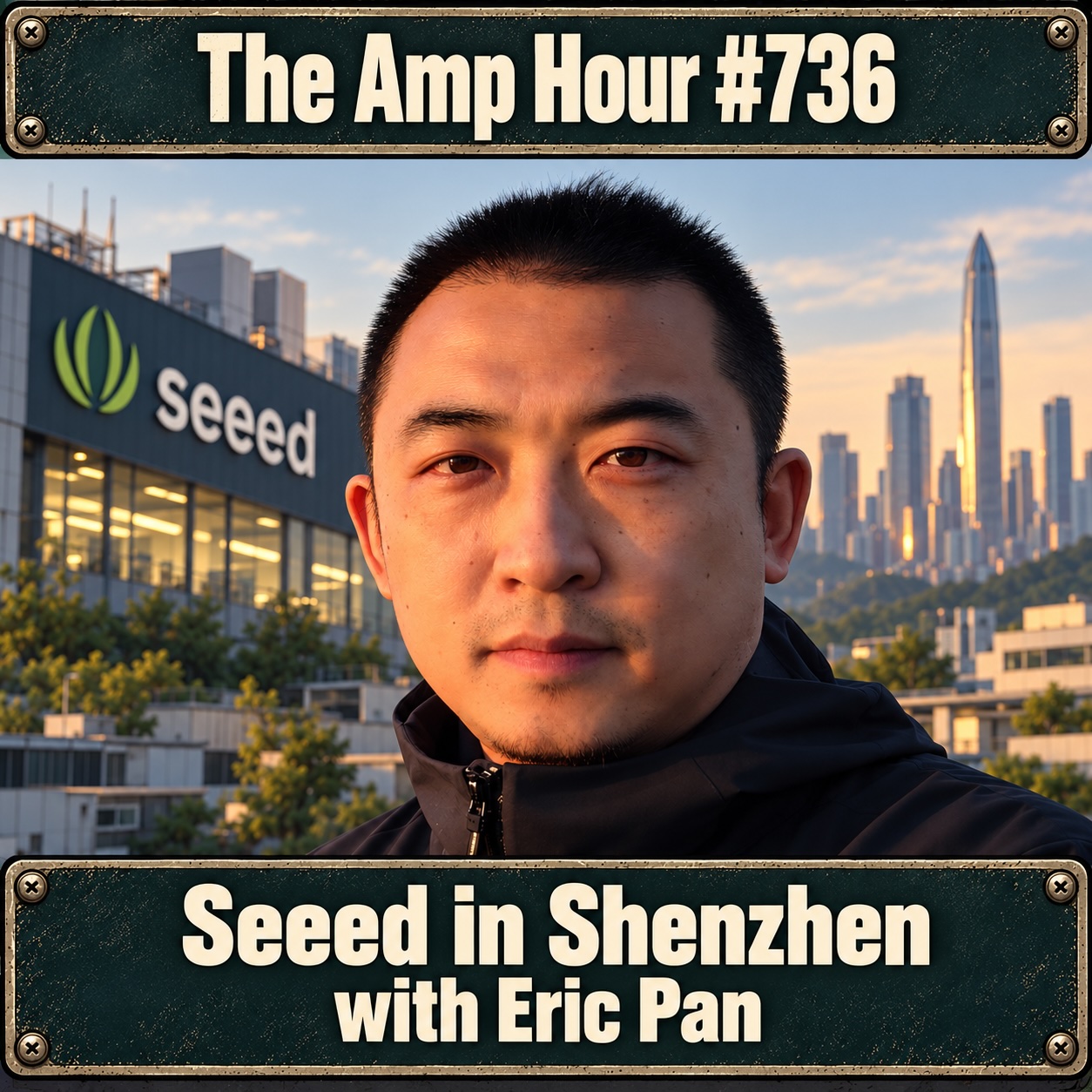
Eric Pan is the founder and CEO of Seeed Studio, an open-source hardware and manufacturing platform based in Shenzhen, China. He joins Chris to discuss Seeed’s journey from early open-source roots to modern robotics, navigating the hardware ecosystem in Shenzhen, bridging the gap between semiconductor companies and developers, and how physical AI and low-cost hardware platforms are transforming innovation.

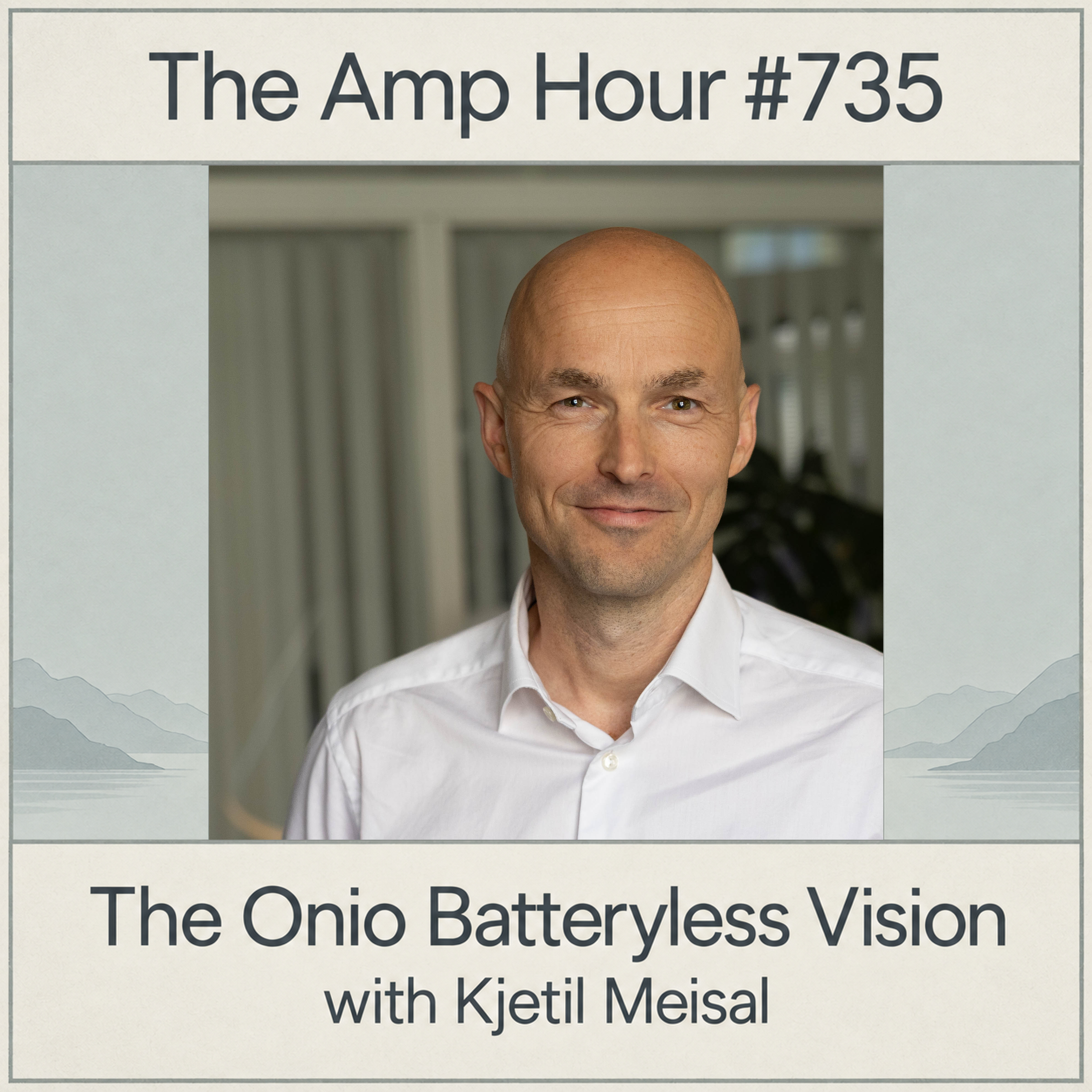
Kjetil Meisal, CEO and co-founder of Norwegian semiconductor startup ONiO, joins Chris to discuss the development of ONiO.zero, a revolutionary batteryless microcontroller powered entirely by ambient energy harvesting.

Dave and Chris catch up on the shift toward practical hands-on engineering education at universities, open-source robotics, calculator forensics, mentoring young engineers, AI-assisted PCB layout tools, reverse-engineering scope RF sections, and why Chris wants to be “the Walmart greeter of electronics”

Andy Kong is creating Chargerless, a pre-seed wearable biometric device that runs on 1 minute of sunshine per day. He joins Chris to talk about low power design, unconventional power schemes, the weird signals of the human body, and more.

Kevin Cloutier is the North American Lead for Physical AI at a global engineering consulting firm and a computer engineer who is passionate about taking complex computations to the edge. He joins Chris to discuss the transition from legacy, statically programmed factory robotics to modern, imitation-learning-based “Physical AI,” building and calibrating the affordable $200 3D-printed SO101 robot arm using the LeRobot open-source framework or Intel’s Physical AI Studio, and orchestrating complex robotic systems entirely on local edge hardware.

Robert Fennis joins Chris to demystify the black magic of RF and talk about his open-source, Python-based 3D electromagnetic solver, EMerge. They discuss why simulation is like building a pyramid of knowledge, how silk screen can completely de-tune a patch antenna, and Robert’s quest to build the “IKEA of FEM solvers” so hardware developers everywhere can simulate their designs without relying on insanely expensive proprietary software.

Dave and Chris celebrate 16 years of the show (1st episode was August 10th, 2010) by launching a brand-new static website featuring searchable transcripts and a “pissed-old amber” SVG scope with a working focus knob–and links to merch!. They also discuss Dave’s new employee, 10 cent RISC-V debuggers, and why naming your startup after an un-Googleable Australian cryptid is a bad move

Dr Greg Charvat, CTO and co-founder of Teradar, joins Chris for a 5th appearance on The Amp Hour to talk about how terahertz frequency radar will revolutionize the automotive space and far outstrips the capabilities of LIDAR and Blobbology

Alex Haro, CEO of Hubble, joins Chris to talk about building a network of terrestrial and space (!) based Bluetooth infrastructure to track low power devices across the globe, without a data plan or a GPS module onboard.
Claim this listing to keep it up to date, reach guests who want to pitch you, and manage bookings with Guestify.
Claim this listing