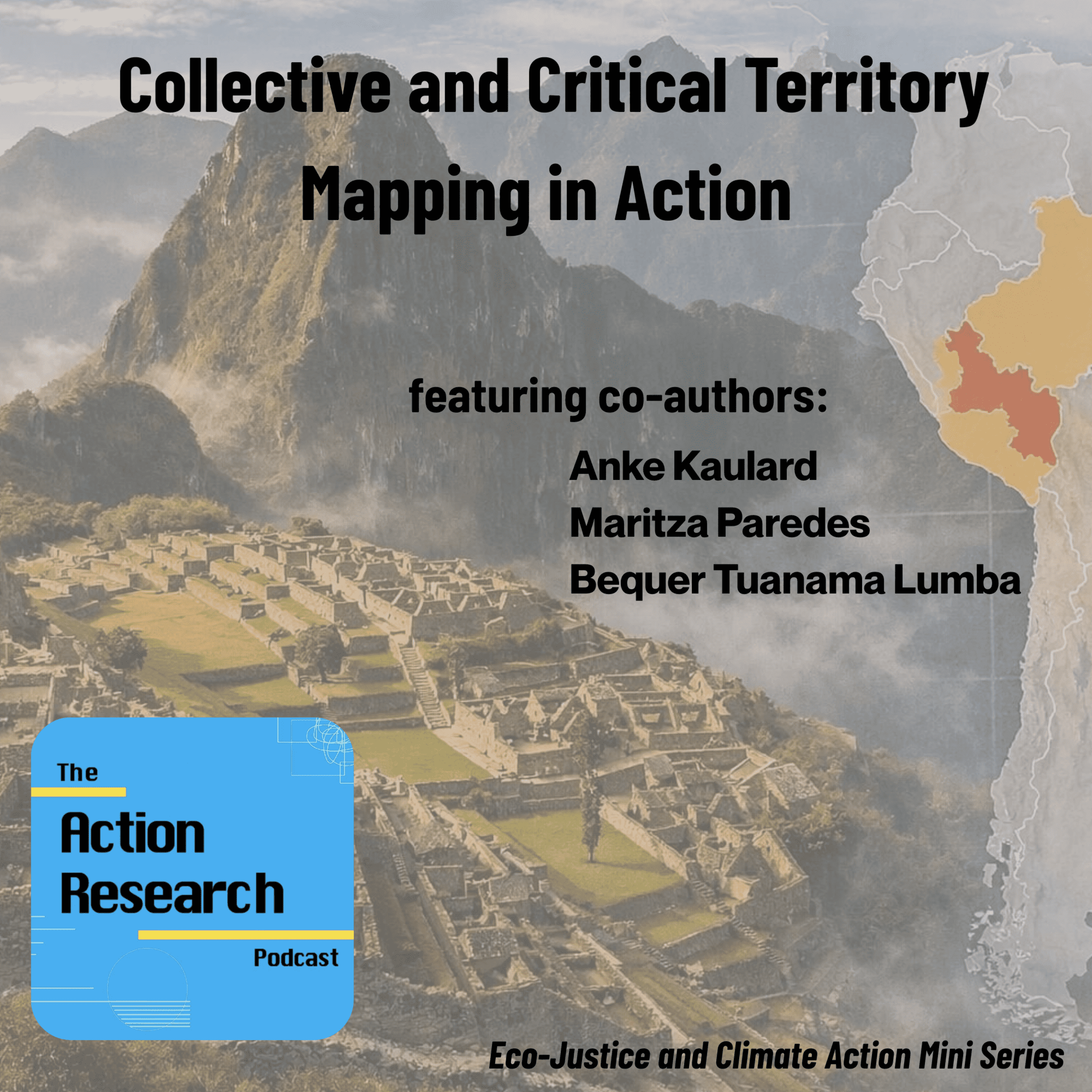
Collective and Critical Territory Mapping in Action
Be sure to check out the grand finale of our Eco-Justice and Climate Action Mini Series! Throughout the last few months, we’ve explored everything from outdoor education in Canada, to a global storytelling initiative, to resilience building in coastal island communities, and more. Today, Joe and Blane explore the story behind “ Crystallizing Territorial Visions and Claims: Critical Mapping with Amazonian Kichwa Communities in Climate Change . We are joined by authors Anke and Maritza, and co-investigator, Bequer Tuanama, from San Martin, Peru. The interview is bilingual, Spanish and English, with translations. The episode is full of meaningful reflections, candid anecdotes about the process, and a deeper look at their research project. Enjoy! The team begins by tracing how the partnership with Kichwa communities in San Martin, Peru came into being, and was built from existing relationships [3:13]. This leads into a discussion of critical mapping itself, and how a participatory research tool gradually became something more [5:57], providing a space for collective reflection, negotiation, and the reimagining of territorial claims in the face of state-led conservation efforts. The power dynamics involved and their negotiations are very insightful [10:32]. Afterwards, the team walks us through what the mapping process actually looked like, and the connection between mapping territory and climate action, using stories, timelines, and imagery of non-human beings which were included, beyond geographic boundaries [14:00]. The team then shares some of emergent practises from collaborating with a diverse group of collaborators on the project, including different layers of knowledge on map, as well as a vision for the territory in the future, along with practical challenges of the logistics of budgeting, transportation, bringing in elders and women, and providing an intercultural approach to the work [22:56]. The episode closes with learning and outcomes from the project, from the universities changing their approach to action research and impact, how mapping is an important tool of dialogue and collaboration across different sectors, bringing women’s voice to the forefront, and engaging different levels, particularly for communicating with the state [35:04]. Thank you Anke, Maritza, and Bequer for sharing your work with us in this episode. Thank you to our listeners for tuning in to this episode of the Action Research Podcast, created by Joe Levitan, Adam Stieglitz, Shikha Diwakar, Cory Legassic, and Vanessa Gold. Produced by Shikha Diwakar and Vanja Lugonjic. Subscribe to our podcast on most major podcast distribution platforms, including Spotify and Apple Podcasts. How have you found yourself in the world of action research? Want to be interviewed or share one of your projects? Get in touch with us. Photo Credit: https://www.machu-picchu.org/location/ Resources: Exhibition Blog Post Maps Atlas of Critical Mapping in Latin America Biographies: Anke Kaulard holds a PhD in sociology and teaches in the Department of Social Sciences at the Pontificia Universidad Católica del Perú (PUCP) and currently at the University of Cologne. She is a former fellow of the trAndeS program (PUCP/FU Berlin) with a focus on inequalities and sustainable development in the Andean region, interested in political economy and ecology. She is a researcher in the action-research project: “Indigenous Visions for Climate Justice” (PUCP/University Diego Portales/TNC, funded by IDRC) and in the project: “Beyond Certification. From voluntary sustainability standards to sector transformation” (PUCP/University of Melbourne). Since 2003 she has been working in action-research, previously in development cooperation projects in the Andean region, Mozambique and Jordan. She works with producer associations and Indigenous Peoples of the Amazon to make visible their demands for climate, economic and social justice. Maritza Paredes is a Full Professor, and Researcher in the Department of Social Sciences, Sociology Section, at the Pontifical Catholic University of Peru. Her expertise lies in political sociology and environmental sociology. Paredes has extensively studied the impacts of extractive industries on the institutions and environmental justice of local communities and indigenous peoples, as well as the effects of climate policies at the local level, particularly among indigenous communities in the Amazon. She obtained her PhD in International Development from the University of Oxford in the UK and a Master's Degree from Columbia University in the USA. Bequer Tuanama Lumba is a Kichwa leader from the community of Kawana Sisa in San Martin, Peru. He served as apu of his community in 2008 and later contributed to the creation of the Kichwa Huallaga Dorado Federation (FEKIHD), which he chaired from two terms starting in 2016. Certified as a professional technician in 2023, he worked as a territorial researcher in the project: "Indigenous Visions for Climate Justice" and made significant contributions to the co-creation of the "Buen Mapeo" process in San Martin. -- This episode is part of our Eco-justice and Climate Action Series. Authors from journal articles in a Special Issue of the Canadian Journal for Action Research hop behind the mic and share the inspirations, process, and findings from their projects. Join Joe Levitan, Shikha Diwakar and special guest host Blane Harvey, as they interview an inspiring group of researchers, educators, organizers, and more, navigating the process of action research.