
Find partners
RegCast

RegCast

Hosted by RegRisk Legal Solutions Limited

Episodes

74

Latest episode

Apr 2026

Language

EN-GB

About the show

RegCast brings you behind the scenes of global financial regulation. Hosted by PJ Di Giammarino, CEO of RegRisk Legal Solutions, it features expert voices from regulators, firms and suppliers. From DORA to AI, RegCast explores how leaders are turning compliance into strategic advantage. Get ahead of the curve and gain insight before the market takes notice.

Listen to episodes

60 recent
April 21, 2026Episode 630 min

MiFIR 2026: The New Supervisory Test

If You Cannot Explain It, You Cannot Defend ItSupervisors are testing decision paths. Most firms are not ready.MiFIR reporting is no longer judged by what gets submitted.It is judged by whether firms can prove how the decision was made.Supervisors are asking more pointed questions, comparing data across regimes, and exposing weaknesses in governance, lineage, and control.Most firms are still treating reporting as an output problem. This episode explains why that no longer works.PJ Di Giammarino, Founder and CEO of RegRisk Legal Solutions, Kim Prado, former CIO at BMO and Sam North, Executive Director of Product Management at The DTCC explore where reporting is breaking today, why divergence matters more than harmonisation, and what firms need to build now if they want to move from producing reports to proving control.

March 9, 2026Episode 535 min

Sovereignty Shock: Which Laws Control Your AI Stack?

AI infrastructure is no longer politically neutral.A leaked diplomatic cable suggests data sovereignty has moved from regulatory debate to geopolitical confrontation. For financial institutions, this raises a harder question than data residency: which law executes inside your AI stack?Sovereignty now lives in the control plane: who holds the encryption keys, who can compel access, whether service can be withdrawn, how models are governed, and whether data and workloads can be ported under stress.In this episode, we examine sovereignty as an operational condition, not a policy label. From foreign access risk and vendor lock-in to regulation-to-enforcement in live operation, we ask what provable control really looks like in 2026.Because when governments disagree, something still executes.

March 4, 2026Episode 435 min

The AI Fines Have Started. Are You Next?

The fines are no longer theoretical. Supervisors are alreadypenalising weak reporting controls, inadequate governance and fragile operating models. Not for misconduct. For failure to demonstrate control. And this is before large-scale AI supervision has fully arrived.AI pilots are moving into production across capital reporting, AML, surveillance and resilience. The legal and technical obligations governing accountability, outsourcing, and operational control are already on the books. When supervisors begin testing AI-driven systems at machine speed, “it was just a pilot” will not be a defence. This episode confronts the uncomfortable reality: if you cannot evidence control now, escalation is not a question of if, but when.

February 4, 2026Episode 340 min

MiFIR Correlation, Cost and Control: Your Live Inspection Has Started

MiFIR reporting reform is no longer something firms are preparing for. Live inspection has started.Regulators are now correlating MiFIR data against prudential and statistical views of the same activity, turning divergence into evidence and data quality into a supervisory judgement. This is happening while core reporting systems remain operational, leaving little room for trial-and-error change.In this episode, industry leaders share 80+ years of experience on what breaks first during in-flight reform, why loss of supervisory trust is the real failure mode, how costs escalate before root causes can be fixed, and what must be reused to prevent fragmentation becoming permanent. They also explain why AI and automation will surface weaknesses faster unless meaning, validation, and governance are fixed first.This is not about designing the target state.It is about regaining control while your systems are being examined.Join in and follow all the analysis from the RegTech FS conference registration site:https://regtechconference.co.uk/.

January 27, 2026Episode 238 min

From Templates to Models: The Reporting Backbone Reset

Supervisors are rebuilding reporting from the ground up.Regulators are moving away from prescriptive templates toward model-based reporting built on granular data, shared semantics, and provable lineage. This shift promises better data quality and faster insight, but it also forces firms to make hard architectural and governance decisions now. In this episode, regulatory and industry leaders explain what“templates to models” really means, why fragmented dictionaries and interpretations will fail, and why 2026 is the year supervision starts testing whether firms can prove how their reporting actually works. If reporting quality, data lineage, and regulatory convergencematter to your 2026 agenda, this episode is required listening.Join in and follow all the analysis from the RegTech FS conference registration site: https://regtechconference.co.uk/.

January 22, 2026Episode 134 min

From Pressure to Proof: How Governance Gets Examined

2026 marks a decisive shift in financial supervision. The focus has moved from regulatory pressure and compliance narratives to supervisory testing based on evidence.Governance is no longer judged by frameworks or stated intent. It is examined through how systems behave in practice, how decisions are made and overridden, how data quality is sustained under change, and whether architecture holds up when scrutiny intensifies.In this opening episode of RegCast Season 7, we explore why governance has become examinable, how political dynamics and regulatory divergence across the UK, EU, APAC and US are sharpening supervisory expectations, and what this means for operating models, technology choices, and assurance through 2028. The discussion sets the control lens for the season and frames the decisions firms must make before expectations harden and become costly to reverse. Join in and follow all the analysis from the RegTechFS conference registration site: https://regtechconference.co.uk/.

November 5, 2025Episode 633 min

FIXing Trust in Trading

The financial markets run on data and after30 years of FIX messaging, trust in that data is under pressure.91% of firms report fragmented systems.70% link that fragmentation to compliance risk.In this episode of RegCast, PJ Di Giammarino sits down with Jim Kaye, Executive Director of the FIX Trading Community, to discuss how AI, open standards, and smarter governance can FIX trust at the source.Learn how new collaboration in 2026 between ISO, FIX, CDM, and DRR could create the first truly AI-ready market infrastructure just in time for new regulatory demands to get it right.Download our latest FREE MiFIR research report: https://regrisksolutions.com/intelligence/document/mastering-mifir-build-one-runbook-to-bridge-the-transparency-chasm/Register for RegTech 2026 conference March 26, London https://regtechconference.co.uk/

October 23, 2025Episode 543 min

MiFIR Divergence 2026: The Race to Rebuild Reporting Control

Episode 5: MiFIR Divergence 2026: The Race to Rebuild Reporting ControlEurope’s reporting machine processes 15 billion trades a year. In October 2025, ESMA froze 115 Level-2 acts while the UK FCA pressed ahead with Digital Regulatory Reporting and new MiFIR standards for 2026.The result: two rulebooks, two control philosophies — and billions in added cost.In this RegCast episode, PJ Di Giammarino is joined by Dawd Haque (Deutsche Bank, Chair of the Bank of England and FCA’s Data Standards Committee) and Grant Haley (First Derivative, an EPAM company) to explain how firms can build once and prove everywhere. They discuss:✅ Why data quality is now a capital variable.✅ How vendor fragility threatens market resilience.✅ The semantic “rulebook to runbook” approach.📘 Download the FREE report Mastering MiFIRDivergence → https://regrisksolutions.com/intelligence/document/mastering-mifir-build-one-runbook-to-bridge-the-transparency-chasm/🎟️ Register for RegTech 2026 London → https://regtechconference.co.uk/🎧 Subscribe to RegCast for new episodes #MiFIR #RegTech #FinancialServices#DataQuality #OperationalResilience #CapitalRisk #BuildOnceProveEverywhere

September 17, 2025Episode 436 min

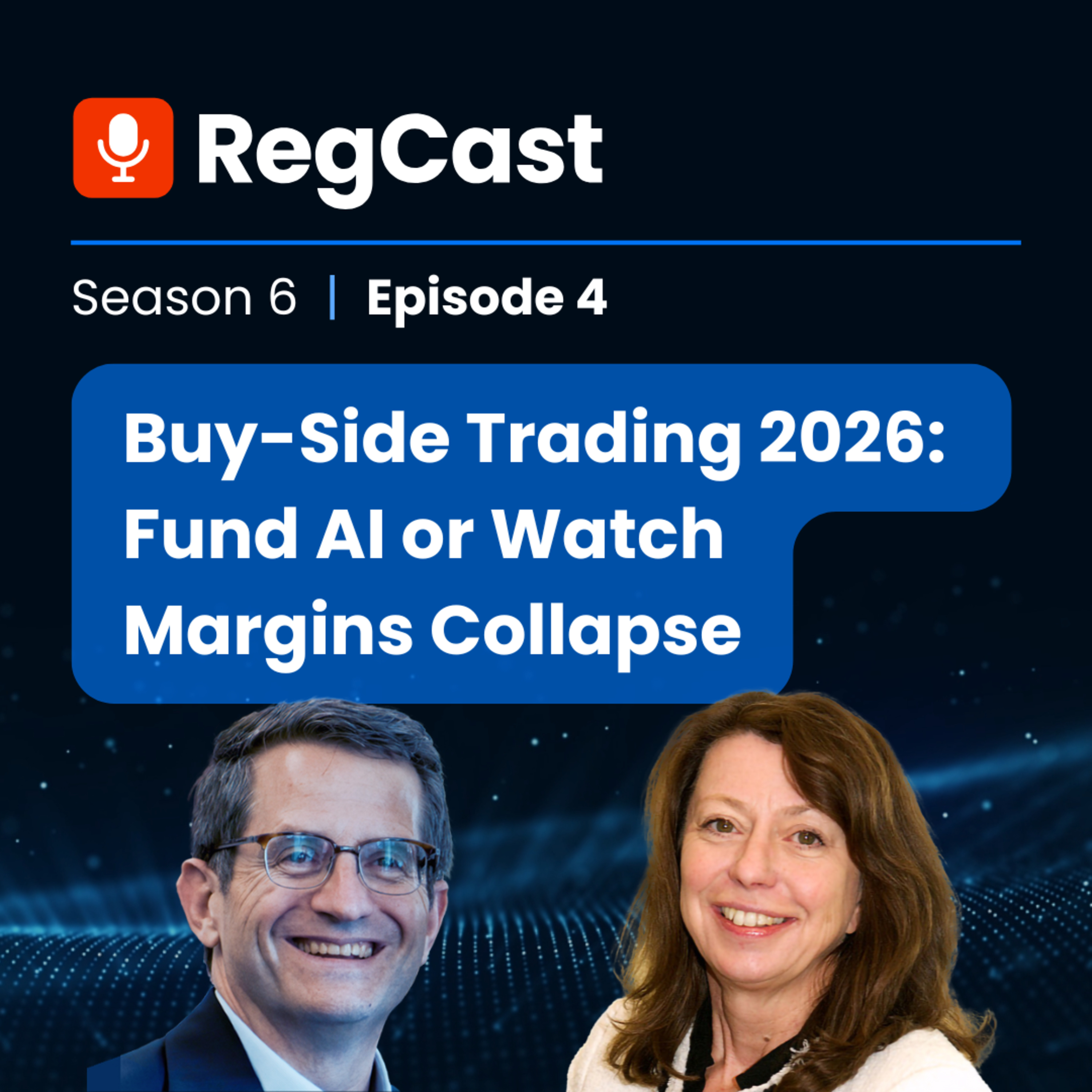
Buy-Side Trading 2026: Fund AI or Watch Margins Collapse

91% fragmented. 70% report compliance failures. As ⁠Connectivity in the Age of AI reveals⁠, the buy side’s wiring is broken, and AI is making the cracks impossible to ignore.Execution economics are collapsing, clients demand transparency, and supervisors are embedding ICT and data risk directly into Pillar 2 capital. In 2026, that means a 0.5% surcharge — wiping out 10 to 15% of ROE — is no longer theoretical but the likely outcome for firms that fail to act.This episode brings PJ Di Giammarino, CEO of RegRisk Legal Solutions, together with Rebecca Healey, Chair of the FIX Trading Community’s AI Working Group, to unpack why AI has forced execution into the boardroom — and how standards like FIX, CDM, and DRR-style logic can turn compliance from a capital penalty into competitive advantage.👉 Listen now. Q4 2025 is the last budget window before AI in trading becomes the next capital test.

July 25, 202528 min

Building for Control: MiFID III, DRR, and the Architecture of Trust

Episode 3: Building for Control — MiFID III, DRR, and the Architecture of TrustOn 23 July 2025, the FCA issued its second major warning in 180 days. Market Watch 82 makes it clear: firms must fix the quality of their transaction reporting data or face escalating consequences.In this episode of RegCast, PJ Di Giammarino is joined by Dawd Haque (Deutsche Bank, Chair of the Bank of England and FCA’s Data Standards Committee) and Grant Haley (First Derivative) to tackle the hard truths behind today's transaction reporting, Digital Regulatory Reporting (DRR) and what machine-readable compliance really demands.📌 What’s inside:✔️ Why machine-readable reporting is now expected✔️ How DRR and the Common Domain Model (CDM) reshape control frameworks✔️ What firms need to build now to meet 2027 deadlines✔️ How to reduce execution risk and avoid capital impact under the ECB’s SREPThis is no longer just a tech or compliance issue. It is about rebuilding trust in regulatory reporting from the ground up.#MiFIDIII #MarketWatch82 #TransactionReporting #DRR #CDM #DataQuality #RegCast #Compliance #SREP #PillarII #FCA #ESMA #RegTech #FinancialServices #ArchitectureOfTrust

Is this your show?

Claim this listing to keep it up to date, reach guests who want to pitch you, and manage bookings with Guestify.

Claim this listing

More Technology podcasts