Find partners
Particle Accelerator: A Particle41 Podcast

Particle Accelerator: A Particle41 Podcast

Hosted by Particle41

Episodes

115

Latest episode

Jul 2026

Language

EN-US

About the show

Welcome to the Particle Accelerator Podcast , presented by Particle41 . Hosted by Ben Johnson , a serial entrepreneur who has founded, built, and sold multiple businesses, this podcast delves into conversations with future-thinking business leaders about how to accelerate their business and grow their teams. Each episode features in-depth discussions that reveal strategies for accelerating business growth, cultivating high-performing teams, and uncovering new technological advancements across various industries. Catered for CEOs, entrepreneurs, and forward-thinking professionals alike, the podcast provides valuable insights to help you discover emerging technologies and stay ahead in the competitive tech landscape. It's highly relevant for those seeking to expand their horizons and make impactful connections in the technology world. Tune in to stay ahead of the curve and gain a deeper understanding of the forces driving the evolution of technology and business. The Particle Accelerator Podcast—where innovation meets acceleration. #ParticleAcceleratorPodcast #Particle41 #Entrepreneurship #BusinessGrowth #Innovation #Leadership #BusinessStrategies #TechnologyLeadership #EmergingTechnologies #TechEntrepreneurs #Business #TechnologyInsights #HighPerformingTeams #CompetitiveAdvantage #ForwardThinking #IndustryInnovators #TechIndustry #GrowthMindset #SuccessStrategies #FutureOfBusiness Learn more about Ben @ Particle41.com

Listen to episodes

60 recent
July 20, 202657 min

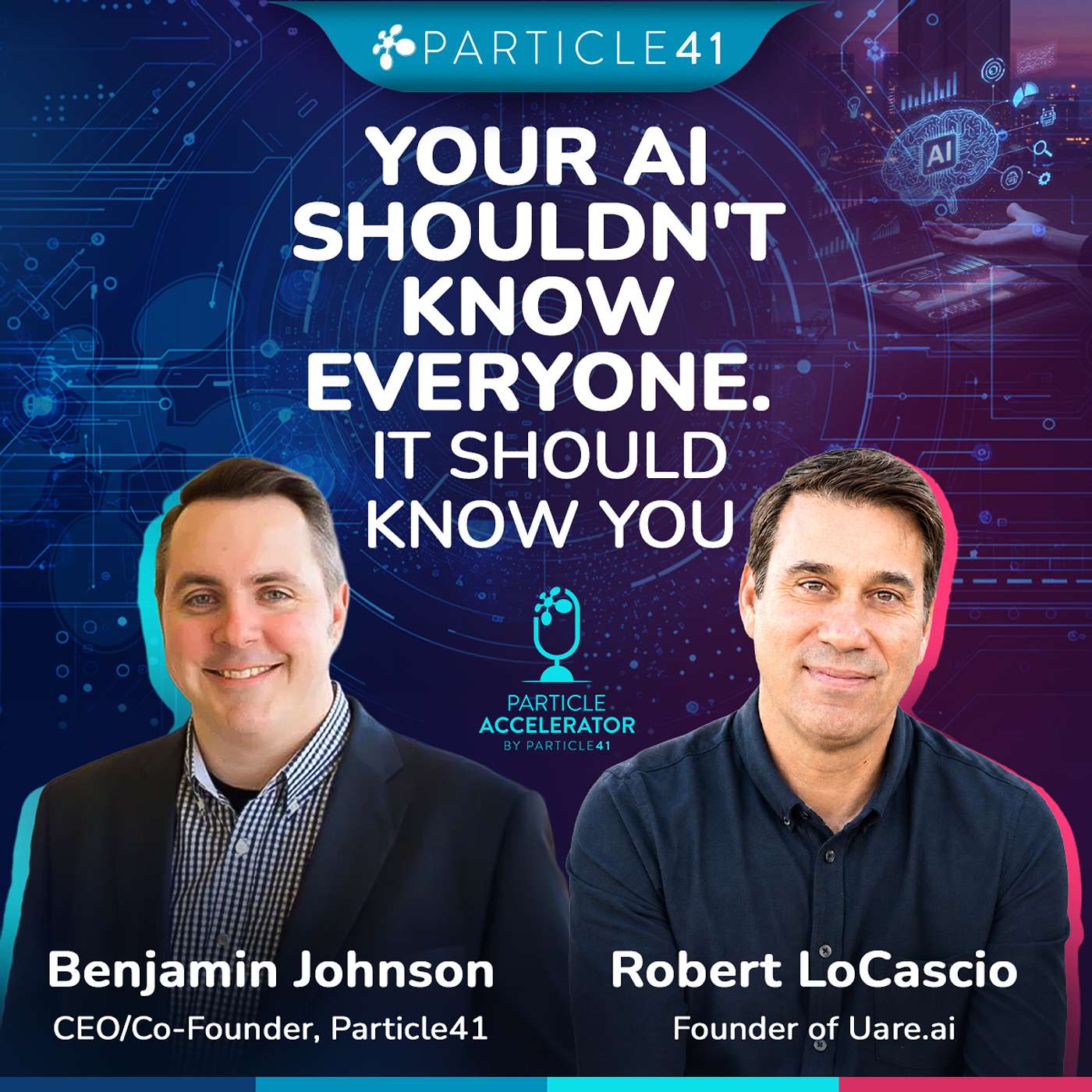
Your AI Shouldn't Know Everyone. It Should Know You. | Robert LoCascio

In 1995, Rob LoCascio looked at the early internet and asked a simple question: where are the people? His answer became live chat, a piece of software now running on billions of websites. He built that into LivePerson, took it public, and ran it for almost three decades. Now he's building something that argues against the entire direction of the AI industry. Instead of one giant model trained on everyone's data, Rob believes the future belongs to individual AIs — trained only on you, owned by you, and monetizable by you. His new company, Uare.ai, has raised $10M, has thousands of people on a waitlist, and is about to launch. In this episode of The Particle Accelerator, host Benjamin Johnson (Founder & CEO, Particle41) talks with Rob about: 00:00 – Rob's origin story: inventing live chat and reading the early internet right 02:37 – What everyone else missed about e-commerce trust 06:14 – The "human life model": 7 categories that make an AI actually yours 11:20 – Why hallucination-proofing works differently when the AI only knows one person 13:48 – The monetization model: setting a price, sharing your AI, scaling your expertise 19:35 – Why data ownership is the whole pitch, and why big platforms can't credibly offer it 33:34 – Guardrails: no deepfakes, mandatory verification, protecting the person behind the AI 40:07 – A tax firm owner's story: seeing her business's future for the first time 42:44 – Faith, stewardship, and building a company without losing yourself in it Rob LoCascio, Founder of Uare.ai, former Founder & CEO of LivePerson Connect with Rob: https://www.linkedin.com/in/rlocascio/ Learn more about Uare.ai: https://www.uare.ai/ Benjamin Johnson, Host, Particle Accelerator Podcast & CEO, Particle41 Connect with Benjamin: https://www.linkedin.com/in/benjaminrjohnson/ Learn more about Particle41: https://particle41.com/ #ParticleAccelerator #AI #Entrepreneurship #Podcast #ArtificialIntelligence #FutureOfWork
July 11, 202656 min

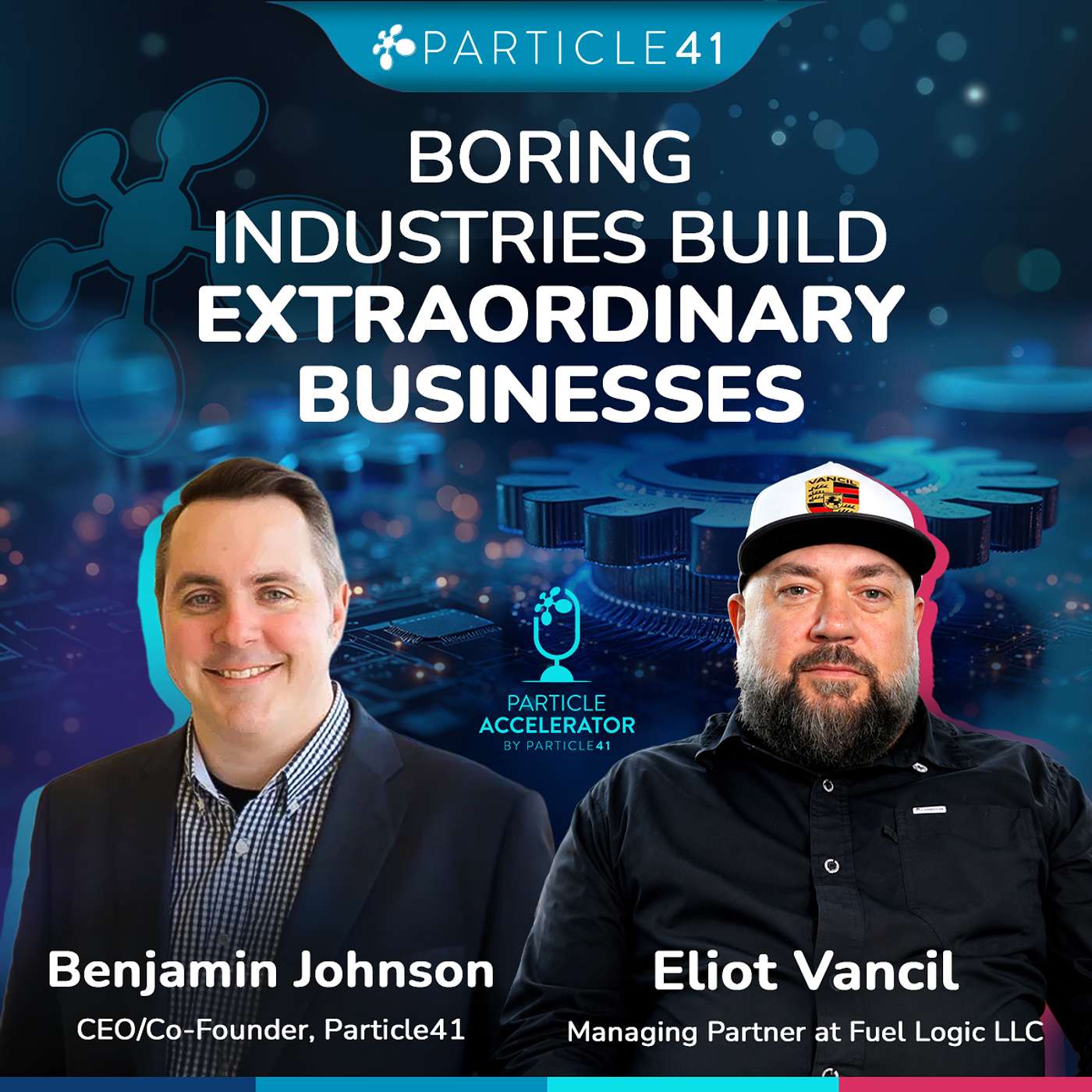
The "Dumbest Idea" That Built a $100M Fuel Empire | Eliot Vancil

Eliot Vancil grew up the son of a house painter in Oakliffe, mowing yards for spending money. Twenty-five years later, he's built, scaled, and sold multiple companies, a Texas IT business he ran for 20 years, a telecom company he sold without an earnout, and then turned his attention to one of the most archaic, paper-driven industries in the country: fuel delivery. The result is Fuel Logic, which Eliot calls "the dumbest idea that ever worked." By applying the same technology, ticketing, and process discipline he used running an IT company, Eliot built a nationwide fuel brokerage that now does north of $100 million in revenue, including convincing Walmart to consolidate roughly 500 regional fuel vendors down to one. In this episode of The Particle Accelerator, host Benjamin Johnson (Founder & CEO, Particle41) talks with Eliot about: The "dumbest idea that worked", why a commoditized, capital-intensive industry was actually wide open for a tech-first operator How Fuel Logic found its niche inside Walmart's supply chain by going after the deliveries no one else wanted Why "Network Logic" taught him that culture, not hustle, is the real bottleneck to scaling Turning EOS into the "Elliot Operating System", and what changed when he actually committed to running it properly Bootstrapping vs. bringing in corporate discipline: where grit hits a ceiling Building the business alongside his own kids, by design, and how he engineered their work ethic from childhood How he's using Claude and AI to vibe-code his own dispatch systems, customer portals, and BI dashboards What actually breaks once you cross from a $10M business into $100M+ territory 00:00 Intro & welcome 01:07 What Fuel Logic does 03:04 Mowing yards & early entrepreneurial roots 03:50 30 years of marriage, the one-sentence secret 05:56 Selling to Bain vs. buying a 140-year-old hotel 07:19 Working with his two kids every day 09:09 Where the entrepreneurial DNA came from 09:20 Lessons from Network Logic (1998–2022) 11:21 "A skyscraper with no foundation" 15:13 The "dumbest idea that ever worked" 19:40 The Walmart story: 500 vendors to 1 22:42 Hitting $100M, bigger than any past venture 25:41 EOS vs. the "Elliot Operating System" 28:34 How 20 years of IT/telecom built Fuel Logic's edge 29:51 Defending an 85% first-page search moat 31:17 Using Claude/AI for dispatch, invoicing, and BI 35:00 The modern version of recurring revenue 38:23 Gritty bootstrapper vs. corporate hire 42:09 Deliberately raising entrepreneurial kids 58:16 Where to find Eliot & who he wants to meet 59:30 Final advice: $10M to $100M Eliot Vancil, Managing Partner at Fuel Logic LLC Connect with Eliot: https://www.linkedin.com/in/eliotvancil/ Learn more about it: https://www.fuellogic.net/ Benjamin Johnson, Host, Particle Accelerator Podcast & CEO, Particle41 Connect with Benjamin: https://www.linkedin.com/in/benjaminrjohnson/ Learn more about Particle41: https://particle41.com/ #ParticleAccelerator #Entrepreneurship #Fuel #Logistics #EOS #AI

July 10, 202650 min

Growth doesn't break companies. Founder dependency does.| Brooke M Dukes

Growth doesn't break companies. Founder dependency does. In this episode of The Particle Accelerator, Benjamin Johnson sits down with Brooke Dukes - co-founder of a 17-year consulting firm, author of international bestseller Burn On, Not Out, and founder of BMD - to unpack the pattern that silently stalls scaling companies, the founder who becomes the system. Brooke has worked with companies from $1M to $2B+ in revenue and has seen the same dynamic play out every time. When a company is young, the founder being the hub makes sense. But past a certain revenue threshold, that same behavior becomes the growth ceiling. Her flagship program, Success by Design, installs what she calls a leadership operating system - the behavioral layer that most business operating systems (like EOS) never address. In this conversation you'll learn: Why founder dependency - not strategy - is what actually stalls companies The 48-hour decision audit that reveals your real bottlenecks in 5 days Why every reopened decision costs $2,000–$5,000 (conservative estimate) The 3-question filter: Is this decision actually mine? What breaks if I don't act? Am I reopening something already decided? The difference between delegating a task vs. delegating authority (and why it matters) How to use Eisenhower's matrix to protect your strategic time Why behavior change requires small daily steps - not willpower overhauls How Brooke built an AI coaching platform (Oz) trained on her IP for founder CEOs The neuroscience and behavioral science behind why founders keep making fear-based decisions Heart coherence meditation, Be-Do-Have vs. Do-Have-Be, and the unconscious identity loops that drive founder behavior Timestamps: 00:00 - Introduction 01:46 - Starting a business the way you want to end it 03:34 - Human design, neuroscience, and behavioral science 05:45 - Replacing human coaches with AI 07:41 - Meditation, Yoga Nidra, and heart coherence 13:28 - Be-Do-Have vs. Do-Have-Be (identity and belief) 18:56 - Lessons from 17 years working with billion-dollar companies 22:27 - The decision system breakdown 26:57 - The 4 phases of Success by Design 30:37 - Why founders reopen decisions (the 3 AM version) 35:06 - The 48-hour reset 40:03 - Building Oz: AI coaching trained on founder IP 44:30 - Discipline vs. ignoring new information 46:06 - How Success by Design differs from EOS and Vistage 49:12 - Does a system fix the founder or just manage them? Brooke M Dukes, Founder-CEO, BMD Consulting & Host, Burn On Not Out Connect with Brooke: https://www.linkedin.com/in/brookedukes/ Learn more about it: https://www.brookemdukes.com/ Benjamin Johnson, Host, Particle Accelerator Podcast & CEO, Particle41 Connect with Benjamin: https://www.linkedin.com/in/benjaminrjohnson/ Learn more about Particle41: https://particle41.com/ #Leadership #FounderLife #CEO #BusinessGrowth #ExecutiveCoaching #ParticleAccelerator

July 9, 202645 min

Innovation Isn't an Idea Problem, It's a Leadership Problem | Robyn M. Bolton

What's the real reason innovation dies inside organizations? In this episode of The Particle Accelerator, Benjamin Johnson sits down with Robyn Bolton, founder of MileZero, former P&G brand manager on the Swiffer launch team, BCG and InnoSight advisor, author of Unlock Innovation, and 2026 Thinkers50 Radar honoree, for an unflinching look at the human side of corporate innovation. Robyn has spent her career at the intersection of big ideas and organizational reality. Her core thesis, companies don't fail at innovation because they lack ideas. They fail because leadership behavior, not strategy, not structure, is what makes or breaks a growth culture. In this conversation, you'll learn: The "organizational antibody" that's more dangerous than a flat-out no Why loving an idea to death is the sneakiest form of resistance The ABCs of change, and which one leaders need to fix first How to make the CFO your biggest innovation champion What a P&G VP told Robyn about three-ring binders that changed how she works forever. How AI initiatives get derailed, and what actually survives The difference between activity and a real business outcome in tech bets. Why having more ideas is the wrong goal Whether you're a founder, an executive, or a practitioner trying to drive change inside a large org, this episode is a masterclass in the leadership behaviors that separate companies that grow from the ones that stall. Timestamps: 00:00 - Intro: Robyn Bolton and MileZero 01:08 - What MileZero actually does 02:14 - When Robyn first realized the problem was organizational, not ideational 05:44 - What launching Swiffer taught her (ownership + courage to break rules) 07:47 - Frameworks, culture, and working patterns that matter 10:30 - Speaking the right language to results-oriented leaders 12:15 - Asking execs what success looks like 13:47 - From advisor to operator: what changes 17:32 - Organizational antibodies explained 19:07 - The "yes but" team vs. the "no" team (compliance + legal) 21:06 - "What would make you say yes?" - the reframe 21:59 - Loving an idea to death: the sneakiest antibody 25:14 - The most common well-intentioned mistake after making the right call 27:09 - How to spot AI bets that show up in business vs. just in plans 29:16 - Where organizational antibodies attack AI initiatives 36:47 - Why innovation accountability is hard - and what convinces a CFO 42:04 - The belief most executives have that's flat wrong 44:04 - A leader's rate call is stalling six months in - first move 44:46 - Robyn's core superpower: complexity busting 47:23 - Where to find Robyn and MileZero Robyn M. Bolton, Founder, MileZero LLC & Author, Unlock Innovation Connect with Robyn: https://www.linkedin.com/in/robynmbolton/ Learn more about: https://www.milezero.io/ Benjamin Johnson, Host, Particle Accelerator Podcast & CEO, Particle41 Connect with Benjamin: https://www.linkedin.com/in/benjaminrjohnson/ Learn more about Particle41: https://particle41.com/ #innovation #Leadership #ProductStrategy #MileZero #ParticleAccelerator #CorporateInnovation #AIStrategy

July 8, 202649 min

The gap between demo and reliable ROI | Pratik Verma

Your AI agent nailed the demo. But two weeks after going live, you're staring at support tickets you can't reproduce, cloud bills you can't explain, and behavior nobody predicted. In this episode of Particle Accelerator, our host Benjamin Johnson sits down with Pratik Verma, Founder and CEO of Okahu AI, to unpack exactly why AI agents break in production and what it takes to actually build reliable, observable agentic systems. Pratik has spent years at Microsoft and leading his own AI infrastructure companies. His open-source Monocle library and Okahu platform are purpose-built for the era of non-deterministic, LLM-powered agents, filling the gap that Datadog, New Relic, and traditional APM tools simply weren't designed for. In this conversation, Benjamin and Pratik get into: The most common root cause of agent failure (hint: it's not the model) Why the orchestration layer is where everything breaks Real-world example, how an Epson QA team cut triage from 30 hrs to 2 hrs with agents The structural difference between tracing a microservice vs. tracing an agent Evals vs. observability, what they are, why you need both, and how they connect How to instrument for token cost waste from day one MCP observability, what happens when you can't see inside the calling agent The self-healing agent loop, observability, coding agent, fix and repeat What software engineering looks like in 3 years Chapters: 00:00 - Intro & Guest Welcome 01:05 - Why agents fail: lab vs. production reality 02:28 - The orchestration layer: where flexibility becomes fragility 04:00 - The noun confusion failure mode (real-world example) 04:51 - The failure mode engineering leaders never see coming 06:29 - Why Datadog doesn't work for AI agents 11:22 - Instrumenting for cost: token budgets, session tracking & alerts 14:22 - Evals vs. observability: drawing the line 17:21 - From deterministic to non-deterministic systems 18:24 - Real-world case study: Epson QA agents 22:51 - Call center AI & observability signals in practice 30:07 - MCP observability and institutional knowledge loops 35:10 - The emerging agent economy and skill repositories 46:26 - What the next 3 years of AI looks like Pratik Verma, Founder & CEO, Okahu AI Connect with him: https://www.linkedin.com/in/pratikrverma/ Learn more at: https://www.okahu.ai/ Benjamin Johnson, Host, Particle Accelerator & CEO, Particle41 Connect with Benjamin on LinkedIn: https://www.linkedin.com/in/benjaminrjohnson/ Learn more about Particle41: https://particle41.com/ #AIAgents #MLOps #AIObservability #ProductionAI #EngineeringLeadership #TheParticleAccelerator #Particle41

July 7, 202652 min

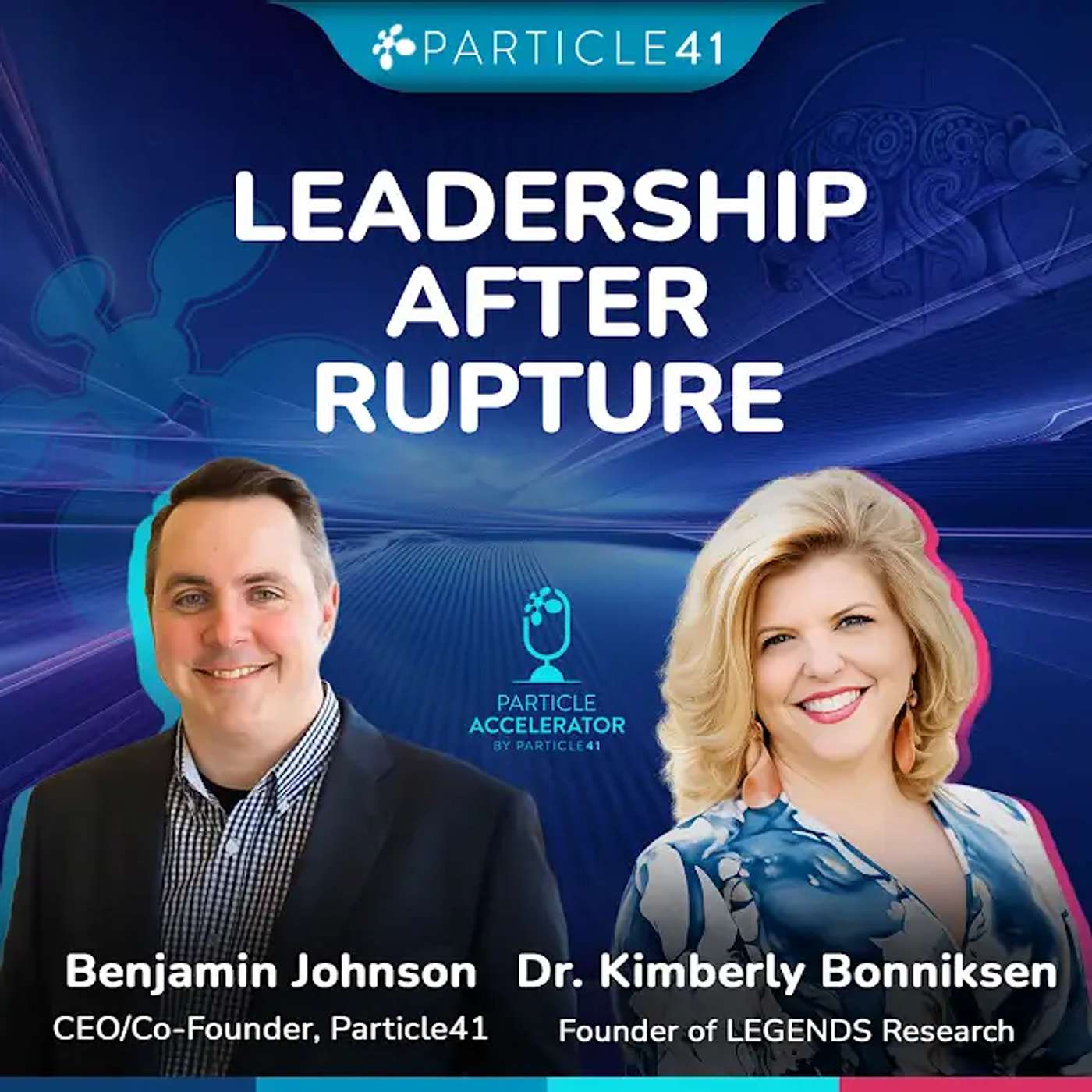
Leadership after rupture | Dr. Kimberly Bonniksen

In this episode of the Particle Accelerator, host Benjamin Johnson sits down with Dr. Kimberly Bonniksen, founder of Legends Research and creator of Kairos AI. A researcher, Dr. Kimberly brings three decades of experience studying how leaders carry responsibility, sustain trust, and create meaning that endures. From her early work scaling the University of Phoenix online division to her groundbreaking research with Tony Robbins and Chet Holmes, Kimberly has built a unique framework for leadership rooted in ancient narrative structures and modern data science. In this conversation, they explore: The critical difference between persuasion and manipulation, and why leaders cross the line without realizing Why servant leadership has created an "Atlas Complex" that's unsustainable How to escape the "box" of self-deception and lead from a place of genuine service The power of third-party validation in organizational change The three life-defining moments (her stroke, her horse fire, and a wildfire) that reshaped her research How Kairos AI uses ancient leadership principles to help organizations make better decisions The future of personalized learning in education, powered by persuasion technology Kimberly's story of resilience, including the miraculous recovery of her Arabian horse Fire after being struck by lightning in the Nevada desert, illustrates how rupture, not strategy, is where real transformation begins. Dr. Kimberly Bonniksen, Founder of LEGENDS Research Connect with her: https://www.linkedin.com/in/kimberlybonniksen/ Learn more at: https://legendsresearch.com/ Benjamin Johnson, Host, Particle Accelerator & CEO, Particle41 Connect with Benjamin on LinkedIn: https://www.linkedin.com/in/benjaminrjohnson/ Learn more about Particle41: https://particle41.com/ #ParticleAccelerator #Particle41 #LeadershipPodcast #PersuasionTechnology #BusinessLeadership #AI #Education #Resilience

July 7, 20261 hr 10 min

The Question Jay Abraham Asks Every Founder

If you've ever used the phrase "unique selling proposition" in a meeting - you've used Jay Abraham's work. Same with strategy of preeminence, risk reversal, power partnering, and relational capital. These are frameworks the business world now runs on, often without knowing where they came from. In this episode, Particle41 CEO Benjamin Johnson sits down with Jay Abraham - founder of The Abraham Group, Forbes Top 5 Executive Consultant, 10,000+ clients across 400+ industries - for a wide-ranging conversation on what's working, what's broken, and what the next three years in business actually look like. What we cover: Why AI is following the same pattern as every "best practice" wave before it, and what the real competitive edge will be The over-automation trap: how replacing human touchpoints costs you your best, most loyal customers "Successfully stuck", the most dangerous place a business can be when things appear to be going well OPIs (Overlooked Performance Indicators): the 40–60 drivers sitting behind your KPIs that almost no one manages The difference between preeminence and influence, and why confusing them is quietly eroding market trust Power partnering and joint ventures: why companies like Microsoft and Zoom generate billions through partnerships most founders never consider Jay's vault of 24 unpublished books, 97 methodologies, and why he's spent decades frustrated by the gap between learning and application What the entrepreneurial world looks like in three years, and what he's most worried about About Jay Abraham: Jay Abraham is the founder of The Abraham Group and one of the most recognized business growth strategists in the world. Tony Robbins devotes a full day of his premier five-day business event to teaching Jay's three-ways-to-grow framework. Forbes named him one of the top five executive consultants in the United States. He has generated an estimated $9 billion in results for his clients across more than four decades of work. Chapters: 0:00 - Introduction & Jay's background 1:28 - Indianapolis roots & going back to your origins 8:40 - Starting at 28: the mail order world and the beginning 13:55 - What founders get wrong about AI 17:17 - When automation kills customer relationships 20:00 - Fast gears, slow gears & the hybrid model 22:06 - How to spot strategy vs. execution gaps in the first meeting 27:24 - What's missing when great strategy fails to execute 33:00 - Cultural connection to mission & global teams 35:32 - Power partnering, joint ventures & distribution channels 37:00 - Being "successfully stuck" 40:00 - OPIs: Overlooked Performance Indicators 43:17 - Agentic AI and call transcript analysis 45:30 - Jay's vault: 24 books, 97 methodologies, and legacy 52:13 - The AI clone experiment & why people don't apply knowledge 55:10 - What the inspired Jay wants to build 1:00:45 - Where Jay started - and what still drives him 1:04:08 - Preeminence vs. influence 1:06:09 - What the world looks like in 3 years 1:09:09 - Closing: the obligation to add value Jay Abraham, Founder, The Abraham Group | Forbes Top 5 Executive Consultant Connect with Jay Abraham on LinkedIn www.linkedin.com/company/the-abraham-group/ Learn more here: www.abraham.com/ Benjamin Johnson, Host, Particle Accelerator & CEO, Particle41 Connect with Benjamin on LinkedIn www.linkedin.com/in/benjaminrjohnson/ Learn more about Particle41: https://particle41.com/ #FounderMindset #BusinessPhilosophy #Preeminence #JayAbraham #Entrepreneurship #Particle41 #ParticleAccelerator

July 6, 20261 hr 4 min

How One Founder Built the "Google Street View" for HOAs | Wesley Hunt

Wesley Hunt co-founded Optic Systems after nearly a decade inside the property management industry - and the company he built looks nothing like what you'd expect. It started with a simple observation that property managers are expected to respond to homeowners instantly while also physically driving to every community they manage. You can't do both. Something always breaks down. The solution Wes and his co-founder landed on? "Google Street View, but on demand and for the private sector." 360-degree video inspections, GPS-synced, quality-checked, and delivered to a platform that property managers, landscapers, paving companies, and city code enforcement offices can all use. In this episode, we trace the full arc - from Wesley's first job at 17 as a land survey technician in Pennsylvania, through law school, HOA management, a patent filing, a failed SaaS model, a successful pivot to a driver service model, a full platform replatforming, and now a new AI-ready hardware system launching at CAI. We also get into the hard stuff, what it actually takes to build real-time integrations with legacy property management platforms, what broke when their MVP hit unexpected growth, and what the aging HOA manager workforce means for the whole industry. If you work in property management, proptech, public works, landscaping, land development, or you're building a B2B SaaS platform with a physical operations component - this one is for you. What we cover: 00:08 - Intro & lightning round: bills fan, drone pilot, Adam Grant 04:18 - Age 17, GPS computation, and land surveying in Pennsylvania 06:10 - Why law school, and what transactional law taught him 08:22 - Falling into property management and running 19 communities 11:18 - The worst weeks on the job and what actually breaks in HOA world 14:16 - The 2018 conversation that became Optic Systems 17:38 - The patent process and what it did for investor conversations 22:24 - Vertical strategy: HOAs, landscaping, construction, public works 26:33 - Opening doors with municipalities 30:35 - What happens behind the scenes when a manager opens their dashboard 34:44 - What Wes is most proud of 36:35 - The integration problem nobody warned them about 43:33 - The platform replatforming decision - and how to do it without losing customers 46:29 - What's the difference between a vendor and a partner 52:18 - What they're launching at CAI: AI-ready triple-camera system 57:30 - Autonomous vehicles, driverless fleets, and the long-term roadmap 58:58 - What Wesley would tell any property management exec right now Wesley Hunt, President & Co-Founder of Optic Systems Connect with Wesley Hunt on LinkedIn - https://www.linkedin.com/in/wesley-f-hunt-b955b340/ Benjamin Johnson, Host, Particle Accelerator Podcast & CEO, Particle41 Connect with Benjamin on LinkedIn https://www.linkedin.com/in/benjaminrjohnson/ Learn more about Particle41: https://particle41.com/ #PropertyManagement #PropTech #HOA #StartupFounder #B2BSaaS #Particle41 #ParticleAccelerator

July 5, 20261 hr 28 min

Building in the Dark | Robbie Abed

Robbie Abed is not a developer. He's a writer who once penned a resignation letter so good that the CEO of Deloitte Consulting forwarded it to the entire firm. He's an Inc. columnist with millions of views. He took 250 coffee meetings in 400 days. He wrote a book - Fire Me I Beg You - and James Altucher wrote the foreword. Then he disappeared into his basement for six months and built a SaaS product. This is that conversation. In this episode of the Particle Accelerator podcast, Benjamin Johnson (CEO of Particle41) sits down with Robbie in a peer-to-peer conversation - no interview format, no script - about what it really takes to go from services to software, from idea to production, and from builder to founder. What we get into: - Why Robbie spent 6 months alone building before talking to a single customer - The George Test - what happens when a non-technical user tries to use your software for the first time - Vibe coding: the gift and the curse - and why "done" from an AI means there's a 5% chance it's actually done - What enterprise due diligence really reveals about your product - Where the real money in enterprise AI will move over the next 18 months - The slow gear vs. fast gear framework - what AI has sped up and what it absolutely has not - Why most marketing agencies don't have confidence in their own playbook - Nuclear simplicity as a product strategy - Why QA and requirements must be the same document - Logging everything: why PostHog, Sentry, and GCP logs are now the system of truth Whether you're a founder in the basement, a CIO wondering what to do with your Claude credits, or a growth leader trying to turn LinkedIn into a revenue channel - this episode will give you a new framework. Find Robbie at SoManyLemons.com | robbie@soManylemons.com Connect with him on LinkedIn https://www.linkedin.com/in/robbiejabed/ Connect with Benjamin on LinkedIn https://www.linkedin.com/in/benjaminrjohnson/ Learn more about Particle41: https://particle41.com/ Chapters: 0:00 - Intro & Robbie's background 2:34 - The worst coffee meeting (and what 250 coffee meetings taught him) 5:22 - The Deloitte resignation letter & finding out he was a good writer 10:25 - Six months in the basement: the lowest moment 14:00 - The agony and absolution cycle in software 19:30 - Vibe coding vs. pre-vibe: what actually changed 22:31 - The freelance client who sparked So Many Lemons 25:47 - When did you know it was a real product? 29:46 - Productizing a service vs. building a real product 32:40 - Why agencies get it wrong (and how confidence in a playbook changes everything) 38:00 - Pitching to enterprise: what the conversation looks like 40:03 - What enterprise due diligence actually tests for 43:00 - Slow gear vs. fast gear in the AI era 49:01 - The George Test 51:15 - Going nuclear on simplicity 58:48 - QA is the same as requirements (the shift-left moment) 1:05:00 - Observability, logging, and self-healing software 1:12:00 - Where the money moves in enterprise AI (next 18 months) 1:17:30 - The Claude credits economy 1:23:00 - The problem with Apollo and feature-bloated SaaS 1:24:22 - How Particle41 uses So Many Lemons 1:28:00 - Wrap-up & how to find Robbie #ProductBuilding #VibeCoding #StartupLife #SoftwareDevelopment #EntrepreneurMindset #AITools #LinkedInMarketing #SoManyLemons #Particle41 #ParticleAccelerator

July 3, 202651 min

How Anderson Business Advisors Scaled Without Adding Headcount | Aaron Videtto

What does it actually look like when a growing company's technology can no longer keep up with its growth? In the first episode of The Particle Accelerator, Ben Johnson (CEO of Particle41) sits down with Aaron Videtto, Head of Product & Client Experience at Anderson Business Advisors, for a conversation that is anything but theoretical. Anderson is a one-stop shop for private real estate investors, handling entity formation, tax strategy, bookkeeping, and estate planning for clients whose journeys span seven to eight years on average. When PE investment poured fuel on the growth engine, the 12-year-old WordPress client portal couldn't keep up. Clients were waiting. Staff were pushing paper. The client experience was starting to crack. Aaron came in with a clear mandate: profitable growth at scale. Not just fix the process, transform the economics. In this episode, they cover: Why Product and Client Experience should live under one leader, and what breaks when they don't How to build a business case that gets PE firm buy-in (hint: quantify the FTEs you won't need to hire) The discovery that a complex financial product could be purchased online, at 2am, on a Saturday What made the Particle41 partnership different from every other vendor relationship The "fast gear vs. slow gear" framework for thinking about AI in enterprise software Why the best product managers spend 2-3 days a month in the field with clients The concrete results: 5% top-line revenue growth, 4-5% EBITDA improvement, and a path to 11% by 2028 Aaron Videtto - https://www.linkedin.com/in/aaronvidetto/ Benjamin Johnson, Host, Particle Accelerator Podcast & CEO, Particle41 Connect with Benjamin on LinkedIn https://www.linkedin.com/in/benjaminrjohnson/ Learn more about Particle41: https://particle41.com/ If you're a CTO, head of product, or operations leader staring at systems that are starting to threaten your client experience, this conversation was built for you. Learn more about Anderson Business Advisors Work with Particle41: www.particle41.com

Is this your show?

Claim this listing to keep it up to date, reach guests who want to pitch you, and manage bookings with Guestify.

Claim this listing

More Technology podcasts