Dedicated to helping people navigate living above the line. The line is that imaginary set point that can be referred to as our 'Upper Limit'. It is not a real limit and in '7 Fitness Areas', we will uncover, and share insights that unlock your path to more health, wealth, love, and happiness. https://7fitnessareas.substack.com/ 7fitnessareas.substack.com
Listen to episodes
60 recent
November 18, 20261 hr 5 min
The 30-30-30 Adaptation Model: How to Rewire Your Brain for a Powerful Phase Two
Ever wonder why breaking through comfort zones gets harder as you get older, or why standard visualization and “Law of Attraction” techniques hit a wall? In this session of the Four Pillars of Self-Mastery , we dive deep into the neurobiological reality of adaptation. We move past vague self-help labels to look at the actual mechanics of neural imprinting, allostasis, and how to systematically upgrade your capabilities at any stage of life. In this replay, you’ll discover: * The 30-30-30 Framework: How neurological conditioning and life expectancy break down across three 30-year blocks (0–30, 31–60, and 61–90). * The Biology of the Comfort Zone: Why your brain’s survival network screams “danger” when you try to change, and how cognitive dissonance is actually neuroplasticity in action. * Signal vs. Muscle: Why neural pathways (glutamate and acetylcholine) degrade faster than physical muscle, and the exact training methods used to rebuild high-performance signal strength. * The Purpose-Passion Cone: How to use a “proxy for purpose” to generate the enduring drive needed to push through high-friction periods (like economic downturns or industry shifts). * An Introduction to the 7-Step Reset: How to intercept your 30,000 daily stimulus-reaction cycles at the subconscious network level to maintain stability amidst chaos. Stop relying on willpower and start engineering real adaptation. Ready to stop reacting and start rewiring? Explore the 7-Step Reset Experience —a specialized 1-on-1 coaching framework designed to help leaders and professionals master their state under pressure. This is a public episode. If you'd like to discuss this with other subscribers or get access to bonus episodes, visit 7fitnessareas.substack.com/subscribe
November 16, 202620 min
Why Manifestation Sometimes Fails
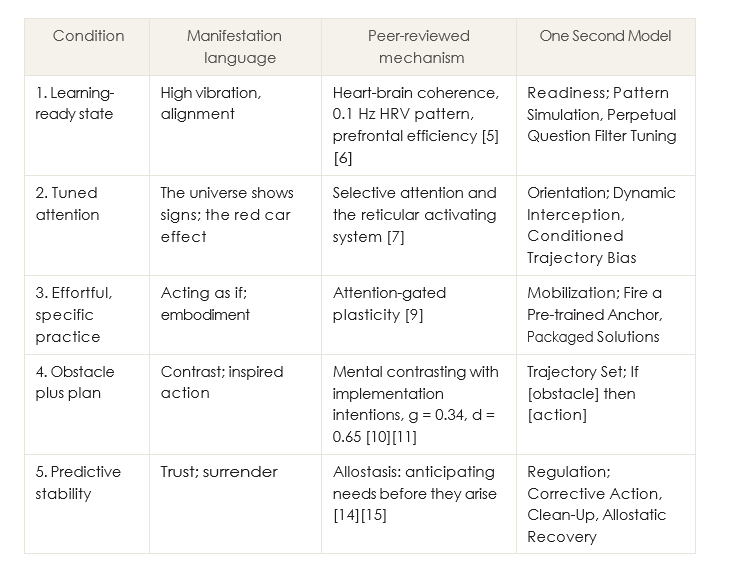
Executive Summary The Secret and the Law of Attraction gave the world a simple formula: thoughts plus feelings plus vibration equals reality. It has been a huge cultural success. Surveys suggest that more than a third of adults endorse manifestation beliefs [1]. But as science, the formula is incomplete. Controlled studies find no direct causal link between thought alone and outside events. And positive fantasy, without any confrontation with obstacles, actually lowers follow-through. So why does manifestation sometimes work? Because its practices accidentally engage five mechanisms that are well documented in peer-reviewed research, and that really do change behavior and perception. When those five line up, people get results. When they don’t, people reach for an explanation, and that is where words like Universe, Vibration, and Parallel Self come in. This paper proposes that manifestation can be explained without any metaphysical gaps. The five mechanisms are: coherence as a learning-ready state, attention-gated neuroplasticity, mental contrasting with implementation intentions, allostatic predictive regulation, and levels of adaptation, including quest-driven niche construction. The short version: positive thinking alone is not manifestation. Mental contrasting with an obstacle and an if-then plan is. 1. Why the Easy Process Works Just Often Enough Rhonda Byrne’s The Secret , published in 2006, claims that like attracts like, and that the universe delivers your wishes when you use positive self-talk and visualization. The book has sold around 30 million copies. Videos tagged “manifestation” on TikTok had passed 34.6 billion views by 2023 [2]. And yet no peer-reviewed experiment has ever shown thought alone producing a physical object. None. What the research does show is more interesting. In three studies with 1,023 participants, Dixon and colleagues built a Manifestation Scale and looked at who scored high. High scorers saw themselves as more successful, had bigger success aspirations, and expected success to arrive faster. They were also more drawn to risky investments, and they had higher rates of bankruptcy [3]. In other words, the belief system is linked to both motivation and risk. Here is my own observation, and it matters for everything that follows. Coherence is the component that holds the others together. When risk climbs to the point that fight-or-flight kicks in, coherence drops, and so does heart rate variability, or HRV. Take coherence out, and you don’t get alignment on the other four mechanisms. Two psychological gaps create the demand for an explanation, and there is always someone willing to supply one. The first gap is intermittent success. Sometimes visualization is followed by success, and sometimes by failure. That variation has to be explained somehow. The second gap is the lack of a mechanism. The Secret offers anecdotes, not mechanisms. Vibration, the universe, and parallel realities are placeholders for something nobody has specified. When the mechanism is missing, readers fill the space with magical thinking, which researchers define as the belief that we can influence events at a distance with no known physical explanation [4]. The good news is that there are real mechanisms hiding in plain sight. 2. Five Mechanisms That Accidentally Make Manifestation Work 2.1 Coherence: The Learning-Ready State Heart-brain coherence is a state where your heart rhythm, your breathing, and your autonomic nervous system fall into sync. On a monitor, your HRV settles into a smooth, sine-wave-like pattern at about 0.1 hertz, roughly one cycle every ten seconds [5]. This pattern goes along with better prefrontal cortex activity and stronger executive function [6]. It also goes along with more parasympathetic activity, the rest-and-digest side of your nervous system. In my work, I use frameworks and models to translate this into practical terms, because it is hard to consciously switch on something like “parasympathetic activity.” In my One Second Model, this territory is Readiness, Pattern Simulation, Structural Boundaries, and Preemptive Priming. A person in coherence is in what I call a Learning-Ready State. Prefrontal efficiency goes up. Threat detection narrows. Attention becomes available. Now think about the classic manifestation ritual: slow breathing, gratitude, calm appreciation. Those practices produce coherence whether or not the person ever uses the word. So the result is not the universe delivering. It is your prefrontal cortex working better. In my 7 Step Reset, returning to high coherence is Step 2. The Reset is fractal. It doesn’t matter whether you are dealing with something that takes two minutes, two hours, or two years. The framework applies at every time scale. 2.2 Attention: The Filter and the Builder This mechanism has two halves. The first half is the filter. Your senses take in an estimated 11 million bits of information per second. Conscious awareness handles something like 50 bits [7]. These are widely cited estimates, and they are rough, but the point stands: almost everything is filtered out before you notice it. The reticular activating system in the brainstem plays a key role in this filtering, and it prioritizes what your intention has tagged as important. Attention networks in the cortex play a part too. If your intention tags “red car,” red cars appear everywhere. If your intention tags “opportunity for my quest,” opportunities appear. Psychologists call the underlying process selective exposure, a core piece of confirmation bias, where we notice information that fits what we already believe [8]. This is not the universe conspiring. In One Second Model language, it is Dynamic Interception, with a Conditioned Trajectory Bias. And this is why a vision board can work. It primes the filter. Timing makes this feel spiritual. These processes run a quarter to a half second before conscious thought, so the result seems to arrive from outside us. But it is happening inside us, driven by our own patterns. Often those patterns are habits, and when we look at them through the lens of coherence, they can explain a lot of the on-again, off-again success people report. The second half is the builder, and it is attention-gated neuroplasticity. Michael Merzenich’s primate research established that the brain’s cortical maps reorganize in response to attended, effortful, repeated practice. Passive exposure doesn’t do it [9]. Focused attention, carried by the brain’s cholinergic and noradrenergic signaling, is the chemical setting in which plasticity happens. The adult brain allows lasting change only under the control of working memory, selective attention, and an assessment of the behavioral outcome. In the One Second Model, this is Mobilization, and one action you can take is to Fire a Pre-trained Anchor. With deep practice you can also condition this part of the chain to apply standing instructions every time. For example: always produce a low-cost solution, a quick-fix version, and an ideal solution. I call that training Automatic Synthesis. Repeated, attended practice builds Neural Circuitry, Neural Imprinting, and Behavioral Automation, much the way it builds the more familiar muscle memory. So visualization without attention does not meet Merzenich’s criteria. Visualization with specific, effortful, attended repetition does. Research on pianists points the same way: focused mental rehearsal, without touching the keyboard, has been shown to produce measurable changes in the brain’s motor maps [add citation]. 2.3 Mental Contrasting: Why Positive Thinking Alone Fails Gabriele Oettingen’s research program at NYU found that imagining success without confronting reality drains energy. Positive visualization on its own is a poor predictor of follow-through. Her alternative is called mental contrasting. You picture the best outcome, and then you picture the inner obstacle standing between you and it. The formal version is the acronym WOOP: Wish, Outcome, Obs… This is a public episode. If you'd like to discuss this with other subscribers or get access to bonus episodes, visit 7fitnessareas.substack.com/subscribe
November 11, 202630 min
The Skunkworks Playbook: Rapid Prototyping and Enterprise Agility for Creators
In Part 3 of our masterclass series, we bridge personal leadership with tactical business execution. Whether you are an established business owner, a corporate team leader looking to carve out internal revenue, or an influencer tired of chasing fleeting sponsored posts, the rules of engagement have changed. Waiting days or weeks for web developers or tech agencies to implement changes is a luxury we no longer possess. Speed is your only true remaining advantage. Drawing on a modernized application of the classic Ansoff Matrix, we explore how to take existing products into new markets or new products into existing markets using enterprise-grade, interface-based platforms like Clickfunnels. Learn how to transition from an idea on Monday morning to a live, revenue-generating test by Tuesday—all without writing code, patching disparate apps together, or eating away your margins with third-party discounts. We also examine how influencers can evolve from chasing ad revenue into acting as empowered manufacturers’ reps, building proprietary communities and owning their customer relationships rather than renting space on volatile algorithms. Tune into the live replay chat, bring your questions, and let’s discover how to build fast, test smart, and secure your financial independence. For past events and information about upcoming events visit: www.7StepReset.com/Live This is a public episode. If you'd like to discuss this with other subscribers or get access to bonus episodes, visit 7fitnessareas.substack.com/subscribe
November 10, 202626 min
The 7 Step Reset: Building Internal Stability in a Chaotic World
In Part 2 of our masterclass series, we shift our focus inward to explore the core mechanics of personal agency, self-mastery, and the fractal seven-step reset. Most people approach life’s challenges by asking the knee-jerk question, “What are you going to do?”—jumping straight to external action because it feels comfortable and familiar. However, without first establishing internal alignment, your view of the external world remains compromised by fear, limiting beliefs, and stress. This session breaks down the four pillars of self-mastery: fundamentals and levers, habit mastery, state mastery, and performance hygiene. We explore how to manage the optimal pressure curve, shifting away from emotional collapse or stagnation and stepping into true, 24/7 agency. By understanding how habits wire together, you can learn to detect early and adjust rapidly, matching the speed of an evolving technological landscape without burning out. Join us in the chat as we live-stream this replay, unpack the difference between homeostasis and true adaptive evolution, and discuss how to take absolute control of your internal engine. This is a public episode. If you'd like to discuss this with other subscribers or get access to bonus episodes, visit 7fitnessareas.substack.com/subscribe
November 8, 202630 min
Navigating The Changing Landscape and How The Playbook Is Changing
Thank you to everyone who tuned into my live video! Join me for my next live video in the app. This is a public episode. If you'd like to discuss this with other subscribers or get access to bonus episodes, visit 7fitnessareas.substack.com/subscribe
March 2, 202654 min
Physiology, Anxiety, and Transformation: Why Change Begins in the Body
In this episode, we explore a foundational premise of personal transformation: Anxiety and transformation follow the same physiological pattern. Rather than treating mindset, emotion, and behavior as separate psychological concepts, this session reframes change through physiology — how the nervous system processes experience, forms habits, and determines reactions before conscious thought occurs. transcript_2026-03-01T04_57_07.… The discussion introduces the idea that what is often called the “subconscious mind” can be more practically understood as a network of neurons shaped by past associations , operating faster than conscious reasoning and responsible for most daily behavior. Key Concepts Explored 1. Physiology as the Foundation of Change * Cognitive processing as a physiological process * Why habits live in nervous system patterns rather than willpower * How breathing, posture, hydration, and physical state influence thinking and emotion 2. Anxiety and Transformation Use the Same Mechanism * Anxiety spirals and growth breakthroughs share similar energetic signatures * The difference lies in recognizing and adjusting early signals * Transformation begins by interrupting downward physiological trajectories 3. The Seven-Step Reset Model A practical framework for self-coaching built around stimulus-response cycles: * Pre-stimulus state and priming * Conditioned reactions * Pause and awareness * Emotional modulation * Intentional action * Return to presence The goal is not maintaining a perfect mindset, but recovering quickly and repeatedly throughout the day. 4. Agency Through Self-Regulation * 95% of behavior operates through habitual neural pathways * Change occurs by retraining patterns rather than fighting them * Personal leadership begins with regulating one’s internal state 5. From Habit Living to Principle Living * Early conditioning creates automatic responses * Growth requires shifting from habit-driven reactions to principle-guided decisions * Stability comes from consistent internal practices rather than external control Practical Applications Listeners will learn how to: * Recognize physiological signals before anxiety escalates * Use simple daily practices to prime mental and emotional state * Develop reliable internal “anchors” during stress * Reduce emotional volatility while pursuing growth * Build agency through repeatable self-regulation practices Who This Episode Is For This conversation is designed for individuals who want to: * Improve emotional stability and resilience * Understand anxiety through a practical lens * Develop personal leadership skills * Build sustainable habits aligned with long-term vision * Begin or deepen a personal transformation process Core Takeaway Transformation is not primarily psychological or motivational. It is physiological. When the body is trained to stabilize under pressure, clarity, agency, and performance follow naturally. This is a public episode. If you'd like to discuss this with other subscribers or get access to bonus episodes, visit 7fitnessareas.substack.com/subscribe
February 16, 202646 min
You Don’t Control Reactions — You Condition Them | Ep. 104
This episode explains why most attempts at emotional control fail: they occur after the nervous system has already decided. The conversation centers on Step 2 (physiology) of the 7-Step Reset and the idea that leadership, performance, and anxiety are governed less by conscious thought and more by fast neurological prediction. Humans process millions of bits of sensory input every second, yet only a tiny portion reaches awareness. By the time you try to “think clearly,” your body has often already entered a threat response. The key is upstream intervention. Within roughly one second, the brain predicts demand, applies past associations, organizes a reaction, and only then hands control to conscious thought. When reaction and response become identical, people escalate emotionally and rational thinking disappears. Preventing this requires conditioning the system before the moment — through physiology, self-talk, and deliberate association training. Topics covered: * Why anxiety spirals feel uncontrollable once triggered * The difference between thinking and neural associations * How physiology acts as the dashboard of emotional intelligence * Using breathing and self-talk to interrupt conditioned reactions * Homeostasis vs allostasis — stability versus upward adaptation * Why identity change precedes sustained behavior change The central claim: self-mastery is not regulation after the fact but preparation before the moment. Leadership effectiveness begins with the ability to detect and shift state before reaction becomes behavior. This is a public episode. If you'd like to discuss this with other subscribers or get access to bonus episodes, visit 7fitnessareas.substack.com/subscribe
February 13, 20262 min
Micro Turns. Major Change
On this ski run, every turn changes the entire complexion of the slope ahead. Steepen the edge slightly, adjust pressure, recover early—and the whole line evolves. Personality works the same way. Your “identity” isn’t a fixed thing. It’s a construct—built from thousands of micro-adjustments made in real time. If you try to change yourself at the personality level, it’s overwhelming. Too complex. Too slow. That’s 50 bits per second thinking. Real transformation happens upstream. Instead of trying to become a different person, build the habit of instantaneous recovery. Adjust sooner. Stabilize faster. Recover at the sub-second level. When recovery becomes automatic, the dip disappears—and the run changes without drama. This is what the Four Pillars of Self Mastery is all about. Learn more about the upcoming workshop with this link: Self Mastery Workshop After 50, this matters even more. Longevity isn’t built on big declarations. It’s built on micro-corrections repeated over decades. Stay active. Stay adaptive. Change at the element level—and let the construct take care of itself. This is a public episode. If you'd like to discuss this with other subscribers or get access to bonus episodes, visit 7fitnessareas.substack.com/subscribe
January 26, 202649 min
The Levers & Drivers of The Four Pillars of Self Mastery | Ep. 102
The Levers & Drivers of The Four Pillars of Self Mastery [Replay]Join me as I demystify the anatomy of habit patterns and how this is the gateway to Agency.You can get information about past events as well as watch selected recordings at: www.7StepReset.com/Live This is a public episode. If you'd like to discuss this with other subscribers or get access to bonus episodes, visit 7fitnessareas.substack.com/subscribe
January 19, 202645 min
Step Two of the Seven-Step Reset Part 1 | Ep. 101
This is a public episode. If you'd like to discuss this with other subscribers or get access to bonus episodes, visit 7fitnessareas.substack.com/subscribe
Is this your show?
Claim this listing to keep it up to date, reach guests who want to pitch you, and manage bookings with Guestify.