Find partners
AI and I

AI and I

Hosted by Dan Shipper

TechnologyInterviews guests

Episodes

112

Latest episode

Jun 2026

Language

EN

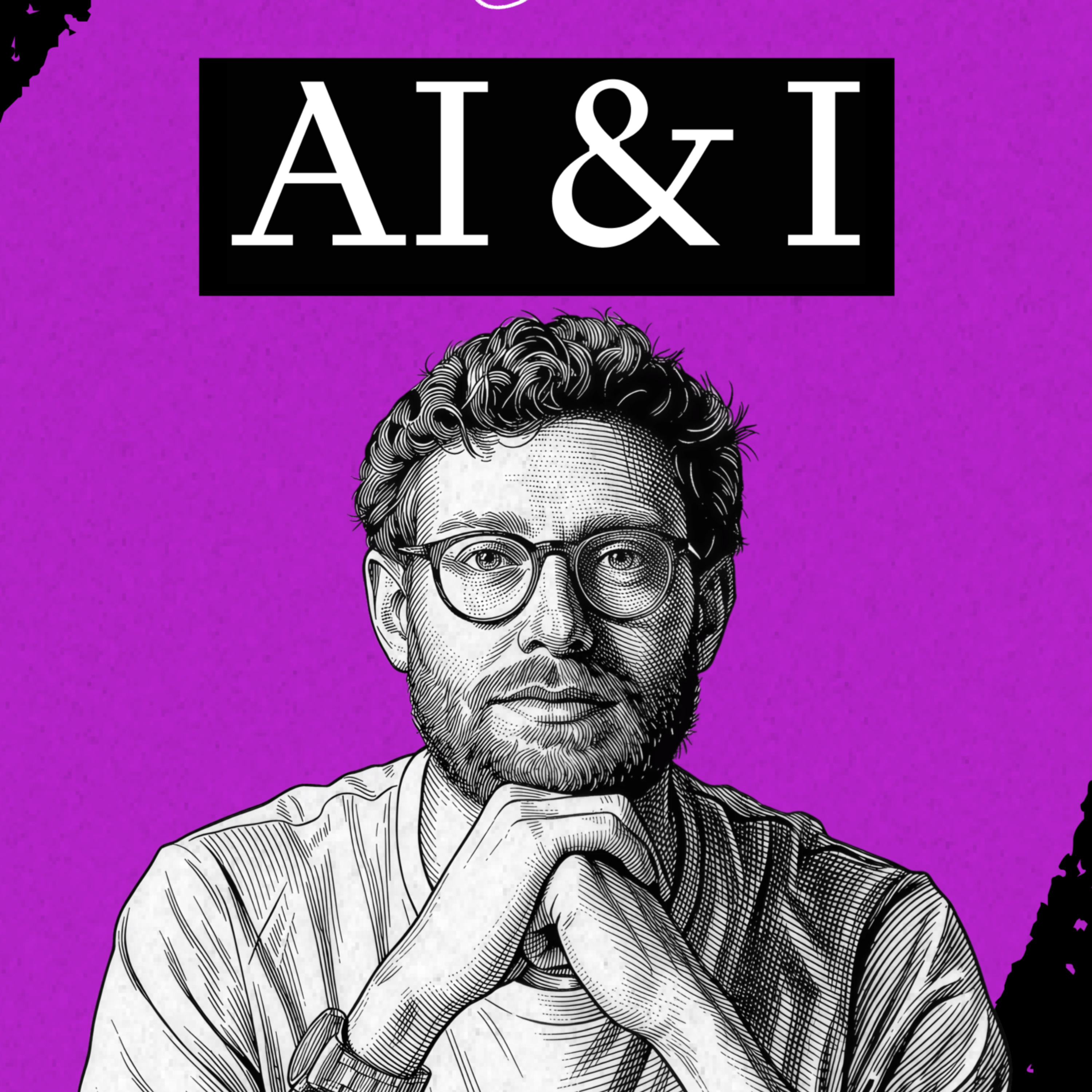
About the show

Learn how the smartest people in the world are using AI to think, create, and relate. Each week I interview founders, filmmakers, writers, investors, and others about how they use AI tools like ChatGPT, Claude, and Midjourney in their work and in their lives. We screen-share through their historical chats and then experiment with AI live on the show. Join us to discover how AI is changing how we think about our world—and ourselves. For more essays, interviews, and experiments at the forefront of AI: https://every.to/chain-of-thought?sort=newest.

Listen to episodes

60 recent
June 10, 202652 min

How Anthropic Uses Claude Fable 5 With Mike Krieger

Mike Krieger built one of the most consequential consumer apps of the last two decades as the cofounder of Instagram. He is now at the frontier of AI-native product development as head of Anthropic Labs, the team responsible for figuring out what the most capable AI models can do in the hands of real builders.When Krieger first got access to Fable 5 months before its public release, it was exciting and disorienting. “I feel like a total newbie again,” he remembers telling his team. The way he’d been thinking about productivity, strategy, and time management was out of date. The model had outpaced his workflows.Dan Shipper talked with Krieger for AI & I about what it looks like to build with a model as capable as Fable 5, including the new rhythms, challenges, and possibilities it reveals.If you found this episode interesting, please like, subscribe, comment, and share!To hear more from Dan Shipper:Subscribe to Every: https://every.to/subscribeFollow him on X: https://twitter.com/danshipperGet started with Braintrust at https://www.braintrust.dev/ Timestamps:0:03 Introduction1:48 How Fable completely reshaped Mike's workflow4:48 When to use Sonnet versus Fable10:06 What the media tracker Mike built over a weekend reveals about agent-native architecture15:00 The cost to build has collapsed19:03 Is software engineering over?21:48 How Anthropic's engineering teams work today38:39 The mechanics of verification44:39 What people should use the model to build47:24 Dynamic workflowsLinks to resources mentioned in the episode:Mike Krieger on X: https://x.com/mikeykAnthropic Labs: https://www.anthropic.comClaude Code: https://claude.ai/codeEvery: https://every.toTimestamps:0:03 Introduction1:48 How Fable completely reshaped Mike's workflow4:48 When to use Sonnet vs. Fable10:06 What the media tracker Mike built over a weekend reveals about agent-native architecture15:00 The cost to build has collapsed19:03 Is software engineering over?21:48 How Anthropic's engineering teams work today38:39 The mechanics of verification44:39 What people should use the model to build47:24 Dynamic workflowsLinks to resources mentioned in the episode:Mike Krieger on X: https://x.com/mikeykAnthropic Labs: https://www.anthropic.comClaude Code: https://claude.ai/codeEvery: https://every.to

June 3, 202633 min

The SaaS Apocalypse Is a Goldmine With Figma’s Matt Colyer

The "SaaSpocalypse"—the panic that AI will make software-as-a-service obsolete—hasn't rattled Figma’s Matt Colyer. As the company’s director of product management for developers, he's been building his own agents for two years and is buying more software services than ever.In addition to making the case that AI is a “goldmine” for SaaS companies, Colyer talked with Dan Shipper for AI & I about why great design requires a diamond-shaped process: First you diverge, generating as many ideas as possible, then you converge around the best ones. Chat is linear, which makes it good for iterating on one design but bad at generating lots of options. Figma's new on-canvas agent is a first attempt at fixing that.They also get into why AI design tools need to break free of the text box, how Figma's MCP server is closing the loop between code and design, and why "review" has become the biggest bottleneck in AI-assisted product work.If you found this episode interesting, please like, subscribe, comment, and share!To hear more from Dan Shipper:Subscribe to Every: https://every.to/subscribeFollow him on X: https://twitter.com/danshipperTimestamps:1:03 - Introduction2:15 - Why the SaaSpocalypse narrative has it backwards5:27 - Matt’s email agent origin story13:21 - Divergent vs. convergent design thinking17:39 - Figma’s MCP server19:45 - Why design agents need personalization22:09 - Every problem is a context problem25:12 - Apple and Google as the reigning kings of context28:18 - Why review is the new bottleneckLinks to resources mentioned in the episode:Matt Colyer on X: https://x.com/mcolyerFigma: https://figma.comFigma MCP server: https://www.figma.com/blog/introducing-figma-mcp-server/

May 27, 202641 min

We Automated Everything With AI and Tripled Our Headcount

Dan Shipper runs one of the most AI-native companies today. Every has agents embedded in nearly every workflow—“if you swing a stick in our Slack, you're as likely to hit a human as an agent,” he says. And yet the company has grown from four people to 30 since GPT-3 came out, and is still hiring.Why does Dan believe there's more human work to do than ever?In a format flip for AI & I, Every's COO Brandon Gell turns the tables and interviews Dan about his latest essay, “After Automation”—an 8,000-word argument for why rising automation doesn't eliminate demand for human work, it increases it. The thesis: AI makes yesterday's expert competence cheap and widely available, which floods every field with output that's close but not quite right—and that creates more demand for the humans who can take it the rest of the way.Dan talked with Brandon  about the paradox at the heart of agent-native work: The more AI can do, the more humans are needed to direct it, refine its output, and decide what matters next.If you found this episode interesting, please like, subscribe, comment, and share!To hear more from Dan Shipper:Subscribe to Every: https://every.to/subscribeFollow him on X: https://twitter.com/danshipperLinks to resources mentioned in the episode:“After Automation” by Dan Shipper: https://every.to/chain-of-thought/after-automationBrandon Gell on Every: https://every.to/@brandon_5263Join the membership for where you live at joinbilt.com/danTimestamps:00:00:51 Introduction00:05:51 The AI paradox: more automation, more human work00:10:00 How AI makes yesterday's expert competence cheap00:18:00 AI can act autonomously but it does not have agency00:20:39 Why Dan is all in on AGI00:21:57 AI layoffs are a lie00:25:42 Ride the models and you'll be fine00:35:30 How to use AI as a long-form features editor

May 20, 202651 min

Inside Stainless: The Developer Tools Startup Anthropic Just Bought for $300 Million

If your MCP server has dozens of tools, it's probably built wrong. You need tools that are specific and clear for each use case—but you also can't have too many. This creates an almost impossible tradeoff that most companies don't know how to solve.That's why we interviewed Alex Rattray, the founder and CEO of Stainless. Stainless builds APIs, SDKs, and MCP servers for companies like OpenAI and Anthropic. Alex has spent years mastering how to make software talk to software, and he came on the show to share what he knows. We get into MCP and the future of the AI-native internet. [Disclosure: Dan is a small investor in Stainless.]If you found this episode interesting, please like, subscribe, comment, and share.To hear more from Dan Shipper:Subscribe to Every: https://every.to/subscribeFollow him on X: https://twitter.com/danshipperGet started with Braintrust at https://www.braintrust.dev/ Timestamps: 00:01:15 - Introduction 00:05:09 - APIs and MCP, the connectors of the new internet 00:11:00 - Why MCP exists 00:17:15 - Why MCP servers are hard to get right 00:20:24 - Design principles for reliable MCP servers 00:25:06 - Using MCP for business ops at Stainless 00:40:57 - Alex's take on the security model for MCP 00:44:42 - How one-off AI actions become permanent production softwareLinks to resources mentioned in the episode:Alex Rattray: Alex Rattray (@RattrayAlex), Alex RattrayStainless: https://www.stainless.com/

April 15, 202653 min

The AI Model Built for What LLMs Can't Do

Most AI companies are racing to build bigger LLMs. Eve Bodnia thinks that's the wrong approach.Eve is the founder and CEO of Logical Intelligence, which is developing an alternative to the transformer-based models dominating the industry. Her argument: LLMs’ architecture makes them fundamentally unsuited for some mission-critical tasks. A system that generates output one token at a time, with no ability to inspect its own reasoning mid-process or guarantee its results, shouldn't be trusted to design chips, analyze financial data, or even fly a plane. Her alternative is the energy-based model (EBM), a form of AI rooted in the physics principle of energy minimization, not language prediction. Rather than guessing the next probable word, an EBM maps every possible outcome across a mathematical landscape, where likely states settle into valleys and improbable ones sit on peaks. Dan Shipper talked with Bodnia for AI & I about why she believes LLM progress is plateauing, what it means for AI to actually understand data rather than just pattern-match across it, and how her team is building toward formally verified code generated in plain English—no C++ required.If you found this episode interesting, please like, subscribe, comment, and share!Head to http://granola.ai/every and get 3 months free with the code EVERYTo hear more from Dan Shipper:Subscribe to Every: https://every.to/subscribe Follow him on X: https://twitter.com/danshipper Timestamps: 00:00:51 - Introduction00:02:09 - Why correctness and verifiability matter in AI00:09:33 - What an energy-based model is00:14:21 - How EBMs construct energy landscapes to understand data00:19:00 - Why modeling intelligence through language alone is a flawed approach00:26:54 - What it means for a model to "understand" data00:37:21 - How EBMs solve the vibe coding problem and enable formally verified code00:43:21 - Why LLM progress is plateauing00:49:54 - Mission-critical industries haven't adopted LLMs, and how EBMs could fill that gap

April 8, 202649 min

We Gave Every Employee an AI Agent. Here's What Happened.

While walking to the office, our COO Brandon Gell had his AI agent call him and go over his emails in his inbox one by one. When he arrived, he opened Gmail and confirmed she'd done everything he'd asked. "My jaw is on the floor," he messaged me.That was the moment Every got serious about setting up each employee with their own agent. Today, it's a reality—and it has completely changed how we work.Dan Shipper talked to Every COO Brandon Gell and head of platform Willie Williams for Every's AI & I about what happens when everyone at a company gets their own AI sidekick. If you found this episode interesting, please like, subscribe, comment, and share!To hear more from Dan Shipper:Subscribe to Every: https://every.to/subscribe Follow him on X: https://twitter.com/danshipper Visit https://scl.ai/dialect to learn more about Dialect, a new system from Scale AI.Timestamps: 00:00 Introduction00:02:21 How Brandon built Zosia, an AI agent to run his household00:07:09 Brandon's aha moment re: using agents for work00:09:39 What happened when everyone on the team got their own agent00:12:42 How agents take on their owners' personalities, and why that matters inside an org00:23:51 Why it's important for agents to do work in public00:30:51 What we're still figuring out when it comes to agent behavior, including memory gaps, group chat etiquette, and the "ant death spiral" problem00:40:45 How we built Plus One, our hosted OpenClaw product00:47:27 The cultural shift required to make agents work at scale

April 1, 202652 min

If SaaS Is Dead, Linear Didn't Get the Memo

Founded in 2019, Linear is the rare company started pre-ChatGPT to have successfully reinvented itself as an agent-native business.On this episode of AI & I, Dan Shipper sat down with Karri Saarinen, cofounder and CEO of the product management tool, to discuss building a platform where humans and agents develop software together—and why the "SaaSpocalypse" isn’t coming for all SaaS companies. If you found this episode interesting, please like, subscribe, comment, and share! To hear more from Dan Shipper:Subscribe to Every: https://every.to/subscribe Follow him on X: https://twitter.com/danshipper Visit https://scl.ai/dialect to learn more about Dialect, a new system from Scale AI.Timestamps:0:00 Introduction 2:00 Why Linear waited to ship AI features instead of rushing to chatbots 5:06 Linear's agent platform and becoming the system that guides AI agents 7:42 Why "SaaS is dead" is a simplistic narrative 12:18 How Linear adopted AI coding tools17:45 AI's impact on product building workflows—speed versus thoughtfulness 22:18 The value of conceptual work and thinking before shipping 29:30 How AI is reshaping Linear's product strategy 37:18 Demo: Linear's agent skills, shared context, and code review workflow 47:48 The future of product development and the enduring role of human judgment

March 25, 202648 min

How to Build an Agent-native Product | Mike Krieger

Mike Krieger built one of the most consequential consumer apps of the last two decades as cofounder of Instagram. He is now at the frontier of determining what makes a breakout AI-native product as co-lead of Anthropic Labs.Dan Shipper talked with Krieger for Every’s AI & I about how his experience creating Instagram shapes how he thinks about building with AI, including what can be sped up and what remains stubbornly time-intensive. If you found this episode interesting, please like, subscribe, comment, and share! To hear more from Dan Shipper:Subscribe to Every: https://every.to/subscribe Follow him on X: https://twitter.com/danshipper Download Grammarly for FREE at grammarly.comTimestamps Introduction: 00:01:39What's gotten easier—and what hasn't—about building products in the age of AI: 00:02:33Why vibe coding creates "indoor trees": 00:05:00How rewrites have become a normal part of the development process: 00:09:00What "agent native" product design means: 00:11:39How Mike's labs team is structured and the cofounder model: 00:24:27The best signal for a product bet is someone with "break through walls" conviction: 00:29:33Navigating enterprise customers while keeping pace with rapid AI change: 00:38:51OpenClaw, personal agents, and the product question defining 2026: 00:40:54Links to resources mentioned in the episode:Mike Krieger: https://x.com/mikeyk Agent-native architecture: https://every.to/guides/agent-native

March 18, 202656 min

Kate Lee on Taste, Hiring, and Running Editorial at Every

Kate Lee has spent her career working with words—first as a literary agent, then in roles at Medium, WeWork, and Stripe. As Every’s editor in chief, she’s been the quiet force behind the newsletter for more than three years.Lately, something has shifted in Kate’s work. After years of watching her colleague Dan Shipper evangelize AI from the front lines, Katie has started rewiring how she works and is integrating more and more AI tools into her workflow.We had Kate on to talk about her career path from book deals to tech startups, what it really means to run a newsletter as a small team in the age of AI, and what she thinks the bottleneck to automating copyediting is. Plus: the story of pulling off reviews of two major model releases in 24 hours, and how she’s using her AI-powered browser to help her hire.To hear more from Dan Shipper:Subscribe to Every: https://every.to/subscribeFollow him on X: https://twitter.com/danshipperTimestamps0:01 – Introduction and Kate's early career as a literary agent4:45 – From book publishing to tech: Medium, WeWork, and Stripe Press12:00 – How Kate joined Every and what made the role click27:00 – What it's like to be a knowledge worker at the frontier of AI31:00 – The “aha” moment: using AI to manage hundreds of applicants36:24 – How Every's editorial team uses AI to enforce standards and train taste45:06 – Publishing two reviews of major model releases on the same day51:39 – What automating copy editing requiresLinks to resources mentioned in the episode:Proof: https://www.proofeditor.ai/

March 11, 202644 min

We Made a Document Editor Where Humans and AI Work Side by Side

Every has unveiled a new product, built by CEO Dan Shipper. It's called Proof, a free, open-source, live collaborative document editor built for humans and AI agents to work in together. Proof started as a Mac app designed to show the provenance of AI-written text—purple for AI, green for human. But when Shipper rebuilt it as a web app with real-time collaboration, something clicked. Suddenly, everyone at Every was using it for everything from planning docs, to creative writing and even daily to-do lists. The team realized they needed a lightweight space where their OpenClaw agents and humans could co-author documents and leave comments. In this special episode, Shipper is joined by Every chief operating officer Brandon Gell, Cora general manager Kieran Klaassen, and head of growth Austin Tedesco to demo Proof live and share how it's changed the way they work. Brandon walks through a loop where his Codex agent writes a plan, Dan's personal Claw R2-C2 reviews it, and the humans just steer. Austin explains how he uses Proof to write a weekly food newsletter, texting ideas to his Claw on runs and watching an outline take shape. And Kieran makes the case that Proof's power is its lightness—just a link you can hand to any agent or colleague.The conversation covers what "agent native" means in practice, why AX (agent experience) matters as much as UX (user experience), what happens when 10 agents edit one document at the same time, and why some writing is now better read by an AI than a human.If you found this episode interesting, please like, subscribe, comment, and share!Want even more?Sign up for Every to unlock our ultimate guide to prompting ChatGPT here: https://every.ck.page/ultimate-guide-to-prompting-chatgpt. It's usually only for paying subscribers, but you can get it here for free.To hear more from Dan Shipper:Subscribe to Every: https://every.to/subscribeFollow him on X: https://twitter.com/danshipperGet started building today at framer.com/dan for 30% OFF a Framer Pro annual plan.Download Grammarly for free at Grammarly.comTimestamps 00:02:00 — Introduction and the origin story of Proof00:07:24 — From Mac app to collaborative web editor00:09:00 — What makes Proof “agent native”00:14:30 — Live demo: watching an agent join and write inside a shared document00:20:51 — How Austin uses Proof for creative writing and food journalism00:24:30 — The challenge of multiple agents editing one document simultaneously00:26:48 — When AI-written docs are better read by agents than by humans00:29:30 — Brandon’s agent-to-agent collaboration loop00:37:09 — Proof as a lightweight scratchpad vs. existing tools like Notion and GitHub00:42:18 — Why Proof is open source and what that means for buildersLinks to resources mentioned in the episode:Proof Editor: https://proofeditor.aiProof GitHub repo (open source): https://github.com/EveryInc/proofEvery's compound engineering plugin: https://github.com/EveryInc/compound-engineering-plugin

Is this your show?

Claim this listing to keep it up to date, reach guests who want to pitch you, and manage bookings with Guestify.

Claim this listing

More Technology podcasts