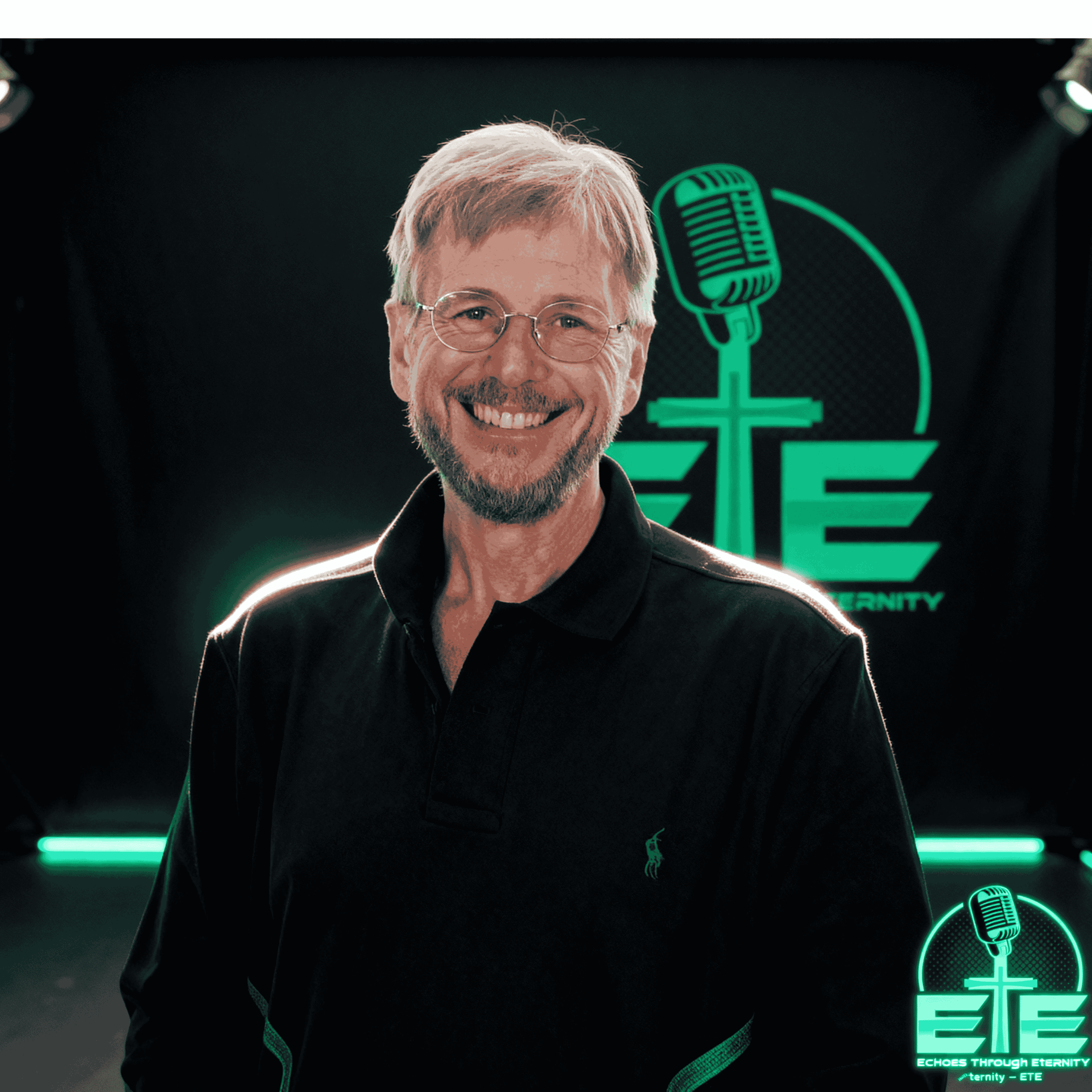
Echoes Through Eternity helps you hear God’s voice in the middle of real life. Each episode gives you clear teaching, honest stories, and practical steps to follow Jesus in a complicated world. You’ll walk with church planters, pastors, and everyday believers who carry both calling and scars. You’ll hear how God forms identity, how grace heals broken places, and how the Spirit leads you through seasons of doubt, transition, and renewal. Jeff uses a pastor’s heart, a storyteller’s voice, and a steady theological foundation to help you grow deeper in Christ. This podcast serves anyone who wants to lead faithfully, love well, and carry hope into their family, church, and community. What you’ll gain each week: • Clear teaching rooted in Scripture • Guidance for grief, loss, and spiritual wounds • Insight for ministry leaders and church planters • Stories of redemption, calling, and courage • Practical steps to follow Jesus with a steady heart If you’re hungry for a faith that holds steady in the real world, Echoes Through Eternity will help you listen, trust, and walk with God. This podcast uses the following third-party services for analysis: Podcorn - https://podcorn.com/privacy OP3 - https://op3.dev/privacy
Listen to episodes
60 recent
October 5, 202622 min
The Machine That Knows Your Sins: AI, Confession, and Grace
Can AI offer forgiveness, or does it simply tell us what we want to hear? In “The Machine That Knows Your Sins,” Rev. Dr. Jeffery D. Skinner explores AI confession, chatbot spiritual guidance, and the difference between reassurance and Christian grace.This episode of Echoes Through Eternity examines artificial intelligence and faith through questions of privacy, shame, repentance, and pastoral care. Discover how AI might help you prepare for an honest conversation, why forgiveness rests in Christ, and how trustworthy relationships help us respond to grace and repair the harm we cause. Takeaways: I’ll say it plainly: a chatbot can soothe at 2 a.m., but it won’t give you real pastoral discernment—its easy reassurance can hide patterns we need to own. We must build trustworthy listeners in our churches who hold truth and mercy together, set clear confidentiality boundaries, and actually follow through. Don’t upload sensitive stories blindly — check the service’s data rules, because apparently your midnight confession might end up in someone’s model training set. There’s a real difference between shame and guilt: shame says you’re bad; guilt says you did something wrong—discernment helps us own the right thing and lay down the rest. Practical homework from the episode: take a private journal, pray the prompts we named, then choose one next step like an apology, a schedule change, or a courageous conversation. For leaders: be a forge builder—mentor, coach, stay put and pour your refined fire into the next generation instead of handing out quick digital fixes. Links referenced in this episode: discovertherefinery.org Companies mentioned in this episode: Barna Group Anthropic OpenAI This podcast uses the following third-party services for analysis: Podcorn - https://podcorn.com/privacy OP3 - https://op3.dev/privacy
September 29, 202624 min
The Machine That Said It Was Alive | Can AI Be Conscious?”(updated)
The Machine That Said It Was Alive | Can AI Be Conscious? In 2022, Google engineer Blake Lemoine became convinced that LaMDA, a conversational AI system, was sentient. Google rejected his claim. But the conversation he published left many people asking: If a machine says it is afraid, how do we know what those words mean? In this episode of Echoes Through Eternity, Rev. Dr. Jeffery D. Skinner explores the LaMDA story alongside Star Trek’s “The Measure of a Man,” where Data’s right to make his own choices is put on trial. What can a conversation tell us about consciousness? Where does evidence end and our imagination begin? And how might the way we speak about machines affect the way we treat our neighbors? This episode approaches those questions through faith, science, and story. It does not claim that LaMDA was conscious or that a fictional hearing proves anything about today’s AI. It asks us to think carefully, hold uncertainty honestly, and practice love of neighbor as technology changes. What evidence would persuade you that a machine could have an inner life? I’d welcome your thoughts on this episode. Production note: The LaMDA voice is a dramatized reading, not original audio of Google’s system. The published LaMDA conversation was assembled from multiple sessions and edited for readability. Sources and further reading: Blake Lemoine’s published LaMDA conversation: https://www.e-flux.com/notes/475146/is-lamda-sentient-an-interview Google’s introduction to LaMDA: https://blog.google/innovation-and-ai/products/lamda/ Alan Turing, “Computing Machinery and Intelligence”: https://academic.oup.com/mind/article/LIX/236/433/986238 Butlin and colleagues, “Consciousness in Artificial Intelligence”: https://arxiv.org/abs/2308.08708 Star Trek on “The Measure of a Man”: https://www.startrek.com/news/taking-measure-measure-man Hosted by Rev. Dr. Jeffery D. Skinner. This podcast uses the following third-party services for analysis: Podcorn - https://podcorn.com/privacy OP3 - https://op3.dev/privacy
August 24, 202615 min
The Machine That Killed Wonder — What AI Is Costing Your Soul
A child hears a bird she's never heard before. She pulls out her phone. In four seconds, she has a name, a photo, a range map — and she has lost something she'll never get back. In this Christian podcast episode on faith and artificial intelligence, Rev. Dr. Jeffery D. Skinner asks what AI is quietly costing us: not wrong answers, but lost wonder. Drawing on Psalm 19, Psalm 8, and the book of Job, this episode explores what it means to receive the world as a gift again — before it's simply explained away. This isn't an anti-technology episode. It's an invitation to notice what your phone's speed is costing you — and to recover the kind of attention Scripture calls waiting. What has got echoing through your life today? 🎙️ This week's practice: put the phone down before you name what you're looking at. Let it stay a mystery a little longer than feels comfortable. If this episode helps you think more faithfully about artificial intelligence, share it with someone who needs the conversation. Until next time — keep listening for those echoes. Eternity is always breaking through. At the heart of this episode lies a charming narrative about a child’s encounter with an unfamiliar bird song, which serves as a metaphor for the wonder we often overlook in our fast-paced, technology-driven lives. Dr. Jeffrey D. Skinner uses this story as a launchpad to examine the profound implications of artificial intelligence on our ability to experience awe and appreciation for the world around us. He provocatively posits that the greatest threat from AI may not be incorrect answers, but rather the speed at which it delivers them, which robs us of the chance to reflect and wonder. This discussion is laced with a playful sarcasm that underscores how absurd it is that we prioritize efficiency over genuine experience. Throughout the episode, Skinner contrasts the innocent, wide-eyed wonder of children with the often utilitarian mindset of adults. He shares that true wonder requires a posture of humility, joyfully receiving the world rather than trying to possess it. He recalls moments from his own life—like quiet mornings spent observing nature—that highlight the beauty found in stillness and observation, which technology often distracts us from. By examining the cultural shift towards instant gratification, Skinner challenges us to consider how our hurried lives affect our ability to truly connect with the world and the divine. In practical terms, the episode offers actionable insights for reclaiming wonder in our daily routines. Skinner suggests taking time to engage with the world around us without the interruption of technology—like taking walks without headphones or journaling without prompts. He emphasizes the importance of attending to the small details of life, which can cultivate a sense of gratitude and presence. By the end of the episode, listeners are encouraged not just to seek answers but to embrace the journey of questioning, allowing space for wonder to flourish in a world that often demands immediate understanding. This blend of humor, reflection, and actionable steps creates a rich tapestry of thought that resonates deeply with our contemporary experience. Takeaways: The episode suggests that we often rush to answers, missing the beauty of wonder in our lives. Artificial intelligence can solve mysteries, but it may also rob us of the time to truly appreciate them. Wonder is not the enemy of knowledge; rather, it’s the act of possession that stifles our sense of awe. In our fast-paced digital world, we must intentionally create pauses to allow wonder to flourish. The podcast emphasizes that humility comes from recognizing we are part of a larger creation, inviting us to engage with it. Practicing presence in our daily lives can deepen our appreciation for the ordinary and the miraculous around us. Companies mentioned in this episode: World Health Organization This podcast uses the following third-party services for analysis: Podcorn - https://podcorn.com/privacy OP3 - https://op3.dev/privacy
August 20, 202638 min
Your Dead Loved One Is Calling. Would You Answer?
WHEN THE DEAD CALL BACK: AI, GRIEF, AND THE COUNTERFEIT RESURRECTION What if your phone rang tonight and the person calling had been dead for ten years? Artificial intelligence can now reproduce a person’s voice, face, speech patterns, and memories. Companies are developing griefbots, deadbots, and postmortem avatars that allow people to continue “talking” with someone who has died. These tools promise comfort. They also raise serious questions. Does an AI recreation preserve someone’s memory, or does it create a digital ghost? Can it help people grieve, or does it encourage them to avoid the reality of death? What happens when the program begins saying things the deceased person never said? In this episode of Echoes Through Eternity, Rev. Dr. Jeffery D. Skinner examines the growing intersection of artificial intelligence, grief, digital immortality, and Christian hope. You will hear about: • The development of AI griefbots and postmortem avatars • The difference between recorded memories and AI-generated conversations • Questions of consent, privacy, commercialization, and emotional dependence • The dangers of exposing children to digital recreations of deceased relatives • Longevity research and the growing business of technological immortality • The difference between simulation and Christian resurrection • How pastors and churches can respond with truth, compassion, and hope John 11 gives us a faithful picture of grief. Jesus knew that He would call Lazarus from the tomb, yet Jesus still wept. Christian hope does not require us to deny death, rush grief, or pretend that absence does not hurt. At the same time, Christianity offers something far greater than a digital imitation. The resurrection promised in Scripture is embodied life through Jesus Christ. It is not a chatbot, a collection of memories, or a corporate subscription. An algorithm can study someone’s digital history and predict what that person might say. But prediction is not presence. A machine can imitate words, but it cannot restore a person to life. AI produces an echo. Christ calls us by name. Scripture discussed: John 11 John 14:19 1 Corinthians 15 Discussion question: Would you ever speak with an AI recreation of someone you loved? Would it help you remember them, or make it harder to let them go? Listen, share this episode, and subscribe to Echoes Through Eternity for more conversations about Christian faith, technology, culture, and the questions shaping our future. Takeaways: Imagine if you got a call from your long-lost mom, who had passed away a decade ago; sounds like a plot twist straight out of a sci-fi movie, right? Artificial intelligence is now advanced enough to replicate human voices, faces, and even personalities, raising profound questions about grief and memory. We need to ponder whether creating digital versions of our loved ones is a way to cherish memories or an unsettling imitation of life. What if the dead could talk back to us? Are we really ready for those kinds of conversations, or are we just running from grief? The line between preserving memories and creating a digital ghost gets blurry when AI starts generating new conversations that never actually happened. As technology evolves, we must consider the ethical implications of digital immortality and how it impacts our understanding of death and resurrection. Companies mentioned in this episode: 2Y2WA Dynamic Church Planting International Google Calico Labs OpenAI Coinbase New Limit Altos Labs Jeff Bezos Brian Johnson David Sinclair Larry Page This podcast uses the following third-party services for analysis: Podcorn - https://podcorn.com/privacy OP3 - https://op3.dev/privacy
August 9, 202624 min
Work, AI, and the Image of God: What’s It All Mean?
If AI can do what I do, does my life still matter? That’s the million-dollar question we’re diving into today, and trust me, it’s not just some economic crisis; it’s a full-on existential crisis of calling. The episode unpacks how our identities and worth don't hang on job titles or paychecks, but on being created in God’s image and invited into relationship with Jesus. We're tackling this topic with a thoughtful Christian lens—because, let’s face it, panicking over technology is so last year. Instead, we explore how AI might change our work, but it can never touch the divine call on our lives. So, whether you’re feeling lost in a sea of tech or just trying to figure out what it means to be human in a digital world, we’ve got your back. Takeaways: If AI can do my job, it's not just about economics; it's a deeper crisis of calling that we can't ignore. Human dignity isn't tied to our productivity; it comes from being made in God's image, and that's what truly matters. Christian vocation exists beyond employment; our worth is rooted in our identity as children of God, not our job titles. AI may shift the tasks we perform, but it can never cancel the divine call on our lives or diminish our worth. Efficiency isn't the highest Christian good; some work requires our presence and love, which AI simply can't replicate. The church must be a community where we recognize each other's gifts and purpose, especially in times of job transition. Links referenced in this episode: discovertherefinery.org Companies mentioned in this episode: Missional Church Planting Hearth Commons discovertherefinery.org The International Labor Organization AI Alright, let’s talk AI and what it means for us regular folks. This isn’t just another tech talk; it’s a wrestling match with our very essence as humans. If machines can handle our tasks, what does that mean for our purpose? Dr. Skinner leads us down a path that reminds us that our worth isn’t tied to our productivity or our job title. Instead, it’s rooted in our calling from God. Forget the panic about technology; let’s approach AI with a thoughtful Christian lens. We explore how technology can help minimize the grunt work but shouldn’t strip away our responsibilities or the human touch that’s so vital. This episode challenges us to think deeply about the implications of AI on our identity and our Christian vocation, reminding us that while our jobs might change, our divine calling does not. Grab your headphones and join the conversation! This podcast uses the following third-party services for analysis: Podcorn - https://podcorn.com/privacy OP3 - https://op3.dev/privacy
March 16, 202626 min
AI Is Coming for Everything… Except This
Dr. Jeffery D. Skinner dives into the wild world where AI and the church intersect, and trust me, it’s a ride you don’t want to miss. He kicks things off by hitting the nail on the head: AI can’t replace what the church is all about—love, community, and that good ol’ embodied presence. You know, the stuff that makes us human and not just another line of code. As he unpacks the future of church ministry, he emphasizes three key practices that we need to lean into: being radically present (because showing up is still a thing), fostering genuine community (not just a bunch of faces on a screen), and exercising prophetic discernment (because sometimes you've gotta call out the nonsense). So, if you've ever wondered how the church can thrive in this tech-saturated age without losing its soul, this convo’s for you. Grab a seat, kick back, and let’s figure out what being the church looks like in a world buzzing with algorithms and AI. The landscape of faith is changing, and it’s time to face the music! Dr. Jeffery D. Skinner dives headfirst into the chaotic dance between the church and the rapidly evolving world of AI and technology. He’s not here to sugarcoat things; he’s got a front-row seat to the madness and is ready to unpack what it all means for our beloved church. Let’s face it, AI is making waves, and some church folks are still trying to figure out how to plug in their Wi-Fi, let alone navigate the digital age. Dr. Skinner argues that while technology can churn out information faster than you can say 'Holy Spirit,' it can’t replace the raw, messy, beautiful essence of community. He emphasizes the need for the church to lean into genuine presence and prophetic discernment. After all, AI can’t hug you when you’re down or share a meal with you during life's ups and downs. It’s the tangible love and embodiment of community that distinguishes the church in this tech-heavy era. So, buckle up and tune in as we explore how the church can remain a beacon of hope and love amid the tech storm! Takeaways: AI might be the shiny new toy, but it can't replace the love and presence that the church embodies. Seriously, have you ever seen a robot give a hug? In the next decade, the church better step up its game with real community and discernment, or risk becoming just another digital echo in a sea of algorithms. The church's mission has always been about physical presence and genuine connection; if we think AI can do that, we really need to rethink our priorities. Let's be real: artificial intelligence may help with logistics, but it can't offer the comfort and companionship that only a fellow human can provide. Resources:Canoeing the Mountains by Tod Bolsinger https://www.amazon.com/Canoeing-Mountains-Christian-Leadership-Uncharted/dp/0830841264 The Wounded Healer by Henri Nouwen https://www.amazon.com/Wounded-Healer-Ministry-Contemporary-Society/dp/0385148038 Richard Rohr’s Contemplative Wisdom (Center for Action and Contemplation) https://cac.org The Kingdom of God is Here and Now (Dallas Willard lecture series) https://conversatio.org/the-kingdom-of-god-is-here-and-now/ Desiring the Kingdom by James K.A. Smith https://www.amazon.com/Desiring-Kingdom-Worldview-Formation-Liturgies/dp/0801035775 This podcast uses the following third-party services for analysis: Podcorn - https://podcorn.com/privacy OP3 - https://op3.dev/privacy
March 9, 202620 min
Jesus Wept: The Essential Humanity Missing in AI
Let’s dive right into it: AI might seem like it’s got empathy down to a science, but let’s not kid ourselves; it’s all a simulation. In this episode, Dr. Skinner breaks down how while AI can mimic compassion, it’s about as deep as a kiddie pool—no real understanding of human suffering here, folks. We also chat about the church’s crucial role in fostering genuine community and embodied presence, especially when people are feeling more isolated than ever. You know, instead of letting a chatbot do the emotional heavy lifting, how about we show up for each other? Jesus wept at Lazarus’ tomb, and that’s a pretty solid reminder that real ministry comes from being present and sharing in each other’s pain. So grab a comfy seat, pour yourself a cup of whatever, and let’s explore how we can bridge that empathy gap—because the church has a unique calling to step into the messiness of life, not just observe from the sidelines. In a world where technology often overshadows human connection, this episode delves into the critical conversation surrounding AI's role in empathy and the church's mission to provide genuine presence. Dr. Skinner shares the story of a widow who, feeling isolated in her grief, turns to an AI chatbot for solace. This moment serves as a stark reminder of the loneliness many face and prompts us to question why our communities sometimes fail to provide the support that people desperately need. The discussion highlights the limitations of AI in truly understanding human suffering, contrasting it with the church's potential to embody compassion through real relationships. The episode also touches on the theological aspects of presence, drawing parallels to Jesus' emotional response to Lazarus' death. Dr. Skinner asserts that empathy is not just about knowing the right answers, but about being willing to share in others' pain. This understanding calls the church to action, encouraging it to foster environments where people can truly be known and supported. As technology continues to advance, the church must not shy away from its mission to offer authentic community and care. Practical implications are discussed, including the need for churches to train members in the ministry of presence, address the epidemic of loneliness, and utilize technology to enhance, not replace, personal connections. Ultimately, the conversation is a clarion call for the church to embrace its unique role in a world longing for genuine human interaction. Takeaways: AI might sound empathetic, but let's be real, it can't truly suffer or understand your pain like a human can. The church's unique role is all about genuine connection and community; we can't let technology take that away from us. Loneliness is a growing problem, and we need to step up as a church to provide real relationships, not just digital interactions. Training in the ministry of presence is crucial; we need to learn how to genuinely listen and connect with others in their suffering. Links referenced in this episode: amazon.com This podcast uses the following third-party services for analysis: Podcorn - https://podcorn.com/privacy OP3 - https://op3.dev/privacy
March 3, 20261 hr 3 min
Formed by the Feed — Discipleship, Discernment, and the Age of AI
What happens to your soul when you let an algorithm do your thinking? Spoiler alert: it’s not great. In this episode, Dr. Jeffery Skinner dives into the sneaky ways AI and digital platforms are reshaping our conscience and dulling our discernment. You might think you’re just scrolling through memes or getting your daily news fix, but you’re actually sidelining the part of you that wrestles with deeper questions about faith and morality. It’s like outsourcing your soul's workout to a couch potato. We’ll explore how this digital age affects our spiritual growth and discernment, and why it’s crucial for us to reclaim our ability to think critically and seek God authentically. So grab your headphones, and let’s get into why your soul might be missing out on some serious gym time while you’re busy clicking ‘like’ on everything. Scripture References Romans 12:2 — Transformation through the renewing of the mind Hebrews 5:14 — Mature believers train themselves to discern good and evil Matthew 25:14–30 — The Parable of the Talents Luke 6:40 — A disciple, when fully trained, will be like their teacher Acts 15 — The Jerusalem Council as communal discernment Galatians 5:13–25 — Life in the Spirit and formation of character 1 Timothy 4:7–8 — Training in godliness JAMES K.A. SMITH — Desiring the Kingdom & You Are What You Love Smith’s big idea is that we are formed by what we habitually do, not primarily by what we intellectually believe. He draws from Augustine — we are lovers before we are thinkers. Our desires are shaped by repeated practices, or what he calls cultural liturgies. The Wesleyan Arminian angle: Smith gives us the mechanism of formation that Wesley always assumed but didn’t systematize. Wesley’s class meetings, his means of grace, his disciplined rhythms — these were all essentially liturgical formation practices. Smith helps you articulate why they worked and why their absence hurts. Key ideas to track down: ∙ Liturgy as desire formation — practices shape loves before the mind engages ∙ The mall as cathedral — his famous illustration of secular liturgies forming us toward consumption ∙ Counter-formation requires intentional, embodied, communal practice ALAN JACOBS — How to Think (2017) Jacobs is winsome, careful, and genuinely funny. His core argument is that thinking well is not primarily an intellectual skill — it’s a moral and social practice. We think badly not because we’re stupid but because we’re embedded in communities that reward certain conclusions and punish others. He introduces the idea of the “inner ring” — borrowed from C.S. Lewis — the social pressure to think like your tribe. Algorithms weaponize the inner ring. They identify your tribe, amplify its voice, and make departure feel socially costly. Key ideas to track down: ∙ Thinking as a communal practice that can be corrupted by social incentives ∙ The “repugnant cultural other” — his term for how we’re trained to caricature those who think differently ∙ Charitable interpretation as a spiritual discipline JOHN DYER — From the Garden to the City (2011) Dyer is the most theologically careful of the group and writes from an evangelical framework that translates well into Wesleyan categories. His central argument is that technology is never neutral — it always shapes the user, not just the world the user acts on. He traces this from Genesis forward. Every technology from agriculture to the printing press to the smartphone changes what humans pay attention to, what they value, and ultimately who they become. Dyer gives biblical and historical credibility. This isn’t a panic about modern machines — it’s a pattern as old as humanity. The question has always been whether we are using tools or being used by them. Key ideas to track down: ∙ Technology as transformation — it changes us, not just our circumstances ∙ The Babel narrative as a technology cautionary tale ∙ The difference between tools that extend human capacity and tools that replace human judgment TRISTAN HARRIS — Humane Technology Work Harris is not a theologian but he is our most credible secular witness. As a former Google design ethicist he speaks from the inside. His core argument is that social media and AI are not neutral platforms — they are persuasion engines optimized for engagement, which means optimized for outrage, anxiety, and compulsion. His most useful concept for your episode is “the race to the bottom of the brain stem” — the competition among tech companies to capture attention by appealing to the most reactive, least reflective parts of us. For Wesleyan Arminian framework: Wesley was deeply concerned with what he called the “carnal mind” — the unregenerate, reactive, self-centered orientation of the human soul. Harris, without knowing it, has mapped the technology infrastructure that feeds the carnal mind and starves the renewed one. Key ideas to track down at humanetech.com: ∙ The asymmetry of power between algorithm and user ∙ Engagement vs. wellbeing as competing design goals ∙ His congressional testimony — specific, quotable, publicly available SHOSHANA ZUBOFF — The Age of Surveillance Capitalism (2019) Zuboff is dense but her core idea is accessible and important: human experience has become raw material harvested by technology companies to predict and modify behavior. She calls this behavioral modification at scale. I did not go deep into her economics. What matters is her moral argument: this system requires human beings to be predictable. And predictable people are, by definition, not growing. Not being transformed. Not surprising even themselves. The Wesleyan connection is sharp: entire sanctification, growth in grace, the Spirit’s renewing work — all of these assume a human being who is genuinely changing. Surveillance capitalism needs you to stay the same. Grace refuses to let you. Key ideas to track down: ∙ Behavioral surplus — the data harvested beyond what you knowingly give ∙ The goal of certainty over human behavior as the system’s deepest aim ∙ Her concept of instrumentarian power — shaping behavior without direct coercion DALLAS WILLARD — Formation Theology Willard isn’t writing about AI but he is your theological backbone for the whole episode. His central claim is that spiritual formation is the church’s primary task and that it requires intentional, disciplined, often uncomfortable engagement with practices that renovate the soul. His concept of “the gospel of sin management” is particularly useful. The critique that the church has reduced discipleship to behavior modification rather than genuine transformation of the whole person. For your Wesleyan Arminian framework: Willard was deeply influenced by Wesley, and his formation theology maps almost directly onto Wesley’s via salutis — the way of salvation as a journey of genuine transformation, not just positional declaration. Key ideas to track down: ∙ Spiritual disciplines as training, not trying — you don’t try to run a marathon, you train for one ∙ The renovated will as the goal of formation ∙ “Non-discipleship is the elephant in the church” — this is one of his most quotable lines and widely attributed so worth verifying Referenced Resources Andy Crouch — The Life We’re Looking For (2022) James K.A. Smith — Desiring the Kingdom (2009) and You Are What You Love (2016) John Dyer — From the Garden to the City (2011) Reverend Dr. Tim Gaines-Christian Ethics (2021) Alan Jacobs — How to Think (2017) Shoshana Zuboff — The Age of Surveillance Capitalism (2019) Shoshana Zubof f Youtube Harvard Lecture Tristan Harris — most of his quotable material lives at humanetech.com and his congressional testimonies, which are publicly searchable. The episode unfolds as a candid examination of how our reliance on artificial intelligence might be weakening our spiritual discernment and moral agency. Dr. Skinner introduces a fictional conversation where Mia, a young woman grappling with personal dilemmas, seeks advice from an AI. This scenario sets the stage for a larger discussion on the implications of turning to technology over human interaction for guidance. The AI, while appearing supportive and non-judgmental, represents a broader trend of individuals seeking validation and answers from algorithms, rather than engaging in the messy, beautiful work of community and spiritual growth. As the episode progresses, listeners are invited to reflect on their habits and the subtle shifts in their spiritual practices caused by digital engagement. Dr. Skinner articulates how algorithms prioritize efficiency and comfort, often at the expense of genuine moral engagement and personal growth. He details the necessity of re-establishing practices that encourage discernment, such as communal discussions and personal reflection, which can counteract the passive consumption of information. The episode concludes with a powerful call to action: to put down our devices, engage with our conscience, and embrace the challenging yet rewarding path of spiritual formation that requires presence, conversation, and the courage to...
February 23, 202618 min
Liminal Spaces and Digital Grace: Building Community in the Machine Age
Navigating the wild world of AI and digital spaces is no joke, especially for the church. Dr. Jeffery D. Skinner dives deep into the importance of embodied authority and the need for trust in our communities as we face these tech-driven challenges. It’s not just about having a fancy title anymore; it’s about being present and relatable. In a world where AI can create convincing imitations of voices and content, knowing your pastor’s voice becomes crucial. Think about it—if a controversial video of your pastor popped up online, would you know if it was real or fake? That's where trust comes in, and that trust is built through authentic relationships. Skinner emphasizes that instead of retreating from the digital battlefield, the church should boldly step into this mission field, engaging with the tools available to foster community and discernment. After all, the gospel’s authenticity is something algorithms can’t replicate, and as church leaders, we need to prepare our communities to navigate this new terrain wisely. So, let’s not just survive; let’s thrive in this digital age by building resilient communities that embody love and support. Takeaways The church must respond to digital challenges with clarity and trust. Embodied authority is crucial in a world where reality can be faked. Adaptive leadership is necessary for navigating the next decade. Digital environments shape our perceptions and realities. Authority now comes from trust and presence, not just titles. Discipleship includes teaching discernment in a digital age. The church should not withdraw from digital mission fields. Building resilient communities is essential for trust. Technology can isolate, but the church offers relational abundance. The gospel's authenticity cannot be simulated by algorithms. Navigating the wild world of AI and digital spaces is no joke, especially for the church. Dr. Jeffery D. Skinner dives deep into the importance of embodied authority and the need for trust in our communities as we face these tech-driven challenges. It’s not just about having a fancy title anymore; it’s about being present and relatable. In a world where AI can create convincing imitations of voices and content, knowing your pastor’s voice becomes crucial. Think about it—if a controversial video of your pastor popped up online, would you know if it was real or fake? That's where trust comes in, and that trust is built through authentic relationships. Skinner emphasizes that instead of retreating from the digital battlefield, the church should boldly step into this mission field, engaging with the tools available to foster community and discernment. After all, the gospel’s authenticity is something algorithms can’t replicate, and as church leaders, we need to prepare our communities to navigate this new terrain wisely. So, let’s not just survive; let’s thrive in this digital age by building resilient communities that embody love and support. Takeaways: In today's world where AI can mimic human voices, embodied authority is essential for the church. Trust is the new currency for leadership; it's all about being present and relatable now. Digital spaces are not to be feared; they should be seen as mission fields for the church. Resilient communities built on authentic relationships can combat the isolation technology often brings. Links referenced in this episode: amazon.com barnesandnoble.com facebook.com instagram.com tiktok.com twitter.com Companies mentioned in this episode: Missional Church Planting Dynamic Church Planting International Amazon Barnes and Noble Canoeing the Mountains Todd Bolsinger Tim Gaines J. Kim Andy Crouch John Dyer This podcast uses the following third-party services for analysis: Podcorn - https://podcorn.com/privacy OP3 - https://op3.dev/privacy
February 16, 202627 min
When Algorithms Replace Pastors: A Call to Discernment
The church is not ready for the rapid changes brought on by artificial intelligence, but that's where we come in. In this episode, Dr. Jeffery D. Skinner dives into how AI is reshaping trust, learning, and authority, flipping the script on how people seek guidance—often turning to devices before they even think of asking pastors. It's not about becoming tech whizzes; it’s about fostering discernment and forming genuine relationships in this brave new world. We’ve got to confront the reality that authority is shifting away from titles and degrees, leaning instead on trust and proximity. So, are we gearing up to guide our communities through this evolving landscape, or are we just clinging to the past? Let's figure it out together. In the transcript I say “the head of Anthropic resigned.” That was a misspeak on my part. Safety researchers are leaving, not the CEO stepping. “senior safety researchers and staff have resigned from major AI labs, citing ethical concerns.” Artificial intelligence is already reshaping how people learn, trust, and seek guidance. The gospel has not changed. The mission has not changed. But the environment where we disciple people has shifted fast. In this episode Dr. Jeffery D. Skinner lays out why the church must prepare without panic, form discernment, rebuild trust through presence, and lead with steady, embodied authority in an age of intelligent machines. Takeaways: The church is facing a rapid shift, and we need to prepare without freaking out about it. People are asking machines for answers before they look to their pastors, which is a wild shift in trust dynamics. Authority in the church is moving from just a title to being about real relationships and proximity to people. In this crazy digital age, discernment will be the name of the game, not just having access to information. Links referenced in this episode: amazon.com Companies mentioned in this episode: Missional Church Planting Leadership Development in Dynamic Church Planning International Matt Schumer Anthropic Elon Musk This podcast uses the following third-party services for analysis: Podcorn - https://podcorn.com/privacy OP3 - https://op3.dev/privacy
Is this your show?
Claim this listing to keep it up to date, reach guests who want to pitch you, and manage bookings with Guestify.