Find partners
The DeadThree Coaching Show: Leadership and Team Development

The DeadThree Coaching Show: Leadership and Team Development

Hosted by George Evjen

Episodes

137

Latest episode

Oct 2026

Language

EN

About the show

Every team plays to the standard its leader holds. The DeadThree Coaching Show gives leaders a working system. No pep talks. Host George Evjen breaks down real team and leadership situations the way he does with clients: set the standard, build the discipline to hold it, then execute. Every episode ties back to the SDE Framework (Standards, Discipline, Execution) or the Nine Principles of high-performing teams. Every episode ends with one move you can make in your next conversation. Built for leaders and managers who already know culture matters and want to know what to do about it on Monday. Take the free SDE Assessment: deadthreecoaching.com/sde-assessment

Listen to episodes

60 recent
October 26, 2026Episode 13842 min

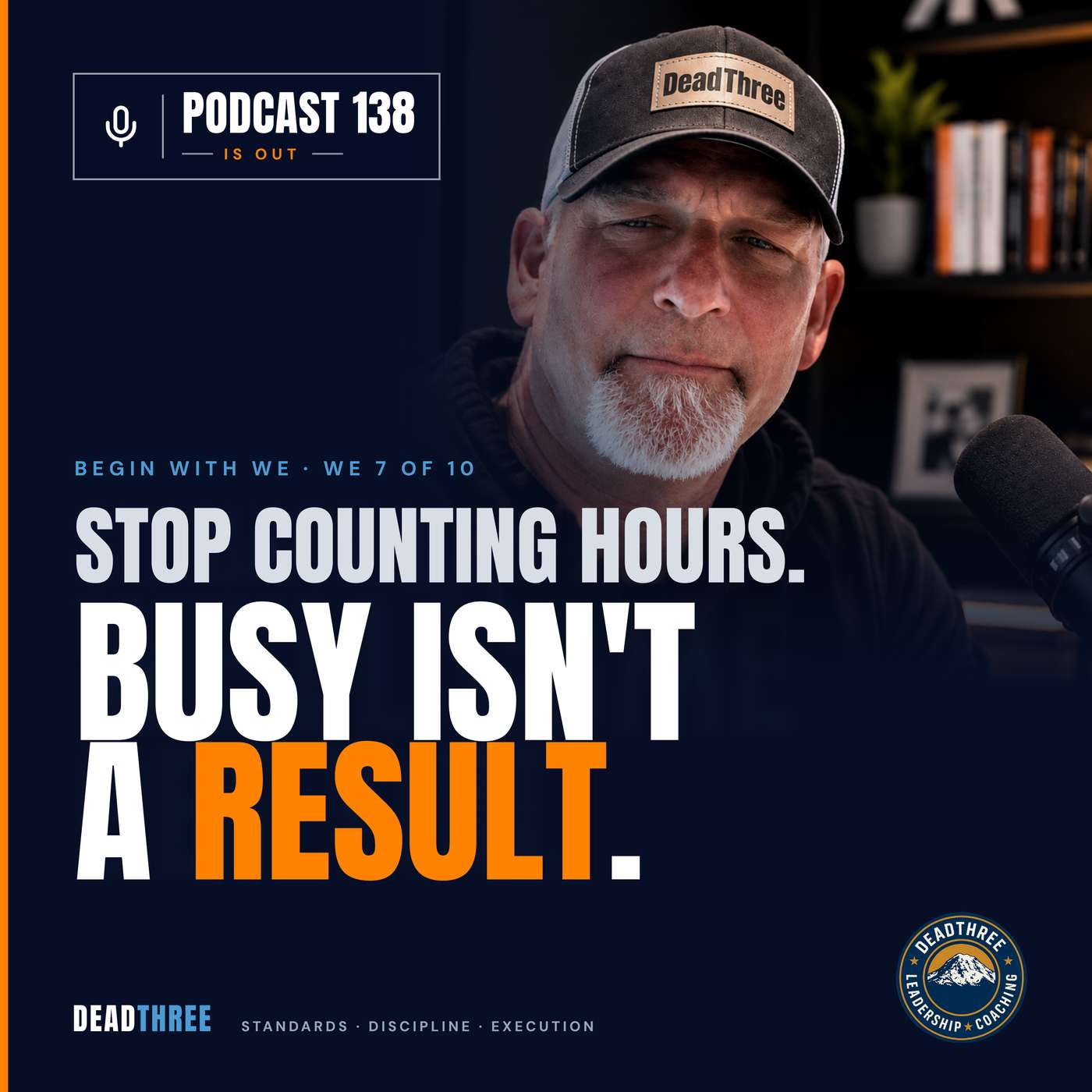
Busy Isn't a Result

Pull out your calendar. Look at this week. Which of those blocks actually produced something? Not which ones kept you busy. Which ones moved the scoreboard. In episode 138, I break down WE 7 from Kyle McDowell's Begin With We : we measure ourselves by outcomes, not activity. Last week was about picking each other up. So now you have a team with a standard. It moves, it tells the truth and it has each other's back. Here's the danger: a team like that can work incredibly hard on the wrong things. WE 7 aims the effort. In this episode: John Wooden: don't mistake activity for achievement Hundreds of reports that nobody read Outcomes are the WHAT. Activities are the HOW. You get paid for the WHAT The line test: if an activity doesn't connect to an outcome, it's in the way The busy drug, and the executive who turned his laptop around to prove he was overwhelmed The meeting numbers: 67% of workers say most meetings keep them from their best work Five questions to ask before any meeting Five moves to shift a team from busy to results Your move this week: Audit your calendar. Mark every block O or A: outcome or activity. If you can't draw the line to an outcome, cut it, shorten it or hand it off. Put the outcome in the invite. "By the end of this meeting, we will have ___." If you can't fill in the blank, cancel the meeting. "Stop counting hours. Start counting outcomes." Mentioned in this episode: Begin With We by Kyle McDowell, John Wooden This is WE 7 of 10 in the Begin With We series. Catch up with episode 132 (The One Standard That Holds Up Every Other Standard), episode 133 (Who Sets the Temperature on Your Team?), episode 134 (Built or Destroyed One Commitment at a Time), episode 135 (We Take Action), episode 136 (Tough on the Problem, Easy on the Person) and episode 137 (Sit Back Down, We'll Come Get You). Next week, WE 8: we challenge each other diplomatically. If this one hit, send it to the person on your team with the fullest calendar. Find out where your team stands. Take the free 30-question SDE assessment and download the SDE Playbook at deadthreecoaching.com/sde-assessment
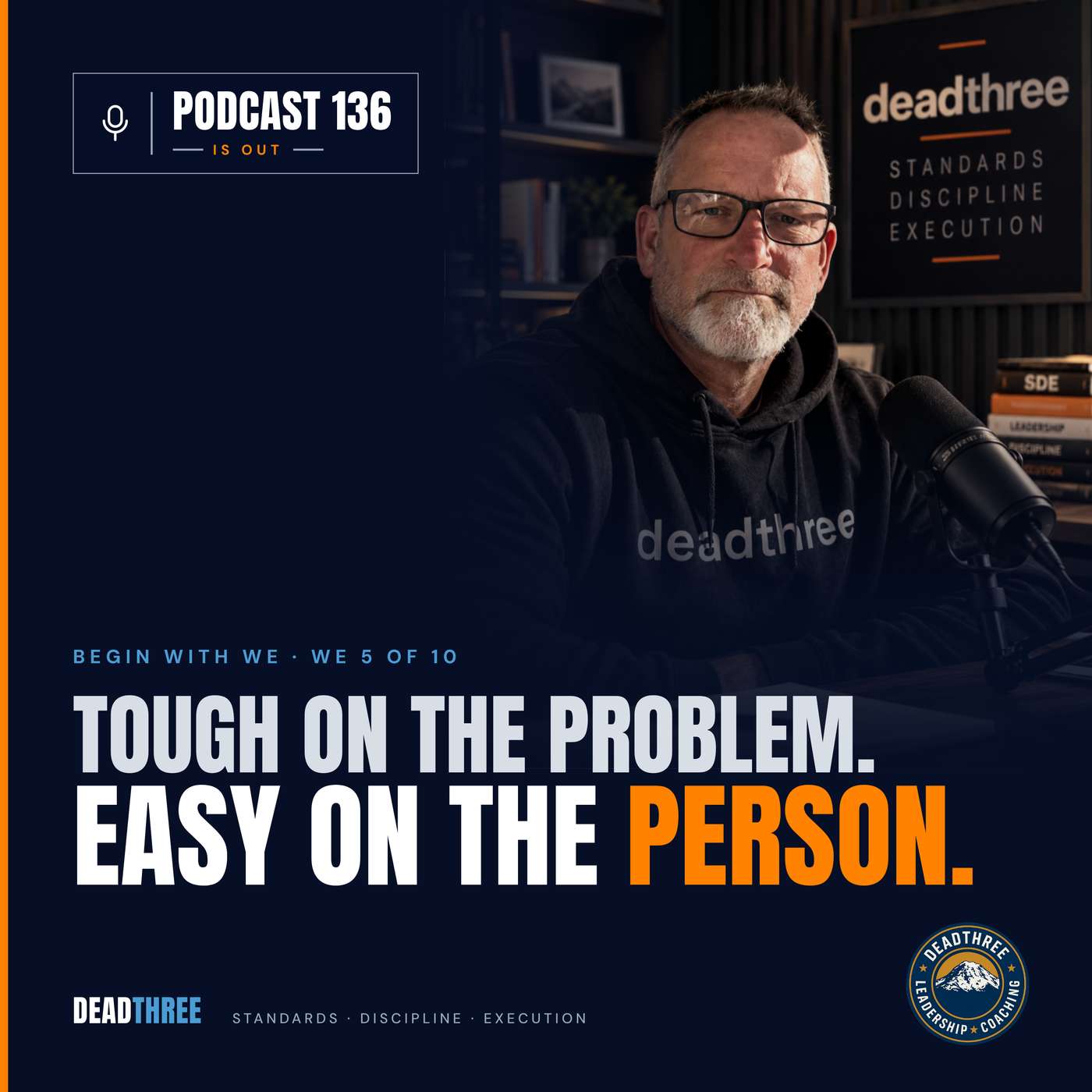
October 20, 2026Episode 13749 min

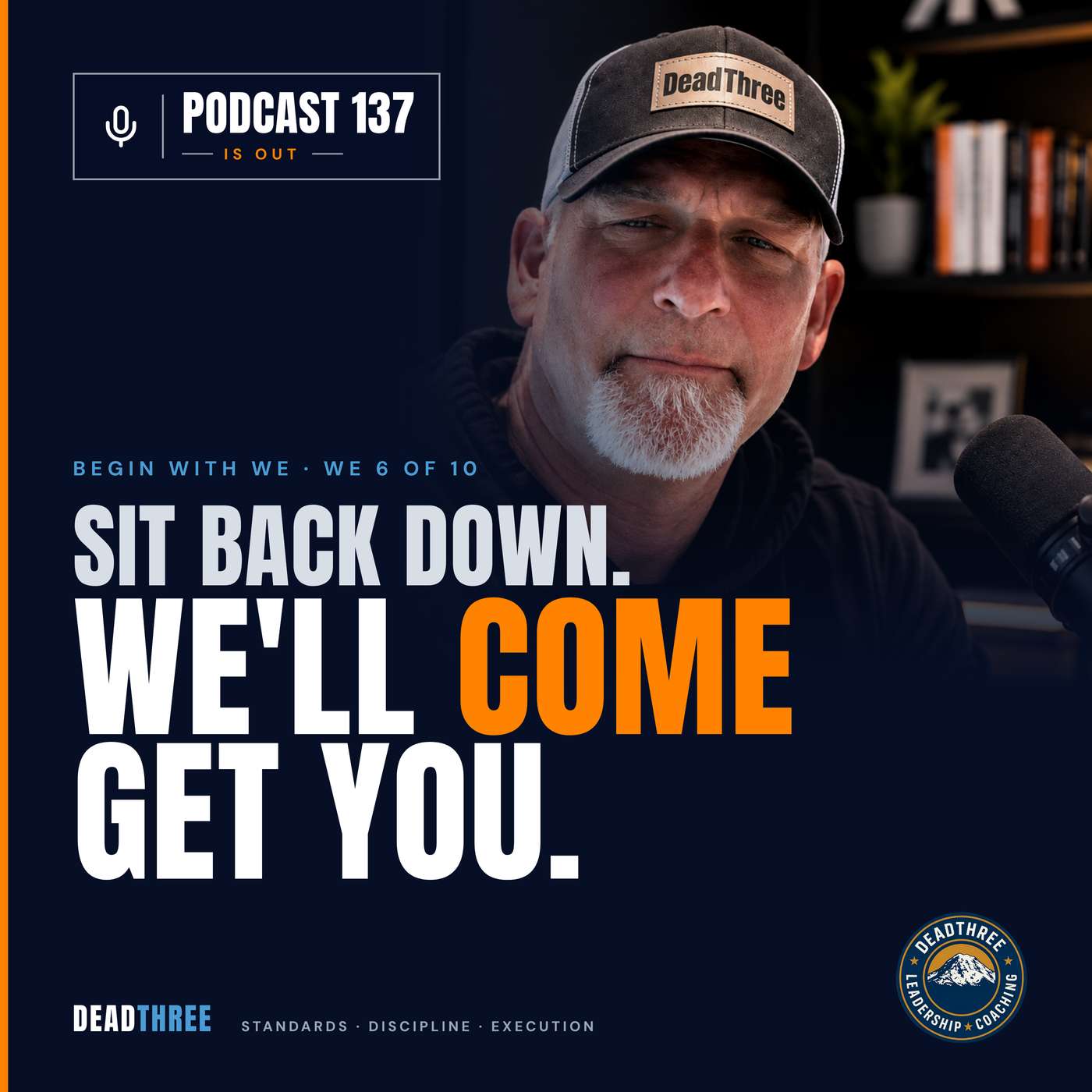
Sit Back Down, We'll Come Get You

A teammate hits the floor in a preseason game and starts to get up on his own. LeBron tells him: sit back down. We will come get you. That's a standard. That's not a feeling. Somebody on your team is on the ground right now. When they went down, who moved? In episode 137, I break down WE 6 from Kyle McDowell's Begin With We: we pick each other up. This is the one I don't see enough of. Teams talk about it. Very few have it as a standard. Last week was about owning your mistakes. This week is what comes right after. Somebody shows a red. The room goes quiet. Nobody helps. They fix it alone at 11 o'clock at night and learn one thing: don't show a red again. In this episode: - We need to quit calling ourselves a team when we're just a group of people - Stack it up: the standard, the model, the proof, the movement, the honesty, and now the support - What happens when you get WE 5 right and skip WE 6 - Tie your shoe with your eyes closed: somebody didn't let you quit - LeBron's standard: nobody gets up alone - When a teammate takes a charge, it's about the other four - What "on the ground" looks like at work, and why most leaders call it a performance problem - The test: who notices first? - McDowell: it's everybody's responsibility, and no one person is more important than the next - The star is the most important person that picks others up Your move this week: 1. Go through your team one by one and ask Don Meyer's question: what do they need and how can I help? Find the one who's on the ground. 2. Run the test. Somebody's struggling right now. Who noticed first? If it's you every time, you don't have WE 6 yet. 3. When a teammate picks somebody up, call it out. That's the behavior you want everyone to see. "On this team, nobody gets up alone. When somebody goes down, everybody moves." Chapters 00:00 Somebody on your team is on the ground 00:40 Who moved? 02:13 WE 6 of the Begin With We series 03:01 Quit calling yourselves a team 05:19 Stack it up: WE 1 through WE 5 06:15 Nick Saban: how can I trust you? 08:43 Why the order matters 10:49 Get WE 5 right and skip WE 6 11:41 The room goes quiet at 11 at night 15:40 Encouragement, the first E 16:09 Tie your shoe with your eyes closed 18:30 LeBron: sit back down, we'll come get you 22:29 If everybody had your attitude and body language 23:56 When a teammate takes a charge 26:55 It's about the other four 27:57 Flip the script on the shooter 29:45 What "the ground" looks like at work 31:11 Not always a performance problem 34:14 The test: who notices first? 35:45 Purpose stops being a slide 37:19 McDowell: it's everybody's responsibility 39:48 The star picks others up 42:38 Stack it up: the support 43:23 Duke and the four guys who sprint over 44:45 Next week, WE 7: outcomes, not activity 46:54 The free SDE assessment Mentioned in this episode: - Begin With We by Kyle McDowell - The Advantage by Patrick Lencioni - The SDE Playbook - Nick Saban, Ben Newman, Jon Scheyer, Don Meyer, LeBron James, Steve Nash and John Wooden - Simon Sinek with Oprah Winfrey on Barry-Wehmiller This is WE 6 of 10 in the Begin With We series. Catch up with episode 132 (The One Standard That Holds Up Every Other Standard), episode 133 (Who Sets the Temperature on Your Team?), episode 134 (Built or Destroyed One Commitment at a Time), episode 135 (We Take Action) and episode 136 (Tough on the Problem, Easy on the Person). If this one hit, send it to somebody on your team. Better yet, send it to the person who's on the ground right now. Find out where your team stands. Take the free 30-question SDE assessment and download the SDE Playbook at https://deadthreecoaching.com/sde-assessment

October 12, 2026Episode 13646 min

Tough on the Problem, Easy on the Person

Your team will make mistakes the minute you tell them to move. What you do next decides your culture. We are not judged by our mistakes. We're judged by how quickly we fix them and whether we repeat them. In episode 136, I break down WE 5 from Kyle McDowell's Begin With We: we own our mistakes. Last week was about getting your team to take action. This week is what comes right after. Punish the mistake and the movement stops. Make people hide it and trust dies. McDowell tells the Ford story. Every week, every executive status report came in green while the company lost billions. Alan Mulally said: red, yellow or green, I just want the truth. Mark Fields finally showed the first red. Instead of getting hammered, he got help. A few weeks later the reports looked like a bag full of Skittles. Fields later became CEO of Ford. In this episode: - Resiliency: how quickly you get back to your baseline - Why this show is called DeadThree, and what happens to your best shooter when you pull him after one miss - Shout praise, whisper criticism - The program review where every team hit 30 or 40% and everyone clapped - The day I deleted every shoe on shoes.com, and why I still remember how my boss Keith made me feel - McDowell's three kinds of mistakes: careless, malice and good faith. Most leaders respond to all three the same way. - If you treat a good-faith mistake like malice, you'll never see initiative from that person again - Four sentences of ownership, and why your team can't fix a problem they don't know exists Your move this week: 1. Show your team a red. One thing you got wrong or one thing that isn't going well. Say it out loud: here's why and how it happened, here's how and when we fix it, here's what we do so it doesn't happen again. 2. The next time something breaks, catch yourself before you ask who. Ask what happened. Then ask why five times. "You need to be tough on the problem, but you need to be easy on the person." — Kyle McDowell Chapters 00:00 WE 5 of the Begin With We series 00:58 "It's a WE thing" 06:46 WE 5: we own our mistakes 07:07 Resiliency and your baseline 09:57 Recap: WE 1 through WE 4 10:38 Your team moves, your team makes mistakes 12:46 Punish the mistake and the movement stops 13:57 Why it's called DeadThree 17:13 Shout praise, whisper criticism 19:12 Dare to fail greatly 20:59 Everything is green 24:19 Ford: red, yellow or green 27:24 Mark Fields shows the first red 27:49 Assess it, own it, fix it, don't repeat it 28:39 The day I deleted shoes.com 30:30 Talking to one, coaching all 34:11 Three kinds of mistakes 35:47 Good faith treated like malice 37:34 Four sentences of ownership 40:25 Two actions for this week 41:35 Tough on the problem, easy on the person 43:02 Stack it up, and a look at WE 6 Mentioned in this episode: - Begin With We by Kyle McDowell - Extreme Ownership by Jocko Willink - The Advantage by Patrick Lencioni - Multipliers by Liz Wiseman - The 4 Disciplines of Execution - Robert F. Kennedy, Alan Mulally, Mark Fields, Don Meyer and John Wooden This is WE 5 of 10 in the Begin With We series. Catch up with episode 132 (The One Standard That Holds Up Every Other Standard), episode 133 (Who Sets the Temperature on Your Team?), episode 134 (Built or Destroyed One Commitment at a Time) and episode 135 (We Take Action). If this one hit, send it to the leader on your team who still asks "who did this?" first. Find out where your team stands. Take the free 30-question SDE assessment and download the SDE Playbook at https://deadthreecoaching.com/sde-assessment

October 5, 2026Episode 13546 min

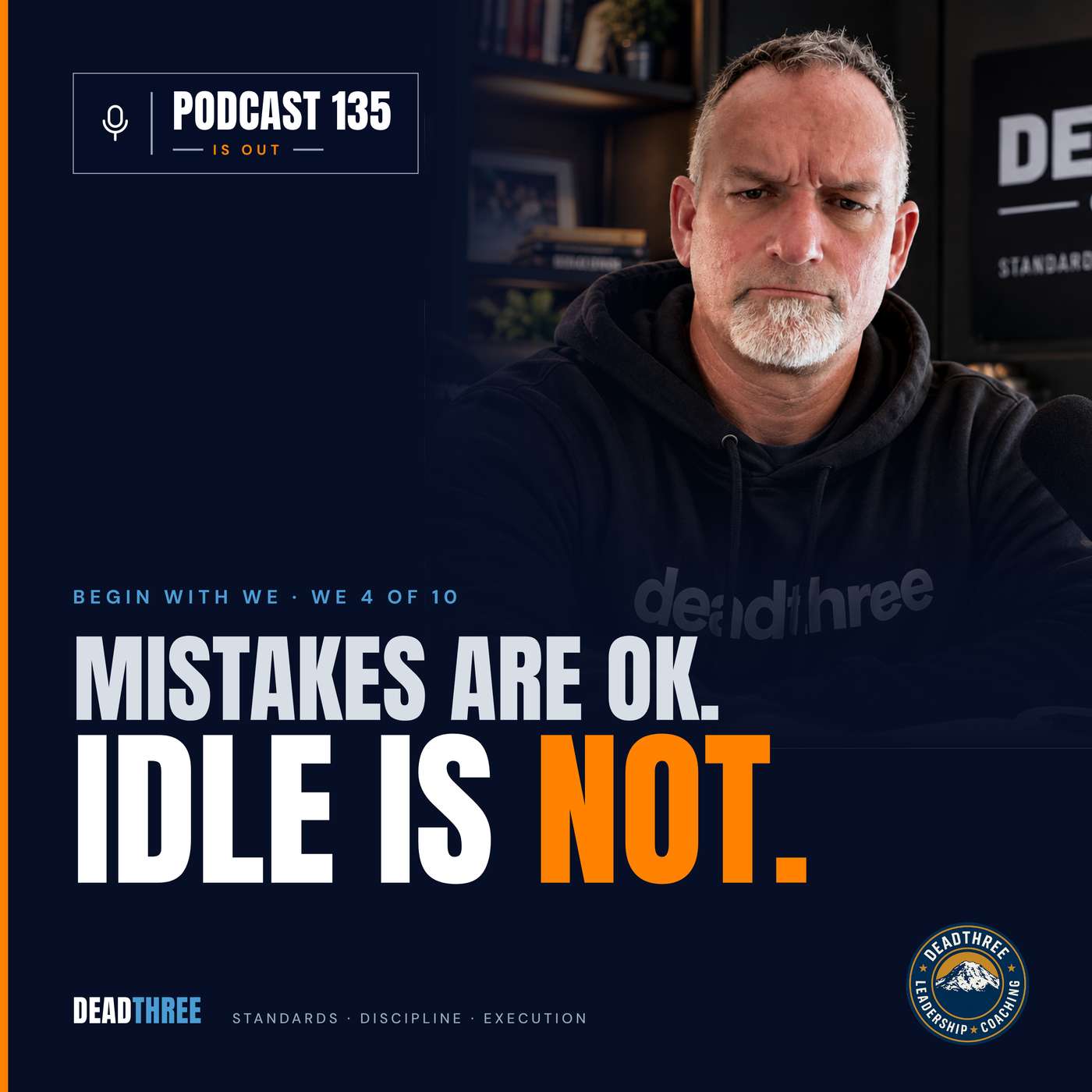
WE Take Action

Your team isn't stuck because of bad ideas. It's stuck because everyone is waiting for permission. Taking action and making mistakes is OK. Being idle is not. In episode 135, I break down WE 4 from Kyle McDowell's Begin With We, and I'll be honest: this is the one I struggle with most. You can set great standards. You can lead by example and keep every commitment. If nobody on your team is willing to move, try or risk, everything you've built is a well-organized parking lot. Ideas, strategies and plans, parked and going nowhere. McDowell tells a story about a leader named Bob. Bob heard a talk on culture, loved it and wanted to bring it to his team. First, he said, he'd need to ask permission. Permission to talk culture with his own team. Who's stopping you? Nobody. Bob is in every company, at every level. Senior leaders waiting for permission to do the very thing they were hired to do. In this episode: - Why being idle feels like caution and prudence, and why it's really a choice - The question Jesse Itzler asks his kids every night at dinner: "What did you fail at today?" - The best restaurant in the world, and the man in the back of the room who said, "That looks exhausting" - What happens to people when you ask them to do less than they're capable of - Why nobody pays for average - Why "we've always done it that way" should be considered profane, and what Northwestern basketball teaches about losing cultures - The one question to ask about every process on your team: would I keep doing this if I owned the company? Your move this week: 1. Name one thing you've been waiting on permission to address. A process that makes no sense. A conversation you keep putting off. An initiative sitting in the parking lot. Get it done. You are the leadership. 2. Have one conversation with your team that gives them permission to act. Not a policy. Not a memo. Tell them: if you see something to improve, go do it. "Taking action and making mistakes is OK. Being idle is not." — Kyle McDowell Chapters 00:00 WE 4 of the Begin With We series 03:10 Why this is the WE I struggle with most 04:22 Taking action is OK, being idle is not 04:48 Ben Newman and stacking days 06:30 Recap: WE 1, WE 2 and WE 3 08:23 A well-organized parking lot 08:56 Books, people and the risks you take 13:26 The enemy of action is being idle 14:09 Shawshank and asking permission 15:19 Who's stopping you? 17:04 Bob is everywhere 21:55 Mistakes are inevitable 22:45 What did you fail at today? 24:39 Write this down 25:15 Being idle is a choice 27:09 "That looks exhausting" 29:25 Asked to do less than they're capable of 30:31 Nobody pays for average 32:35 The status quo sandwich 33:45 "We've always done it that way" should be profane 34:21 Northwestern basketball and a losing culture 39:22 If I owned this company 42:57 Two actions for this week 45:13 The parking lot's full Mentioned in this episode: - Begin With We by Kyle McDowell - The Standard by Ben Newman - Mindset by Carol Dweck - 2 Second Lean by Paul Akers - Don Meyer, Jesse Itzler and Ed Mylett This is WE 4 of 10 in the Begin With We series. Catch up with episode 132 (We Do What Is Right, Always), episode 133 (Who Sets the Temperature on Your Team?) and episode 134 (Built or Destroyed One Commitment at a Time). If this one hit, send it to the leader on your team who's still waiting for permission. Find out where your team stands. Take the free 30-question SDE assessment and download the SDE Playbook at https://deadthreecoaching.com/sde-assessment
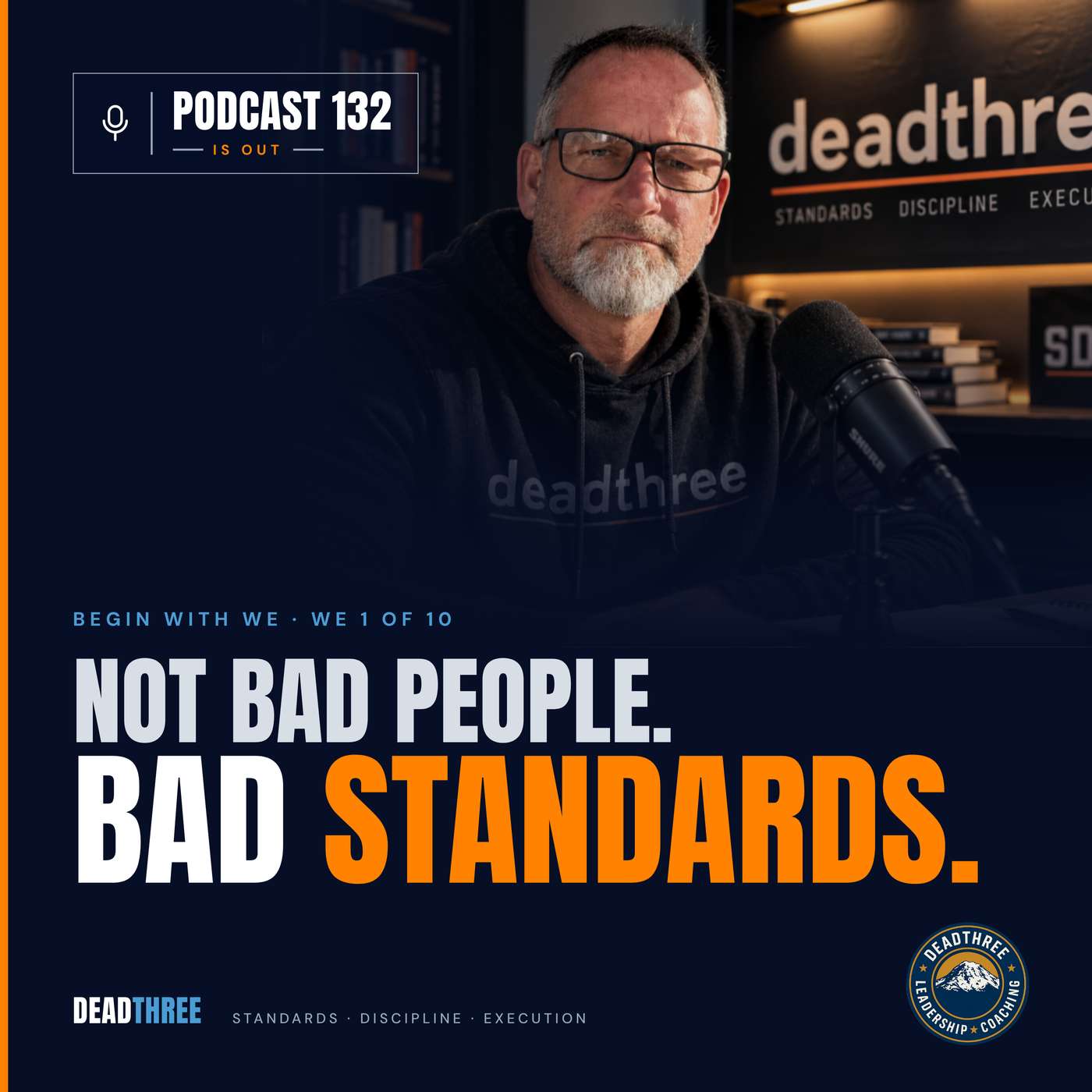
September 28, 2026Episode 13446 min

Built or Destroyed One Commitment at a Time

Your team is keeping score. Not on your title. On whether you did what you said you'd do. Your credibility is your brand, and it gets built or destroyed one commitment at a time. In episode 134, I break down WE 3 from Kyle McDowell's Begin With We: we say what we're going to do, and then we do it. This is the principle that decides whether the first two are real. You can do the right thing and lead by example in every meeting. Miss the delivery, and none of it counts. Follow-through is the proof. In this episode: The Friday-at-3 moment every team faces, and the engineer who shut it down with "Ain't nobody going anywhere. We said we would do this." Why your clients are grading your delivery right now, and how a team climbs from a D-minus to an A-plus The two kinds of trust every team runs on, and what breaks when either one is missing Why your employees are your first customers Why most follow-through failures come down to clarity, not character The three things every meeting has to end with Your move this week: End every meeting with who's doing what, and by when. Confirm everyone heard it the same way. Put it in writing. Run it for 30 days and watch what changes. Find one commitment you made and didn't keep. A deliverable, a conversation, a check-in you cancelled. Close it this week. "Be a leader. Do what you say you're going to do, then demand the same thing from your team." — Kyle McDowell Chapters 00:00 The Sunday-afternoon culture test 02:44 Recap: WE 1 and WE 2 04:32 The leader who had integrity and modeled it 07:12 WE 3: we say what we're going to do, and we do it 09:00 Friday, 3 p.m.: "Ain't nobody going anywhere" 10:52 Your credibility is your brand 12:51 "Always delivers" or "seldom delivers"? 15:18 Follow-up and follow-through set you apart 18:08 Confidence is keeping the promises you make to yourself 19:59 How your clients grade your delivery 22:08 The two levels of trust 28:56 High-integrity teams can't deliver bad service 32:37 Your employees are your customers 33:57 Ambiguity is the enemy of execution 35:40 Who's on point, what, and by when 39:46 Two moves for this week 43:25 Three lines to lead by, and what's next Mentioned in this episode: Begin With We by Kyle McDowell The Athletics of Business podcast with Ed Molitor The Standard by Ben Newman The 4 Disciplines of Execution John Maxwell and Ed Mylett This is WE 3 of 10. Start with episode 132 (We Do What Is Right, Always) and episode 133 (Who Sets the Temperature on Your Team?). Next up, WE 4: we take action, and the most dangerous word in any organization.

September 21, 2026Episode 13349 min

Who Sets the Temperature on Your Team?

George is back with the second principle from Kyle McDowell's Begin With We: We Lead By Example. Using Einstein's line that example isn't the main way to influence people, it's the only way, he breaks down Michael Jordan and the Chicago Bulls, a software engineer named Z who reset her team's standard on a Friday afternoon, and the question every leader has to answer: are you the thermostat, or are you the thermometer? In this episode Recap of WE One — we do the right thing always — and why it means nothing on a poster or an email signature WE Two: we lead by example, opened with Einstein's quote that setting an example is the only means of influencing others Current reality and compelling vision, and the Chris Collins / Northwestern basketball turnaround Michael Jordan and the Chicago Bulls: the hotel room story from The Last Dance, and the moment Jordan chose not to walk in Thermostat versus thermometer — who sets the temperature in your organization, and who just reports it Z, the software engineer who reset her team's sprint standard on a Friday afternoon: "ain't nobody going home" The standard you set is the standard you get — Jordan on why a great player lands on a bad team Small standards that are really big standards: punctuality, cameras on in meetings, Danny Hurley's intensity at UConn The mirror test — your words and actions get replicated by your team whether you like it or not Two actions for the week: a 48-hour audit, and closing one gap

September 12, 2026Episode 13255 min

The One Standard That Holds Up Every Other Standard

It's been a year since the last episode. George is back, and he's not easing in. This one breaks down principle one from Kyle McDowell's Begin With We — the standard that has to hold before any other principle in your organization works. Trust, the John Lucas story, the Tylenol crisis, and twenty years of watching corporate America choose low standards over high ones. Corporate America isn't broken because of bad people. It's broken because of bad standards. George connects that idea to a story from John Gruden about looking left and right in the locker room, the difference between a me culture and a we culture, two distinct types of trust, and a leadership crisis that turned into a case study in doing the right thing under pressure. If you lead a team, run a company, or are just trying to figure out why your workplace feels off, this one's for you. Get the book. Run the mirror test. And find the one standard you're holding your team to that you're not holding yourself to. In this episode: Why bad standards, not bad people, are what actually break workplaces The 10 "we" principles from Kyle McDowell's Begin With We The difference between a me culture and a we culture Two types of trust, and why you need both A crisis-response case study in leading by example Company, client, crew — the only three things that should matter The mirror test: how to find where you're not modeling your own standard Mentioned in this episode: Begin With We by Kyle McDowell The Advantage by Patrick Lencioni The Multiplier by Liz Wiseman Get in touch: deadthreecoaching.com

January 6, 2026Episode 13142 min

Let the Room Raise You: Standards, Consistency, and Belonging

In this episode of the DeadThree Coaching Show, we kick off 2026 by finishing a two-part conversation about getting into uncomfortable rooms—and more importantly, what it takes to stay there, grow there, and eventually belong there. Getting access is only the first step. High performers separate themselves by what they do after the door opens. This episode breaks down three defining principles that will shape who rises and who stalls in 2026: bringing value before validation, letting the room raise your standards, and earning belonging through repetition. These aren’t motivational ideas—they’re execution standards. Using real leadership moments, business examples, sports analogies, and lessons from Gary Vee, Ben Newman, James Clear–style systems thinking, and years inside software and IT organizations, this episode challenges leaders to stop seeking approval and start earning relevance. This is a message for leaders who are done being comfortable—and ready to raise their operating system. You’ll hear: Why getting in the room is easy compared to earning your place in the room The hard truth: high-level rooms reward value and humility—not insecurity or performance What “value before validation” actually looks like in leadership conversations Why elite rooms expose your gaps—and why that’s a gift, not a threat How the right rooms raise your standards without saying a word Why belonging is built through consistency, reliability, and follow-through The real difference between inspiration and transformation Why 2026 will separate people based on standards, not goals How discipline, consistency, and preparation become your identity Why leaders don’t rise to the level of their goals—they rise to the level of the rooms they consistently sit in Core Principles from This Episode Bring value before you seek validation Support momentum instead of dominating conversations Let the room raise your standards Treat every room like a classroom Belonging is earned through repetition, not one big moment Three Questions to Take Back to Your Team When I walk into important rooms, am I focused on being impressive—or being useful? What gaps are the rooms I’m in currently exposing about my preparation, discipline, or consistency? If my standards matched the rooms I want to be in, what would I need to upgrade immediately? Identify one room that represents your next level in 2026—a client, a mentor, a leadership table, or a conversation that makes you uncomfortable. Don’t wait to feel ready. Show up prepared. Bring value. Be consistent. Let the room raise you—and earn your place through repetition. This year isn’t about pressure. It’s about opportunity. Join the Conversation: 👉 Follow me on Instagram, LinkedIn, and YouTube for more leadership and high-performance insights. Instagram: https://www.instagram.com/deadthreecoaching LinkedIn: https://www.linkedin.com/in/gevjen 👉 Join our community and connect with leaders focused on growth, discipline, and execution. Website: https://deadthreecoaching.com Encouragement Course: https://deadthreecoaching.com/encouragement Community: https://community.deadthreecoaching.com

December 22, 2025Episode 13038 min

The Room Will Raise You: Why Growth Demands Discomfort in 2026

As we close out 2025 and look straight at 2026, this episode is a line in the sand. Growth does not happen in familiar rooms. It happens when you intentionally place yourself in environments where you’re uncomfortable, challenged, and not the most experienced voice in the room. In this episode, recorded on a cold Missouri walk, I unpack a core principle that will define elite leaders in 2026: You don’t grow by preparing longer. You grow by exposure. Drawing from coaching basketball, leadership work, and real-world business environments, this conversation challenges you to rethink how—and where—you pursue growth. This is Part One of a two-part series focused on entering rooms you don’t feel ready for and learning how those rooms shape who you become. In this episode, we cover: Why staying in the same rooms guarantees stagnant growth The difference between humility and insecurity when stepping into elite environments How to treat every unfamiliar room like a classroom—not a performance Why exposure beats preparation every time How the right rooms recalibrate your standards and expose blind spots The leadership discipline required to stop waiting for permission If you’re serious about making 2026 a defining year—not just another calendar flip—this episode will force you to confront a simple but uncomfortable question: What rooms are you willing to put yourself in this year? Because the truth is this: If all your 2026 rooms look like your 2025 rooms, nothing changes. Key Takeaway: The right rooms will stretch your thinking, recalibrate your standards, and force you to close gaps you didn’t even know existed. This episode sets the foundation. Part Two will focus on what happens after you enter the room—how to create value, how to stop being invisible, and how to belong without losing yourself. Three Actions to Take Today: List the Rooms: Write down three rooms, environments, or conversations that make you slightly uncomfortable—and commit to pursuing access to one of them in Q1. Audit Comfort: Identify one area of your life or leadership where you’ve been too comfortable. That’s your growth gap. Change the Question: Stop asking “Am I ready?” and start asking “What would this room teach me?” If this episode challenged you, share it with someone who needs to hear it. And if you’re building toward something bigger in 2026—join the conversations we’re having, connect with us, and stay close. The room will raise you—if you’re willing to walk in.

December 9, 2025Episode 12928 min

The Three Things Every Leader Needs to Build a Confident, High-Energy Team

In this episode of the DeadThree Coaching Show, we start with a Duke vs. Florida basketball moment and turn it into a leadership blueprint for IT teams and organizations. Duke guard Isaiah Evans was 0-for-7 from three. Game on the line. Instead of going away from him, Coach Jon Scheyer drew up the final play for Evans — and he buried the game-winning three. That decision wasn’t just about X’s and O’s. It was about belief, confidence, and the energy a leader chooses to bring to their team. We break down why your team’s confidence and energy are a reflection of you — not your slide decks, not your strategy documents, but your daily presence. Using lessons from Duke basketball, High Performance Habits, Ego Is the Enemy, and Beyond the Hammer, he walks through three non-negotiables every IT leader (and any leader) must master to build elite, high-performing teams. You’ll hear: Why belief in your people matters more than their last “miss” How Coach Scheyer’s decision to trust an 0-for-7 shooter is the model for how we lead at work Why your team feels your energy long before they hear your words How your emotional state becomes the culture your team lives in The three energy standards every leader must own: Leaders go first – you are the power plant, you generate energy Emotional calibration – your internal state becomes the team’s external behavior Consistency of presence – reliability and steadiness are your competitive advantage This episode is for leaders, coaches, and managers who are tired of reactive, low-juice teams and want to create a culture where people feel trusted, valued, and ready to take the last shot. Three Questions to Take Back to Your Team Where am I withholding belief from someone on my team because of a recent “miss”? What emotional ripple do I leave behind after meetings, stand-ups, or 1:1s? If my team copied my energy this week, would we be playing to win or just trying not to lose? Call to Action This week, pick one teammate and intentionally “draw up a play” for them — give them a visible opportunity, tell them you believe in them, and support them through the outcome. Win or lose, you’re building a standard of belief and energy that your whole organization will feel. Join the Conversation: 👉 Follow me on Instagram, LinkedIn, and YouTube for more leadership and high-performance insights. Instagram: https://www.instagram.com/deadthreecoaching LinkedIn: https://www.linkedin.com/in/gevjen 👉 Join Our Community and connect with like-minded leaders focused on growth and execution. Website: https://deadthreecoaching.com Newsletter: https://deadthreecoaching.com/newsletter Community: https://community.deadthreecoaching.com

Is this your show?

Claim this listing to keep it up to date, reach guests who want to pitch you, and manage bookings with Guestify.

Claim this listing