Find partners
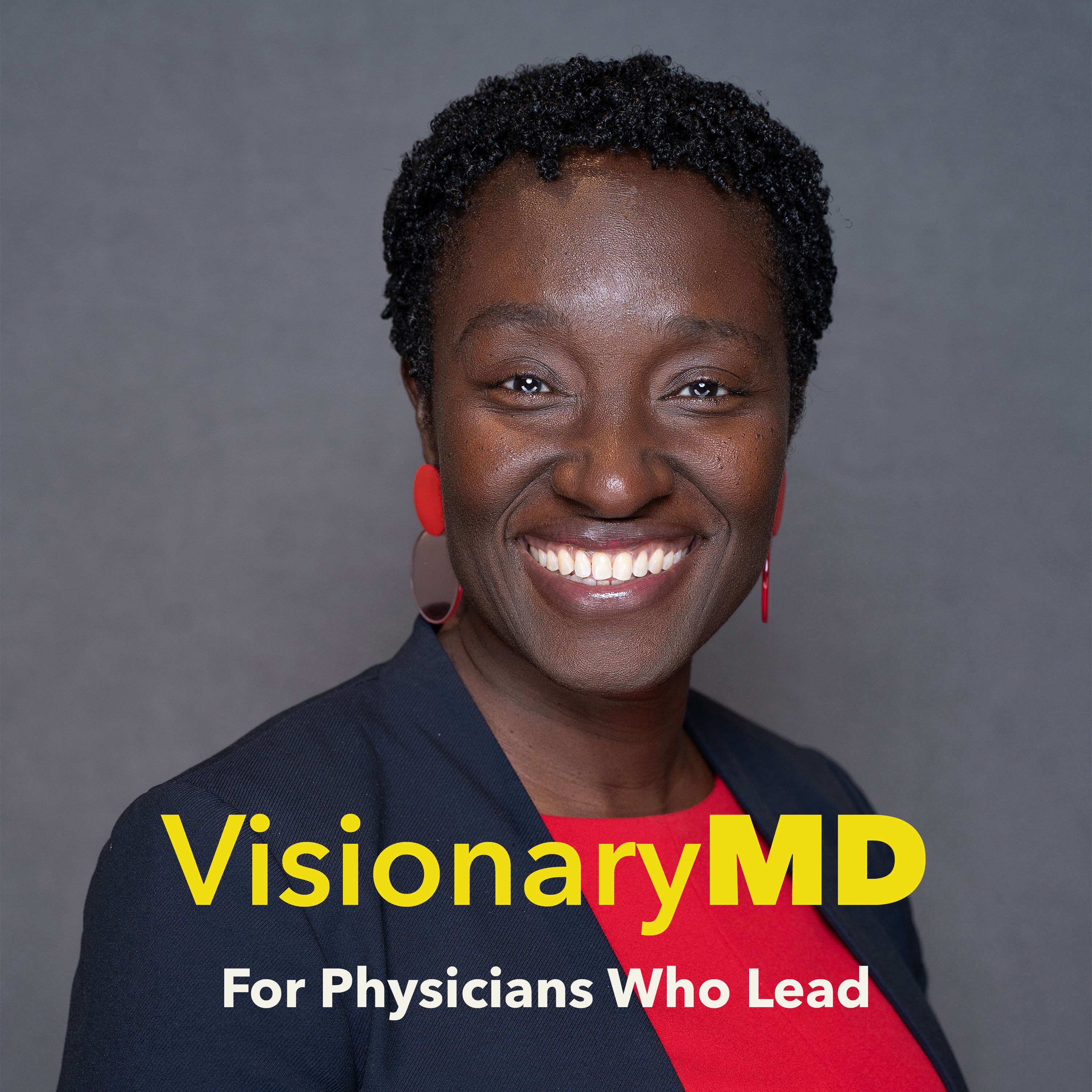
VisionaryMD

VisionaryMD

Hosted by Toyosi Onwuemene

Episodes

226

Latest episode

Jun 2026

Language

EN

About the show

As a physician leader, your words and vision shape how others thrive. VisionaryMD equips you to lead with confidence and clarity. VisionaryMD is the podcast for physicians in academic medicine who are ready to step confidently into leadership. Hosted by Dr. Toyosi Onwuemene, executive coach for physician leaders, each episode gives you practical tools and inspiring insights to lead with confidence, clarity, and vision. Whether you’re leading morning rounds, directing a research program, or guiding your institution through change, you’ll learn how to lead beyond boundaries and shape the academic medicine landscape of the future.

Listen to episodes

60 recent
June 15, 202621 min

Physicians: Don’t Just Work, Win! 5 Career Moves That Matter

In this episode of the VisionaryMD Podcast, Dr. Toyosi Onwuemene challenges physicians to rethink how they approach their careers. Yes, the work is meaningful. Yes, it’s intellectually and emotionally fulfilling. But here’s the question: what are you actually taking with you when this role ends?Because every role ends.Whether you transition, retire, or pivot, your time in any position is finite. And if all you leave with is the memory of meaningful work, you may be missing critical opportunities to build a sustainable, impactful career.5 Essential Wins Every Physician Should Take From Their Career1. Who You Become Your greatest asset isn’t your title—it’s your transformation. Are you growing in confidence, capacity, and vision? Be intentional about your personal and professional evolution.2. Leadership Experience Leadership isn’t about titles—it’s about influence. Look for opportunities to serve, mentor, and create pathways for others. Your impact should extend beyond your individual work.3. Creative Output (Your Body of Work) What tangible evidence exists of your contributions? Publications, talks, programs, or educational content—build a portfolio that reflects your expertise and legacy.4. Meaningful Relationships Not all workplace connections last—but some should. Invest in genuine relationships that extend beyond the job. These become lifelong professional and personal assets.5. Financial Growth High income doesn’t guarantee wealth. Physicians must be intentional about investing, diversifying income streams, and building financial security for both the short and long term.Final ThoughtPhysicians are trained to give—time, energy, expertise. But this episode is a reminder to also gain. When you approach your career with intention, every role becomes a stepping stone—not just for serving others, but for building a life of impact, autonomy, and sustainability.This is how you don’t just work—you win.

June 8, 202632 min

It’s Not You, It’s the System: How Physicians Can Take Back Control

In this episode of the VisionaryMD Podcast, Dr. Onwuemene explores a powerful mindset shift for physicians navigating overwhelming workloads: it’s not you—it’s the system.Drawing from a real clinic day, Dr. Onwuemene shares how a fully booked schedule—plus unexpected e-consults—forced her to make a critical decision: honor her boundaries or sacrifice her personal time. Instead of defaulting to overwork, she chose a different path, illustrating a key lesson in physician burnout prevention and boundary setting.Key Takeaways for Physicians1. The System Will Always Demand More Healthcare systems are designed for growth and efficiency. That means no matter how hard you work, expectations will continue to rise. The solution? Decide in advance how hard you will work—and stick to it.2. If You Have Free Time, It Will Be Filled Unscheduled time quickly becomes clinical time. Protect your energy by intentionally planning your schedule, including personal priorities like rest, family, and health.3. You May Lose Resources but Keep Expectations Whether it’s fewer staff or limited support, physicians are often asked to maintain the same output. Focus on doing the work you have the tools for, and communicate clearly about limitations.4. You Can’t Meet Every Standard From patient satisfaction to teaching responsibilities, expectations can conflict. Ask leadership to define the top three priorities, and focus your excellence there.5. Redefine Success on Your Terms You may never achieve a perfect performance review in a flawed system. Instead, set your own performance standards aligned with your values and priorities.Final ThoughtThis episode is a must-listen for physicians seeking work-life balance, career sustainability, and autonomy in medicine. By recognizing systemic pressures and setting intentional boundaries, you can continue delivering excellent patient care—without sacrificing yourself in the process.

June 1, 202626 min

The Hidden Math Behind Your First Physician Job

When physicians start a new job, it’s easy to assume that healthcare systems exist primarily to support doctors and patients. But beneath the surface, every institution operates within a business model that shapes how physicians are hired, supported, and evaluated.In this episode of the Visionary MD Podcast, Dr. Onwuemene introduces a powerful metaphor: the horse farm. Just as a horse farm exists not simply for the horses but for what the horses make possible, healthcare organizations exist to accomplish broader goals—and physicians play a central role in making that work.Understanding this perspective can help early‑career physicians make sense of the expectations placed on them and navigate their careers more strategically.Key insights from this episode:Early in your career, you are like a “foal.” Institutions expect a period of growth and learning before major productivity is required.Your long‑term value has already been estimated. Institutions invest in early‑career physicians because they anticipate future contributions.Your role is often shaped by your training and background. In many ways, your professional trajectory is partially predetermined by the expertise you bring.Physicians help sustain the organization. Whether through clinical revenue, research funding, leadership, or innovation, each role contributes to the system’s sustainability.Changing career directions is possible—but it often requires a clear justification because institutions have already planned around certain expectations.Experienced physicians negotiate differently. With experience comes a clearer understanding of value, resources, and the conditions needed to succeed.The most important question to ask yourself is: What am I optimizing for right now in my career?Whether that’s financial stability, research impact, flexibility, leadership, or family time, clarity about your priorities will shape how you navigate opportunities and make career decisions.

May 25, 202624 min

How to Write a Faculty Startup Wishlist That Gets Funded

In this follow‑up episode of the Visionary MD Podcast, Dr. Onwuemene continues the conversation about faculty startup negotiations and explains how early‑career physician scientists should approach writing their startup wishlist.In the previous episode, Tracy described how institutional funding decisions resemble investment decisions. Academic leaders manage pools of capital and deploy that funding strategically in researchers who are likely to generate strong returns through grants, program growth, and long‑term funding.In this episode, she shifts perspective to the investigator and explains how to design a startup wishlist that aligns with the way institutional “investors” think.If you are being asked to submit a wishlist during recruitment or early faculty development, it likely means leadership is considering whether to bring your case forward for investment. Your document must therefore function as a clear and compelling investment proposal.Key elements of a strong faculty startup wishlist:Alignment with institutional priorities. Your research program should clearly fit the institution’s existing portfolio, disease focus areas, or strategic priorities.The operator: you. Investors want to know who will lead the program. Your training, track record, expertise, and credibility matter.The team you will build. Successful research programs are not one‑person operations. Clearly outline the personnel and expertise needed to support your work.Feasibility of the research plan. Your proposal should demonstrate that the science, resources, and operational plan make success realistic.Ask for what is required to succeed. Avoid under‑asking. Institutions evaluate whether the investment can realistically lead to major funding and program growth.A clear return on investment. Show how institutional support leads to career development awards, R‑level grants, and long‑term funding.Defined milestones. Map the path from startup support to major grant funding so leaders can see how the investment unfolds over time.When structured thoughtfully, your startup wishlist becomes more than a resource request—it becomes a strategic investment case for your future research program.

May 18, 202623 min

Why Your Faculty Startup Wishlist Is Actually an Investment Pitch

Many early‑career physician researchers are told that startup funding for research is scarce. But the reality inside most academic medical centers is different: there is money available. The key is understanding that this money functions as investment capital, not discretionary support.In this episode of the Visionary MD Podcast, Dr. Onwuemene breaks down the investor mindset behind academic research funding and explains why your faculty startup “wishlist” is actually an investment pitch. When institutions ask you to submit a wishlist during recruitment or early career development, they are asking for a document that helps them justify investing in you.Academic leaders evaluate these requests much like venture capital decisions. Their goal is to deploy institutional funds in ways that generate meaningful returns—through major grants, program growth, national visibility, and long‑term research funding such as R01 grants.Understanding this perspective can completely change how you think about requesting resources and building your research program.Key insights from this episode:There is a real pool of money available in academia—but it exists to multiply through strategic investments.Institutional startup funds function like investment capital, not general support.Funding decisions are typically made by a team of leaders and financial stewards.Money is deployed when there is a clear path to return on investment (ROI).Institutions often prefer making large bets on a few investigators rather than small investments in many people.Decision‑makers look for signals of likely success, including prior funding, productivity, and a strong research vision.Because some investments will fail, institutions prioritize opportunities with the potential for very large wins.Many of these "investment" conversations happen behind the scenes before you ever see the decision.In the next episode, Dr. Onwuemene shifts perspectives and explains how physician scientists can design a wishlist that aligns with this investment mindset and strengthens their case for institutional support.

May 11, 202628 min

Dear Physician, Why Working Harder Isn’t Making You More Valuable

Why doesn’t working harder always lead to higher pay, recognition, or fulfillment for physicians?In this episode of the Visionary MD Podcast, we explore a critical shift in thinking: value in healthcare is defined by the organization—not just by your effort or performance.Using the “circus owner” metaphor, this episode breaks down how value is actually perceived inside organizations—and why doing more (more patients, more RVUs, more output) often leads to incremental gains, not transformational growth.Key Insights:Every organization has an owner Decisions about compensation and opportunity are shaped by leadership priorities—not just individual performance.Applause ≠ value Patient praise, awards, and visibility feel meaningful—but they don’t always translate into organizational value.More work is not the solution Doing more of the same work faster keeps you on the same treadmill.Value must change to get different results To grow your income, impact, or flexibility, you must change the kind of value you create—not just the volume.The Bottom LineIf you want a different outcome in your career, you can’t rely on working harder alone. You need to think differently about how value is created—and how it’s perceived.Work With MeIf you’re ready to step off the treadmill and rethink your career strategy, I’d love to support you.Visit VisionaryMD.com to learn more about coaching and start the conversation.

May 4, 202627 min

Physicians Must Adapt in a Changing Healthcare System

What is a physician’s role inside a large healthcare organization? And how can physicians continue to grow when the system around them is constantly changing?In this episode of the Visionary MD Podcast, we zoom out from individual performance and take a wider look at the organization itself. This conversation is for physicians who want to better understand the systems they work in, the mission of their institution, and how to stay aligned with their own purpose as healthcare continues to evolve.A key message in this episode is that physicians do not work in isolation. Every physician practices within an organization, and every organization has a mission, pressures, priorities, and moving parts. While patient care may feel like the central purpose of the institution, the broader mission of the organization may be more complex than many physicians realize.This episode explores what happens when:physicians see themselves only through their clinical or academic rolethe mission of the organization no longer aligns with their personal missioncareer growth plateaushealthcare systems shift faster than physicians are prepared foridentity becomes tied too tightly to one role, one title, or one way of workingKey takeaways from this episode1. Physicians work within organizations No matter how skilled or specialized you are, your work depends on a much larger system. Understanding that system helps you lead more effectively and think more strategically about your career.2. Every organization has a mission It is important to understand not just the official mission statement, but the real priorities driving decisions in your institution. Clarity here helps physicians identify alignment and misalignment.3. Mission looks different depending on where you sit Operations, finance, leadership, and clinical teams may all interpret the mission differently. Recognizing this can reduce frustration and improve perspective.4. Organizations can be powerful growth platforms Your institution may be helping you develop skills, expertise, and leadership capacity. The question is whether it is still supporting your growth in the way you need now.5. Growth must be intentional At some point, physicians can plateau. When that happens, it becomes essential to ask whether the current environment still supports your next level of growth.6. Expectations and environments change Healthcare is evolving. Reimbursement, culture, systems, and priorities are shifting. Physicians who regularly step back to reflect are better prepared to adapt.7. You need your own mission Your organization has a mission, but you need one too. When you clarify your own mission, you are better equipped to make decisions about growth, alignment, and next steps.Why this episode mattersIf you are feeling frustrated, stuck, or uncertain about your future in medicine, this episode offers a bigger framework for understanding what may be happening. Sometimes the issue is not simply workload or burnout. Sometimes the deeper issue is misalignment between who you are becoming and what your current environment is designed to support.This episode is an invitation to think like a visionary physician: to assess the landscape, understand the system, clarify your mission, and prepare intentionally for change.If this episode resonates with you and you are ready to think more deeply about your next step, I’d love to support you.Visit VisionaryMD.com to learn more about coaching and start the conversation.

April 27, 202624 min

Escape the Performance Trap by Doing Less To Achieve More

Are you a physician feeling trapped in a cycle of constant productivity, increasing expectations, and little time for reflection? In this episode of the Visionary MD Podcast, we explore a critical question: What does it take for physicians to do less—and live more intentionally?Building on the “performance trap” concept, this episode examines the productivity treadmill in medicine—a system that always demands more patients, more RVUs, more research, and more output. The key insight: the system continues, with or without you. While your contributions matter deeply, the pressure to keep producing never ends unless you choose to step back and redefine your role.This episode answers important questions physicians are asking:Why does the demand for productivity in medicine never stop?How can physicians step off the cycle of “doing more” without guilt?What does it mean to define “enough” in a medical career?How can physicians create a more fulfilling and sustainable path?Key Takeaways for Physicians:1. Create intentional space for reflection Most physicians operate on autopilot, moving from one demand to the next. True clarity requires stepping off the treadmill long enough to evaluate your career, your goals, and your future.2. Tell yourself the truth about your work You may enjoy parts of your career—but not all of it. Acknowledging what drains you versus what energizes you is essential for meaningful change.3. Build safe spaces for honest conversations Not every professional environment allows full transparency. Finding a trusted space—through coaching or mentorship—enables you to explore what you truly want.4. Define your personal value—not just institutional value What do you want from your career? Your priorities evolve over time, and your definition of success should evolve with them.5. Have the courage to change direction Whether it’s a small shift or a major pivot, physicians have more options than they often realize. Fulfillment requires intentional decisions, not default pathways.The Bottom LineThe healthcare system will always demand more—but you get to decide what role you play within it. Doing less isn’t about disengaging—it’s about creating space for what matters most.If you’re ready to step off the productivity treadmill and design a career aligned with your values, this episode is your starting point.Work With MeIf this episode resonates and you’re ready to explore what’s next in your career, I invite you to connect with me online at Visionary MD

April 20, 202622 min

High-Achieving Physicians and the Performance Trap

Are you a physician feeling stuck in a cycle of constant performance, rising expectations, and diminishing fulfillment? In this episode of the Visionary MD Podcast, we unpack “the performance trap” and why high-achieving physicians often feel less satisfied the more successful they become.Using the metaphor of a circus trapeze artist, this episode illustrates how performance-based validation works. At first, one “flip” earns recognition—your first publication, your initial productivity goals, or early career milestones. But over time, expectations increase. What once impressed others becomes the baseline, pushing you to do more, produce more, and achieve more—often at a personal cost.This episode answers key questions physicians are asking today:Why does success in medicine sometimes lead to burnout instead of fulfillment?How do productivity pressures (RVUs, publications, promotions) impact physician well-being?What are the hidden costs of constantly performing at a high level?How can physicians redefine success beyond external validation?Key insights from this episode:1. Identify who you are performing for Many physicians operate in systems that reward output, not purpose. Understanding whether you are driven by institutional expectations, peer comparison, or internal pressure is the first step toward change.2. Recognize the cost of high performance Sustained overperformance can lead to burnout, strained relationships, and loss of identity outside of work. Excellence should not come at the expense of your well-being.3. Decide when the performance ends Medical careers often default to “more”—more patients, more research, more productivity. But without intentional boundaries, the cycle never stops.4. Redefine what success means to you External applause—titles, metrics, recognition—fades over time. True fulfillment comes from aligning your work with your values, purpose, and long-term vision.5. Choose whether to keep performing—or evolve Physicians have the agency to step out of the performance cycle and design a more meaningful, sustainable career path.If you’ve ever wondered why achieving more doesn’t feel like enough, this episode offers a framework to help you reclaim control of your career and your life.

April 13, 202624 min

Physician Entrepreneurship: 7 Signs You Already Think Like a Builder (And How to Use It in Your Career)

In this episode of the Visionary MD Podcast, we explore why physicians should consider thinking entrepreneurially—not just by starting businesses, but by embracing a “builder mindset” within their current careers.After a restorative break and time to reflect, Dr. Onwuemene shares insights inspired by the Ice House Entrepreneurship Program and how shifting your mindset can unlock new possibilities. At the core is a simple but powerful idea: your thinking drives your actions, and your mindset is always upgradable.Many physicians enjoy diverse, meaningful work—clinical care, research, teaching, and leadership. Yet increasing clinical demands often crowd out these fulfilling activities. This episode challenges you to reclaim those aspects by recognizing and leveraging your entrepreneurial traits.7 signs you may already be a “builder”:You work hard—and persistently—but question whether your effort yields the outcomes you want.You value autonomy and prefer setting your own schedule.You have a clear vision of how things should be done.You can inspire others to share and pursue that vision.You’re comfortable navigating ambiguity and complexity.You believe in future possibilities—for yourself and your patients.You are creative and enjoy building, improving, and innovating.Entrepreneurship isn’t just about launching a company—it’s about creating, shaping, and building within your current environment. Where can you design new programs, innovate in patient care, or expand your professional impact?Key takeaway: You may have more autonomy than you think. The opportunity is to find it, use it, and align your work with what truly fulfills you.If you’re ready to think differently about your career and explore what’s possible, this episode is for you.

Is this your show?

Claim this listing to keep it up to date, reach guests who want to pitch you, and manage bookings with Guestify.

Claim this listing

More Careers podcasts