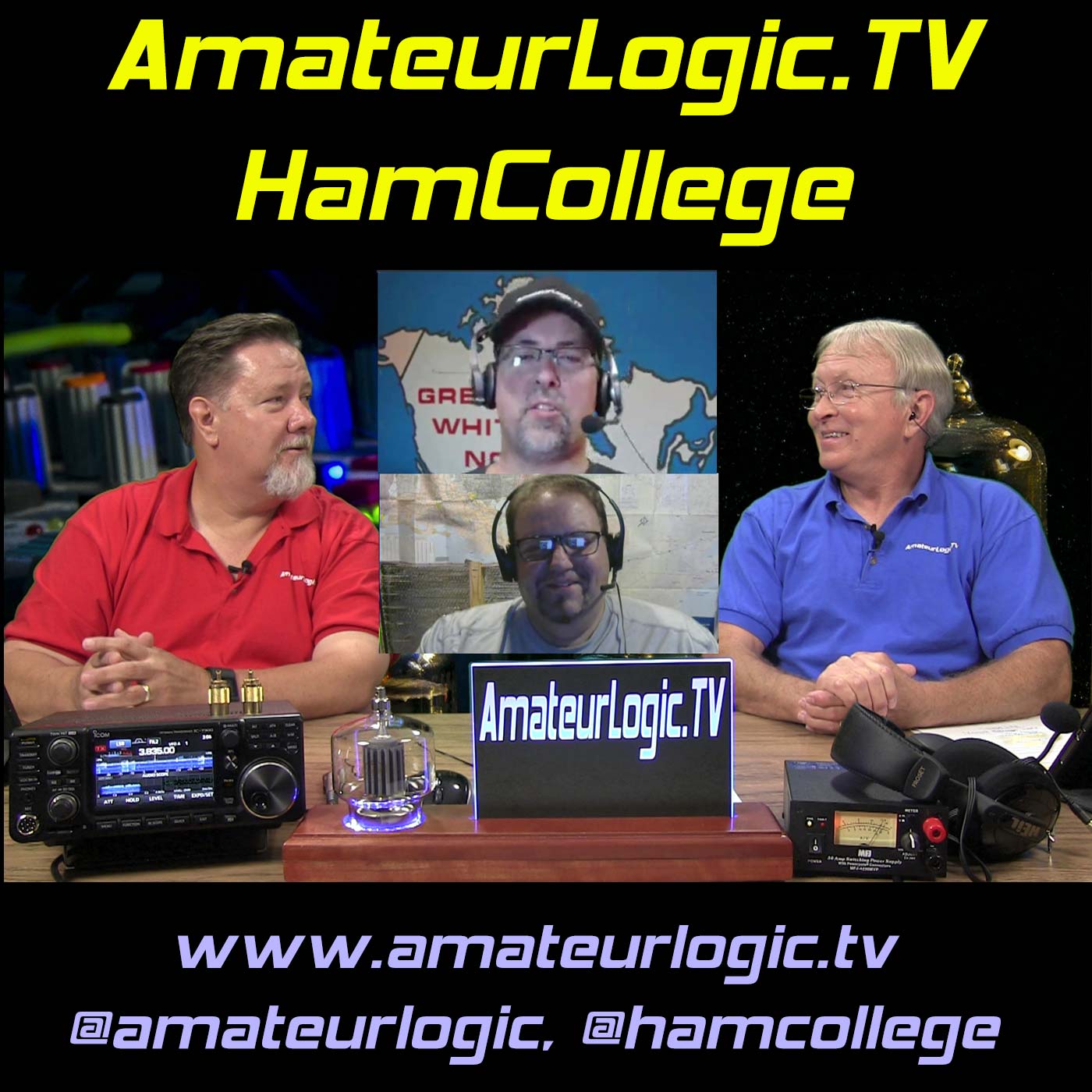
Ham College 140: Beginning General Class Studies = General Part 1
G1A – General class control operator frequency privileges. Primary and secondary allocations. 50:20

Episodes
327
Latest episode
Jun 2026
Language
EN-US
AmateurLogic.TV Audio only downloads.
G1A – General class control operator frequency privileges. Primary and secondary allocations. 50:20
George and Tommy's Excellent Adventure to Hamvention 2026. Meet some old friends. See some new items and some that don't even exist yet. Visit the West Chester Amateur Radio Association (WC8VOA) at the VOA Museum. And get a quick peek of some of the new things at the VOA Museum in a special episode coming soon. 1:32:46
T0A – Power circuits and hazards: hazardous voltages, fuses and circuit breakers, grounding, electrical code compliance, Lightning protection; Battery safety. T0B – Antenna safety: tower safety and grounding, installing antennas, antenna supports. T0C - RF hazards: radiation exposure, proximity to antennas, recognized safe power levels, radiation types, duty cycle. 1:26:11
Exploring the Ham Dash App ham radio dashboard. Consolidating the shack with Raspberry Pi 5 and M.2 solid state drive. Should you Repair or Replace that appliance with the recently expired warranty. 58:09
T9A – Antennas: vertical and horizontal polarization, concept of antenna gain, definition and types of beam antennas, antenna loading, common portable and mobile antennas, relationships between resonant length and frequency, and dipole pattern. T9B – Feed lines: types, attenuation vs frequency, selecting. SWR concepts, Antenna tuners (couplers), RF Connector selecting and weather protection. 59:17
T8C – Operating activities: radio direction finding, contests, linking over the internet, exchanging grid locators. T8D – Non-voice and digital communications: image signals and definition of NTSC, CW, packet radio, PSK, APRS, error detection and correction, amateur radio networking, Digital Mobile Radio, WSJT modes, and Broadband-Hamnet. 56:55
T8A - Basic characteristics of FM and SSB: Bandwidth of various modulation modes: CW, SSB, FM, fast-scan TV, Choice of emission type: selection of USB vs LSB, use of SSB for weak signal work, use of FM for VHF. T8B - Amateur satellite operation: Doppler shift, basic orbits, operating protocols, modulation mode selection, transmitter power considerations, telemetry and telecommand, satellite tracking programs, beacons, uplink and downlink mode definitions, spin fading, definition of “LEO”, setting uplink power. 55:05
Cutting a 1/4 wave shorted stub. DR Mode travel prep for automatic repeater memories. ATS 20+ Firmware update improvements. Emile’s latest shack update. 1:23:14
T7C - Antenna and transmission line measurements and troubleshooting: measuring SWR, effects of high SWR, causes of feed line failures, Basic coaxial cable characteristics, Use of dummy loads when testing. T7D - Using basic test instruments: voltmeter, ammeter, and ohmmeter, Soldering. 1:13:09
T7A – Station equipment: receivers, transceivers, transmitter amplifiers, receive amplifiers, transverters; Basic radio circuit concepts and terminology: sensitivity, selectivity, mixers, oscillators, PTT, modulation. T7B – Symptoms, causes, and cures of common transmitter and receiver problems: overload and overdrive, distortion, interference and consumer electronics, RF feedback. 59:05
Claim this listing to keep it up to date, reach guests who want to pitch you, and manage bookings with Guestify.
Claim this listing
Jeremy Snyder
Richey Malhotra

Drive Electric Alabama

Proxify

Rupa Singh

The National Academy of Sciences