Find partners
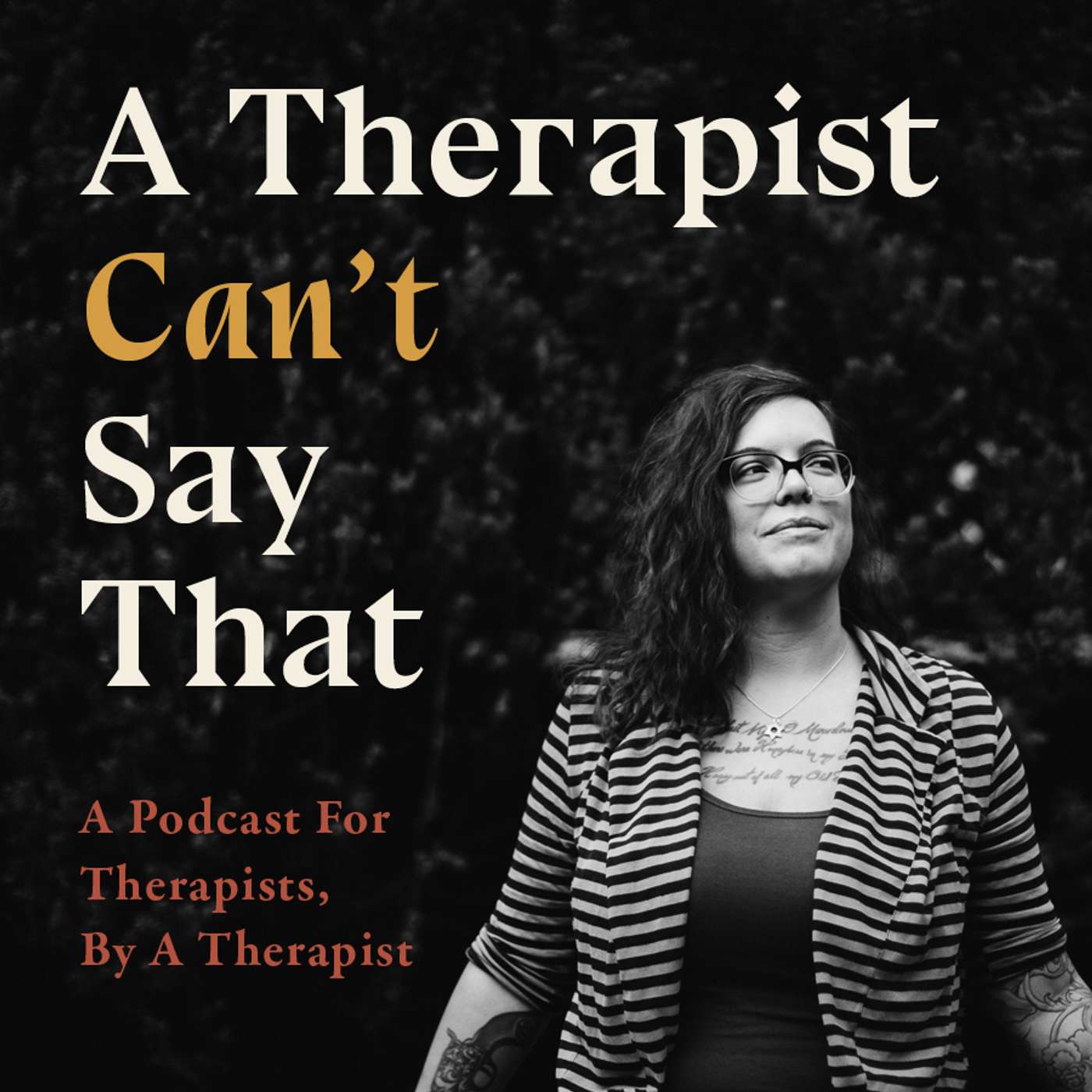
A Therapist Can't Say That

A Therapist Can't Say That

Hosted by Riva Stoudt

Episodes

46

Latest episode

Jan 2025

Language

EN

About the show

Therapy is full of cliches. There are things we’ve all been taught as therapists not to question, even when we get that feeling deep down in our guts that the truth might be a bit more complicated than that. Riva Stoudt wants to talk about it. Each episode dives into a cliche, truism, or best practice of therapy to look at how it really plays out in practice. Whether you agree or not, you’ll appreciate a candid look at the things therapists don’t normally talk about.

Listen to episodes

46 recent
March 22, 20222 min

Introducing A Therapist Can't Say That

When you became a therapist, what did you think you were signing up for?Maybe grad school prepared you for the endless introspection, the awkward intake sessions, and the pile of unfinished notes that is somehow always waiting for you, even when you were pretty sure you just finished it.Maybe you weren’t too thrown by the onslaught of personal problems your Uber driver suddenly reveals to you when you mention what you do for work.Maybe you’ve even found a workaround for the lower back pain that comes from sitting in a chair all day or a way to yawn with your mouth closed in that mid-afternoon session so your client doesn’t take your drowsiness personally.But there’s some other stuff isn’t there?Probably no one told you that you might join a Facebook group for therapists and be blindsided by a gaggle of other clinicians calling you unethical in response to what you thought was an innocuous question.You might not have expected how much you’d chafe at the same old clichés being trotted out at trainings and supervision groups and on beautifully designed squares on your Instagram feed, finding yourself wondering, am I the only one who thinks everyone might not be doing their best all the time?And while you might have been warned against burnout and been told to stave it off with self-care, you weren’t prepared for the moral injury that awaited you when you entered the mental health profession, and how no amount of meditation or strolls in the woods could erase its impact.For a field that prides itself on helping people talk about things that nobody else talks about, there are a lot of things we don’t talk about. Things that don’t fit with the image of the good therapist that lives in our heads or in the heads of other therapists.Well, I’m Riva Stout and I’m ready to talk about them.On my podcast, A Therapist Can’t Say That, we’re going to be getting real about what it’s like to do this job.We’re going to unpack the clichés you’ve assumed every other therapist believes, and speak out loud the thoughts you’ve thought no other therapist has had.We’re going to let it get messy, complicated, and uncomfortable. And we’re going to say it’s okay for therapists to disagree, even in public, without immediately accusing each other of being unethical.Subscribe to A Therapist Can’t Say That on Apple Podcasts, Spotify, Overcast, or wherever you listen to podcasts. And be sure to share the show with a therapist friend you know is thinking about this stuff too.We’re always asking our clients to get out of their comfort zones. Come get out of yours and get real with me on A Therapist Can’t Say That.Learn more about Riva Stoudt:Into the Woods Counseling

April 5, 202252 min

Ep 02 - The Myth of the "Good Therapist" with Nancy Jane Smith

If you’re a therapist, even if you’re far from your practicum days, you can probably relate to the feeling of sitting in a session and being distracted by the thought of whether you’re living up to the standard of a good therapist.And you’ve probably had a moment where you’re sitting with a client or group and you heard something come out of your mouth and immediately thought, “That doesn’t sound like something a good therapist would say.”Who is this mythical good therapist? What are their qualities and where do those ideas come from? When you think about that archetypal good therapist that you compare yourself to, is that therapist a blank slate?Does a good therapist take all the most challenging cases? Do they self-disclose? Do they diagnose and write treatment plans? Are they a quiet introvert? Do they have it all together? Nancy Jane Smith and I are talking through some of these questions today and how uncomfortable it can be when we sense we’re going out of the “good therapist” box.Nancy Jane Smith, MSEd., LPC is a Licensed Professional Counselor trainer, and author specializing in high-functioning anxiety. Nancy completed her postgraduate training in Gestalt Therapy at the Gestalt Institute of Central Ohio and is a Certified Daring Way™ Facilitator, based on the research of Dr. Brené Brown.She has over 20 years of working as a counselor and coach and most recently created Self Loyalty Schoo,l an audio-based program to help quiet high-functioning anxiety. Nancy has written 3 books with tips, lessons, and stories on reducing anxiety, most recently, The Happier Approach: Be Kind to Yourself, Feel Happier and Still Accomplish Your Goals. Listen to the full episode to hear:Why Nancy struggled to feel like a legit therapistHow norms around self-disclosure are shifting and why Nancy is open about her own anxietyHow different therapist subcultures influence the image of the good therapist and create new pressuresWhy Nancy regrets being too passive with early clients and why some therapists don’t talk enoughWhy the good therapist isn’t an effective therapistLearn more about Nancy Jane Smith:NancyJaneSmith.comThe Happier Approach: Be Kind to Yourself, Feel Happier, and Still Accomplish Your GoalsLearn more about Riva Stoudt:Into the Woods CounselingInstagram

April 5, 202215 min

Ep 01 - Why I Started A Therapist Can't Say That

I got the idea for this podcast in late 2019. I had been in the field for several years at that point. Long enough to work through the first wave of impostor syndrome, experience my first episode of burnout, bounce back from burnout, get high on the grandiosity when I realized I really was helping people and changing their lives, go through the second wave of impostor syndrome when I realized there were some people I really WASN’T helping, and then settle somewhere relatively comfortable between confidence and humility.When you’ve been in a field for a while, you start to get a sense of its parameters–the things you’re allowed to say, and allowed to think, the things regarded as self-evident truths that are off-limits for questioning. And if you’re like me, after a while, you start to feel really constricted. Because outside those parameters a lot of things are happening, but aren’t being talked about, and there are unallowable ideas and perspectives that might contain pieces of the truth. Truths that, if we confronted them, might actually make our work better. Listen to the full episode to hear:The first time I said something a therapist can’t sayWhy therapists aren’t supposed to admit that they have unmet needs–or that their clients might meet some of themWhy breaking down clichés and archetypes of the good therapist needs more nuance than Instagram can handleWhat’s coming up on the podcastLearn more about Riva Stoudt:Into the Woods CounselingInstagram

April 26, 202220 min

Ep 03 - Uncharted Waters: The "Good Therapist" and Collective Trauma

The “good therapist” isn't necessarily the type of therapist you want to be.It's not the most actualized version of you as a therapist. It's not even necessarily a particularly effective therapist.The good therapist is about being seen as good and about being able to reassure ourselves that we are good when maybe we don't feel so sure.Maybe we bump up against the specter of the good therapist when we have difficult clients and we genuinely feel at a loss for what to do.Maybe it's when we have something heavy going on in our personal lives and find our minds repeatedly drifting away from a client in session and back to our own problem of the week, because a good therapist wouldn't do that.Maybe the good therapist peeks through the office window judging us when we go against established norms, like when we use self-disclosure more than other therapists might think we should, or talk more in session than we think we're supposed to, or whatever else gives us the sense that we're stepping outside of bounds.And the specter of the good therapist has definitely been much more activated for almost all of us during the past two years of the pandemic.The pandemic has made the gap between who we believe we should be as therapists and who we actually are much, much harder to bridge. Listen to the full episode to hear:How the good therapist archetype creates dishonesty in the name of professionalismWhy therapists aren’t any more equipped than most people to address collective traumaWhy we need to think beyond the good therapist archetype to meet the increasing uncertainty of the futureLearn more about Riva Stoudt:Into the Woods CounselingInstagram

May 10, 202256 min

Ep 04 - Doing Our Own Work: Mental Health and Workplace Culture with Rebecca Ching, LMFT, PCC, Certified IFS Therapist

It’s something of a cliché that being a therapist comes with the obligation to do your own work. And it happens to be a cliché I agree with. And if you’re listening to this podcast, I’m guessing you do too.But what happens when the institutions and systems that train us, employ us, and regulate us act as barriers to actually doing that self-work?Today I’m talking with psychotherapist and certified leadership coach, Rebecca Ching. In addition to therapy and coaching, Rebecca also has extensive experience with supervision, teaching, and advocacy in the mental health field and we’re going to dig into dysfunctional mental health workplace culture, how we got here, and why it’s so hard to change it.Rebecca Ching is a psychotherapist, leadership developer, writer, speaker, and host of The Unburdened Leader podcast, where she goes deep with leaders on how the burdens they carry inspire their life’s work, how they still threaten to take them out, and how they rise from them.Unburdened Leadership™ is the work Rebecca has honed to take leaders and entrepreneurs through so that they can have greater impact and legacy.She is also the CEO and founder of Potentia Family Therapy, Inc. and is a Certified Daring Way™ Facilitator and Consultant and Certified Internal Family Systems Therapist and IFS Approved Supervisor.Rebecca also leads, Rebecca Ching Leadership Coaching and Consulting, and is where she develops leaders through coaching and workshop experiences.Listen to the full episode to hear:How grad school, licensure requirements, and low wages pave the way for early-career burnout Why the professional culture of mental health needs to acknowledge the wounds that lead people into the fieldHow the current educational and licensing systems create barriers to clinicians without financial privilegeWhy the emphasis on efficiency from leadership, funders, and the culture leads to therapists who can’t or won’t do self work Learn more about Rebecca Ching, LMFT, PCC, Certified IFS Therapist:RebeccaChing.comThe Unburdened LeaderInstagram: @rebeccachingmftFacebook: @rebeccachingmftLearn more about Riva Stoudt:Into the Woods CounselingInstagram

May 25, 202224 min

Ep 05 - How Are You Doing? Building A Culture Of Support

As therapists, we know about the power of silence and how much someone is saying when they aren’t saying anything at all. And we know how silence around something big, like a client’s suicide attempt, sends the message that this is too big or too scary to talk about.But if we mostly all agree that therapists are responsible for doing their own self-work, it’s necessary to facilitate conversations around the decision-making that precedes a serious event or to simply check in on a clinician.Because we know that in the aftermath of a crisis event, when a therapist says they’re fine, there’s some work to be done.Yet there is a culture of silence from supervisors that contributes to the dysfunctional workplaces in mental health. Silence imbues the event with shame and inhibits the capacity to do self-work.So what stops supervisors from supporting their clinicians after a crisis?Content warning: This episode contains frank discussion of suicide.Listen to the full episode to hear:How supervisors fail their clinicians when they respond to crises with silenceHow silence is tied to the precarity of funding in community mental healthWhy the conflicting agendas of the multiple stakeholders in mental healthcare make clinician professional development and self-work an uphill battleWhy systemic overhaul of the mental health field is necessary, and maybe inevitableLearn more about Riva Stoudt:Into the Woods CounselingInstagram

June 7, 202252 min

Ep 06 - Carrying the Weight of Moral Injury with Dr. K Hixson

Moral injury.It’s a term that often evokes images of soldiers deep in the fog of war or perhaps of a surgeon in scrubs holding their head in their hands in the hallway of a hospital emergency department. A therapist sitting quietly in their office or in the cubicle of a community mental health agency’s open office plan isn’t really what pops into most people’s heads when someone says the words “moral  injury.” But maybe sometimes it should be.As therapists, we are in daily intimate contact with the moral complexity of human beings. And we also have front row seats to the profound moral failings of the large systems that we and our clients regularly have to  navigate.Today, I'm talking with Dr. K Hixson, a dear friend, colleague, and mentor of mine, as well as a community treasure in our therapist community here in Portland. Dr. Hixson and I get into some of the big factors that contribute to moral injury among therapists like individualism and the burdens of excessive responsibility that we place onto individual clinicians, and how the larger systems that we operate within prevent us from living out our own values, both as clinicians and as regular humans. Listen to the full episode to hear:How the concept of burnout can turn systemic failures into individual problemsHow the shortage of therapists contributes to moral injury in the fieldWhy therapy can’t be divorced from the context of politics, capitalism, climate change, etc.How the individualized medical and insurance model of care fails clinicians and patientsLearn more about Dr. K Hixson:WebsiteLearn more about Riva Stoudt:Into the Woods CounselingInstagramResources:What is Moral Injury - Syracuse University Moral Injury Project

June 28, 202225 min

Ep 07 - The Poison and The Cure: Expanding Our Understanding of the Wounded Healer

Therapists are tasked with being secret keepers.The first layer of secrecy seems easy and simple. Maintaining client confidentiality. You can probably recite the limits of confidentiality off the top of your head, and you probably do it regularly during intake sessions.Everything else goes in the vault. But the vault isn’t a what, it’s a who. The vault is us.We mostly talk about confidentiality from the client’s perspective. The absolutely crucial nature of it, the ethical dilemmas that come up when we have to breach it, how the client’s understanding of confidentiality impacts the therapeutic process… All very important things.But we rarely talk about what confidentiality means for therapists beyond a set of rules or ethical puzzles to navigate.What does it really mean for us as therapists to be the bearers of all of this confidential information about other human beings? Content note: References to interpersonal traumasListen to the full episode to hear:How bearing witness to the capacity for human beings to cause harm challenges our illusions and contributes to moral injuryWhy the disruption of our expectations of human beings as moral agents has the possibility of being generative, for ourselves and for our clientsWhy our institutions need to support the passage of intergenerational knowledge among therapistsHow therapists experience traumas intrinsic the work and as a result of the systems we work inLearn more about Riva Stoudt:Into the Woods CounselingInstagramResources:A Therapist Can’t Say That Ep. 6: Carrying the Weight of Moral Injury with Dr. K HixsonA Therapist Can’t Say That Ep. 4: Doing Our Own Work: Mental Health and Workplace Culture with Rebecca Ching, LMFT, PCC, Certified IFS Therapist

July 12, 20221 hr 1 min

Ep 08 - Why We Become Therapists with Ben Fineman and Carrie Wiita

There are so many ways, so many careers we can choose where helping people is the central thing.And the type of helping that we are interested in and pursue says at least as much about us, if not more, than the fact that we want to help in general.Yet, if you ask a therapist why we decided to get into this field, the answer you're most likely to get is to help people.But what are some of the other deeper, more complicated, maybe less flattering answers to why we became therapists? And why is it important to look at those reasons up close?Today I’m joined by Ben Fineman and Carrie Wiita, co-hosts of the Very Bad Therapy podcast, where they not only feature client stories about negative experiences with therapy, but they also call into question a lot of the conventional wisdom about what makes therapy effective and what makes therapists skillful.We’re discussing the reasons we become therapists, consciously and unconsciously, and how that shows up in the therapy room for us and for our clients.Ben Fineman is the co-host of the Very Bad Therapy podcast. He works as the Clinic Director of Sentio Counseling Center and the Chief Operating Officer of Sentio University, two new nonprofit organizations which use the emerging science of Deliberate Practice to improve the quality of therapist training and education. Ben is also an Associate Marriage and Family Therapist in the state of California.Caroline Wiita is a marriage and family therapist trainee in Los Angeles, California. Her interests include the professional development of therapists, postmodern approaches to psychotherapy, and the finer points of cheap wine. She also runs MFT California, an online catalog of marriage and family therapy (MFT) programs in California, and offers personal coaching for anyone thinking about becoming an MFT.Listen to the full episode to hear:Why we need to interrogate our reasons for becoming therapists beyond altruismThe cultural assumptions and scripts we interact with when we tell people we’re therapistsHow our self-presentation impacts our relationships with our clients and how we can use that to generate positive outcomesHow our conscious and unconscious motivations for doing this work show up in the therapy roomLearn more about Very Bad Therapy:Very Bad TherapyFacebook: @VeryBadTherapyLearn more about Riva Stoudt:Into the Woods CounselingInstagram

July 26, 202226 min

Ep 09 - It's Complicated: Why We Become Therapists

Why do we become therapists?You wouldn’t necessarily think this is a spicy topic, but it is.Some therapists would say that we as therapists are just people who are unusually compassionate, empathetic, and giving, even selfless or altruistic. I don’t agree.I don't think we're more inherently compassionate or giving people than anybody else. Often, we're people who took on caregiver roles in our families of origin and we learned to give in order to get, and ultimately, we’re no less selfish than anyone else.But if you say that out loud in a group of therapists, as I have, they will bristle. Unless it’s on Facebook or Twitter, and then it will be a flame war.The first answer is obviously the more flattering version - the version that’s been run through Instagram filters. The second answer might not be as flattering, but it might be more real.Why does it matter what we think our reasons are for becoming therapists? Why do we need to accept the less flattering portrait of ourselves?Because whether we acknowledge it or not, it’s in the room with our clients.Listen to the full episode to hear:Why the grandiosity of thinking we’re more compassionate or altruistic is a problem for our work as cliniciansHow attachment to the self-belief that we are especially compassionate is connected to moral injury, burnout, and shameWhy we have to acknowledge that making sense of people often motivates us at therapistsWhy it’s necessary to interrogate our relationship to power and influence in our roles as therapistsLearn more about Riva Stoudt:Into the Woods CounselingInstagramResources:Episode 06: Carrying the Weight of Moral Injury with Dr. K HixsonEpisode 07: The Poison and the Cure: Expanding Our Understanding of the Wounded HealerEpisode 08: Why We Become Therapists with Ben Fineman and Carrie Wiita

Is this your show?

Claim this listing to keep it up to date, reach guests who want to pitch you, and manage bookings with Guestify.

Claim this listing

More Careers podcasts